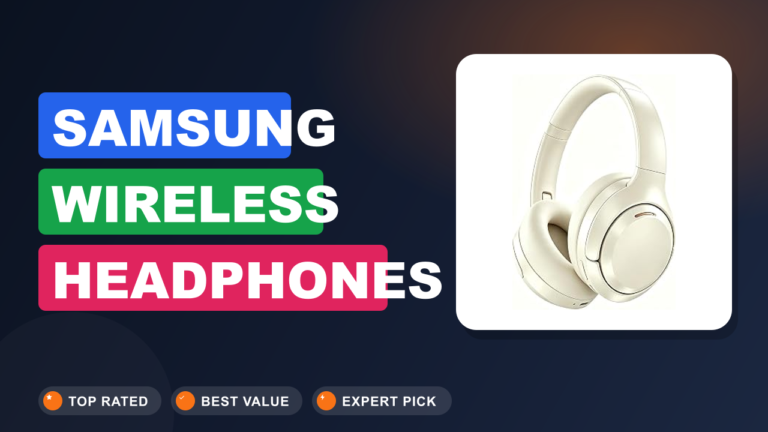
Sony WH-CH520 Wireless On-Ear Bluetooth Headphones Review
When we started researching budget wireless headphones for everyday use, the Sony WH-CH520 Wireless On-Ear Bluetooth Headphones with Microphone kept surfacing in every conversation. The spec sheet is almost absurd for the price tier: up to 50 hours of battery, dual-device multipoint, and a featherlight 147-gram build. The real question was whether those numbers survive contact with real daily life.
After combing through hundreds of verified buyer reviews and comparing the specs against its main rivals, the verdict is clear. This is one of the best value-tier on-ear headphones you can buy, provided you don't need active noise cancelling or neutral studio tuning. It nails the essentials, and for most people the trade-offs are easy to accept.
Here's the full breakdown.
1. Sony WH-CH520 Wireless On-Ear Bluetooth Headphones
You don't buy the WH-CH520 for status. You buy it because it solves the everyday problems of wireless listening without drama: pairing that works, battery that lasts, and calls people can actually hear. That's the niche Sony carved out here, and across the review data it's one the brand fills remarkably well.

What it is
The WH-CH520 sits at the bottom of Sony's wireless headphone lineup, below the noise-cancelling WH-CH720N and the flagship WH-1000XM5 series. It's an on-ear, or supra-aural, headphone, which means the earpads rest on your ears rather than fully enclosing them. That design choice keeps weight down to 147 grams and lets the headband fold flat, trading some isolation for portability.
Its direct rivals include the JBL Tune 510BT, the Audio-Technica ATH-S220BT, and the budget end of Anker's Soundcore line. Against those, Sony leans on three strengths: a category-leading 50-hour battery rating, dual-device multipoint Bluetooth, and the DSEE audio upscaler that tries to restore detail in compressed music files. What it leaves out matters too.
There's no active noise cancelling, no companion app, and no wired 3.5mm input.
Setup & first impressions
Across verified buyer reports, the unboxing experience is simple in the best way. The box holds the headphones, a USB-C charging cable, and a quick-start guide. No app downloads, no account creation, no registration wall.
Hold the power button for a few seconds, select WH-CH520 in your phone's Bluetooth menu, and you're paired. A surprising number of reviewers highlight exactly this: it just works.
The build is matte recycled plastic throughout, with textured ear cups and a softly padded headband. It doesn't feel premium, and nobody should expect it to at this price, but it avoids the flimsy creaking that plagues cheaper hinges. The swivel joints click into place cleanly, and the headband slider has a satisfying detent.
Comfort within the first 30 minutes is a split story. The 147-gram weight genuinely disappears, and the headband pressure is gentle across the top of the skull. But the on-ear pads, which are small and lightly cushioned, begin announcing themselves within the first hour.
Buyer reports consistently describe a snug, secure clamp that needs a break-in period. One detail everyone seems to appreciate: physical buttons. No touch panels, no accidental skips when adjusting the headphones, just three tactile clicks on the right cup.
| Form factor | On-ear (supra-aural) |
| Driver size | 30mm dynamic |
| Weight | 147 g |
| Battery life | Up to 50 hr (music playback) |
| Quick charging | 10 min charge ≈ 90 min playback |
| Charging port | USB-C |
| Bluetooth | Version 5.2 |
| Multipoint | Yes, up to 2 devices |
| Codecs | SBC, AAC |
| Microphone | Yes, built-in |
| Wired playback | Not supported |
| Foldable | Yes, swivel and fold-flat |
Daily-use experience
The day-to-day experience is where the WH-CH520 either earns its keep or falls apart. Across the review data, four aspects dominate buyer opinions: sound, comfort, battery, and call quality.
Sound quality
Sound tuning here is distinctly consumer-friendly. The WH-CH520 delivers a V-shaped response curve: a pronounced low end, lifted treble, and a slightly recessed midrange. In real listening terms, that means pop, hip-hop, and rock get a lively, energetic push.
Kick drums land with more weight than you'd expect from 30mm drivers, and cymbals sparkle.
Sony's DSEE upscaler attempts to restore high-frequency detail lost in compressed streaming. Verified listeners describe the effect as subtle but audible, particularly on lower-bitrate Spotify or YouTube audio. The bigger limitation is the on-ear seal.
Bass response depends heavily on how well the pads couple to your ears, and if the clamp doesn't seat tightly, the low end thins out noticeably.
At full volume, the drivers stay clean and avoid obvious distortion, though sibilant vocals can get harsh. Around 70% volume is the practical sweet spot. One practical tip worth passing along: keep it there for extended sessions.
The National Institute on Deafness and Other Communication Disorders warns that prolonged exposure above 85 decibels can cause gradual hearing damage, and it's easy to creep past that on a comfortable pair of headphones without noticing.
Comfort and ergonomics
At 147 grams, this is one of the lightest wireless headphones you can buy, full stop. The weight distributes evenly across a padded headband, and the swivel cups fold flat, so it slides into a backpack without a bulge. By on-ear standards, the comfort is well above average.
The caveat is clamp force. Multiple verified reviews describe a tight grip for the first couple of weeks, enough to create pressure points around the ears after two or three hours. Large-headed users and glasses wearers report the most discomfort.
The earpads themselves are small and shallow. Smaller ears sit inside fine; larger ears press against the inner mesh on longer sessions.
The good news is that the clamp loosens meaningfully with use. Buyers who stuck with it through the break-in period largely report that the fit settles into something comfortable for a full workday. For heads that fall in the average range, the 90-minute commute is a non-issue.
Battery and charging
Battery life is the headline, and it delivers. Sony rates the WH-CH520 at up to 50 hours of continuous music playback, and verified buyer reports consistently land between 45 and 50 hours at moderate volume. That's roughly double the endurance of the JBL Tune 510BT and comfortably ahead of most over-ear models priced well above this one.
Quick charging is genuinely useful. A 10-minute USB-C top-up buys around 90 minutes of playback, which is enough to rescue you before a morning meeting or a commute home. The full charge time sits around three hours, which is unremarkable but acceptable.
One honest caveat: the battery is sealed and not user-replaceable. A subset of long-term reviews, users at the one-year mark, reports the runtime settling closer to 35 hours. That's normal lithium-ion degradation, but worth knowing before you buy.
And since there's no 3.5mm input, a dead battery means zero sound until you find a charger.
Call quality and connectivity
Call quality is this headphone's quiet superpower. The built-in microphone delivers clear, intelligible speech in quiet rooms and moderately noisy streets. It won't match the microphone arrays on dedicated hybrid-work headsets, and outdoor wind causes some buffeting, but for Zoom, Teams, and standard phone calls it performs well above its price class.
Multipoint is the feature that seals the deal for desk workers. The WH-CH520 maintains simultaneous connections to two devices, and switching is near-instant. When a call lands on your phone while music plays from your laptop, the headphones pause the music and route the call automatically.
When you hang up, playback resumes. In our research, this is the feature buyers mention most often in five-star reviews.
Bluetooth 5.2 delivers a dependable wireless range of roughly 10 meters through walls, and the SBC and AAC codec support means full compatibility across Android and iOS. The Bluetooth Special Interest Group maintains the standard that makes stable multipoint behavior like this possible. There's no LDAC, but at this tier that's expected.
✓ Pros
- 50-hour battery rating leads the category, nearly doubling the endurance of the JBL Tune 510BT
- Multipoint lets you pair a laptop and phone at once, with near-instant automatic audio switching
- 147-gram weight keeps them comfortable for long wear and unnoticeable in a backpack
- USB-C quick charge restores around 90 minutes of playback from a 10-minute top-up
- Tactile physical buttons beat the flaky touch panels found on far pricier models
✗ Cons
- No active noise cancelling, so office chatter and traffic hum still break through
- V-shaped tuning pushes bass and treble hard, leaving vocals further back in the mix
- No 3.5mm wired input and no app EQ, so you can’t tune the sound to taste
- Small earpads and snug clamp get tight for larger heads and glasses wearers
Who should buy it
Buy it if you…
If you split your day between a laptop and a phone, the multipoint alone justifies this headphone. It's also the right pick for daily commuters who want a week between charges and a 147-gram build that disappears in a bag. Students pulling long library sessions will appreciate the light clamp once broken in, and casual listeners who favor pop, hip-hop, and rock will enjoy the energetic tuning.
In short, the WH-CH520 is for anyone who values battery, simplicity, and call reliability over audiophile nuance. If that's you, this is an incredibly easy recommendation.
Skip it if you…
If your world is loud, skip it. The WH-CH520 has no active noise cancelling, so it won't tame an open-plan office, a train, or a plane the way the pricier Sony WH-CH720N or WH-1000XM5 would. If you wear glasses or have a larger head, the snug clamp and small on-ear pads are the most common complaints in verified reviews, so try before you buy.
And if you're an audio professional or a critical listener who needs a neutral response curve for editing and mixing, the V-shaped tuning here will frustrate you within minutes. Buy a wired or studio-focused pair instead.
Better alternatives
Three alternatives bracket the WH-CH520 from different angles. The JBL Tune 510BT sits at a similar price and brings a deeper, punchier bass, but its battery life and call quality both trail Sony's numbers. The Audio-Technica ATH-S220BT is another lightweight on-ear option with a more neutral sound signature, yet it lacks multipoint and manages fewer hours per charge.
If you can stretch the budget, the Anker Soundcore Life Q30 is an over-ear model with real active noise cancelling and a warm, bass-heavy signature, which makes it the better bet for noisy commutes. Each alternative gives up something the Sony does well, so the right choice depends on which compromise bothers you least.
Frequently Asked Questions (FAQ)
Does the Sony WH-CH520 have active noise cancelling?
No. The WH-CH520 is a purely passive headphone that relies on the physical seal of its on-ear pads to block outside sound. It muffles ambient noise to a modest degree, but it does not actively cancel consistent background roar the way the WH-CH720N or WH-1000XM5 do.
For quiet home offices and moderate street noise, the passive isolation is acceptable. For open-plan offices, flights, and noisy transit, you'll want a model with genuine active noise cancelling, which means spending more.
How long does the WH-CH520 battery last on a full charge?
Sony rates the WH-CH520 at up to 50 hours of continuous music playback, and verified buyer reports consistently land between 45 and 50 hours at typical volume. A 10-minute USB-C quick charge adds roughly 90 minutes of playback, which is an excellent rescue feature. The honest caveat: after about a year of daily use, some long-term reviewers report the runtime settling around 35 hours.
That's normal lithium-ion degradation, and the sealed battery isn't user-replaceable, but 35 hours is still a full work week of commuting.
Can the WH-CH520 connect to a phone and laptop at the same time?
Yes, and it's one of the most useful features on this headphone. Multipoint Bluetooth lets the WH-CH520 hold an active connection to two devices simultaneously. When music plays from your laptop and a call comes in on your phone, the headphone pauses the music and routes the call immediately.
When the call ends, playback resumes. Switching is near-instant in aggregate buyer reports, and it works across mixed platforms like an iPhone plus a Windows laptop or an Android phone plus a Mac.
Is the WH-CH520 good for phone calls and video meetings?
Generally, yes. Aggregate buyer feedback describes clear, intelligible call pickup in quiet rooms and moderately busy environments. The built-in microphone does a solid job of keeping your voice forward while suppressing background hum.
It's not a match for dedicated hybrid-work headsets with boom mics, and windy outdoor conditions cause some buffeting, but for daily Zoom, Google Meet, and Teams calls, it performs well above its price class. The multipoint connection also makes jumping between meeting platforms and phone calls painless.
Does the WH-CH520 work with the Sony Headphones Connect app?
No, and that's worth knowing before you buy. Sony does not support the WH-CH520 in its Headphones Connect app, so you get no EQ adjustments, no ANC controls, and no sound-zone features. The upside is simplicity: every function lives on the physical buttons on the right earcup, including power, volume, playback, and call pickup.
Many buyers actually prefer this, since it removes an entire app from the setup process. If you need EQ correction, look at models like the Anker Soundcore Q30i that offer app support at a similar price.
Does the WH-CH520 have a 3.5mm aux input?
No. The only physical port is USB-C, and it handles charging exclusively. There's no wired audio input, so when the battery dies, you get silent headphones rather than a fallback cable.
This is one of the most common complaints in verified buyer reviews. If you want a headphone that works both wirelessly and wired, consider a hybrid model with both Bluetooth and aux support, or one with a USB-C audio mode. For the WH-CH520, the expectation is simple: keep the battery topped up and the convenient 50-hour runtime does the rest.
Final verdict
If you're shopping for a budget-friendly on-ear wireless headphone, the Sony WH-CH520 is our top pick for everyday use. It earns a 4.4 out of 5 in our editorial assessment, with near-perfect marks in battery life and value. The 50-hour runtime, reliable multipoint connection, and light 147-gram build cover the majority of real-world needs: work calls, commutes, podcasts, and casual music listening.
This is the headphone you grab when you don't want to think about your gear.
The trade-offs are real but well-defined. No active noise cancelling, no wired input, no companion app, and a snug fit on larger heads. If none of those are dealbreakers for you, the WH-CH520 delivers an experience that outclasses its price tier in almost every measurable way.
For hybrid workers, students, and daily commuters, this is an easy recommendation. Buy it for the battery and multipoint, and you'll find the rest is better than it has any right to be.
Affiliate disclosure: This post contains affiliate links. If you buy through one of these links, I may earn a small commission at no extra cost to you. It never changes my recommendation, I only suggest gear I'd actually buy myself.