Best AI Smart Speakers: Top Picks For Every Home
The best AI smart speakers blend clear voice control, useful AI tools, easy setup, and strong privacy controls.
A smart speaker can feel like a tiny helper at home. It can answer questions, play audio, control lights, and help you stay on schedule. Yet choosing one is not easy, especially when product listings use terms like AI speech, dual microphones, and smart interaction. I looked at the hardware, likely use cases, ease of expansion, and limits of each option below. These products are development boards rather than ready-to-use mainstream speakers, so they suit makers and curious users more than buyers seeking a simple plug-and-play device.

ESP32-S3 AI Smart Speaker Development…
ESP32-S3-AUDIO-Board adopts ESP32-S3R8 module with 32-bit LX7 dual-core processor, up to 240MHz main frequency. Supports 2.4GHz Wi-Fi (802.11 b/g/n) and Bluetooth 5 (LE), with onboard antenna Integrated 512KB Static RAM,…

ESP32-S3 AI Smart Speaker Development…
High-Performance MCU & Wireless Connectivity: This ESP32-S3 AI Smart Speaker Development Board, adopts ESP32-S3R8 module with Xtensa 32-bit LX7 dual-core processor, up to 240MHz main frequency. Supports 2.4GHz Wi-Fi (802.11…

ESP32-S3 AI Smart Speaker Development…
ESP32-S3 AI Smart Speaker Dev Board Adopts ESP32-S3R8 module with 32-bit LX7 dual-core processor, up to 240MHz main frequency, integrated 512KB S-RAM, 384KB ROM, 8MB PSRAM, external 16MB Flash memory,…
ESP32-S3 AI Speaker Board With RGB Light

This ESP32-S3 AI smart speaker board is made for users who want to build voice projects from the ground up. Its dual microphone array can help capture speech from more than one direction. That matters when a speaker sits on a desk, shelf, or workbench instead of right beside the user. The onboard RGB lighting also gives the project a clear visual cue for status, listening, or response modes.
I see this board as a flexible starting point rather than a finished home speaker. It supports AI speech functions and can connect with external LCD displays and cameras, which opens the door to richer interfaces. A maker could create a voice timer, desk assistant, home control panel, or small educational robot. The final experience will depend on the software, enclosure, power setup, and audio output chosen by the builder.
Pros:
- Dual microphone array supports more natural voice capture
- RGB lighting gives quick visual status feedback
- Supports external LCD displays for richer controls
- Camera support expands future AI project options
- ESP32-S3 platform offers a strong base for custom builds
- Useful for voice assistant, automation, and learning projects
Cons:
- Requires setup, coding, and compatible project software
- May need extra parts for a finished enclosure and power system
- Not the best choice for buyers who want a ready-made speaker
ESP32-S3 AI Speech Interaction Board

This ESP32-S3 development board focuses on AI speech interaction in a compact form. It may suit a buyer who wants to test voice commands without starting with a large and complex hardware kit. The ESP32-S3 family is popular in embedded projects because it combines wireless connectivity with enough processing power for many small devices. Still, the board itself is only one part of a complete smart speaker system.
The main appeal here is the chance to shape the user experience yourself. I would consider it for a classroom demo, a voice-controlled gadget, or an early proof of concept. It can also help a developer learn how microphones, commands, network services, and audio feedback work together. Buyers should review the listing details and software support before ordering, since the board may require additional modules or programming work.
Pros:
- Designed around AI speech interaction
- Compact platform for prototypes and small devices
- Good fit for students, makers, and embedded developers
- Can support custom voice commands with suitable software
- Wireless ESP32-S3 design suits connected projects
- Usually takes less space than a full desktop speaker build
Cons:
- Software setup may be difficult for first-time users
- Audio performance depends on the rest of the project
- May not include every part needed for standalone operation
ESP32-S3 Dual-Mic AI Speaker Board

This ESP32-S3 AI speaker board adds several useful features for a more complete interactive build. It supports dual-microphone audio capture, AI speech interaction, RGB lighting, and connections for outside displays and cameras. The mix gives it more room to grow than a basic voice board. It also lists 2.4 GHz Wi-Fi and Bluetooth 5 support, which can help it communicate with other devices in a connected project.
I would look closely at this model when building a smart control panel or a small multimedia assistant. The external display option can show a timer, weather data, menu, or status message while voice input handles the basic controls. RGB light can make the device feel more alive and can show whether it is idle, listening, or working. As with other development boards, the buyer must plan the software, speaker output, case, and safe power source.
Pros:
- Dual microphones can improve voice capture flexibility
- Supports both Wi-Fi and Bluetooth 5 connectivity
- RGB lighting adds useful visual feedback
- External LCD support allows a visual smart assistant
- Camera support enables broader AI and monitoring projects
- Strong option for advanced custom builds
Cons:
- More features can mean a longer setup process
- Requires careful planning for wiring and enclosure design
- Wireless features still need compatible software and network setup
AI Smart Glasses With Camera

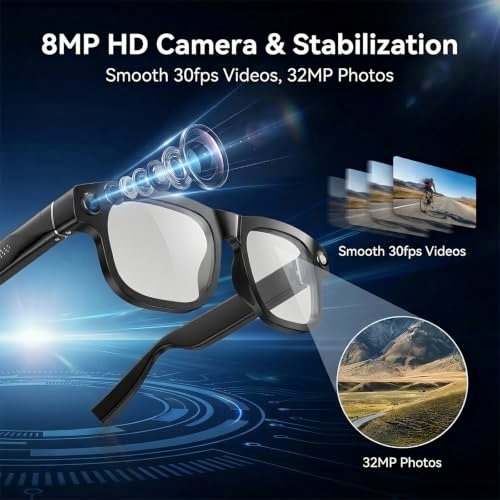
This camera-equipped AI smart glasses product is different from the three ESP32 boards. It is a wearable device aimed at hands-free photo and video capture. The listing highlights a 13MP camera, 4K electronic image stabilization, and photochromic lenses. Those features may appeal to travelers, outdoor users, and people who want to record moments without holding a phone.
I would not place these glasses in the same category as a traditional living-room smart speaker. They do not replace a home audio hub, and their value depends on camera controls, battery life, comfort, and companion software. The photochromic lens design may help users move between indoor and outdoor areas with less glare. Privacy also matters, so I recommend using a visible recording indicator respectfully and checking local rules before recording other people.
Pros:
- 13MP camera supports detailed image capture
- 4K video specification suits high-resolution recording
- Electronic image stabilization may reduce shaky footage
- Photochromic lenses can adapt to changing light
- Hands-free design is useful for travel and outdoor activity
- Compact wearable form leaves both hands free
Cons:
- Not a direct replacement for a home AI smart speaker
- Battery and storage limits may affect long recording sessions
- Camera wearables require extra care around privacy and consent
My Recommendation
For most builders, the ESP32-S3 dual-microphone board is the most capable choice in this group. It combines speech input, wireless support, RGB feedback, and connections for a screen or camera. That mix gives an experienced maker more ways to create a useful device. It is also the closest match to a custom AI smart speaker project, though it still needs software and supporting hardware.
The first ESP32-S3 board is a good pick for a flexible desk assistant with light and voice feedback. The simpler speech interaction board makes sense for students or beginners who want a smaller project scope. The dual-mic version is better for advanced builds that need display, camera, and wireless options. The AI glasses are best for hands-free visual capture, not for buyers seeking a classic voice-controlled speaker.
| Best for | Why |
|---|---|
| Custom voice assistant | The dual-mic ESP32-S3 board offers speech input, RGB feedback, wireless support, and expansion ports. |
| Learning and quick prototypes | The speech interaction board keeps the project focused on voice commands and embedded development. |
| Hands-free photos and video | The camera glasses offer a wearable design, 13MP capture, 4K video, and photochromic lenses. |
What Makes the Best AI Smart Speakers Worth Buying?
The phrase “AI smart speaker” covers more than one type of product. Some devices are ready for daily use. Others are boards that let you build a custom voice system. A good buying decision starts by knowing which group you need. I would not judge a development board by the same standard as a finished speaker from a major home audio brand.
A finished speaker should offer simple setup, stable software, good sound, and clear privacy controls. A development board should offer useful pins, strong wireless support, microphone access, documentation, and room for expansion. The products in this review mainly target the second group. They can become the heart of a smart speaker, but the builder must supply the rest of the body.
Voice Pickup Matters More Than Many Buyers Expect
A voice assistant is only useful when it can hear you. A single microphone may work well in a quiet room, but it can struggle with distance, music, fans, and wall reflections. A dual-microphone array can help a system capture speech from a wider area. It may also support better noise handling when the software uses both microphone signals.
Microphone count alone does not guarantee perfect recognition. The microphone placement, enclosure, digital signal processing, network connection, and wake-word software all affect results. I treat a dual-mic design as a useful foundation, not a promise of flawless commands. This is one reason the first and third boards stand out for custom voice builds.
AI Features Need Software Support
Hardware terms can sound impressive, but AI features need a complete software path. A board may capture your voice while another service handles speech recognition. The device may then send text to an AI model and play back a reply through a speaker. Each step can add delay, cost, account needs, or privacy concerns.
Before buying, I suggest checking the listing for firmware details, example code, supported development tools, and community help. A board with clear documentation often saves more time than a board with one extra feature. Also check whether the product includes a speaker, microphone cable, display connector, battery support, or power adapter. Missing parts can quickly change the final project budget.
Wi-Fi and Bluetooth Have Different Jobs
Wi-Fi is useful when the project needs cloud services, home automation, updates, or access to online data. Bluetooth can help connect accessories, sensors, or nearby devices. The third ESP32-S3 board lists 2.4 GHz Wi-Fi and Bluetooth 5, so it has a useful base for connected projects. Still, a wireless chip does not remove the need for software configuration.
Many home routers still support 2.4 GHz networks because they offer good range through walls. That band can be crowded in apartments and busy homes, though. I recommend testing the final speaker in the place where it will live. A device that works on a desk near the router may act very differently in a kitchen or garage.
Displays and Cameras Add Real Value
Voice control feels natural, but a screen can remove guesswork. It can show a timer, confirm a command, display a menu, or give an error message. Camera support can add image recognition, video calls, security experiments, or visual AI tools. Both features make a project more flexible, but they also increase power, code, and privacy needs.
The first and third boards support connections for external LCD displays and cameras. That makes them more suitable for a smart dashboard than a simple voice button. I would choose a display size and camera module only after planning the case. Loose wires and exposed boards may work on a test bench but feel fragile in a family room.
RGB Lighting Is More Than Decoration
RGB lights can make a small device easier to understand. A soft blue glow might show an idle state, while a different color could show listening or an error. This helps when the speaker has no screen. It can also make a homemade project feel polished, like adding a small dashboard to a plain car.
Lighting should never replace a clear privacy signal. Users should know when a microphone or camera is active. I recommend using a simple, consistent color code and writing it into the project instructions. Bright lights may also disturb sleep, so a night mode or brightness control is worth adding.
How I Evaluate AI Smart Speaker Hardware
I look at four main areas: voice input, expansion, connectivity, and practical ownership. Voice input tells me whether the board has a sensible base for commands. Expansion shows whether the project can grow beyond a basic demo. Connectivity affects how easily the device can work with online services and other hardware.
I also consider the skill level required. A product can be powerful and still be a poor choice for a beginner. Clear examples, safe power guidance, and active support often matter more than a long feature list. For this review, I also separated the camera glasses from the speaker boards because they solve a different problem.
Build Quality and Enclosure Planning
Development boards usually arrive without the polished case found on a retail speaker. That is not a flaw, but it changes the buying decision. You may need a 3D-printed case, acrylic cover, small box, or custom mount. The enclosure must leave room for microphone openings and should not block the speaker or wireless signal.
Heat and airflow also deserve attention. A compact board may stay cool during simple tasks but warm up during wireless activity or camera use. Avoid covering the board with thick material until you understand its operating needs. Keep the design stable, protect exposed contacts, and use a reliable power source.
Audio Output Can Define the Final Experience
Voice input gets most of the attention, but output matters just as much. A smart speaker must give clear replies at a comfortable volume. Some boards may need an external amplifier, driver, or speaker module. Check the product details before assuming that a board includes a complete audio path.
For a desk project, a small speaker may be enough. For a kitchen or open room, you may need more volume and better sound placement. Keep the microphone away from the speaker when possible. That reduces the risk of feedback, which can make voice control frustrating.
Privacy and Data Control
Any connected microphone or camera deserves careful use. Voice data may stay local, or it may travel to an online service, depending on the software. The same applies to images and video. I recommend reading the privacy terms of every service used in the final build, not just the hardware listing.
A physical power switch can offer peace of mind. So can a microphone mute control and a clear camera indicator. If children or guests will use the device, explain what it does in plain words. Good privacy design is not a luxury; it is part of making a smart device worthy of trust.
Which Board Is Easiest for Beginners?
The simpler ESP32-S3 speech interaction board is the most approachable starting point of the three speaker boards. Its stated focus is AI speech interaction, so a beginner can keep the first project narrow. Start with one command, one response, and one clear status light. Small wins make embedded work feel less like a mountain.
The first board is a better next step when you want dual microphones, lighting, a screen, or a camera. The third board offers the broadest feature set, but its extra options can add more planning. I would choose it after learning the basic flow of input, processing, and output. This path reduces setup stress and helps you understand what each part does.
Can These Products Replace Alexa or Google Nest?
Not in their listed form. Mainstream smart speakers normally include a finished enclosure, built-in audio hardware, an established app, automatic updates, and a polished setup process. These ESP32-S3 products are development boards. They can support a custom smart speaker, but they do not provide the same out-of-box experience.
That difference is also their main advantage. A retail speaker gives you a fixed experience, while a board lets you decide what the device does. You can add a local command system, a custom display, a sensor, or a unique light pattern. The best AI smart speakers for makers are often the ones that leave room for personal ideas.
Setup Tips for a Better Voice Project
Begin with a clean work area and identify every connector before applying power. Read the seller’s instructions and confirm the required voltage. Use short test steps instead of connecting every extra part at once. This makes it easier to find the cause if the board does not respond.
Next, test the microphone in a quiet room. Speak at several distances and from different angles. Then test with normal background noise, such as a fan or low music. These simple checks show whether the final enclosure needs a different microphone position.
After voice capture works, add output. Test a beep or short audio reply before building a full conversational system. Then add RGB feedback, wireless services, a display, or a camera one at a time. This method takes patience, but it prevents a long list of unknown errors.
AI Smart Speaker Buying Mistakes to Avoid
The first mistake is assuming that every product called a smart speaker is ready to use. Product titles can include “AI speech” even when the item is a development board. Read the photos, package contents, and technical details closely. Look for missing items such as speakers, cables, batteries, and cases.
The second mistake is buying the most feature-rich board without a clear goal. A camera and display sound useful, but you may not need either for a simple voice timer. Extra parts add cost and coding work. Choose based on the project you will build, not only on the longest feature list.
The third mistake is ignoring the network and privacy model. Cloud AI may offer better language skills but can require an account and an internet connection. Local processing may offer more control but can need stronger hardware or simpler commands. Decide what trade-off fits your home before you write the first line of code.
Best AI Smart Speakers for Different Users
For a DIY home assistant, I favor the ESP32-S3 dual-mic board. Its support for a display, camera, RGB light, Wi-Fi, and Bluetooth gives it the widest design range. It can start as a voice button and grow into a wall panel or desk hub. The project still needs care, but the hardware leaves fewer obvious dead ends.
For education, the simpler speech interaction board makes more sense. A teacher or student can focus on the basic idea of voice input and response. It may also fit a small robotics project or a classroom demonstration. Beginners should confirm that they can access suitable software examples before ordering.
For a decorative, interactive desk device, the first board offers a strong balance. Dual microphones can help with voice pickup, while RGB lighting shows activity. The LCD and camera connections give a path for later upgrades. It is a practical choice for a maker who wants room to experiment without starting with every possible feature.
For travel content, outdoor notes, or hands-free capture, the camera glasses are the better match. Their wearable form changes the goal from home voice control to visual recording. They may be convenient, but comfort, battery life, storage, and privacy should guide the final choice. They are not a substitute for the other products.
What to Check Before Ordering
- Confirm whether the item is a board or a complete speaker.
- Check if the package includes a speaker, microphone, cables, and power parts.
- Review supported software, firmware, and development tools.
- Confirm Wi-Fi band support for your home network.
- Plan the enclosure before connecting a display or camera.
- Check return terms in case the board does not fit your project.
- Review privacy rules for cloud voice and camera services.
- Compare the total project cost, not only the board price.
FAQs Of Best AI Smart Speakers
Are these AI smart speakers ready to use out of the box?
No. The three ESP32-S3 products are development boards. They need software, power, audio parts, and often a case before they become complete speakers.
Which board is best for a custom voice assistant?
The ESP32-S3 dual-mic board is the strongest choice here. It combines dual microphones, wireless support, RGB lighting, and connections for an LCD and camera.
Do these boards work without the internet?
It depends on the software. Basic local commands may work offline, while cloud AI services usually need an internet connection and may require an account.
Are the AI smart glasses a type of smart speaker?
Not really. They focus on hands-free camera use and video capture. They fit wearable technology needs better than home audio or voice assistant needs.
What should I know about privacy?
Microphones and cameras can collect sensitive data. Use clear recording indicators, get consent before recording people, and review the privacy rules of any connected AI service.
Final Verdict: Which Should You Buy?
The ESP32-S3 dual-mic AI speaker board is the best overall pick for makers. It offers the widest path for voice, light, display, camera, Wi-Fi, and Bluetooth projects. Choose the simpler board for learning, or the glasses for hands-free capture.
The best AI smart speakers depend on your goal. These boards reward curious users who enjoy building, testing, and improving a device over time.