Best Mesh WiFi System: Top Picks For Fast Home Internet
The Best Mesh WiFi System delivers steady coverage, fast speeds, and simple control across your entire home.
Dead zones can turn a simple video call into a frozen screen. A weak signal can also make streaming, gaming, smart cameras, and work devices feel slow. A mesh WiFi system solves this by using several linked units that share one network name. I look for strong backhaul, easy setup, useful ports, stable roaming, and fair value when comparing the Best Mesh WiFi System options for 2026. The six systems below cover small homes, large houses, fast fiber plans, busy families, and budget buyers.

TP-Link Deco X55 AX3000 WiFi…
Wi-Fi 6 Mesh Wi-Fi – Next-gen Wi-Fi 6 AX3000 whole home mesh system to eliminate weak Wi-Fi for good(2×2/HE160 2402 Mbps plus 2×2 574 Mbps) Whole Home WiFi Coverage -…

TP-Link Deco 7 BE25 Dual-Band…
𝐃𝐞𝐜𝐨 𝟕 𝐒𝐮𝐩𝐞𝐫𝐜𝐡𝐚𝐫𝐠𝐞𝐝 𝐰𝐢𝐭𝐡 𝟒-𝐒𝐭𝐫𝐞𝐚𝐦 𝐁𝐄𝟓𝟎𝟎𝟎 𝐃𝐮𝐚𝐥-𝐁𝐚𝐧𝐝 𝐖𝐢𝐅𝐢 𝟕: Delivers up to 4324 Mbps (5 GHz) and 688 Mbps (2.4 GHz) speeds for 4K/8K streaming, AR/VR gaming, and more◇. Performance…

TP-Link Deco 7 BE23 Dual-Band…
𝐍𝐞𝐱𝐭-𝐆𝐞𝐧 𝐖𝐢-𝐅𝐢 𝟕 𝐰𝐢𝐭𝐡 𝟒-𝐒𝐭𝐫𝐞𝐚𝐦 𝐃𝐮𝐚𝐥-𝐁𝐚𝐧𝐝 𝐮𝐩 𝐭𝐨 𝟑.𝟔 𝐆𝐛𝐩𝐬 – Designed with the latest Wi-Fi 7 technology, featuring Multi-Link Operation (MLO), Multi-RUs, and 4K-QAM, The Deco 7 BE23 delivers…
TP-Link Deco X55 AX3000 WiFi 6 Mesh

The TP-Link Deco X55 is a strong all-round WiFi 6 mesh system for homes that need broad coverage without a high premium. Its three units can cover up to 6,500 square feet under ideal conditions, although walls, floors, and nearby networks can reduce that figure. Each unit has three gigabit Ethernet ports, so I can connect a desktop, TV, game console, or wired access point with less fuss. The AX3000 class also gives this system enough room for many phones, laptops, cameras, and smart home devices.
Deco X55 creates one network name and helps devices move between nodes as I walk around the house. That roaming feels much better than switching between separate router and extender names. It supports Ethernet backhaul, which is a major benefit if my home has network cable in the walls. HomeShield tools add basic security and parental control features, though some advanced tools may require a paid plan.
Pros:
- Wide coverage for large homes and ranch-style layouts
- Three gigabit ports on every mesh unit
- WiFi 6 support for busy homes with many devices
- Ethernet backhaul can improve speed and stability
- Simple app-based setup and network management
- One network name supports smooth home roaming
Cons:
- Gigabit ports limit wired speed above 1 Gbps
- Wireless backhaul performance depends on node placement
- Some security and control features may need a subscription
In daily use, the X55 makes sense for a family that wants a stable network rather than a list of extreme speed numbers. It is especially useful when the modem sits at one end of the home and several rooms need better coverage. The three-port design also helps avoid buying extra switches for common wired devices. I would place the main node in an open area, then place the other two units halfway toward weak rooms.
This model does not target the newest WiFi 7 phones or multi-gig fiber plans. Still, WiFi 6 remains a practical standard for most current devices in 2026. The Best Mesh WiFi System for many buyers is not always the newest model; it is the one that gives reliable coverage at a sensible cost. The Deco X55 earns that position through useful ports, broad coverage, and easy control.
TP-Link Deco BE25 WiFi 7 Mesh System

The TP-Link Deco BE25 brings WiFi 7 features to a home mesh design with a claimed coverage area of up to 6,600 square feet. It uses a dual-band BE5000 class design and supports a combined advertised rate of up to 5 Gbps. The two 2.5 gigabit ports on each unit are important for newer fiber plans, fast network storage, and wired desktop systems. For a home that already has fast internet, this system offers more useful headroom than a basic gigabit mesh kit.
WiFi 7 adds features such as Multi-Link Operation, wider channels, and improved traffic handling on compatible devices. These features do not make older phones suddenly reach WiFi 7 speeds, but they can help newer laptops and phones use the network more efficiently. The BE25 also supports wired backhaul, VPN functions, AI-assisted roaming, and HomeShield tools. I like the mix because it gives advanced users room to tune the network while keeping the main setup process simple.
Pros:
- WiFi 7 support helps prepare for newer devices
- Two 2.5Gbps ports per unit support fast wired links
- Useful choice for multi-gig fiber internet
- Supports Ethernet backhaul for stronger mesh links
- Multi-Link Operation can improve compatible device performance
- Large advertised coverage suits wide homes
Cons:
- Dual-band design may have less wireless backhaul capacity than tri-band systems
- Older devices cannot use every WiFi 7 feature
- Maximum speed depends on client hardware and network conditions
I see the BE25 as a smart step-up choice for buyers who want WiFi 7 without moving to an expensive premium kit. It fits homes with several new phones, gaming PCs, streaming boxes, or a 2.5Gbps internet plan. A wired backhaul makes the system even more attractive because the cable carries traffic between nodes instead of using wireless airtime. That can help keep the network calm when many people are online.
Placement still matters. A mesh node cannot fix a signal that must pass through several concrete walls or a metal utility area. I would test each satellite with the Deco app and move it closer to the main unit if the link looks weak. For buyers planning to keep their system for several years, the BE25 may be the Best Mesh WiFi System among the newer WiFi 7 choices because it balances speed, ports, and coverage.
TP-Link Deco BE23 WiFi 7 Mesh System

The TP-Link Deco BE23 is a lower-speed WiFi 7 option that still brings the main benefits of the newer standard. This three-pack uses a dual-band BE3600 design with an advertised combined rate of up to 3.6 Gbps. Its coverage rating reaches up to 6,500 square feet, making it a practical fit for a large home with a moderate internet plan. Each unit includes two 2.5 gigabit ports, which is a welcome feature at this level.
The BE23 supports 160 MHz channels, Multi-Link Operation, AI roaming, VPN features, and HomeShield controls. Actual results will vary by device, channel traffic, building materials, and distance between nodes. I would not buy this system only for a speed label, but I would consider it for a home that needs many access points and wants modern hardware. The three-pack can also reduce the temptation to place one satellite too far away from the main unit.
Pros:
- Modern WiFi 7 features at a more approachable performance level
- Three units provide flexible coverage for larger layouts
- Two 2.5Gbps Ethernet ports per unit
- 160 MHz channel support for compatible clients
- Wired backhaul can improve node-to-node stability
- Useful roaming and security controls through the Deco app
Cons:
- Lower throughput than the BE25 model
- Dual-band operation can be less ideal for wireless backhaul
- Some WiFi 7 benefits require newer client devices
The BE23 is a good example of why shoppers should compare real needs instead of chasing the largest number. A three-node system can create a more even signal across bedrooms, offices, and outdoor-adjacent rooms. The 2.5Gbps ports also give the kit a longer useful life than a standard gigabit system. If I had a wired home, I would connect the nodes by Ethernet and use the wireless radios mainly for client devices.
This system suits families that use several devices at once but do not need the top WiFi 7 tier. It can handle work calls, 4K streaming, smart home traffic, and casual gaming when placed well. As with any mesh product, the coverage figure is a guide, not a promise for every building. The BE23 is a sensible Best Mesh WiFi System candidate for value-focused buyers who want WiFi 7 and 2.5Gbps ports.
TP-Link Deco S4 AC1900 Mesh WiFi System
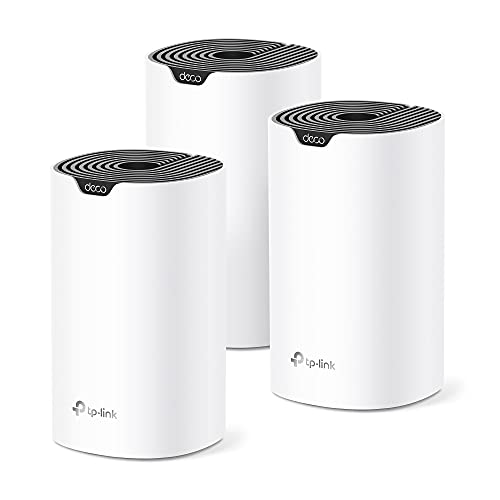
The TP-Link Deco S4 is an older AC1900 mesh system, but it remains useful for basic coverage at a low price. Its three-pack is rated for up to 5,500 square feet, and each unit includes gigabit ports for wired devices. It replaces a traditional router and extender setup with one shared network. For browsing, HD streaming, online classes, smart speakers, and ordinary home use, the S4 can be enough.
Its dual-band WiFi 5 design does not match the capacity or efficiency of newer WiFi 6 and WiFi 7 systems. That limitation matters in homes with fast fiber, many heavy users, or large file transfers. Yet the S4 can still provide a clean upgrade over an old router with weak coverage. Alexa support and the Deco app make it approachable for people who want simple controls rather than complex network menus.
Pros:
- Lower purchase cost than newer mesh systems
- Three units help cover rooms with weak signals
- Gigabit ports support wired TVs, consoles, and computers
- Simple shared network reduces WiFi name confusion
- Works with Alexa for basic voice control
- Suitable for modest internet plans and light-to-medium use
Cons:
- WiFi 5 offers less capacity than WiFi 6 or WiFi 7
- No 6 GHz band or 2.5Gbps Ethernet ports
- Heavy traffic can reduce performance on wireless backhaul
I would recommend the S4 when the goal is better coverage, not maximum speed. It can be a good match for an apartment, small office, rental home, or older house with a slower cable plan. The system is also easy to understand for someone replacing a basic router and extender. I would avoid it for a new multi-gig fiber installation because its ports and wireless standard would become the bottleneck.
Budget buyers should also consider long-term value. A low price is useful only if the system meets the home’s needs for several years. If most devices support WiFi 5 and the internet plan is moderate, the S4 remains a reasonable choice. It is not the Best Mesh WiFi System for advanced users, but it can be the best practical answer for simple whole-home coverage.
NETGEAR Orbi 770 Series WiFi 7 Mesh

The NETGEAR Orbi 770 Series is built for large homes and demanding networks. This router-and-two-satellite kit is rated to cover up to 8,000 square feet and supports up to 100 devices, according to the listed specifications. Its tri-band WiFi 7 design gives the mesh more room to manage communication between nodes and client devices. The system also includes a 2.5Gbps internet port, which makes it a better match for fast broadband service.
Orbi systems are known for a strong focus on whole-home coverage and easy roaming. The 770 Series adds newer WiFi 7 support for compatible phones, laptops, and other devices. A tri-band layout can be helpful in a busy home because the network has more wireless capacity than a basic dual-band kit. NETGEAR also offers security tools, but buyers should check which features are included and which require a subscription.
Pros:
- Large advertised coverage for wide or multi-level homes
- Tri-band WiFi 7 design supports busy networks
- 2.5Gbps internet port supports faster broadband plans
- Designed for many connected devices
- Strong option for wireless mesh backhaul
- Security features help monitor and protect the home network
Cons:
- Usually costs more than basic TP-Link mesh systems
- Some security features may involve a recurring subscription
- Large units may be harder to hide than compact nodes
The Orbi 770 is the system I would examine first for a large home where running Ethernet is difficult. Its tri-band design gives the satellites a better chance to maintain a strong wireless link while devices stream, work, and play. The broad coverage rating can also reduce the need to buy extra nodes. Still, I would place the satellites in open areas rather than at the far edge of the house.
This kit makes the most sense for users with fast internet, many connected devices, or a large floor plan. It may be more system than a small apartment needs. Buyers should also budget for possible subscription costs if they want the full security package. For large homes, the Orbi 770 can be the Best Mesh WiFi System when coverage and wireless backhaul matter more than the lowest price.
TP-Link Deco XE75 WiFi 6E Mesh System

The TP-Link Deco XE75 uses WiFi 6E and adds access to the 6 GHz band. Its three-pack is rated for up to 7,200 square feet, making it a strong fit for large homes that need wide coverage. The AXE5400 class offers a useful blend of speed and capacity, while the tri-band design gives the mesh another band for compatible devices and network traffic. Each unit also has gigabit Ethernet ports for wired connections.
The 6 GHz band can offer cleaner short-range links because it has newer spectrum and less legacy traffic in many areas. However, 6 GHz does not pass through walls as well as lower bands, so device placement still matters. The XE75 can use AI-driven roaming, Ethernet backhaul, VPN tools, and HomeShield features through the Deco platform. It is a mature choice for buyers who want more capacity than WiFi 6 but do not need WiFi 7.
Pros:
- 6 GHz band supports compatible WiFi 6E devices
- Tri-band design helps manage busy home networks
- Large advertised coverage with a three-pack
- Ethernet backhaul improves performance in wired homes
- Useful app controls and automatic roaming
- Good balance between advanced features and simple setup
Cons:
- Gigabit Ethernet limits wired throughput
- 6 GHz signals have shorter range through walls
- Older devices cannot use the 6 GHz band
I like the XE75 for homes with newer laptops and phones that support WiFi 6E. The extra band can act like a clear side road for compatible devices, which leaves the older bands less crowded. It also works well for families that want several simultaneous streams and calls. If the home has Ethernet cable, wired backhaul can make the system feel even more consistent.
The XE75 remains a good value when its price sits below comparable WiFi 7 kits. It does not provide the newest standard, and its gigabit ports may not suit every multi-gig plan. Even so, WiFi 6E offers a real improvement for compatible clients in crowded areas. I would rank the XE75 among the Best Mesh WiFi System options for users who want tri-band capacity and 6 GHz access at a reasonable cost.
How I Compare the Best Mesh WiFi System Options
A mesh system is more than a speed number printed on a box. Manufacturers list combined theoretical rates across several bands, but a single phone usually uses only one connection at a time. Real speed changes with distance, walls, device limits, channel traffic, and the quality of the link between mesh nodes. I pay close attention to those details before calling any system the Best Mesh WiFi System for a home.
Coverage comes first. A three-pack may cover a large area, but the units still need a strong path between them. Putting a satellite in a dead zone is like placing a bridge after the river; it cannot receive a good signal there. I prefer a central main unit and satellites placed halfway toward weak rooms, with open space around each device.
Backhaul is also important. Wireless backhaul uses some of the available radio capacity to connect the nodes. Wired Ethernet backhaul sends that traffic through a cable and often gives better results. If a home has Ethernet wiring, I consider it one of the best upgrades a mesh owner can make.
Band design affects busy homes. Dual-band systems can work well, but they share radio space between client devices and the wireless mesh link. Tri-band models add another band, which can improve capacity and help wireless satellites. WiFi 6E adds 6 GHz, while WiFi 7 adds newer tools such as Multi-Link Operation and wider channel support for compatible hardware.
WiFi 6, WiFi 6E, or WiFi 7?
WiFi 6 remains a strong choice for many homes in 2026. It improves network efficiency, especially when many devices share the same connection. Phones, TVs, cameras, tablets, and smart plugs can all compete for airtime, so efficiency may matter more than peak speed. The Deco X55 is a good example of a WiFi 6 system that focuses on practical home coverage.
WiFi 6E adds the 6 GHz band. This band can provide faster, cleaner short-range links when the device supports it. It does not replace the lower bands, and its shorter reach means it works best near a node. The Deco XE75 is a useful choice when a buyer owns several WiFi 6E devices or lives near many competing networks.
WiFi 7 brings newer features, but the benefit depends on the client device. A WiFi 7 phone can use features that an older WiFi 5 laptop cannot. That does not make WiFi 5 useless, but it means buyers should match the router to the devices they plan to use. The BE23, BE25, and Orbi 770 are the most future-ready products in this group.
I would not replace a good WiFi 6 system only because WiFi 7 exists. I would upgrade when the current network has dead spots, lacks needed ports, struggles with many devices, or cannot support a faster internet plan. A new standard helps most when the entire chain supports it: the internet service, router, client, and network layout.
How Many Mesh Units Do You Need?
One router may cover a small apartment or compact home. A two-pack can suit a small two-story layout. A three-pack often works better for a large home, long ranch floor plan, or house with several thick walls. The product coverage numbers are useful for comparison, but they are not exact measurements for every building.
Concrete, brick, metal, mirrors, appliances, and floors can weaken WiFi signals. A basement node may have trouble reaching an upstairs room through a concrete ceiling. In that case, Ethernet backhaul can solve more than buying a faster router. I recommend starting with the included units before adding extra nodes, because too many nearby nodes can create unnecessary radio traffic.
Most mesh apps show connection quality after setup. I use that feedback as a guide, then test the rooms that matter most. A speed test beside the main router does not tell the full story. I also test the office, bedroom, garage, patio, and any room where calls or streaming often fail.
Features That Matter in Daily Use
Ethernet ports are easy to overlook. A smart TV, desktop PC, game console, printer, or home server may work better with a wired link. The Deco X55, BE25, and BE23 stand out because they provide useful port options on each unit. The Orbi 770 adds a 2.5Gbps internet port for faster service.
Parental controls can help families pause internet access, set schedules, or create profiles. Security tools can warn about some threats and unusual activity. I remind buyers to check the plan details because brands may place advanced features behind a subscription. Basic routing and WiFi functions should still work without paying a monthly fee.
VPN support may matter to remote workers and privacy-focused users. However, VPN speed depends on the router processor, encryption type, and service used. A mesh system can support a VPN, but it may not deliver the same speed as a direct connection. Buyers should treat VPN support as a useful feature, not a guarantee of fast encrypted traffic.
Automatic roaming is another key feature. A proper mesh system uses one network name and helps a phone move toward the strongest node. The switch is not always instant, because the client device also decides when to roam. Still, a unified system is usually easier than manually choosing among several extender names.
Setup Tips for Better Mesh WiFi
I start by updating the modem and checking the internet plan speed. Then I place the main mesh unit in an open, central location, not inside a cabinet or behind a television. The main unit must connect to the modem with Ethernet. I use the app to create the network name and password, then add the satellite units one at a time.
I place each satellite where it can still communicate well with the main unit. A hallway shelf often works better than a far corner. I keep nodes away from cordless phone bases, thick metal objects, microwaves, and large appliances. After setup, I run tests in the rooms that need coverage instead of judging performance from one spot.
For Ethernet backhaul, I connect the cable after the mesh system is set up unless the instructions say otherwise. I label cables and check that the app reports a wired link. A bad cable or incorrect switch setup can cause a node to fall back to wireless. Cat 5e or newer cable is generally suitable for gigabit links, while multi-gig connections may need better cable and compatible hardware.
I also change the default administrator password and use a strong WiFi password. Firmware updates can fix bugs and improve security. I enable automatic updates when the system offers that choice. These small steps often matter more than a minor change in advertised wireless speed.
My Recommendation
The TP-Link Deco X55 is my top all-around pick for most families because it offers broad coverage, WiFi 6 efficiency, and three gigabit ports per unit. It suits homes with normal broadband plans and many everyday devices. For newer multi-gig service, I would choose the Deco BE25 because its WiFi 7 features and 2.5Gbps ports offer stronger long-term value. The Orbi 770 is the better large-home option when wireless backhaul and maximum coverage are the main goals.
The Deco BE23 is best for value-minded buyers who want WiFi 7 without the highest performance tier. The XE75 is a strong middle choice for WiFi 6E devices and busy networks. The Deco S4 remains suitable for basic coverage on a modest budget. Availability and prices can change, so I recommend checking the current Amazon listing, warranty terms, and subscription details before choosing the Best Mesh WiFi System for your home.
| Best for | Why |
|---|---|
| Most families | Deco X55 offers wide coverage, easy control, WiFi 6, and useful gigabit ports. |
| Large homes and fast wireless links | Orbi 770 combines WiFi 7, tri-band capacity, and up to 8,000 square feet of listed coverage. |
| Newer devices and multi-gig plans | Deco BE25 adds WiFi 7 features and 2.5Gbps ports for stronger future value. |
FAQs Of Best Mesh WiFi System
Is a mesh WiFi system better than a WiFi extender?
For whole-home coverage, a mesh system is usually easier to manage. It uses one network name and supports smoother movement between nodes. An extender may cost less, but it can create a separate network and often reduces speed over a wireless link.
Does mesh WiFi increase my internet speed?
It does not increase the speed supplied by your internet provider. It can improve the speed and stability you receive in rooms where the old router had a weak signal. Your actual result depends on the plan, device, walls, node placement, and backhaul.
Should I choose WiFi 6E or WiFi 7?
Choose WiFi 7 if you own newer compatible devices or plan to keep the system for many years. Choose WiFi 6E if you want tri-band capacity and 6 GHz access at a lower cost. WiFi 6 remains enough for many homes with ordinary broadband and older devices.
Can I use Ethernet backhaul with a mesh system?
Yes, many systems support Ethernet backhaul. A wired link can improve speed and reduce wireless congestion between nodes. Check the app after connecting the cable to confirm that the satellite uses the wired path.
Do I need three mesh units?
Not always. One unit may cover a small home, while two units may suit a smaller multi-level layout. A three-pack helps large homes and long floor plans, but good placement matters more than simply adding units.
Final Verdict: Which Should You Buy?
For most homes, I recommend the TP-Link Deco X55 as the Best Mesh WiFi System for balanced coverage, simple control, and fair value. Choose the Deco BE25 for WiFi 7 and multi-gig ports, or the Orbi 770 for a very large home.
Compare coverage, backhaul, ports, and device support before buying. The right mesh WiFi system can turn weak corners into steady, reliable spaces for work, streaming, and play.