5 Best AI Camera Devices: Top Smart Picks For 2026
The best AI camera devices blend smart capture, privacy tools, hands-free use, and practical daily safety features.
Picture this: you are traveling, filming a family moment, checking a rental room, or trying to remember what happened during a busy day. A normal camera can record, but it cannot always understand the scene or help you act faster. The Best AI Camera Devices add useful tools such as object recognition, voice control, smart alerts, translation, or signal scanning. I reviewed the main features, design limits, privacy points, and real-world uses of these devices to help you choose with confidence.

Looki L1 AI Multimodal Wearable…
THE FIRST AI LIFE CURATOR, NOT JUST A CAMERA: Looki L1 doesn’t just capture footage—it understands your day. Acting as your personal life curator, it actively processes your surroundings, synthesizes…

Upgraded Hidden Camera Detector -…
Upgraded AI-Powered Detection: Military-grade technology detects hidden cameras, listening devices, and GPS trackers with precision. Enjoy peace of mind in hotels, offices, and even your own home. Stay one step…

QLUNMOU Hidden Camera Detectors -…
【6-in-1 All-Round Protection】This multifunctional detector integrates 6 core functions, covering multi-scenario privacy and protection needs. Equipped with a built-in AI smart chip and high-definition optical lens, it achieves 180° high-speed…
Looki L1 AI Wearable Camera

The Looki L1 takes a different path from a standard action camera. It is a small, hands-free wearable made for capturing daily moments from your own view. The listed design weighs about 32 grams and includes 1080p video, three microphones, and 32GB of built-in storage. That mix makes it one of the more unusual options among the Best AI Camera Devices for people who want a camera that stays out of the way.
I like the idea of a camera that can record while both hands remain free. It may help during walks, trips, family activities, field work, or quick personal notes. The product also lists AI vlogs, comics, and proactive intelligence, so its value goes beyond simple video capture. Still, buyers should review the app rules, battery details, and privacy settings before relying on it for long recording sessions.
Pros:
- Very light 32-gram wearable design
- Hands-free recording for active use
- 1080p video suits everyday clips
- Three microphones may improve voice capture
- 32GB storage reduces the need for a card
- AI tools can add creative value to recorded moments
Cons:
- 1080p may not satisfy users who want 4K video
- Wearable cameras need careful privacy use around other people
- Battery life and app support may limit long recording days
My Recommendation
I recommend the Looki L1 to creators, travelers, parents, and people who want a small camera for first-person clips. It makes more sense for short daily scenes than for long professional shoots. The light body should feel less tiring than a larger camera worn on a strap or held in the hand. I also see value for users who want AI-assisted memories instead of a simple folder full of video files.
Among the Best AI Camera Devices, this model stands out for its wearable form and privacy-first storage claim. It is not the strongest pick for cinematic quality, low-light work, or long surveillance use. However, it offers a fresh way to capture life without holding a phone. Check the current Amazon listing for battery, software, return, and availability details before ordering.
Upgraded AI Hidden Camera Detector

This upgraded hidden camera detector targets a different problem: unwanted recording and tracking. The listing describes it as an AI-powered anti-spy device with GPS tracker detection, bug detection, and portable RF scanning. That gives it a clear role for hotels, rental homes, offices, cars, and private rooms. For many shoppers, it may be the most practical privacy device in this group.
I would use a detector like this as a first check, not as proof that a room is fully safe. RF tools can find some active wireless signals, but they may not detect every wired, inactive, shielded, or low-power camera. Wi-Fi routers, phones, Bluetooth products, and other electronics can also create signals. A calm visual inspection, a flashlight check, and respect for local privacy laws still matter.
Pros:
- Combines RF scanning with anti-spy functions
- Designed for travel, hotels, offices, homes, and cars
- Portable size should fit easily in a travel bag
- GPS tracker detection adds another layer of privacy help
- Useful for people who manage rental or work spaces
- Supports a simple peace-of-mind check before settling in
Cons:
- Detection results can change with nearby wireless devices
- It cannot guarantee that a room has no hidden camera
- New users may need time to learn signal readings
My Recommendation
This detector is best for frequent travelers, business users, rental hosts, and anyone with a strong need for personal privacy. It is also helpful for people who feel uneasy in unfamiliar rooms and want a repeatable inspection routine. I would scan the room in stages, turn off known devices when possible, and investigate unusual alerts instead of treating every beep as danger. That approach makes the tool more useful and avoids needless alarm.
Compared with image-capture products in the Best AI Camera Devices category, this unit does not record your life. Its job is to help you find possible recording or tracking threats. That focused purpose gives it strong value for privacy-minded buyers. Availability, included accessories, battery performance, and detection range can change, so confirm the latest Amazon details before purchase.
QLUNMOU 6-in-1 Hidden Camera Detector

The QLUNMOU detector is built as a broader personal privacy kit. Its listing highlights six functions, including GPS tracker and bug detection, an intrusion alert, and an SOS flash alert. It is aimed at solo users, hotel guests, office workers, homeowners, and drivers. That wide target audience makes it a flexible choice for people who want one compact device for several checks.
The main benefit is convenience. Instead of carrying separate tools for a possible tracker, bug, or camera, you can keep one unit in a drawer or travel pouch. I would still treat the six-in-one label as a feature list, not a promise of perfect detection in every setting. In practice, the results depend on signal strength, distance, interference, room layout, and how carefully you inspect the area.
Pros:
- Six-in-one design covers several privacy tasks
- Useful for hotels, offices, homes, cars, and solo travel
- GPS tracker and bug detection broaden its purpose
- Intrusion alert may add quick awareness in a private space
- SOS flash alert can support emergency signaling
- Compact form makes regular carrying practical
Cons:
- Multiple modes may make the controls less simple at first
- Alerts can need testing to separate real risks from interference
- It is a detection aid, not a professional forensic instrument
My Recommendation
I would choose the QLUNMOU for a person who wants broad coverage in a small package. It suits solo travelers who value an SOS feature, drivers who worry about unwanted trackers, and renters who want a basic room check. It may also work well as a shared household tool because different family members can carry it when needed. Read the manual before a trip so you know how each mode behaves.
This model earns a place in a review of the Best AI Camera Devices because modern camera safety also includes finding devices that should not be there. It will not replace good judgment or a full security inspection. Yet its range of functions can make privacy checks faster and less stressful. Review current stock, included charging items, and seller support on Amazon before buying.
SGUKZF AI Camera Smart Glasses
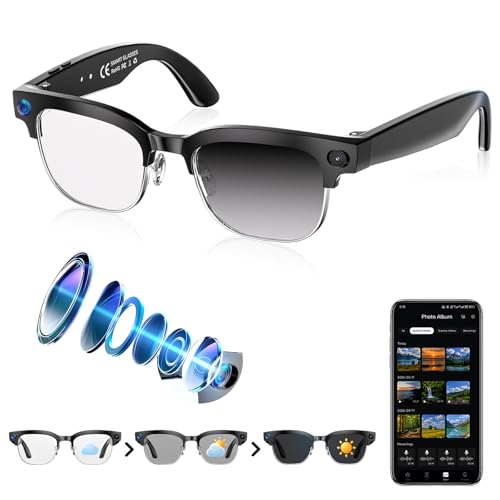
The SGUKZF smart glasses combine a camera, open-ear audio, and AI features in a familiar eyewear shape. The listing names 4K electronic image stabilization, photo and video capture, real-time translation, and object recognition. It also lists photochromic lenses, which can adjust to changing light conditions. For hands-free travel and point-of-view content, this is one of the most feature-rich entries in the Best AI Camera Devices group.
Smart glasses can feel natural because the camera follows your view. That helps when you hike, tour a city, cook, work on a project, or want a quick photo without reaching for a phone. The trade-off is social comfort and privacy. I would tell people when I am recording, follow posted rules, and check how the glasses show recording status before using them in public.
Pros:
- 4K capture may deliver sharper video than basic wearables
- EIS can help reduce motion shake
- Open-ear audio leaves outside sounds easier to hear
- Real-time translation may help during travel
- Object recognition adds useful hands-free support
- Photochromic lenses can suit changing outdoor light
Cons:
- Smart-glass battery life may limit long recording sessions
- Small frames cannot match a dedicated camera for lens control
- Recording in public can raise privacy and social concerns
- App, phone, and language support may affect key AI features
My Recommendation
I recommend these glasses to travelers, vloggers, tour guides, and users who want audio and camera tools without holding a phone. They are especially appealing if translation and object recognition matter as much as video quality. I would not buy them mainly for studio work, sports that involve hard impacts, or serious night filming. Their greatest strength is quick, natural capture during movement.
In the Best AI Camera Devices market, the SGUKZF model offers the broadest mix of camera and smart-glass functions on this list. Its 4K and stabilization claims look attractive, but real results still depend on light, lens quality, software, and user settings. Check the current product page for fit, prescription support, charging details, and app compatibility. A good return policy is useful when buying wearable technology.
2026 AI Upgraded Hidden Camera Detector

This 2026 AI-upgraded detector is aimed at shoppers who want a dedicated hidden-camera check tool. Its short listing focuses on detecting spy cameras, so it may appeal to buyers who do not need a wearable camera or smart glasses. A small detector can be useful before sleeping in a hotel, changing clothes in a rental, or holding a private meeting. It gives users a simple way to add a privacy check to a normal travel routine.
I see this type of product as a helpful layer, much like a flashlight or door wedge. It can point your attention toward suspicious areas, but it cannot see through walls or prove that every device is absent. I would scan mirrors, vents, clocks, chargers, smoke detectors, and unusual objects while also checking for strange wires or reflective lens points. That balanced method is more reliable than trusting any single “AI” label.
Pros:
- Focused design for hidden-camera detection
- Useful for hotel, rental, office, and home checks
- Portable form should be easy to store and carry
- Can support a simple repeatable privacy routine
- May help users inspect areas that are hard to notice
- 2026 labeling may appeal to shoppers seeking a newer model
Cons:
- Short product information leaves some technical details unclear
- Detection can be affected by wireless interference and distance
- It should not replace legal, professional, or physical inspection
My Recommendation
This detector is best for buyers who want a straightforward privacy tool and do not need a camera. It suits travelers, renters, remote workers, and people who often use shared spaces. I would choose it when a compact, dedicated device matters more than a large feature list. Before relying on it, test the controls at home with known electronics and read the included instructions.
For shoppers comparing the Best AI Camera Devices, this product is a reminder that camera technology has two sides. Some devices help you capture memories, while others help you look for unwanted recording. Its value depends on honest expectations and careful use. Confirm the latest Amazon specifications, warranty terms, and customer support details because product information can change.
How I Evaluated the Best AI Camera Devices
I do not judge an AI camera by its feature count alone. A long list can look bright on a product page but feel dull after a week of use. I look at the task first: capture, travel, translation, safety, or privacy. Then I compare the design, controls, likely learning curve, storage, battery needs, and the limits of the claimed smart features.
I also separate a listed feature from a proven result. For example, a product may list 4K video, but sharp footage still depends on light, lens quality, stabilization, and compression. A detector may list AI scanning, but wireless noise can affect an alert. This approach helps keep the Best AI Camera Devices review useful and fair.
Image and Video Quality
Resolution matters, but it is not the whole picture. A 1080p wearable can produce better daily memories than a 4K device that feels heavy or takes too long to start. Stabilization helps when you walk, yet it cannot fix poor light or a dirty lens. Smart glasses also use very small camera modules, so buyers should keep expectations realistic.
For casual clips, family moments, and social posts, 1080p can be enough. For cropping, large displays, or detailed travel footage, 4K has more room to work. The SGUKZF glasses have the strongest listed resolution here. The Looki L1 may win for comfort and fast access instead.
AI Features and Daily Use
AI works best when it removes a small task. Object recognition may help identify something in front of you. Translation may help during a trip. A smart memory tool may help turn short clips into a story. These features should feel like a quiet assistant, not a magic mind reader.
AI tools often depend on a phone app, an internet connection, language packs, or cloud services. That can affect speed and privacy. I recommend checking permissions before setup and turning off features you do not need. A device that respects your control will feel better over time than one that constantly asks for access.
Privacy and Responsible Recording
Camera wearables can capture people who did not expect to be recorded. That matters at home, at work, and in public. I recommend telling people when practical, respecting signs and local rules, and avoiding private places such as changing rooms. A visible status light helps, but it does not remove the need for good judgment.
Storage also matters. Local storage may reduce cloud exposure, while cloud tools can make sharing easier. Read the privacy policy, app permissions, account terms, and deletion options. The Looki L1 lists privacy-first storage, but every buyer should still confirm how the device and app handle files.
Wireless Detection Limits
Hidden-camera detectors need careful handling. An RF scanner looks for radio energy, but many normal products emit radio energy too. A Wi-Fi router, smartwatch, phone, wireless speaker, or nearby network may cause a reading. Some cameras store footage locally or stay inactive, so an RF scan may not find them.
I suggest a three-step check. First, visually inspect the room and cover or unplug devices that you recognize. Second, scan from different distances and angles. Third, examine anything that still seems unusual. This routine is simple, but it keeps fear from taking over and makes the Best AI Camera Devices more practical for real users.
Best For Comparison Table
| Best for | Why |
|---|---|
| Hands-free daily video | Looki L1 offers a light wearable body, 1080p recording, microphones, and built-in storage. |
| Travel privacy checks | The upgraded AI detector combines portable RF scanning with GPS and bug detection. |
| Smart travel and point-of-view capture | SGUKZF glasses list 4K EIS video, translation, open-ear audio, and object recognition. |
What to Consider Before Buying
The right device depends on the problem you want to solve. If you want to save quick first-person memories, choose a wearable camera. If you want translation and open-ear sound, smart glasses may fit better. If your main concern is unwanted recording, a detector is the more sensible buy.
Do not pay for features you will not use. A traveler may value weight and battery life more than advanced editing. A privacy-focused buyer may value clear alerts and a simple scan mode. A content creator may care most about stabilization, sound, storage, and file transfer.
Check Battery and Charging Needs
Small devices have small batteries. Cameras, wireless radios, AI processing, and bright status lights can drain power fast. Ask how long the product can record in the mode you plan to use, not only the best number shown in a listing. Carry a power bank when a full day matters.
Also check charging ports, cable type, charging time, and whether the device can record while charging. A wearable that needs a long reset after each clip may frustrate you. Smart glasses can be harder to charge during travel because their frames may need a special case or cable.
Check Storage and File Transfer
Built-in storage is convenient, but 32GB does not hold unlimited video. Higher resolution uses space faster. Wireless transfer may be easy, but it can take time for large clips. Confirm whether the camera uses a phone app, a memory card, internal storage, or cloud backup.
I also look for easy file names and simple controls. If you cannot find yesterday’s clip, the smart features do not help much. Back up important files and delete sensitive footage when you no longer need it.
Check App and Phone Support
Many AI camera devices need an app for setup, updates, translation, or file sharing. Confirm that the app works with your phone before buying. Check the required operating system, account needs, location access, Bluetooth access, and internet connection.
Software support can shape the product’s life. A device may work well at launch but lose value if updates stop. Look for clear support details and recent buyer feedback. I would also avoid granting broad permissions without reading why the app needs them.
Check Comfort and Controls
Wearables need comfort more than most gadgets. A camera that presses on your face, pulls on your shirt, or feels warm will stay in a drawer. Try the device for short periods first. Make sure the controls are easy to find without looking down.
Glasses should sit securely but not pinch. A clip-on wearable should stay in place when you turn your head. A detector should fit your hand and show alerts clearly. Simple design often beats a crowded button layout.
How to Use an AI Camera Device Safely
Start with a short test at home. Record a few clips, play them back, and check sound, focus, light, storage, and battery use. Learn how to stop recording quickly. This step prevents missed moments and lowers the chance of accidental recording.
Set a clear privacy rule. I avoid recording private conversations without permission and never use a camera where people expect full privacy. For smart glasses, I explain the camera before filming. For detectors, I do not accuse anyone based on one alert; I investigate calmly and follow the law.
Use strong account security if the device connects to an app. Choose a unique password and enable multi-factor login when available. Keep firmware updated from the official app or product channel. These basic steps protect your footage and reduce unwanted access.
Which Product Is Right for Different Users?
For Travelers
Travelers may want two different tools. The SGUKZF glasses can help capture walks, translate speech, and keep audio open to the outside world. A hidden-camera detector can add a privacy check in a hotel or rental. If your budget allows only one, choose based on whether creation or privacy matters more.
For Content Creators
Creators should look at the SGUKZF glasses for higher listed resolution and stabilization. The Looki L1 may be easier for casual vlogs and hands-free clips. Neither replaces a dedicated mirrorless camera for controlled shoots, but both can capture angles that a phone cannot.
For Privacy-Minded Buyers
The Upgraded Hidden Camera Detector and QLUNMOU detector are the better matches. The first focuses on RF, GPS, and bug detection. The second adds a six-in-one approach with intrusion and SOS features. Use either as a helpful first check, not as a perfect security guarantee.
For Families and Everyday Users
The Looki L1 may suit parents, walkers, and active users who want a small camera close at hand. Smart glasses may suit families who want quick photos during a trip. Both need clear household rules so everyone understands when recording starts.
FAQs Of Best AI Camera Devices
What are the Best AI Camera Devices for travel?
The SGUKZF smart glasses suit travelers who want hands-free video, open-ear audio, translation, and object recognition. A hidden-camera detector is better if room privacy is your top concern.
Can AI camera devices record without a phone?
Some can store footage locally, while others need a phone for setup, control, or file transfer. Check the exact storage and app requirements on the current product listing.
Are hidden-camera detectors fully reliable?
No. They can help find some radio signals or lens reflections, but they may miss inactive, wired, shielded, or local-storage cameras. Use visual inspection and sound judgment as well.
Is 4K better than 1080p for a wearable camera?
4K can show more detail and allow more cropping. However, 1080p often uses less storage and power. Comfort, light, sound, and stabilization can matter more for daily use.
Are camera smart glasses legal to use everywhere?
No. Rules vary by location and setting. Avoid private areas, follow posted policies, and tell people when you record whenever practical.
Final Verdict: Which Should You Buy?
For the widest smart camera feature set, I would choose the SGUKZF glasses. For hands-free comfort, the Looki L1 is the better fit. Privacy-focused buyers should choose the Upgraded Detector or QLUNMOU model.
The Best AI Camera Devices solve different needs, so match the tool to your daily task. Check current specs, app support, privacy terms, price, and availability on Amazon before ordering.