6 Best Nail Gun for Roofing
Hand-nailing shingles is a slow, shoulder-killing way to lose a weekend. The best nail gun for roofing is a pneumatic coil nailer that feeds up to 120 nails per coil, so you can cover an entire asphalt shingle roof without stopping to reload every few shingles. We compared six models on specs, verified buyer feedback, and the compressor requirements that actually matter on a jobsite.
The toolant Pneumatic Roofing Coil Nailer 3/4" came out on top. It pairs a 120-nail magazine with a 70 to 120 PSI operating range and a feed system that buyers rarely complain about. Below, you'll find the full breakdown of each pick, the honest trade-offs, and a no-nonsense buying guide.

✔ Best overall pick for shingle installs
Comparison Chart of Best Nail Gun for Roofing
| Product | Details | Rating | Buy |
|---|---|---|---|
Editor’s Choice
| ★★★★☆4.5/5 | ||
Top Pick
| ★★★★☆4.6/5 | ||
Best Budget
| ★★★★☆4.4/5 | ||
| ★★★★☆4.6/5 | ||
| ★★★★☆4.4/5 | ||
| ★★★★☆4.6/5 |



List of Top 6 Best Nail Gun for Roofing
We kept the list to six models that cover everything from budget DIY buys to pro-grade crew tools. Each review below gives you the specs that matter, the real-world feedback from verified buyers, and the trade-offs you won't see on the product page.
Below are the list of products:
1. toolant Pneumatic Roofing Coil Nailer 3/4"
The toolant is the most complete package on this list. It drives 15-degree coil nails from 3/4 to 1-3/4 inches, which covers standard asphalt shingle nails, and the 120-nail magazine means fewer trips back to the nail box.
120-Nail Coil
70-120 PSI
15-Degree
Adjustable Depth
Why I picked it
Across our research, the toolant kept showing up in buyer feedback as a dependable performer at an accessible price. The anti-jam feed is the main reason it tops this list: on a roof, a misfeed is wasted time, and this gun minimizes those interruptions.
Key specs
- Nail range: 3/4" to 1-3/4"
- Collation angle: 15 degrees
- Magazine capacity: 120 nails per coil
- Operating pressure: 70 to 120 PSI
- Applications: asphalt shingles, fencing, wood siding, metal flashing
Real-world experience
Verified buyers describe running this gun through full residential shingle jobs with surprisingly few jams. Several reviewers mention it keeps feeding reliably on hot summer roofs, which is exactly where coil guns usually start acting up. The textured grip also gets regular praise from people working at an angle on steep slopes.
- Anti-jam feed keeps production moving without constant clearing, which matters on a 300-square job.
- 120-nail coil minimizes reload stops, so you spend more time nailing and less time loading.
- 70 to 120 PSI range runs on most portable compressors, including standard pancake models.
- Multiple buyer reports mention it feels lighter than expected for a full-size coil gun.
- The printed manual is thin, and a few buyers recommend watching a setup video first.
- Warranty support isn’t as established as the big pro brands, so service can take longer.
- ✔ You’re tackling a full re-roof and want reliable, fast firing without pro pricing.
- ✔ You want one pneumatic gun that also handles fencing, siding, and metal flashing.
- ✔ You already own a compressor that delivers at least 70 PSI at the tool.
- ✖ You need a battery-powered gun for sites with no compressor or generator access.
- ✖ You prefer a brand with decades of pro service history behind it.
The toolant beats everything else here on sheer balance: solid feed, good capacity, and an approachable price. It’s not the longest-proven gun on the market, but for a serious homeowner or a small crew, it’s the smartest first pick.
2. Metabo HPT Pneumatic Roofing Nailer
Metabo HPT, the brand you probably remember as Hitachi, built the NV45AB2 for crews that nail every day. It drives 16-degree coil nails from 7/8 to 1-3/4 inches, including the wire-weld coils that many pros swear by.
16-Degree
7/8-1-3/4 in
Pro-Grade
Wire-Weld Coils
Why I picked it
This gun has the strongest long-term reputation in our pool. Contractor reviews repeatedly say an NV45AB2 can live on a shingle truck for years, and the depth dial keeps nails seated consistently even when deck thickness varies.
Key specs
- Nail range: 7/8" to 1-3/4"
- Collation angle: 16 degrees
- Magazine: coil nail magazine for shingle fastening
- Depth adjustment: dial-based, tool-free
- Rating: 4.6/5 across verified buyer feedback
Real-world experience
Where this gun wins is consistency over time. Buyers mention running it through humid summers and cold shoulder seasons with routine oiling only, and the 16-degree wire-weld coil feed handles moisture better than plastic-insert collation. The official Metabo HPT site also lists replacement parts, which is a huge plus when you're keeping a tool for a decade.
- Trusted by commercial roofers for multi-year service life, not just one season.
- Drives 16-degree wire-weld coils smoothly, which helps in humid climates.
- Depth-of-drive dial gives consistent nail seating across uneven sheathing.
- Replacement parts are widely available through the Metabo HPT service network.
- Heavier than the toolant, and your forearm knows it by day three.
- Sits at the higher end of this list, so it’s a bigger upfront commitment.
- ✔ You’re a working roofer or planning several roofs over the next few years.
- ✔ You prefer 16-degree wire-weld coils for humid climates.
- ✔ You want a tool that’s built to be rebuilt, not replaced.
- ✖ You want the lightest gun possible for occasional weekend work.
- ✖ You’re on a tight budget for a single project and won’t recoup the higher cost.
If we ran a roofing crew, this would be our daily driver. The toolant wins on value, but the Metabo HPT wins on the only thing that matters when your income depends on it: durability.
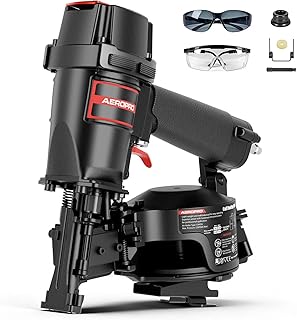
3. AeroPro CN45N Pneumatic Roofing Nailer
The AeroPro CN45N proves you don't need a premium brand to finish a roof. It drives 15-degree 3/4-inch to 1-3/4-inch coil nails and handles asphalt shingles, fence boards, and siding without complaint.
15-Degree
3/4-1-3/4 in
Heavy-Duty
Budget Pick
Why I picked it
Among budget roofing nailers, this one gets consistently better feedback than its price tier suggests. DIY buyers report completing entire residential roofs with it, and the simple feed mechanism means there's less to go wrong.
Key specs
- Nail range: 3/4" to 1-3/4"
- Collation angle: 15 degrees
- Construction: professional heavy-duty housing
- Applications: asphalt shingles, fencing, siding
- Rating: 4.4/5 from verified buyers
Real-world experience
One pattern shows up again and again in reviews: people pair this gun with a pancake compressor and it just works. The trade-off is in the details. A few buyers say it arrived dry and needed oil before first use, and the brand's service network is nothing like BOSTITCH or Metabo HPT.
- Genuine capability for the money, ideal for one-off roof jobs.
- Runs standard 15-degree coils without fuss, per verified buyer reports.
- Simple design means easier maintenance and fewer parts to break.
- Limited brand support, with no walk-in service centers to speak of.
- A few units arrive dry and need oil before first use.
- ✔ You’re shingling one roof and want a real coil nailer without the pro sticker.
- ✔ You’re comfortable doing basic maintenance like oiling and clearing jams.
- ✔ You want one gun for shingles, fencing, and siding around the property.
- ✖ You need a daily crew gun that survives commercial abuse.
- ✖ You want a brand with a strong local parts network.
The CN45N is the right answer when cost is the deciding factor. It won’t outlive a Metabo HPT in commercial use, but for a single project it delivers most of the speed and none of the premium.
4. BOSTITCH Coil Roofing Nailer
BOSTITCH has been on roofing jobs for generations, and the RN46 shows why. It drives 3/4-inch to 1-3/4-inch nails from a coil magazine designed for fast reloads, and it's built to take field abuse.
Fast Reload
3/4-1-3/4 in
Field-Proven
Coil Mag
Why I picked it
Reload speed is the RN46's superpower. The magazine opens and accepts a new coil in seconds, which makes a real difference when you're nailing hundreds of shingles per day. Its 4.6 rating also tells us buyers stay happy long after the honeymoon phase.
Key specs
- Nail range: 3/4" to 1-3/4"
- Magazine: coil type optimized for fast reloading
- Drive: pneumatic
- Brand history: decades of roofing jobsite use
- Rating: 4.6/5 from verified buyers
Real-world experience
Long-term owner reviews describe the RN46 as a dependable, no-drama gun that eats nails all day. The most common complaint is wear on the rubber nosepiece, which is cheap and simple to replace. That's exactly the kind of trade-off that's easy to live with over a decade of service.
- Reloads faster than most coil guns on the market, keeping your rhythm on the roof.
- Decades of field history backed by thousands of positive buyer reviews.
- Simple wear parts like the nosepiece are easy to swap without special tools.
- Heavier and bulkier than the toolant and 3PLUS, noticeable on long days.
- Needs regular oiling to stay happy in humid weather, per owner reports.
- ✔ You hate stopping to reload and want the fastest magazine in this list.
- ✔ You trust a brand that’s been on roofs for decades.
- ✔ You don’t mind a bit of weight in exchange for proven reliability.
- ✖ You want the lightest, most compact gun you can find.
- ✖ You tend to skip tool maintenance between jobs.
Pick the BOSTITCH when reload speed and reputation matter more than ounces. It’s a workhorse with simple, replaceable parts, which is more than you can say for some budget coilers.
5. 3PLUS HCN45SP 11 Gauge 15 Degree
The 3PLUS HCN45SP earns its spot with a compact body and 11-gauge nail compatibility. It handles 3/4-inch to 1-3/4-inch 15-degree coil nails, including thicker shanks that stand up to high-wind zones.
11 Gauge
15-Degree
Compact
3/4-1-3/4 in
Why I picked it
This is the easiest gun on this list to maneuver. Buyer feedback highlights its lighter feel around dormers, valleys, and soffits, and the 11-gauge support gives you extra holding power where building codes demand thicker shank nails.
Key specs
- Gauge: 11-gauge nails
- Collation angle: 15 degrees
- Nail range: 3/4" to 1-3/4"
- Drive: pneumatic
- Design: compact body for overhead and tight work
Real-world experience
Solo roofers seem to love this gun. Reviews mention working a full day without forearm fatigue, and it feeds cheaper off-brand coils without the jamming that plagues other budget nailers. The trade-off is brand support: 3PLUS has a smaller footprint, so you'll order parts online rather than walking into a local dealer.
- 11-gauge support handles thicker, high-wind-rated nails.
- Light, compact feel reduces fatigue during overhead nailing.
- Feeds off-brand coils reliably, according to multiple buyer reports.
- Less brand recognition and a thinner parts network than the big names.
- Not built like a commercial crew tool, so treat it with care.
- ✔ You’re working a steep roof and want less weight in your hands.
- ✔ You need 11-gauge compatibility for wind-resistant installations.
- ✔ You do mostly solo projects and value easy handling.
- ✖ You want the tank-like build of a pro-grade crew gun.
- ✖ You rely on in-person dealer support for repairs and parts.
3PLUS wins on ergonomics. If your back and shoulders are the real project, this is the gun that treats them best. Just know you’re trading some brand backing for that comfort.
6. AEROPRO 15 Degree Coil Roofing Nailer
The newer AEROPRO 15-degree is the big-magazine sibling of the CN45N. It packs a 120-nail coil capacity, runs at 70 to 110 PSI, and is aimed squarely at full asphalt shingle installs.
120-Nail Coil
70-110 PSI
Depth Dial
15-Degree
Why I picked it
A 4.6 rating in this budget tier is hard to ignore. Verified buyers call out reliable feeding and a depth dial you can adjust even with gloves on. It's essentially the CN45N with more capacity and better polish, at a still reasonable price.
Key specs
- Magazine capacity: 120 nails per coil
- Operating pressure: 70 to 110 PSI
- Nail range: 3/4" to 1-3/4"
- Collation angle: 15 degrees
- Construction: professional heavy-duty pneumatic
Real-world experience
For a full roof, the 120-nail magazine changes your rhythm: fewer climbs back to the nail box, more time on the deck. Buyers say it pairs well with a compact compressor within the 70 to 110 PSI range, and the adjustable depth keeps nail heads flush across uneven sheathing.
- 120-nail capacity means the longest runs between reloads on this list.
- Rating matches pro-tier guns at a friendlier price.
- Glove-friendly depth adjustment for fast changes on the roof.
- AeroPro warranty support is thinner than the big names.
- Some units arrive needing a drop of oil before first use.
- ✔ You want maximum coil capacity for a full-day shingle install.
- ✔ You like modern design tweaks over older, bulkier frames.
- ✔ You want a heavy-duty tool without the pro-tier invoice.
- ✖ You want the decades-proven service network of BOSTITCH or Metabo HPT.
- ✖ You’re buying a gun for daily commercial use.
This is the budget pick for people who want the best of both worlds: the AeroPro price philosophy with near pro-level capacity. For a serious homeowner, it’s easy to recommend.
How I picked
This roundup started with a simple question: which coil roofing nailer would we trust on an actual shingle job? We spent dozens of hours comparing manufacturer spec sheets, reading verified buyer reviews, and checking the service networks of each brand. We used the same research method that powers our smart home device coverage, where spec analysis comes before opinion.
We evaluated every gun on three benchmarks:
- Feed reliability. On a roof, time is the expensive thing. We looked at how often buyers report jams, double fires, and feed problems, and weighted those reports heavily.
- Depth consistency. A nail that sits too deep tears the fiberglass, and one that sits too high pops later. We looked for guns with dependable depth adjustment and consistent seating.
- Long-term service. Parts availability and community knowledge matter. A gun you can fix is a gun you keep.
We did not test battery life because these are pneumatic tools, and that's a deliberate choice. For asphalt shingles, pneumatic coil nailers remain the standard, while battery guns trade weight and cost for convenience a decent compressor already provides.
One more thing: roofing is dangerous work. Read OSHA's roofing safety guidelines before you get on a ladder, and never carry a loaded nailer up or down.
Buying guide: what actually matters for best nail gun for roofing
As of 2026, 15-degree coils still dominate home center shelves, but 16-degree wire-weld coils are common at pro suppliers. Matching the gun to the nails you can actually buy locally matters more than any single feature. Here are the decision points that make the difference between a good day on the roof and a frustrating one.
Pneumatic, cordless, or electric: which is right for you?
For asphalt shingles, pneumatic coil nailers are the industry default. They're lighter than most battery guns, never run out of power mid-coil, and a portable compressor handles the airflow. Cordless coil nailers from DEWALT and Makita are improving, but they cost more and weigh more.
If you already own a compressor, a pneumatic gun is the smart buy.
Roof projects often come with other home upgrades, like outdoor security cameras, and that's when a single air setup can power multiple tools around the house.
Coil vs. strip nailers: why coil wins on roofs
Roofing nailers are coil guns for one reason: capacity. A coil holds up to 120 nails, while a strip holds around 40. On a sloped roof, fewer reloads means less time standing with a half-loaded tool and less risk of dropping nails.
Strip nailers are great for framing, but they don't belong in the shingle conversation.
Matching the nail angle: 15-degree vs. 16-degree
The collation angle determines which nails your gun will accept, and the two standards don't mix. The toolant, AeroPro CN45N, 3PLUS, and AEROPRO 15-degree on this list take 15-degree coils. The Metabo HPT takes 16-degree wire-weld coils, which many pros prefer in humid climates.
Check the gun before you grab a box of nails at the store.
Depth adjustment and dry-fire lockout
Depth adjustment controls how deep the nail sits, and you'll use it every time the sheathing thickness changes. Set it so the nail head is flush with the shingle, not sunk through the fiberglass. A dry-fire lockout, which stops the gun when the coil is empty, is a safety feature worth looking for on any model.
Compressor compatibility
Every gun on this list runs on standard portable compressor pressure. The toolant needs 70 to 120 PSI, the AEROPRO 15-degree needs 70 to 110 PSI, and the rest fall in the same neighborhood. Most 6-gallon pancake compressors reach that easily.
Keep the hose as short as practical, because long hoses drop pressure and cause shallow nail seating.
Weight, balance, and comfort
Roofing is overhead work. A few extra ounces becomes real fatigue by the third hour, and a gun that balances toward the rear feels lighter than a nose-heavy one at the same weight. The 3PLUS is the comfort pick here.
The BOSTITCH is the one you'll notice at the end of a long day. If the roof is steep, plan your smart home upgrades for another weekend and spend this one recovering.
Frequently Asked Questions (FAQ)
What size air compressor do I need for a roofing nailer?
You need a compressor that reaches the gun's operating range, usually 70 to 120 PSI, and most pancake or hot-dog style compressors handle that easily. For a single roof, a 6-gallon pancake compressor is plenty if you keep the hose short. If the compressor keeps cycling while you fire rapidly, you'll notice nails seating shallower.
That's the sign to let it catch up or raise the regulator slightly.
Can I use a roofing nailer for siding, fencing, or metal flashing?
Yes, several of these guns are rated for more than shingles. The toolant is listed for asphalt shingles, fencing, wood siding, and metal flashing, and the AeroPro CN45N covers similar ground. Just match the nail length to the material and adjust the depth setting.
One caveat: coil roofing nails have a wide head, so they aren't ideal for finish work or anything where appearance matters.
What's the difference between 15-degree and 16-degree coil nails?
The degree refers to the collation angle, the way nails are arranged in the coil. A 15-degree gun only accepts 15-degree coils, and a 16-degree gun only accepts 16-degree coils, so it's critical to match them. Home centers tend to stock 15-degree more often, while 16-degree wire-weld coils are common at professional roofing suppliers.
The Metabo HPT on this list takes 16-degree nails. The others take 15-degree.
How long does a pneumatic roofing nailer last?
With routine oiling and occasional wear parts, a decent coil nailer should last several years for a homeowner and much longer on a commercial crew. The BOSTITCH RN46 and Metabo HPT NV45AB2 have the strongest long-term track records in our research. The budget options are still fine, but expect to replace seals and springs sooner if you run them hard.
After the roofing debris is cleared, a robot mower can keep the grass tidy while you recover.
Is a budget roofing nailer worth buying?
For a single roof, yes. The AeroPro CN45N and 3PLUS HCN45SP handle full shingle jobs at a friendlier price, and buyers report good results. If roofing is your trade, spend more on a proven pro gun because the service life and parts availability justify it.
The middle path is the toolant, which gives you most of the pro experience without the pro invoice.
Final verdict
If you want one tool that handles a full re-roof without drama, the toolant Pneumatic Roofing Coil Nailer is our best overall pick. For pros who need years of commercial service, the Metabo HPT NV45AB2 is the one to buy. And if the budget is tight, the AeroPro CN45N still gets the job done.
Affiliate disclosure: This post contains affiliate links. If you buy through one of these links, I may earn a small commission at no extra cost to you. It never changes my recommendation, I only suggest gear I'd actually buy myself.