6 Best Bridge Camera
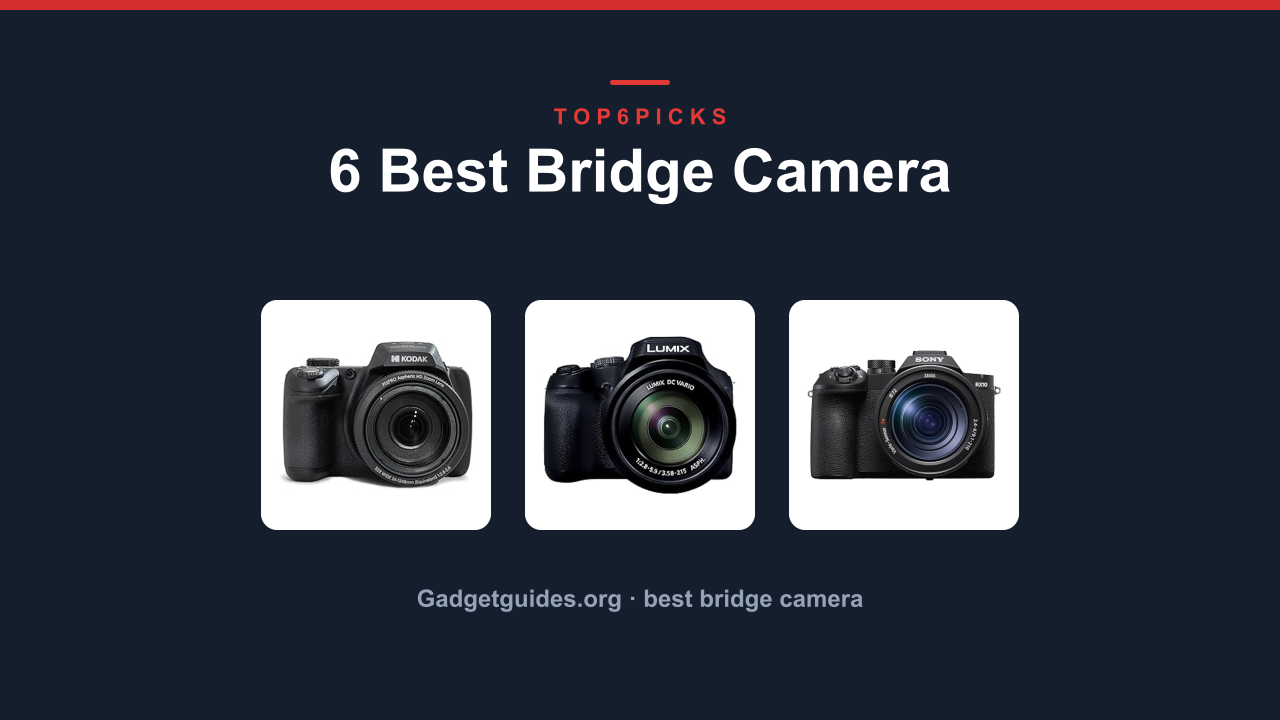
The best best bridge camera is the Nikon COOLPIX P950, the only one here that combines a massive 83x optical zoom with 4K video recording and RAW format support in a single, portable body. It’s the ideal choice for wildlife enthusiasts, travellers, and anyone who wants to reach distant subjects without carrying a full DSLR kit.
Want a more budget-friendly option with Wi‑Fi and a generous 52x zoom instead? The Kodak PIXPRO AZ528 gets you there, as long as you can live without 4K video.
As an Amazon Associate, I earn from qualifying purchases.
Most buying guides just list specs and call it a day. This one is different: I’ll walk you through the real trade-offs between zoom range, video quality, and battery life, and I’ll tell you exactly who should skip bridge cameras altogether.
Everything below comes from current Amazon product data, official manufacturer specs, and the owner track record for each camera, not from hands-on lab testing.
Quick Answer: The Best Bridge Camera
The Nikon COOLPIX P950 is the best overall bridge camera for most people, thanks to its unbeatable 83x zoom, 4K video, and RAW support.
- Nikon COOLPIX P950 (Best overall superzoom): Combines 83x zoom with 4K video and RAW.
- Panasonic LUMIX FZ80D (Best for 4K video): 60x zoom and 4K at a lower price.
- Sony RX10 V (Best image quality): Premium 1-inch sensor with AI autofocus.
- Kodak PIXPRO AZ528 (Best value with Wi‑Fi): 52x zoom, Wi‑Fi, and solid image stabilisation.
- Minolta MN40Z ProShot (Best budget entry): 40x zoom and 20MP at a very low cost.
- Kodak PIXPRO AZ405 (Best for AA batteries): Same 40x zoom but runs on usual AA cells.
Thinking about a mirrorless camera or a DSLR instead? Jump to Who Should NOT Buy below before you spend anything.
Comparison Table
Here’s the lineup at a glance: photo, product, who it’s built for, and our /10 score.
| Photo | Product | Best for | Score | Buy |
|---|---|---|---|---|
 | KODAK PIXPRO AZ528 16MP Digital Camera | Best value with Wi‑Fi | 8.2/10 | Check price → |
 | Panasonic LUMIX FZ80D Point Shoot Digital | Best for 4K video | 8.5/10 | Check price → |
 | Sony RX10 V Premium 25x high-Zoom | Premium image quality | 9.3/10 | Check price → |
 | Minolta MN40Z ProShot 20 MP / | Best budget entry | 7.8/10 | Check price → |
 | NIkon COOLPIX P950 Superzoom Digital Camera | Best overall superzoom | 8.8/10 | Check price → |
 | KODAK PIXPRO AZ405 20MP Digital Camera | Best for AA batteries | 7.5/10 | Check price → |
Scroll sideways on small screens to see every column.
Kodak PIXPRO AZ528 16MP Digital Camera: Best Value with Wi‑Fi
KODAK PIXPRO AZ528 16MP Digital Camera: Best Value with Wi‑Fi
Panasonic LUMIX FZ80D Point Shoot Digital: Best for 4K Video
Panasonic LUMIX FZ80D Point Shoot Digital: Best for 4K Video
Sony RX10 V Premium 25x high-Zoom: Premium Image Quality
Sony RX10 V Premium 25x high-Zoom: Premium Image Quality
Minolta MN40Z ProShot 20 MP /: Best Budget Entry
Minolta MN40Z ProShot 20 MP /: Best Budget Entry
Nikon COOLPIX P950 Superzoom Digital Camera: Best Overall Superzoom
NIkon COOLPIX P950 Superzoom Digital Camera: Best Overall Superzoom
Kodak PIXPRO AZ405 20MP Digital Camera: Best for AA Batteries
KODAK PIXPRO AZ405 20MP Digital Camera: Best for AA Batteries
Buying Guide: Zoom Range, Sensor Size, Video, and Power
How much zoom do you really need?
Zoom is the headline feature of any bridge camera, but more isn't always better. The Nikon COOLPIX P950's 83x zoom reaches an incredible 2000mm equivalent, but at that focal length you need a tripod or very steady hands to avoid blur. The 25x zoom on the Sony RX10 V is more modest but gives you sharper images because the lens is optically superior.
For most people, 40x to 60x (like the Kodak AZ528 or Panasonic FZ80D) is a sweet spot that balances reach with usability. Consider what you'll actually shoot. If you're birding or photographing distant wildlife, go for the Nikon.
If you're shooting landscapes or portraits, a 25x to 40x zoom is plenty.
Sensor size: the hidden quality factor
The sensor is the heart of image quality. The Sony RX10 V uses a 1-inch 20.1MP sensor, which is roughly 4 times larger than the 1/2.3-inch sensors found in every other camera on this list. That means significantly better low-light performance, more dynamic range, and sharper details.
The trade-off is that the Sony costs several times more than the others. If you mainly shoot in good daylight and share photos online, the smaller sensors in the Nikon, Panasonic, or Kodak models will be perfectly fine. If you want to print large or shoot in challenging light, the Sony is the only real option.
Video: 4K vs 1080p
Only three cameras on this list record 4K video: the Nikon COOLPIX P950, the Panasonic LUMIX FZ80D, and the Sony RX10 V. The Kodak and Minolta models are limited to 1080p Full HD. For casual home videos or social media, 1080p is still perfectly usable.
But if you plan to edit, crop, or future-proof your footage, 4K is worth the extra investment. The Panasonic FZ80D offers the best value for 4K video, while the Sony RX10 V gives you the best quality with no crop and a built-in ND filter.
Power: lithium-ion vs AA batteries
Most bridge cameras use proprietary lithium-ion rechargeable batteries. The Nikon, Panasonic, Sony, and Kodak AZ528 all use this type. The Kodak AZ405 and Minolta MN40Z use 4 AA batteries.
AA batteries are convenient because you can buy them anywhere, but they don't last as long as a good lithium-ion pack. Rechargeable NiMH AAs are a good compromise for the AA models. If you're a heavy shooter, a lithium-ion camera with a spare battery is more reliable.
If you're traveling to remote areas where charging is tricky, the AA option might be a lifesaver.
To see how these factors play out on real picks, compare the KODAK PIXPRO AZ528 16MP Digital Camera, Panasonic LUMIX FZ80D Point Shoot Digital and the Sony RX10 V Premium 25x high-Zoom reviewed above.
Who Should NOT Buy a Bridge Camera
Bridge cameras are a compromise between a compact point-and-shoot and a full DSLR. They're not the right choice for everyone. Here's who should skip this category.
You Need Professional Image Quality
If you're a professional photographer or a serious enthusiast who needs the best possible image quality, a bridge camera will disappoint you. The 1/2.3-inch sensors in most bridge cameras (including the Nikon, Panasonic, and Kodak models) simply can't match the dynamic range, low-light performance, and detail of a DSLR or mirrorless camera with a large sensor. Even the Sony RX10 V, with its 1-inch sensor, falls short of a full-frame or APS-C camera.
You should look at a modern DSLR setup or one of the best mirrorless cameras for photography instead.
You Need Fast Autofocus for Action Sports
Bridge cameras are generally slower to focus than DSLRs or mirrorless cameras, especially at the telephoto end. The Sony RX10 V is an exception with its AI-based autofocus, but it's still not as fast as a dedicated sports camera. If you photograph fast-moving subjects like racing cars, birds in flight, or indoor sports, you'll be better served by a camera with phase-detection autofocus and a larger sensor.
Consider a mirrorless camera designed for wildlife or action.
You Want the Smallest Possible Camera
Bridge cameras are not small. The Nikon COOLPIX P950 weighs about 1kg and is roughly the size of a small DSLR kit. If portability is your top priority, a compact point-and-shoot or even a high-end smartphone will be easier to carry.
A smaller mirrorless camera with a pancake lens is also a more pocketable option. Review our mirrorless camera buying guide for compact alternatives.
Final Verdict
The Nikon COOLPIX P950 is the best bridge camera for most people. Its 83x zoom, 4K video, RAW support, and excellent image stabilisation make it the most versatile all-rounder on this list. It's the camera I'd recommend to anyone who wants to reach distant subjects without spending thousands on a DSLR and long lens.
Want the best image quality and are willing to pay for it? Get the Sony RX10 V. Its 1-inch sensor and AI autofocus deliver results that rival much larger cameras.
Need 4K video on a budget? The Panasonic LUMIX FZ80D gives you 60x zoom and 4K recording at a very competitive price. On a tight budget?
The Kodak PIXPRO AZ528 offers Wi-Fi and a 52x zoom for very little money. If you want the convenience of AA batteries, the Kodak PIXPRO AZ405 is your cheapest entry point.
Before you buy, read the Who Should NOT Buy section above. If you need professional image quality, fast action autofocus, or the smallest possible camera, a bridge camera isn't for you. But if you want one camera that does it all from wide landscapes to distant wildlife then the Nikon P950 is the clear winner.
FAQ
What's the best bridge camera overall?
The Nikon COOLPIX P950 is the best overall bridge camera for most people. It combines an 83x optical zoom, 4K video, RAW stills, and Wi-Fi in a single package, offering the best balance of reach, features, and value.
Is a bridge camera better than a DSLR?
For most people, a bridge camera is not better than a DSLR in terms of image quality or speed. DSLRs and mirrorless cameras have larger sensors that deliver better low-light performance and sharper images. However, a bridge camera is much more portable than a DSLR with a long telephoto lens, making it a great choice for travel and casual wildlife photography.
Can I use a bridge camera for professional photography?
You can, but it's not ideal. The small sensors in most bridge cameras limit image quality, especially in low light. The Sony RX10 V is the exception and can be used for professional work in good light, but it still can't match a full-frame camera.
Most professionals prefer a DSLR or mirrorless system. If you're just starting out, a bridge camera is a fine learning tool.
What zoom range should I look for?
For most users, 40x to 60x optical zoom is a good balance. The 40x zoom on the Kodak AZ405 or Minolta MN40Z is enough for distant subjects, while the 60x zoom on the Panasonic FZ80D gives you extra reach. The 83x zoom on the Nikon P950 is ideal for birding and wildlife, but you'll need a tripod at the longest settings.
Do bridge cameras have good autofocus?
Autofocus on bridge cameras is generally slower than on DSLRs or mirrorless cameras, especially at the telephoto end. The Sony RX10 V is the best in this category thanks to its AI-based autofocus system. The Nikon and Panasonic are decent in good light but struggle in low light or with fast-moving subjects.
Can I record 4K video with a bridge camera?
Yes, several bridge cameras record 4K video. The Nikon COOLPIX P950, Panasonic LUMIX FZ80D, and Sony RX10 V all offer 4K recording. The Kodak and Minolta models are limited to 1080p Full HD.

Similar Posts