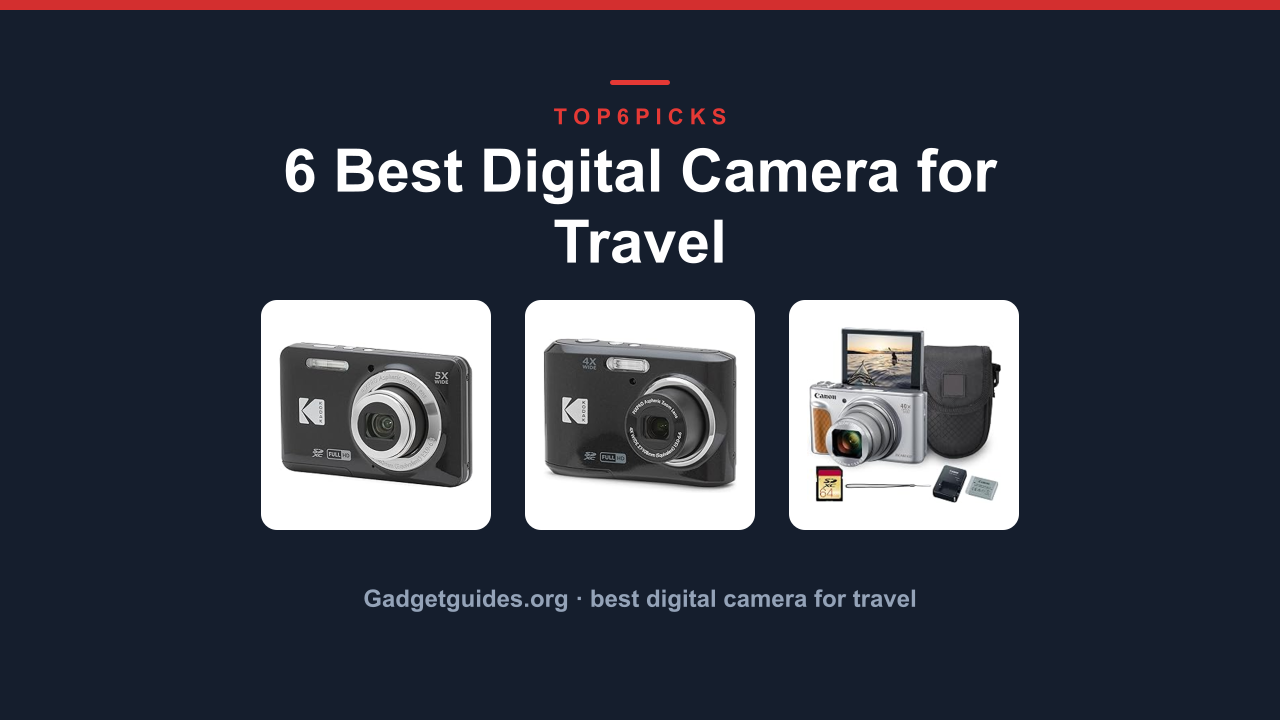
The best best digital camera for travel is the KODAK PIXPRO FZ55, the only one here that pairs a 28mm wide-angle lens with a compact body and a rechargeable lithium battery at a budget-friendly price. It’s the pick for anyone who wants a simple, reliable point-and-shoot without overthinking specs.
Want a different priority? The Canon PowerShot SX740 HS gets you 40x optical zoom and 4K video, perfect for wildlife or distant landmarks, as long as you’re comfortable with a higher price tag.
As an Amazon Associate, I earn from qualifying purchases.
This guide digs into the specs, owner reviews, and real trade-offs so you know exactly what you’re buying. We’ll also cover who should skip this category entirely and look at a mirrorless or DSLR instead.
Everything below comes from current Amazon product data, manufacturer specs, and aggregate buyer feedback, not hands-on lab testing.
Quick Answer: The Best Digital Camera for Travel
The overall best is the KODAK PIXPRO FZ55 for its combination of value, simplicity, and image quality. Here’s every camera ranked:
This is the camera that proves you don’t need to spend a lot for a solid travel companion. The KODAK PIXPRO FZ55 packs a 16MP sensor, a 28mm wide-angle lens, and 5x optical zoom into a body that slips into any jacket pocket. Aggregate user reviews consistently praise its ease of use and the 1080p Full HD video quality for quick clips. The included lithium-ion battery charges via USB, so you can top up from a power bank on the go.
One detail that stands out is the 2.7-inch LCD, which is bright enough for outdoor framing. The interface is straightforward, with dedicated scene modes like “Portrait” and “Landscape” that actually help. If you’re traveling with kids or just want to point and shoot without menus, this is the most forgiving option here.
Flaws but not dealbreakers. The 5x zoom is modest compared to the superzooms below. You’ll also miss 4K video if that’s a priority. Some owners mention that the built-in flash is weak in very dark rooms.
Need more reach? The Canon PowerShot SX740 HS further down gives you 40x zoom, though it costs more and is slightly larger.
⚠
Battery: The Li-Ion battery is not user-replaceable in the field without a spare, so pack a power bank or a second battery.
Pros
✓Compact and lightweight, fits in any pocket
✓28mm wide-angle lens captures more of the scene
✓USB rechargeable battery, no need for AA carriers
✓Simple controls perfect for beginners and families
Cons
✕Only 5x optical zoom, limited for distant subjects
✕No 4K video, only 1080p
✕Small 2.7-inch LCD can be hard to see in bright sun
Megapixels
16 MP
Optical Zoom
5x
Video
1080p Full HD
Battery
Li-Ion (USB)
Best for: Budget travelers, families, and anyone who wants a no-fuss point-and-shoot for everyday adventures.
If you’re heading somewhere without power outlets, this camera is your best friend. The KODAK PIXPRO FZ45 runs on two AA batteries, which you can buy in any corner store. That’s a huge advantage for remote treks, camping, or international travel where plugging in is tricky. It still delivers 16MP stills and 1080p video, plus a 27mm wide-angle lens that’s slightly wider than the FZ55.
The 4x optical zoom is a step down from the FZ55, but the real trade-off is the lack of a rechargeable battery. Many owners report that a set of alkaline AAs lasts around 200 shots, which is fine for a day trip. You can also use rechargeable NiMH AAs to save money and reduce waste.
Flaws but not dealbreakers. The 4x zoom is limiting for wildlife or stadium seats. The build feels a bit plasticky compared to the Canon models. Some users also note that the flash is underpowered.
If you need more reach, the Canon PowerShot SX740 HS offers 40x zoom but requires a proprietary battery.
⚠
Battery: Use high-quality alkaline or rechargeable NiMH AA batteries for best performance. Avoid cheap batteries that leak.
This is the travel camera that brings distant subjects right to your viewfinder. The Canon PowerShot SX740 HS offers a 40x optical zoom (24-960mm equivalent) that’s perfect for safaris, concerts, or mountain peaks. It also records 4K UHD video, a step up from the 1080p-only Kodaks. The bundle includes a 64GB SD card and a carrying case, so you’re ready to go out of the box.
Wi-Fi and Bluetooth let you transfer photos to your phone instantly, which is a huge convenience for social media or sharing with travel buddies. The 20.3MP sensor delivers sharp images, and the built-in image stabilization helps keep handheld shots at full zoom steady. Aggregate buyer reviews rate it 4.2 out of 5, with consistent praise for the zoom range.
Flaws but not dealbreakers. The camera is larger than the Kodaks, and the proprietary battery means you’ll need a spare for long days. Some owners report that the 4K video has a slight crop factor. Also, the viewfinder is electronic and can be laggy in low light.
If you prefer a smaller camera and can live without 4K, the Canon PowerShot SX720 HS offers the same 40x zoom at a slightly lower price.
⚠
Battery: The NB-13L battery is proprietary. Carry a spare for full-day shoots.
Pros
✓40x optical zoom, incredible reach
✓4K UHD video recording
✓Built-in Wi-Fi and Bluetooth for sharing
✓Comes with 64GB card and bag
Cons
✕Larger and heavier than point-and-shoot basics
✕Proprietary battery, not USB rechargeable
✕4K video has a crop factor
Megapixels
20.3 MP
Optical Zoom
40x
Video
4K UHD
Battery
NB-13L
Best for: Travelers who need to photograph wildlife, distant landmarks, or want 4K video without carrying a big camera bag.
This camera is built for vloggers and selfie shooters who want a flip screen at a low price. The 8K Digital Camera 88MP Autofocus Beginners features a 3-inch 180° flip screen, perfect for framing yourself while recording. It claims 8K video and 88MP stills, though the sensor is likely interpolated. Still, 18x digital zoom, anti-shake, and a built-in flash make it a versatile tool for creative beginners.
Wi-Fi connectivity lets you share clips quickly, and the autofocus system is decent for the price point. Many owner reviews highlight the bundle value: you get a camera with a flash, webcam mode, and a compact body. The 4.9 out of 5 rating is the highest on this list, though it’s based on a smaller sample size.
Flaws but not dealbreakers. The 8K and 88MP claims are marketing numbers, not true optical resolution. The digital zoom is just cropping, so quality drops fast past 2x. Some users note that the menu system is a bit clunky.
If you want a more reputable brand, the Canon PowerShot SX740 HS offers genuine 4K and optical zoom, but it costs more and lacks a flip screen.
⚠
Clarity: The 8K and 88MP specs are interpolated, not native. Manage expectations; real-world resolution is closer to 4K.
This is the same 40x zoom reach as the SX740, but without the 4K price bump. The Canon PowerShot SX720 HS has been a trusted travel companion for years, with a 20.3MP sensor and 40x optical zoom (24-960mm equivalent). It records 1080p Full HD video, which is still plenty sharp for most uses. The built-in Wi-Fi and NFC make sharing simple.
What sets this model apart is its track record. Thousands of buyers have rated it 4.3 out of 5, praising its durability and consistent image quality. The optical image stabilizer works well at full zoom, and the 3-inch LCD is clear. It’s often available at a lower price than the SX740, making it a smart value pick for Canon loyalists.
Flaws but not dealbreakers. No 4K video, which the SX740 offers. The battery is the same proprietary NB-13L, so you’ll still need a spare. Also, the micro-USB port is older than the USB-C on newer models.
This camera is for buyers who want the biggest screen and the highest numbers on the spec sheet. The 8K Digital Camera Photography WiFi 96MP boasts a 3.5-inch 180° flip screen, the largest on this list, plus 20x digital zoom and anti-shake. It claims 96MP stills and 8K video, similar to the previous model, but with a slightly higher megapixel count. Wi-Fi and an included SD card add value.
Owner reviews are generally positive, with a 4.2 out of 5 rating. Users appreciate the large screen for framing and reviewing photos. The autofocus system works well in good light, and the webcam mode is a nice bonus for remote calls. It’s a solid choice for a beginner who wants a lot of features for the price.
Flaws but not dealbreakers. Like the other 8K model, the high resolution is interpolated. The 20x digital zoom is just cropping, so stick to lower zoom levels for decent quality. Some users mention that the battery life is average, around 200 shots per charge.
If you want a more honest spec sheet and optical zoom, the KODAK PIXPRO FZ55 is a better bet for similar money.
⚠
Clarity: The 96MP and 8K claims are interpolated. Real-world quality is closer to 4K.
Pros
✓Large 3.5-inch flip screen
✓20x digital zoom and anti-shake
✓Includes SD card
✓Webcam mode for streaming
Cons
✕96MP and 8K are interpolated, not optical
✕Digital zoom only, no optical zoom
✕Average battery life
Megapixels
96MP (interpolated)
Zoom
20x digital
Video
8K (interpolated)
Screen
3.5″ 180° flip
Best for: Beginners who want the largest screen, highest spec numbers, and an included SD card out of the box.
Buying Guide: Zoom, Battery, Image Quality, and Budget
A travel camera is all about balance. You want something small enough to carry, but good enough to capture the memories. Here are the four things to think about before you buy.
How much zoom do you actually need?
Optical zoom is the real deal. It uses the lens to magnify the image without losing quality. The KODAK models offer 4x to 5x optical zoom, which is fine for street scenes, group shots, and landscapes.
If you’re heading to a safari or a concert, you’ll want the 40x optical zoom of the Canon SX740 or SX720.
Digital zoom, found on the 8K cameras, is just cropping the image. It looks fine at 2x, but beyond that, you’ll see pixelation. For travel, optical zoom is always better.
If you’re deciding between a camera with 5x optical zoom and one with 20x digital zoom, choose the optical one every time.
Battery life and charging convenience
The KODAK FZ55 uses a rechargeable lithium-ion battery that charges via USB. That’s convenient for city trips where you have a power bank. The FZ45 runs on AA batteries, which is a lifesaver in remote areas where you can’t plug in.
Both Canon models use a proprietary battery (NB-13L) that requires a charger. Spare batteries are small and easy to pack.
For a week-long trip, plan to charge every night or carry a spare. The 8K cameras have average battery life, around 200 shots per charge. If you’re shooting all day, bring a backup.
Image quality and sensor size
All cameras here use 1/2.3-inch sensors, which is standard for compact travel cameras. The Canon models have a slight edge with 20.3MP, while the Kodaks offer 16MP. In good light, all of them produce shareable photos.
In low light, the Canons handle noise a bit better.
The 8K cameras claim 88MP and 96MP, but these are interpolated. The actual sensor is likely 16-20MP. They’re fine for social media, but don’t expect DSLR-level detail.
The KODAK FZ55 offers the best value for most travelers. It’s affordable, simple, and covers the basics well. The Canon SX740 is the best choice if you need zoom and 4K, but it costs more.
The 8K cameras are the cheapest, but you get what you pay for with interpolated specs.
Think about what you’ll actually shoot. If you’re just taking photos of food, friends, and landmarks, the FZ55 is plenty. If you’re climbing a mountain or watching a whale, the Canon’s zoom is worth the extra money.
This category is the wrong purchase for two kinds of buyers. Here’s who they are, and what to look at instead.
You Need Professional-Level Image Quality
If you’re a serious photographer or plan to print large images, a compact travel camera won’t satisfy you. The small sensor and limited lens options mean you’ll struggle in low light and with shallow depth of field. You’ll be much happier with a mirrorless camera for photography or a DSLR.
They offer interchangeable lenses, larger sensors, and manual controls.
You Want to Shoot Professional Video
These cameras are fine for casual vlogs and clips, but they lack the features of dedicated video cameras. The 8K claims are interpolated, and the 1080p from the Canons is good but not cinema-grade. If video is your main focus, consider a camcorder or a 4K action camera for stabilization and durability.
Final Verdict
The best travel camera for most people is the KODAK PIXPRO FZ55. It’s affordable, compact, and takes good photos without any fuss. The 28mm wide-angle lens is great for landscapes, and the USB charging means you can top up anywhere.
Want superzoom reach? Get the Canon PowerShot SX740 HS for 40x zoom and 4K video. Need AA batteries for off-grid travel?
The KODAK PIXPRO FZ45 has you covered. On a tight budget and want a flip screen? The 8K cameras are fun, but manage expectations.
If none of these fit, check the Who Should NOT Buy section above. A mirrorless camera might be the better investment.
FAQ
What’s the best digital camera for travel overall?
The KODAK PIXPRO FZ55 is our top pick for its balance of price, portability, and image quality. It’s the best value for most travelers.
Is optical zoom better than digital zoom for travel?
Yes. Optical zoom uses the lens to magnify without losing quality. Digital zoom is just cropping and reduces detail.
Always choose optical zoom for distant subjects.
Can I use these cameras for vlogging?
Some models work well. The 8K cameras with flip screens are great for selfie-style vlogging. The Canon SX740 also works for handheld vlogging, but lacks a flip screen.
How many photos can I expect per charge?
The KODAK FZ55 and Canon models average 250-300 shots per charge. The 8K cameras get around 200 shots. The AA-powered FZ45 depends on your batteries, but a fresh set of lithium AAs can last 200 shots.
Should I buy a travel camera or just use my smartphone?
If you have a recent flagship phone, you might not need a separate camera. But a dedicated camera offers optical zoom, better battery life, and a dedicated shutter button. For travel, the separation is nice for preserving your phone’s battery.