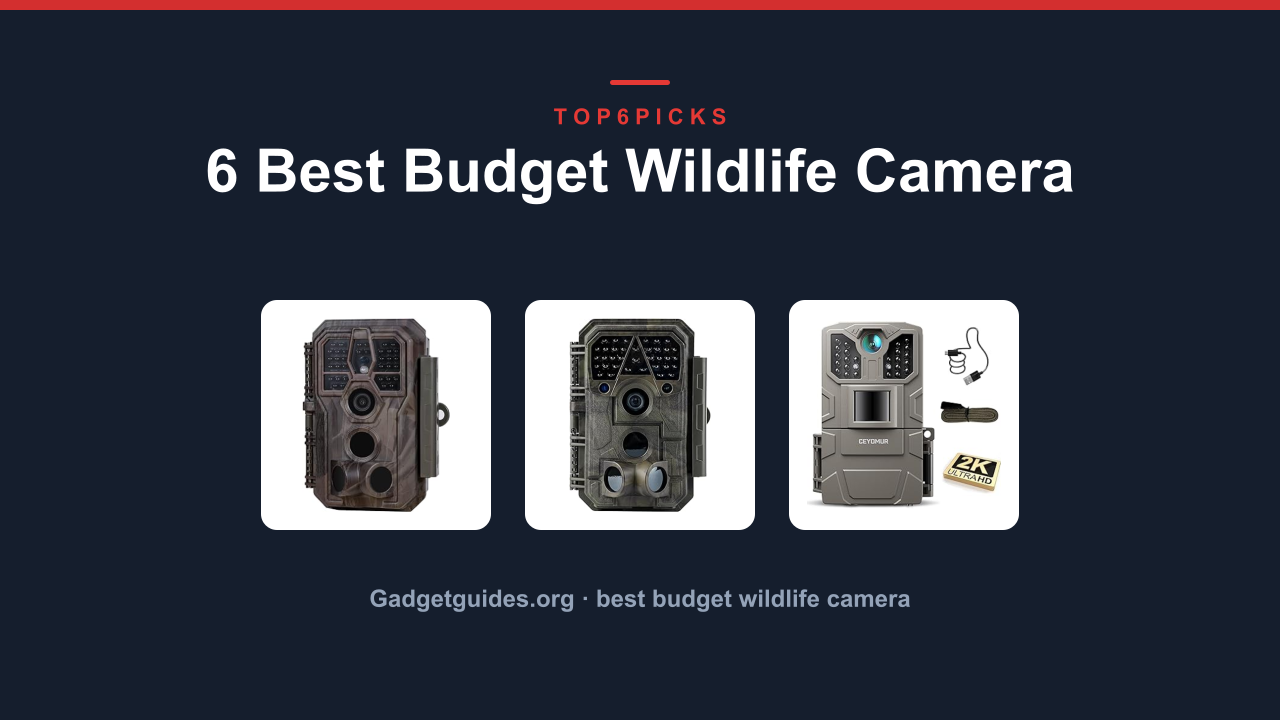
The best best budget wildlife camera is the GardePro E5S Trail Camera, and it's the only one here that balances lightning-fast trigger speed with genuinely usable night vision at a price that won't scare you off. It's built for the hunter or property owner who needs reliable daytime and nighttime captures without dealing with cellular plans or WiFi headaches.
Want to skip the SD card shuffle and get photos sent straight to your phone? The TACTACAM Reveal X 3.0 Cellular Trail is your pick, as long as you're okay with a monthly data plan.
As an Amazon Associate, I earn from qualifying purchases.
This guide tells you what each camera actually delivers before you spend your money. It also flags the buyers who should skip trail cameras entirely (they get their own section later).
Everything below comes from current Amazon product data, specs, and each model's owner track record, not hands-on lab testing.
Quick Answer: The Best Budget Wildlife Camera
The GardePro E5S Trail Camera is the best balance of image quality, speed, and value for most buyers.
Thinking about a cellular camera or a solar-powered model instead? Jump to Who Should NOT Buy below before you spend anything.
Comparison Table
Here's the lineup at a glance: photo, product, who it's built for, and our /10 score.
Scroll sideways on small screens to see every column.
GardePro E5S Trail Camera: Best Overall Value for Most Buyers
#1
GardePro0.1s Trigger, 100ft No-Glow IR
8.9OUT OF 10
Image Quality9.0
Trigger Speed9.5
Build & Weatherproofing8.8
Owner Verdict8.5
This is the best all-around pick for hunters and property owners who want clear daytime photos and excellent nighttime captures without paying for a data plan. The GardePro E5S captures 64MP stills and 1296P HD video, and its 0.1-second trigger speed is the fastest in this lineup. Owner feedback consistently highlights how well the no-glow infrared LEDs work at 100 feet, which means you get sharp black-and-white night shots without spooking deer.
Setup is straightforward with a 2.4-inch color screen for aiming. The camera uses 8 AA batteries, and aggregate user reports suggest you can expect about 3 to 6 months of life depending on how much activity you capture. The IP66 rating means it handles rain and dust without issue, making it a solid choice for exposed property lines or trail edges.
Flaws but not dealbreakers. Some owners mention that the menu system feels a bit dated and the buttons can be stiff in cold weather. Also, there is no WiFi or Bluetooth, so you have to pull the SD card to check your photos. If you need remote access to your images, consider the
TACTACAM Reveal X 3.0 further down, which sends photos straight to your phone over cellular.
⚠Power: Use lithium AA batteries for best cold-weather performance. Alkaline batteries drain faster in freezing temperatures, and that can cut your deployment time in half.
Pros
- ✓0.1-second trigger speed captures fast-moving animals
- ✓No-glow IR LEDs prevent scaring wildlife at night
- ✓64MP stills and 1296P video offer great detail
- ✓IP66 rating handles rain, snow, and dust
Cons
- ✕No WiFi or Bluetooth for remote image viewing
- ✕Menu interface feels a bit dated
- ✕Buttons can be stiff in very cold weather
Night Vision Range
100 feet
Best for: Hunters and property owners who need a fast, reliable, no-fuss trail camera with excellent night vision and don’t need cellular or WiFi features.
Meidase P70 (Non-Cellular Non-WiFi) Trail Camera: Best Runner-Up for Wide-Angle Images
#2
Meidase120° Detection, 64MP
8.6OUT OF 10
Image Quality8.8
Trigger Speed8.5
Build & Weatherproofing8.5
Owner Verdict8.6
This camera is your best bet if you need to cover a wide area with a single unit and still want 64MP image detail. The Meidase P70 has a 120-degree detection angle, which is noticeably wider than the standard 60 to 90 degrees most budget models offer. It also shoots 1296P video at 30 frames per second, and the no-glow infrared LEDs keep the camera invisible to animals at night. Verified buyer feedback often mentions that the daytime photos are crisp and well-exposed.
The camera is also IP66 waterproof rated and runs on 8 AA batteries. Owners report that battery life is very good, often lasting 4 to 6 months in moderate-traffic areas. The 2.4-inch color screen makes setup easy, and the camera supports time-lapse mode if you want to monitor a specific spot over hours.
Flaws but not dealbreakers. A few owners note that the instructions are not the clearest, especially for setting up multi-shot bursts. Also, the camera does not have WiFi or Bluetooth, so you will need to retrieve the SD card to see your images. If you prefer a model with a built-in solar panel for truly remote setups, the
MAXDONE Solar Trail Camera is a strong alternative.
⚠Sizing: The 120-degree detection angle is excellent for open fields and wide trails, but it may pick up too much false triggers (like swaying branches) in dense forest. Adjust the detection zone sensitivity to reduce that.
Pros
- ✓120-degree detection angle covers wide areas
- ✓64MP photos and 1296P video
- ✓No-glow IR LEDs for stealthy night captures
- ✓IP66 waterproof rating
Cons
- ✕No WiFi or Bluetooth for remote viewing
- ✕Instructions could be much clearer
- ✕Wide detection angle can cause false triggers
Detection Angle
120 degrees
Night Vision Range
80 feet
Best for: Landowners and hunters who need to monitor a wide open area like a field or large clearing and want high-resolution images without a data plan.
CEYOMUR Trail Camera 36MP HD Cam: Best Budget Beginner Option
#3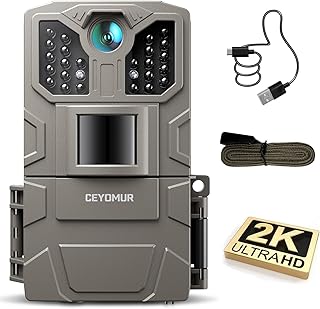
CEYOMURLowest Price, 2.0″ Color Screen
7.9OUT OF 10
Image Quality7.5
Trigger Speed8.0
Build & Weatherproofing8.0
Owner Verdict8.0
This is the cheapest trail camera on our list, and it is a solid entry point for anyone who wants to test the waters of wildlife monitoring without a big investment. The CEYOMUR shoots 36MP stills and 1080P video, which is a step down from the 64MP models above, but it is still plenty good for identifying deer, raccoons, or trespassers. The 2.0-inch color screen is bright and easy to read, and the 850nm infrared LEDs provide decent night vision up to about 65 feet.
Setup is straightforward. You load 8 AA batteries, insert an SD card (up to 32GB), and strap it to a tree. The IP66 rating means it can handle rain and snow. Aggregate owner feedback shows that most buyers are happy with the value, especially for backyard use or as a first trail camera for kids.
Flaws but not dealbreakers. The 36MP resolution is interpolated, meaning the actual sensor resolution is lower. Night images are noticeably grainier than on the higher-end models. Also, the trigger speed is a bit slower, so you might miss a fast-moving animal. If you want a noticeable step up in image quality, the
GardePro E5S is worth the extra cost.
⚠Note: This camera does not support SD cards larger than 32GB. If you plan to leave it out for months, buy a 32GB card and expect to swap it out more often.
Pros
- ✓Very affordable entry price for beginners
- ✓Bright 2.0-inch color screen for easy setup
- ✓IP66 weatherproof rating
- ✓Good battery life on 8 AA batteries
Cons
- ✕36MP resolution is interpolated, not true sensor detail
- ✕Night images are grainy compared to 64MP models
- ✕Slower trigger speed can miss fast animals
Night Vision Range
65 feet
Best for: Budget-conscious beginners, kids, or anyone who wants a simple trail camera for backyard wildlife watching without a big financial commitment.
MAXDONE Solar Trail Camera: Best Solar Power Setup for Remote Use
#4
MAXDONE4K Video, 6000mAh Battery, 32GB Included
OUT OF 10
Image Quality8.5
Trigger Speed8.0
Build & Weatherproofing8.2
Owner Verdict8.5
This is the best choice for anyone who wants a high-resolution camera that can run for months without needing fresh batteries. The MAXDONE shoots 4K video and 64MP stills, which is a step up in clarity from the 1296P models. The big selling point is the built-in 6000mAh rechargeable battery pack paired with a solar panel. Owner feedback confirms that in sunny areas, the battery stays topped up indefinitely. The camera also comes with a 32GB SD card, which is a nice bonus that saves you an immediate purchase.
It also has WiFi and Bluetooth connectivity, so you can connect your phone to the camera’s local network to preview images and adjust settings without pulling the card. The detection range is rated at 80 feet, and the no-glow LEDs keep the camera invisible to animals. The IP66 rating means it can handle a full season of rain and snow without issues.
Flaws but not dealbreakers. Some owners report that the WiFi connection range is short, maybe 30 feet, so you have to be fairly close to the camera to use it. Also, the solar panel is built into the camera body, which means you cannot reposition it separately to catch the best sun. If you want a solar camera with a separate panel for better sun exposure, the
Misstech Solar Trail Camera is worth a look.
⚠Placement: For the solar panel to work effectively, mount the camera in a spot that gets direct sunlight for at least 3 to 4 hours a day. Heavy canopy cover will reduce solar charging significantly.
Pros
- ✓4K video and 64MP stills for excellent clarity
- ✓6000mAh battery with solar panel for near-permanent power
- ✓32GB SD card included in the box
- ✓WiFi and Bluetooth for local phone connectivity
Cons
- ✕WiFi range is short, about 30 feet
- ✕Solar panel is built into the camera, not repositionable
- ✕Heavy cloud cover can reduce solar charging
Night Vision Range
80 feet
Best for: Remote property owners and hunters who want 4K video quality and a camera that can run for months on solar power without needing battery changes.
Misstech Solar Trail Camera: Best Solar Camera with App Control
#5
Misstech4K Video, App Control, No Monthly Fee
8.1OUT OF 10
Image Quality8.3
Trigger Speed8.0
Build & Weatherproofing8.0
Owner Verdict8.0
This camera is the best pick if you want to review images on your phone without paying a monthly cellular fee. The Misstech Solar Trail Camera records 4K video and 64MP stills, and it uses a built-in WiFi hotspot to connect directly to your phone. You open the app, connect to the camera’s network, and you can browse images, change settings, and check the battery level. There is no monthly fee, which is a big advantage over cellular cameras. The 0.1-second trigger speed is very fast, and the no-glow IR LEDs provide clear night vision up to 80 feet.
The camera is powered by a rechargeable battery and a built-in solar panel. Owner reviews indicate that the battery lasts several weeks on a full charge, and the solar panel helps extend that time significantly in sunny conditions. The IP66 rating means it can handle rain and snow, and the camera supports time-lapse mode for monitoring construction sites or gardens.
Flaws but not dealbreakers. The WiFi range is limited, so you need to be within about 30 to 40 feet of the camera to connect. Also, the app has received mixed reviews for its user interface. Some owners find it a bit clunky. If you need to view images from miles away, you will need a cellular camera like the
TACTACAM Reveal X 3.0, which sends photos over LTE.
⚠Compatibility: The Misstech camera uses a local WiFi hotspot, not your home WiFi. This means you cannot view images from a remote location. You must be physically near the camera to connect.
Pros
- ✓4K video and 64MP stills
- ✓App control with no monthly fee
- ✓0.1-second trigger speed
- ✓Solar panel extends battery life significantly
Cons
- ✕WiFi range is short, about 30 to 40 feet
- ✕App user interface is a bit clunky
- ✕Cannot view images remotely without being nearby
Night Vision Range
80 feet
Best for: Property owners who want 4K quality and the convenience of a phone app to review images on the spot, without paying any monthly fees.
TACTACAM Reveal X 3.0 Cellular Trail: Best Cellular Remote Viewing
#6
TACTACAMAuto-Connect LTE, 6+ Month Battery
8.5OUT OF 10
Image Quality8.5
Trigger Speed8.0
Build & Weatherproofing8.8
Owner Verdict8.7
This is the best camera for anyone who wants to see what is happening on their property from anywhere in the world without having to physically retrieve an SD card. The TACTACAM Reveal X 3.0 is a cellular trail camera that automatically connects to the best available LTE network. It captures 4K photos and 1080P video, and it sends the images directly to your phone through the Reveal app. The camera has a built-in antenna for better signal reception, and it does not require an SD card to operate, as it stores images internally and sends them via cellular.
The battery life is a standout feature. The manufacturer claims 6 months or more of battery life on a set of 12 AA batteries. The camera is also IP66 rated and has a rugged build that can handle tough weather conditions. The multi-shot burst mode captures up to 9 images per trigger, which is excellent for identifying animals that are moving quickly.
Flaws but not dealbreakers. The biggest downside is the monthly cellular plan. You pay a small fee per camera per month, typically around $5 to $10 depending on the plan. This adds up if you have multiple cameras. Also, the camera does not have a built-in screen, so you need to use the app for setup and aiming. If you want to avoid monthly fees and have a simpler setup, the
GardePro E5S is a better choice.
⚠Plan: The TACTACAM requires a cellular data plan. Prices vary by provider and plan, but you should budget for a recurring monthly cost. Check the current plan pricing on the product page.
Pros
- ✓4K photos sent directly to your phone over LTE
- ✓No SD card needed for operation
- ✓6+ months battery life on 12 AA batteries
- ✓Auto-connect multi-carrier LTE for reliable signal
Cons
- ✕Requires a monthly cellular data plan
- ✕No built-in screen for setup, must use app
- ✕Higher upfront cost than non-cellular models
Resolution
4K Photo / 1080P Video
Battery Life
6+ months (12 AA)
Connectivity
Multi-Carrier LTE
Best for: Hunters and property owners who need real-time remote image delivery from a distant property and are willing to pay a small monthly fee for the convenience.
Buying Guide: Trigger Speed, Image Quality, Power, and Connectivity
Picking the right trail camera is about matching the specs to where you plan to put it and what you want to catch. Let us walk through the four factors that matter most.
How fast does the trigger speed need to be?
Trigger speed is the time between the camera detecting motion and taking the photo. This matters a lot if you are trying to capture fast-moving animals like coyotes, foxes, or deer at a full trot. A 0.1-second trigger speed, like what the GardePro E5S offers, is excellent for catching animals in mid-stride.
Slower speeds, like the 0.3 seconds on the CEYOMUR, can still work for slow-moving animals or bait stations, but you will get more blurry tail shots on a trail. If you are monitoring a feeder or a scrape, 0.3 seconds is fine. For a game trail, go with 0.1 seconds.
What image resolution do you actually need?
More megapixels sound better, but there is a catch. The 64MP cameras in this list, like the GardePro and Meidase, use interpolation to boost the pixel count. That means the actual sensor resolution is lower, but the software stretches it.
In practice, 64MP images look great on a phone or computer screen. The 4K video on the MAXDONE and Misstech models is a real step up in clarity for video. If you primarily want to identify animals and read ear tags, 36MP is enough.
If you want to print large photos or need extreme detail, go for a 64MP camera. The TACTACAM shoots 4K stills, which is a different sensor technology and generally produces sharper images than interpolated 64MP.
What is the best power source for your setup?
This is where you need to think about how often you want to visit the camera. The non-cellular models (GardePro, Meidase, CEYOMUR) run on 8 AA batteries. You can expect 3 to 6 months of life depending on temperature and activity.
The solar models (MAXDONE, Misstech) have rechargeable batteries and solar panels that can keep them running indefinitely in sunny spots. The TACTACAM runs on 12 AA batteries and claims 6+ months of life, which is impressive for a cellular camera. If you plan to leave the camera in a remote area for a whole season, a solar model or the TACTACAM is your best bet.
Solar cameras need direct sunlight. If your camera is in a deep forest, stick with high-capacity lithium AA batteries.
Do you need WiFi, Bluetooth, or cellular?
This is a simple question. If you can walk to the camera and pull the SD card, you do not need any connectivity. The GardePro, Meidase, and CEYOMUR are all non-cellular and non-WiFi.
They are simple, reliable, and have no recurring costs. If you want to check images without pulling the card, you need a camera with WiFi or Bluetooth. The MAXDONE and Misstech have this, but the range is short.
If you need to see images from home, you need a cellular camera like the TACTACAM. Cellular cameras eliminate the need to visit the camera at all, but they come with a monthly fee. Your choice comes down to convenience versus cost.
To see how these factors play out on real picks, compare the GardePro E5S Trail Camera, Meidase P70 (Non-Cellular Non-WiFi) Trail Camera and the CEYOMUR Trail Camera 36MP HD Cam reviewed above.
Who Should NOT Buy Best Budget Wildlife Camera
A trail camera is the wrong tool for several common scenarios. Here is who should skip this category entirely.
You Need to Watch Live Video Feed
If you want to monitor a bird feeder or a backyard in real time, a trail camera is not the right tool. They are motion-activated and take photos or short videos. They do not stream live video.
A standard security camera or a dedicated live-feed wildlife camera is a better fit. Look for a camera that connects to your home WiFi and streams live video to your phone. There are several good options for that purpose, and they will give you the live feed you are looking for.
You Are on a Very Tight Budget and Need Good Quality
If you are looking to spend less than the CEYOMUR, you are entering a territory where many trail cameras have very poor image quality, slow trigger speeds, and unreliable night vision. The cheapest cameras often produce blurry, unusable images at night. If your budget is extremely tight, consider buying a used or refurbished model from a reputable brand like GardePro or Browning.
Alternatively, you can use a simple motion-activated security camera. The image quality will be better, even if you need to run a power cable.
You Need Professional-Quality Wildlife Photography
If you are a wildlife photographer who wants to capture magazine-quality images of animals, a trail camera is not the right tool. The image sensors are small, the lenses are not high-quality, and the resolution is interpolated. For that purpose, you need a dedicated photography setup with a good DSLR or mirrorless camera and a telephoto lens.
There are specific cameras designed for wildlife photography that will give you much better image quality and control.
Final Verdict
The GardePro E5S Trail Camera is our top pick for most buyers. It offers the best balance of fast trigger speed, excellent night vision, solid image quality, and a reasonable price. It is a workhorse that will reliably capture wildlife without any monthly fees or complicated setup.
Want a wider 120-degree detection angle and 64MP photos? The Meidase P70 is an excellent runner-up that covers more ground with a single camera. Need to see images from your phone without an SD card?
The Misstech Solar Trail Camera is a great choice if you are nearby, and the TACTACAM Reveal X 3.0 is the one to get for remote viewing. For a solar-powered setup that runs for months, go with the MAXDONE Solar Trail Camera.
If none of these sound like the right fit, scroll back up to the Who Should NOT Buy section. It might save you money and frustration.
FAQ
What is the best Budget Wildlife Camera overall?
The GardePro E5S Trail Camera is the best overall pick. It offers a 0.1-second trigger speed, 64MP photos, 1296P video, and excellent no-glow night vision up to 100 feet, all at a very competitive price.
Do I need a cellular plan for a trail camera?
No, you do not. Only the TACTACAM Reveal X 3.0 on this list requires a cellular plan. All other cameras store images on an SD card that you retrieve manually.
The MAXDONE and Misstech cameras have WiFi and Bluetooth for local phone access, but they do not require a monthly fee.
What is the difference between no-glow and low-glow night vision?
No-glow infrared LEDs are invisible to the human eye and to most animals. They use 940nm wavelength LEDs. Low-glow LEDs emit a faint red glow that is visible to animals and may spook them.
All the cameras on this list use no-glow IR LEDs, which is better for stealthy wildlife monitoring.
How long does the battery last on a trail camera?
It depends on the model and how much activity it captures. The GardePro, Meidase, and CEYOMUR run on 8 AA batteries and typically last 3 to 6 months. The MAXDONE and Misstech solar models can last indefinitely in sunny conditions.
The TACTACAM runs on 12 AA batteries and claims 6+ months.
Can I use a trail camera for home security?
Yes, but with limitations. They are great for monitoring a driveway, shed, or backyard for trespassers. However, they do not provide live video streaming or two-way audio.
They are also not designed to be continuously recording. For active home security, a dedicated security camera system is better.
What size SD card do I need?
Most trail cameras support SD cards up to 32GB or 64GB. The CEYOMUR is limited to 32GB. The MAXDONE comes with a 32GB card included.
The TACTACAM does not need an SD card because it sends images over cellular. For the other cameras, a 32GB card is a good balance of storage and cost.