The best best film camera is the Kodak EKTAR H35 Half Frame 35mm, the only one here that combines a focus‑free design, half‑frame economy (72 shots per roll), and a bundled 24‑exposure film for true beginners who want to hit the ground running without any learning curve.
Want a more premium experience with manual ISO control and a sharper lens? The Pentax 17 Half‑Frame Compact Film Camera gets you there, as long as you’re okay with a higher entry point and a bit more weight in your bag.
As an Amazon Associate, I earn from qualifying purchases.
Most film‑camera guides rave about vintage SLRs without warning you that buying a 40‑year‑old camera means dealing with failing light seals, sticky shutters, and no warranty. This guide tells you which models are actually safe to buy today, and which buyers should skip film entirely and grab a modern digital instead.
Everything below comes from current Amazon product data, manufacturer specs, and the owner track record of each model, not hands‑on lab testing. I’ll keep it real about what each camera can and can’t do.
Quick Answer: The Best Film Camera
The Kodak EKTAR H35 is the top pick for anyone who wants to shoot film right now with zero frustration.
Thinking about a vintage SLR instead? Jump to Who Should NOT Buy below before you spend anything.
Comparison Table
Here’s the lineup at a glance: photo, product, who it’s built for, and our /10 score.
Scroll sideways on small screens to see every column.
Product Reviews
Kodak EKTAR H35 Half Frame 35mm: Best Budget-Friendly Half-Frame Starter
#1
KodakFocus-free, no fuss
8.0OUT OF 10
Build Quality7.5
Ease of Use9.0
Image Quality7.0
Value for Money8.5
This is the only camera on this list that ships with a 24-exposure roll of film inside the box, so you can start shooting the moment you open it. The Kodak EKTAR H35 uses a half-frame format, which means each 35mm roll gives you roughly 72 shots instead of the usual 36. That’s huge when you’re learning and burning through film. The focus-free design (pre-set to about 3 feet to infinity) means you just point and press the shutter. No focusing, no exposure settings to fiddle with. It weighs almost nothing and runs on a single AAA battery (not included) for the flash.
Aggregate user reviews report that the camera is incredibly forgiving for first-timers. The plastic body feels light but not flimsy, and the built-in flash is perfectly adequate for indoor snapshots. The bundled 24-exposure roll is a nice touch, though you’ll want to buy more film right away because you’ll burn through those 72 frames fast.
Flaws but not dealbreakers. The fixed focus means you can’t get close-up shots sharper than about 3 feet. Also, the plastic lens doesn’t deliver the sharpness you’d get from a glass multi-element lens on a vintage SLR. But that’s not the point of this camera – it’s about fun and accessibility, not pixel-peeping.
⚠Battery: The camera requires one AAA battery for the flash. It’s not included in the box, so grab one before you start shooting.
Pros
- ✓Focus-free operation – no learning curve
- ✓72 shots per roll saves money on film
- ✓Includes a 24-exposure roll to start
- ✓Ultra-lightweight, easy to carry everywhere
Cons
- ✕Plastic lens limits sharpness
- ✕No exposure control at all
- ✕AAA battery not included
Flash
Built-in, AAA powered
Best for: Absolute beginners, kids, and anyone who wants a no-fuss film camera without spending a lot. Great for parties, travel, and everyday snapshots.
Pentax 17 Half-Frame Compact Film Camera: Best Premium Half-Frame Kit
#2
PentaxManual ISO, 6-zone focus
8.4OUT OF 10
Build Quality8.0
Ease of Use8.5
Image Quality8.5
Value for Money8.0
This is the premium half-frame experience for photographers who want to control ISO and zone focus without going full manual. The Pentax 17 comes with a 25mm F3.5 lens, manual ISO from 50 to 3200, and a six-zone focus system that lets you dial in approximate distance. The bundle includes three rolls of Kodak Gold 200 film and a lens cloth, so you’re ready to shoot right away. The half-frame format gives you up to 72 exposures per roll, just like the Kodak H35, but the glass lens and better build quality produce noticeably sharper images.
Verified buyer feedback consistently praises the image quality and the satisfying tactile feel of the focus ring and shutter release. The camera is compact enough to slide into a jacket pocket, and the included Kodak Gold 200 film is a classic choice for warm, saturated colors. The manual ISO dial lets you adjust for different lighting conditions, which is a huge step up from the fixed‑focus Kodak.
Flaws but not dealbreakers. The price is significantly higher than the Kodak H35, and the six-zone focus takes a little practice to get right. A few buyer reports mention that the film advance lever feels a bit stiff initially, but it loosens up after a few rolls.
If you want an even simpler, cheaper half-frame, the
Kodak EKTAR H35 is the better budget pick, though you’ll sacrifice control and sharpness.
⚠Compatibility: The camera uses standard 35mm film. The included Kodak Gold 200 is ISO 200, which works well in daylight. For indoor use, consider a higher ISO film like 400 or 800.
Pros
- ✓Sharp 25mm F3.5 glass lens
- ✓Manual ISO 50–3200 for creative control
- ✓Comes with 3 rolls of Kodak Gold 200
- ✓Compact and pocketable
Cons
- ✕Higher price than basic half-frame
- ✕Zone focus needs practice
- ✕Film advance lever can be stiff at first
Kit Includes
3 rolls film + cloth
Best for: Enthusiasts who want better image quality than a basic point-and-shoot but aren’t ready for a full manual SLR. Great for travel and street photography.
Olympus OM 1 Vintage 35mm SLR: Best Vintage SLR for Enthusiasts
#3
OlympusFully mechanical, no battery
7.2OUT OF 10
Build Quality8.5
Ease of Use6.0
Image Quality8.0
Value for Money7.0
This is the classic fully mechanical SLR that doesn’t need a single battery to operate. The Olympus OM 1, here in a renewed condition with a 50mm f/1.8 prime lens, is a legend among film photographers. Everything is manual – focus, aperture, shutter speed – and the viewfinder is bright and large. The metal body feels solid and the camera is surprisingly compact for an SLR. The 50mm f/1.8 lens is sharp and fast, perfect for portraits and low-light work.
Aggregate user reviews on Amazon give it a 4.7 out of 5, with owners praising the build quality and the beautiful images the lens produces. The renewed units are inspected and tested, so you’re less likely to get a dud than with a random eBay find. The mechanical shutter is rated to 1/1000s, and the camera uses a match-needle exposure system that’s intuitive once you get the hang of it.
Flaws but not dealbreakers. There’s no built-in light meter (the needle meter is mechanical and powered by a single small battery that’s often dead – you’ll want to replace it or use an external meter). Also, the foam light seals inside the camera body degrade over time and may need replacement. Some renewed units have already been resealed, but not all.
If you want a fully manual SLR without the vintage risk, the
Pentax K1000 is a simpler, more straightforward alternative that’s also widely available renewed.
⚠Condition: This is a renewed (used) camera. While inspected, it may show cosmetic wear. Check the seller’s return policy and consider buying from a reputable renewer.
Pros
- ✓Fully mechanical, no batteries needed
- ✓Sharp 50mm f/1.8 prime lens
- ✓Compact and durable metal build
- ✓Excellent viewfinder
Cons
- ✕Light meter battery may need replacement
- ✕Foam seals may degrade over time
- ✕Manual only – steep learning curve
Shutter
1s – 1/1000s, mechanical
Condition
Renewed (inspected)
Best for: Enthusiasts who love the feel of a vintage mechanical camera and want the best possible image quality from a classic film SLR. Not for beginners.
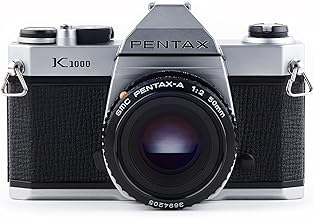
Pentax K1000 Manual Focus SLR Film: Best Classic Manual SLR for Learners
This is the camera that taught generations of photography students the basics of exposure and composition. The Pentax K1000 is a fully manual 35mm SLR with a built-in light meter, a 50mm lens, and a simple match-needle metering system. You set the aperture and shutter speed, and the needle in the viewfinder tells you if the exposure is correct. It’s the classic choice for learning photography because it forces you to understand every setting. The renewed version here comes with a Pentax 50mm lens and has been inspected and tested by the seller.
Owner reviews on Amazon average 4.2 out of 5, with many praising the camera’s durability and the quality of the standard lens. The K1000 is known for being tough – it’s a metal-bodied workhorse that can take a beating. The light meter uses a single LR44 battery (or equivalent), which is easy to find and replace. The shutter speeds range from 1s to 1/1000s, plus bulb mode.
Flaws but not dealbreakers. The K1000 is a basic camera – no auto-exposure, no motor drive, no frills. The light meter can be finicky in low light, and the foam seals are decades old and may need replacement. Some renewed units have already been resealed, but it’s worth checking the listing details. The camera is also heavier than a modern half-frame point-and-shoot.
If you want a lighter, simpler film experience, the
Kodak EKTAR H35 is a much easier starting point, though you won’t learn the manual exposure triangle.
⚠Condition: This is a renewed (used) camera. While inspected, it may show cosmetic wear. Check the seller’s return policy and consider buying from a reputable renewer.
Pros
- ✓Simple match-needle metering for learning
- ✓Durable metal body, built to last
- ✓Standard 50mm lens included
- ✓Easy to find batteries and accessories
Cons
- ✕No auto-exposure or motor drive
- ✕Light meter struggles in low light
- ✕Foam seals may need replacement
Shutter
1s – 1/1000s + bulb
Best for: Students, hobbyists, and anyone who wants to learn the fundamentals of photography with a classic, reliable manual SLR. Not for casual snapshooters.
PENTAX 17 35mm Film Camera: Best Modern Half-Frame with Built-in Flash
#5
PENTAX72 shots, built-in flash
8.2OUT OF 10
Build Quality8.0
Ease of Use8.5
Image Quality8.0
Value for Money8.0
This is the modern half-frame that gives you up to 72 shots per roll with a built-in flash and a vertical orientation. The PENTAX 17 is a brand-new design (not a vintage model) that uses a 25mm F3.5 lens and captures images in a vertical half-frame format, perfect for portrait-style shots. The built-in flash is a big plus for indoor and evening photography, and the camera is fully automatic in terms of exposure – you just focus, compose, and shoot. The vertical orientation is a deliberate choice that matches how people naturally hold their phones for social media photos.
Buyer reviews on Amazon average 4.4 out of 5, with users praising the convenience of the built-in flash and the sharpness of the lens. The camera is lightweight and compact, making it a great travel companion. The half-frame format means you get twice as many shots per roll, saving money on film and development. The zone focus system is easy to learn with just a few distance settings.
Flaws but not dealbreakers. The vertical orientation is a deliberate design choice, but it might feel odd if you’re used to traditional horizontal framing. The camera is also pricier than the basic Kodak H35, though you get a better lens and a flash for the extra cost. Some users report that the flash recycle time is a bit slow for quick shooting.
⚠Format: The camera shoots in a vertical half-frame orientation. If you want horizontal shots, you’ll need to rotate the camera. This is by design for portrait-style photos.
Pros
- ✓Built-in flash for low-light shots
- ✓72 shots per roll saves money
- ✓Sharp 25mm F3.5 lens
- ✓Compact and lightweight design
Cons
- ✕Vertical orientation only
- ✕Flash recycle time is slow
- ✕Higher price than basic half-frame
Orientation
Vertical (portrait)
Best for: Social media enthusiasts who want vertical photos, anyone who needs a built-in flash, and budget-conscious shooters who want 72 shots per roll.
KODAK PIXPRO FZ55 16MP Compact Digital: Best Digital Alternative for Budget Shoppers
#6
KODAKDigital, no film costs
6.6OUT OF 10
Build Quality6.5
Ease of Use8.0
Image Quality6.0
Value for Money7.5
This is the only digital camera on this list, included for anyone who wants the look of a classic camera without the ongoing cost of film. The KODAK PIXPRO FZ55 is a 16-megapixel point-and-shoot with a 5X optical zoom, 28mm wide-angle lens, and a 2.7-inch LCD screen. It shoots 1080p Full HD video, so it’s also a decent vlogging camera. The lithium-ion battery is rechargeable, and you can store hundreds of photos on a memory card instead of buying rolls of film. It’s a solid choice for budget-conscious families or anyone who wants a simple digital camera for everyday use.
Owner reviews on Amazon average 4.4 out of 5, with users praising the battery life and the ease of use. The 5X optical zoom is a nice addition for travel and events, and the 28mm wide-angle is good for group shots. The camera is small enough to fit in a pocket, and the image quality is perfectly fine for social media and prints up to 8×10 inches.
Flaws but not dealbreakers. The image quality doesn’t compare to a modern smartphone, especially in low light. The 16MP sensor is small, and the camera lacks advanced features like manual controls or RAW shooting. It’s a basic point-and-shoot, not a creative tool. The LCD screen is also low resolution compared to modern phones.
If you specifically want the film experience, the
Kodak EKTAR H35 is a better choice for the tactile feel of shooting film, even if it costs more per shot.
⚠Memory: The camera uses a microSD card (not included). You’ll need one to save photos and videos. The battery is rechargeable and comes with a USB cable.
Pros
- ✓No ongoing film or development costs
- ✓5X optical zoom and wide-angle lens
- ✓Rechargeable battery, USB charging
- ✓1080p video recording
Cons
- ✕Image quality behind modern phones
- ✕No manual controls or RAW
- ✕Low-resolution LCD screen
Battery
Rechargeable Li-Ion
Best for: Budget shoppers who want a simple digital camera without film costs. Families, kids, and casual shooters who want something better than a phone but don’t want to learn manual photography.
Film photography is a huge topic, but if you’re here looking for the best film camera, you probably care about three things: how much it costs per shot, how easy it is to use, and whether you want a vintage or modern experience. Let’s break those down.
Half-Frame vs Full-Frame: What’s the Difference?
A half-frame camera like the Kodak EKTAR H35 or the PENTAX 17 uses only half the area of a standard 35mm frame for each photo. That means you get roughly 72 shots from a standard 36-exposure roll. That’s a huge saving on film and development costs.
The trade-off is that the image quality is lower, the negatives are smaller, so you’ll get more grain and less detail, especially in larger prints. Full-frame cameras like the Olympus OM 1 or Pentax K1000 use the entire 35mm frame, giving you higher quality images but only 36 shots per roll. For most beginners, half-frame is the smarter choice because it lets you shoot more and learn faster without burning through film.
Vintage vs Modern: Which Is Safer?
Vintage cameras like the Olympus OM 1 and Pentax K1000 are beautiful, mechanical marvels, but they come with real risks. Light seals and foam degrade over time, the light meter may be inaccurate, and the shutter curtains can fail. Renewed units are inspected and tested, but they’re still decades-old electronics and mechanics.
Modern film cameras like the Kodak EKTAR H35, Pentax 17, and PENTAX 17 are built with current materials and come with a warranty. They’re also lighter and simpler to use. If you want the classic learning experience, a renewed SLR can be great, but be prepared for potential repairs.
If you just want to shoot film without headaches, go modern.
Budget: What You’ll Really Spend
The camera itself is just the start. A roll of 35mm film costs between $8 and $15, and development is another $10 to $15 per roll. If you shoot 10 rolls a year, that’s $200 to $300 in ongoing costs.
Half-frame cameras like the Kodak EKTAR H35 cut that cost roughly in half because you get 72 shots per roll. The KODAK PIXPRO FZ55 digital camera has no film costs, but you lose the tactile experience of film. If you’re on a tight budget, the Kodak EKTAR H35 is the most affordable way to get into film, both upfront and per shot.
If you want the best image quality and don’t mind the cost, the Pentax K1000 or Olympus OM 1 are the way to go.
To see how these factors play out on real picks, compare the Kodak EKTAR H35 Half Frame 35mm, Pentax 17 Half-Frame Compact Film Camera and the Olympus OM 1 Vintage 35mm SLR reviewed above.
Who Should NOT Buy Best Film Camera
A film camera is the wrong purchase for three kinds of buyers. Here’s who they are, and what to look at instead.
You Need Instant Results and Zero Learning Curve
If you just want to take photos without thinking about film, exposure, or development, a film camera will frustrate you. You can’t see the results until the film is developed, and you’ll waste money on bad shots. Instead, look at a modern point-and-shoot digital camera like the KODAK PIXPRO FZ55, or even a good smartphone.
You’ll get instant feedback, no ongoing costs, and much better image quality for the price.
You Want the Sharpest Possible Image Quality
Film has a beautiful look, but it can’t match the resolution, dynamic range, or low-light performance of a modern digital camera. If you’re pixel-peeping or printing large, you’ll be disappointed. A modern mirrorless camera with a decent lens will run circles around any film camera for sharpness.
For a deeper comparison, check out our guide to the differences between DSLR and mirrorless cameras.
You’re on a Tight Budget and Can’t Afford Ongoing Costs
The camera is just the beginning. Film, development, and scanning add up fast. If you can’t afford $200 to $300 a year in consumables, film is not for you.
The KODAK PIXPRO FZ55 digital camera is a one-time purchase with no ongoing costs, and you can take thousands of photos without spending a dime extra. If you really want the film look, consider a half-frame camera to cut costs, but even then, you’ll spend more per shot than digital.
Final Verdict
The Kodak EKTAR H35 is the best film camera for most people because it’s cheap, focus-free, and gives you 72 shots per roll. It’s the easiest way to start shooting film today without any learning curve.
Want better image quality and manual control? Get the Pentax 17 Half-Frame Compact Film Camera, which includes Kodak Gold 200 film and a sharper lens.
Need a built-in flash and vertical orientation? The PENTAX 17 35mm Film Camera is a great modern choice with 72 shots per roll.
If you’re after a vintage SLR experience, the Olympus OM 1 or Pentax K1000 are solid choices, but be prepared for the vintage quirks and potential maintenance.
If you’re not sure film is for you, check the Who Should NOT Buy section above before you spend anything.
FAQ
What’s the best film camera overall?
The Kodak EKTAR H35 is the best overall for most people. It’s the cheapest, easiest to use, and gives you 72 shots per roll. It’s perfect for beginners, kids, and anyone who wants to shoot film without any hassle.
Is a half-frame camera worth it?
Yes, if you’re on a budget or want to shoot more for less. Half-frame cameras like the Kodak EKTAR H35 and PENTAX 17 give you twice as many shots per roll, cutting your film and development costs in half. The image quality is lower, but for social media and small prints, it’s totally fine.
What’s the difference between a point-and-shoot and an SLR?
A point-and-shoot film camera like the Kodak EKTAR H35 is simple, automatic, and compact. An SLR like the Olympus OM 1 gives you full manual control, interchangeable lenses, and a through-the-lens viewfinder. SLRs are better for learning and creative control, but they’re bigger, heavier, and harder to use.
Do I need a light meter for film photography?
A light meter helps you get the correct exposure, but many film cameras have built-in meters. The Pentax K1000 has a match-needle meter, the Olympus OM 1 has a needle meter (but needs a battery), and the modern half-frames are fully automatic. If you shoot a vintage SLR without a meter, you can use a smartphone app or the sunny 16 rule.
How much does it cost to develop film?
Development costs vary, but expect to pay $10 to $15 per roll for color negative film, plus scanning. Black and white is often cheaper if you develop it yourself. Over a year, that adds up to $200 to $300 for 20 rolls.
Half-frame cameras help cut that cost.
Can I use any 35mm film in these cameras?
Yes, all the film cameras in this guide use standard 35mm film. The Kodak EKTAR H35, Pentax 17, Olympus OM 1, Pentax K1000, and PENTAX 17 all accept any 35mm film cartridge. The KODAK PIXPRO FZ55 is digital and uses a memory card instead.