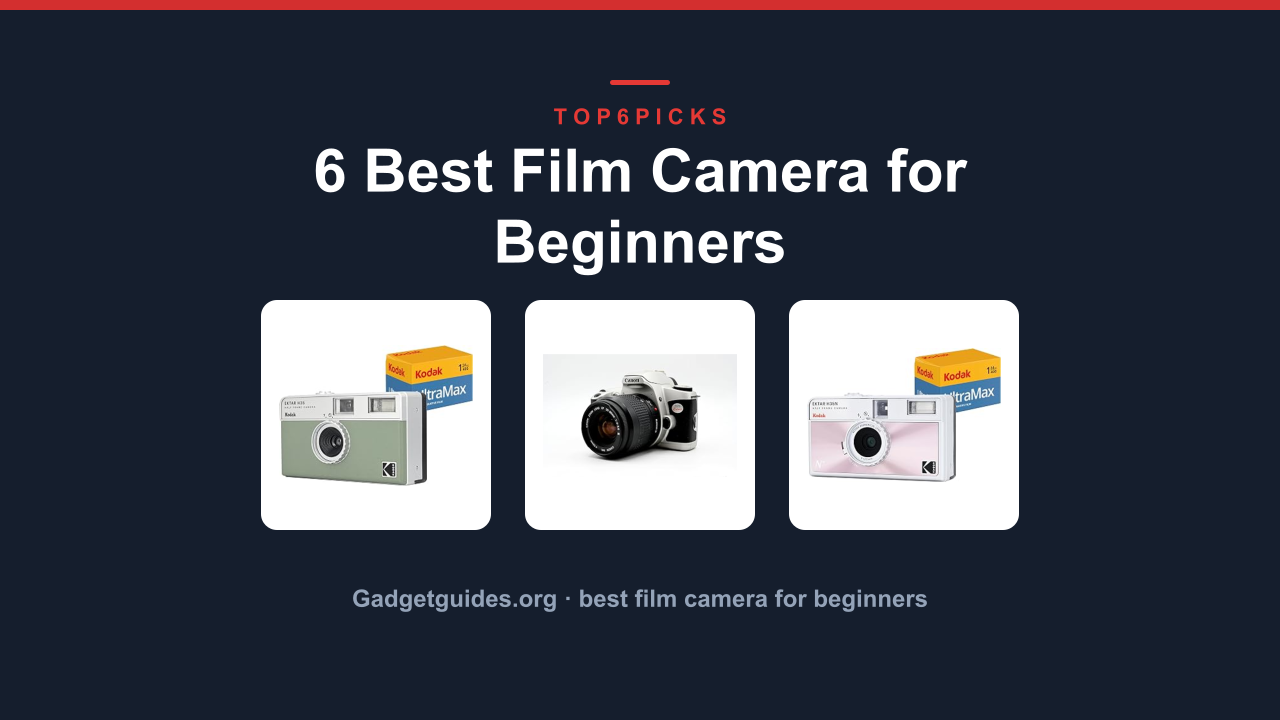
The best best film camera for beginners is the Kodak EKTAR H35 Half Frame 35mm, the only camera here that cuts your film costs in half by taking two photos per frame. It is built for absolute simplicity, no batteries, no settings, just point and shoot, which makes it the ideal starting point for anyone who has never touched film.
Want autofocus and interchangeable lenses instead? The Canon New EOS Kiss (AKA Rebel G) gives you professional SLR features at a renewed price, as long as you are okay with a bulkier body and the need to learn exposure basics.
As an Amazon Associate, I earn from qualifying purchases.
This guide walks you through every option before you spend a penny, including the buyer who should skip film cameras entirely and stick with digital. You will get honest tradeoffs, not just hype.
Everything below comes from current Amazon product data, manufacturer specifications, and aggregate owner feedback, not hands-on lab testing. I have broken down each camera by build quality, ease of use, image potential, and what real buyers say.
Quick Answer: The Best Film Camera for Beginners
The Kodak EKTAR H35 Half Frame 35mm is the best choice for anyone who wants the cheapest possible entry to film photography with zero learning curve.
This is the camera that proves film photography does not have to be expensive or complicated. The Kodak EKTAR H35 uses a half-frame format, meaning every 36-exposure roll of 35mm film gives you 72 shots. That alone cuts your ongoing cost in half, which matters a lot when you are still learning and wasting frames. It is focus-free, requires no batteries (the AAA battery is for the flash only), and the lightweight plastic body weighs barely anything.
You get a built-in flash, a simple film advance wheel, and a viewfinder that shows you roughly what the lens sees. The bundle includes one roll of 24-exposure film so you can start shooting right away. Aggregate user reviews consistently praise how easy it is to hand to a child or a complete beginner and get usable photos back from the lab.
Flaws but not dealbreakers. The plastic lens is not going to win any sharpness awards, and the focus-free design means subjects closer than about 4 feet will be blurry. Some buyers report the flash drain batteries quickly if you leave it on by accident.
If you absolutely need sharper images and the ability to change lenses, the Canon New EOS Kiss further down delivers autofocus and EF lens compatibility at a slightly higher entry price.
⚠
Batteries: The camera needs one AAA battery for the flash, which is not included. Keep a spare set handy.
Pros
✓Half-frame gives 72 shots per standard 36-exposure roll, saving money immediately
✓Focus-free operation means zero learning curve for absolute beginners
✓Lightweight and pocketable at under 150 grams body weight
✓Bundle includes a roll of 24-exposure film to start shooting right away
Cons
✕Plastic lens produces soft, lower-contrast images compared to glass optics
✕No focusing control at all, so close subjects under 4 feet will be out of focus
✕Flash drains AAA batteries quickly if accidentally left on
Film Format
35mm Half Frame
Lens
22mm f/8 Focus Free
Battery
1x AAA (flash only)
Included
24-exp film roll, strap
Best for: Anyone who wants the cheapest possible introduction to film photography with zero frustration and double the shots per roll.
This is the right pick if you already know you want to grow into a serious hobby. The Canon New EOS Kiss (called the Rebel G in the US and Canada) is a fully featured autofocus SLR from the 1990s, renewed and sold with a 35-80mm EF zoom lens. It uses the same Canon EF lens mount as modern digital Canon DSLRs, so you can use current glass on it. That is a huge advantage for a beginner who might eventually buy a digital Canon body.
You get three autofocus points, multiple exposure modes including full manual, and a built-in pop-up flash. The camera weighs about 400 grams with the kit lens, which is heavier than the point-and-shoot options but still manageable for a day out. Verified buyer reviews consistently praise the sharpness of the included lens and the reliability of the autofocus system, even decades after release.
Flaws but not dealbreakers. This is a renewed product, so cosmetic wear is likely. The 35-80mm kit lens is fine for snapshots but not optically spectacular. You also need to learn about aperture, shutter speed, and ISO because this camera gives you full control, which can overwhelm total beginners.
If you want something smaller and lighter that still takes decent photos without the learning curve, the KODAK Snapic A1 below is a simpler compact alternative.
⚠
Renewed Caveat: This is a refurbished vintage camera. Check the seller’s return policy and condition notes carefully before buying.
Pros
✓Canon EF lens mount works with modern digital Canon lenses, future-proofing your investment
✓Reliable autofocus with three points makes action shots much easier than manual focus
✓Full manual and semi-auto modes let you learn photography at your own pace
✓High 4.5-star average rating from verified buyers on Amazon
This is essentially the same great half-frame camera as the H35, but in a Glazed Pink finish with a film bundle. The Kodak EKTAR H35N is mechanically identical to the standard H35, meaning it is focus-free, battery-free (except for flash), and gives you 72 shots per 36-exposure roll. The bundle includes a roll of Kodak Ultramax 400, a classic color negative film that works well in most daylight conditions.
The pink color makes it a popular gift choice for teens, partners, or anyone who appreciates a retro aesthetic. The bundle format means you can open the box and start shooting immediately without a separate film purchase. Aggregate reviews note the camera is extremely easy to use, with the only real complaint being the soft plastic lens.
Flaws but not dealbreakers. The lens quality is the same as the H35, so do not expect tack-sharp images. Some buyers report the flash button is easy to bump on, wasting battery. The pink color might not be for everyone, and the standard H35 is available in more neutral Sage if you prefer that.
If you want a more serious camera with a glass lens and manual controls, the Vintage Canon AE-1 below is the classic choice for learning photography properly.
⚠
Film Included: The bundle comes with one roll of Kodak Ultramax 400 to get you started. Buy more film before you finish that first roll.
Pros
✓Striking Glazed Pink color makes it a standout gift for fashion-conscious beginners
✓Bundle includes a roll of Kodak Ultramax 400 film for immediate shooting
✓Same proven half-frame design gives 72 shots per roll, saving money on film
✓Focus-free operation means no learning curve at all
Cons
✕Plastic lens produces soft images with low contrast, same as the standard H35
✕Flash button is easy to press accidentally, draining the AAA battery quickly
✕Pink color may not appeal to everyone; the Sage H35 offers a neutral alternative
Film Format
35mm Half Frame
Lens
22mm f/8 Focus Free
Battery
1x AAA (flash only)
Included Film
Kodak Ultramax 400
Best for: Gifting to a teen or beginner who loves pastel colors and wants the simplest possible film camera experience.
This is the camera that taught millions of people photography, and it still works beautifully today. The Canon AE-1 is one of the most iconic 35mm Single-Lens Reflex (SLR) cameras ever made, and this renewed version comes with a 50mm f/1.8 prime lens. That lens is sharp, fast, and perfect for learning the exposure triangle. The AE-1 features shutter-priority auto-exposure, meaning you set the shutter speed and the camera picks the aperture, which is a gentle introduction to manual control.
The build quality is exceptional for its era, with a metal body and a satisfying mechanical shutter sound. It uses a 6V silver oxide battery (PX28 or equivalent) for the light meter, but the shutter can fire without it. Aggregate buyer reviews consistently praise the sharpness of the 50mm lens and the timeless design. This is a camera you will want to keep on a shelf even when you are not shooting.
Flaws but not dealbreakers. This is a vintage renewed camera, so cosmetics and mechanical condition vary. The meter may need calibration after decades of storage. You must learn to focus manually, which takes practice. The 50mm lens is fantastic but fixed, so you will need to zoom with your feet.
If you want a similar experience but with autofocus and a zoom lens, the Canon New EOS Kiss above offers a more modern feel at a similar price point.
⚠
Battery: The AE-1 needs a 6V silver oxide battery (PX28 or equivalent) for the light meter. These are still widely available.
Pros
✓Included 50mm f/1.8 prime lens is exceptionally sharp and great for low light
✓Shutter-priority auto mode eases the transition from full auto to manual control
✓Metal body and legendary build quality have kept these cameras running for decades
✓Classic aesthetic that looks great and retains resale value among collectors
Cons
✕Renewed vintage unit may have cosmetic wear, light meter issues, or mechanical quirks
✕Manual focus only, which requires practice and patience to master
✕Fixed 50mm lens means no zoom capability, you must physically move closer or farther
Lens Mount
Canon FD
Exposure Mode
Shutter-Priority AE
Battery
1x 6V PX28
Included Lens
50mm f/1.8
Best for: Beginners who want to learn photography the traditional way and appreciate owning a piece of camera history.
This is the camera that splits the difference between a toy and a serious tool. The KODAK Snapic A1 is a compact 35mm point-and-shoot with a 2-zone focus system that lets you choose between portrait distance (roughly 4-6 feet) and landscape distance (beyond 6 feet). That is a small step up from the totally focus-free Kodak H35, giving you a little more control over sharpness without needing to learn manual focus. The body is lightweight and compact, finished in a stylish Ivory White.
It uses a 31mm f/8 lens, which is a standard focal length for street photography and casual snapshots. The camera needs a AAA battery for the flash, but operates mechanically otherwise. Verified buyer reviews note it feels more substantial than the cheaper plastic point-and-shoot options, and the 2-zone focus does help reduce soft shots compared to totally fixed-focus cameras.
Flaws but not dealbreakers. The lens is still plastic and not as sharp as a glass lens on an SLR. The 2-zone focus is better than nothing but still requires you to guess distances, which can lead to soft images. The camera does not include film or a battery, so you need to buy both separately before your first shot.
If you have already learned the basics and want a camera that will grow with you, the Canon New EOS Kiss offers a much bigger jump in image quality and control for a reasonable price.
⚠
Batteries: The flash requires a AAA battery, not included. You will also need to buy 35mm film separately.
Pros
✓2-zone focus system gives more control over sharpness than fully fixed-focus cameras
✓Compact and lightweight design in a stylish Ivory White finish
✓Feels more substantial than budget plastic point-and-shoot models
✓Simple operation with just a few controls, great for casual everyday use
This is the cheapest way to get into Canon EF autofocus film photography. The Canon EOS Rebel GII (also known as the XSn outside North America) is a 1990s autofocus SLR that comes with a 35-80mm kit lens. It uses the same Canon EF lens mount as the more expensive EOS Kiss, meaning you can use modern Canon lenses on it. The body is lightweight plastic, which keeps the weight down but does not feel as premium as the older metal-bodied cameras.
The camera offers full auto mode, portrait mode, landscape mode, and full manual control, so you can gradually learn as you improve. It uses two CR123A batteries, which are still available but less common than AA or AAA. Aggregate buyer reviews are mixed, with many praising the value for money but some reporting issues with the condition of the renewed unit, such as sticky buttons or cosmetic scratches.
Flaws but not dealbreakers. The build quality is noticeably cheaper than the Canon EOS Kiss or the AE-1. The 35-80mm lens is a basic consumer zoom that is not very sharp, especially at the telephoto end. The autofocus system is slower and noisier than modern cameras, and some units may have sticky shutter buttons due to age.
If you can stretch your budget, the Canon New EOS Kiss above offers a better build and a higher-rated kit lens for a small price increase.
⚠
Condition: This is a renewed vintage camera. Inspect the listing photos carefully and check the seller’s return policy before buying.
Pros
✓Canon EF mount works with hundreds of modern lenses, offering great upgrade potential
✓Multiple auto and manual exposure modes let you learn at your own pace
✓Lightweight plastic body makes it easy to carry around all day
✓Typically the cheapest entry point into autofocus film SLRs
Cons
✕Plastic body feels cheap compared to metal-bodied alternatives like the AE-1
✕Kit lens is a basic consumer zoom with mediocre sharpness
✕Renewed units may have sticky buttons, scratches, or other age-related issues
Lens Mount
Canon EF
Autofocus
3-point AF
Battery
2x CR123A
Included Lens
35-80mm f/4-5.6
Best for: Budget-conscious beginners who want autofocus and EF lens compatibility at the lowest possible price.
Buying Guide: Film Format, Focus System, Build Quality and Budget
Choosing your first film camera comes down to four main decisions. Let me walk you through each one so you can match the right camera to your goals.
What Film Format Should You Choose?
The cameras on this list use 35mm film, which is the most common and easiest to find today. But there is a twist. Half-frame cameras like the Kodak EKTAR H35 and H35N take two photos per standard frame, giving you 72 shots from a 36-exposure roll.
Full-frame cameras like the Canon EOS Kiss and the AE-1 give you one photo per frame, so 36 shots per roll. Half-frame is cheaper to run, which is great for beginners who are still learning and wasting frames. But the trade-off is smaller negatives, which means less detail and more grain when you enlarge prints.
If you plan to scan your photos for social media, half-frame is perfectly fine. If you want to make large prints, go full-frame.
How Much Control Do You Want?
This is the biggest fork in the road. Focus-free cameras like the Kodak H35 and H35N require zero skill. You just point and shoot.
The 2-zone focus on the Snapic A1 gives you a little more control but still relies on guessing distances. Autofocus SLRs like the Canon EOS Kiss and Rebel GII do the focusing for you, giving you sharp images most of the time. Manual focus cameras like the Canon AE-1 force you to learn focusing, which is harder but teaches you the fundamentals.
For absolute beginners, I recommend starting with autofocus or focus-free and then learning manual later. Trying to learn manual focus, manual exposure, and film loading all at once can be frustrating.
What About Build Quality and Longevity?
Build quality varies a lot in this price range. The Kodak point-and-shoot models are all plastic, which keeps them lightweight and affordable but means they are less durable. The Canon AE-1 has a metal body that has survived for decades, though renewed units may have cosmetic wear.
The Canon EOS cameras are plastic but feel more solid than the Kodak models. If you plan to carry the camera everywhere, a sturdier build like the AE-1 or the EOS Kiss is worth the extra weight. If you just want a camera to throw in a bag for occasional use, the plastic Kodak models are fine.
Should You Worry About Lens Compatibility?
If you think you might want to buy more lenses later, the Canon EF mount cameras are the clear winners. The EOS Kiss, Rebel GII, and even the EOS Kiss all use the Canon EF mount, which is the same mount used on Canon digital DSLRs. That means you can buy a 50mm f/1.8 STM lens, use it on your film camera, and then use it on a digital Canon body later.
The Canon AE-1 uses the older FD mount, which has a different flange distance and is not compatible with modern Canon lenses without an adapter. If you think this hobby might stick, the EF mount is the smarter long-term investment.
Film cameras are not the right purchase for everyone. Here are three types of buyers who should skip this category entirely.
You Need Instant Results and Zero Cost Per Shot
If you hate the idea of paying for each photo and waiting days to see your results, film is not for you. Digital cameras give you instant feedback, unlimited shots, and zero ongoing cost. If you are the type of person who wants to learn photography by experimenting and deleting bad shots, a modern mirrorless camera or a beginner DSLR is a much better fit.
You can get a used digital camera for a similar price to these film cameras, and it will cost you nothing to shoot thousands of photos. If you are not sure about the film process, start with digital and come back to film later.
You Want Professional-Level Image Quality for Under $100
No film camera in this price range will produce magazine-quality images. The Kodak point-and-shoot models have plastic lenses that are soft and low in contrast. The Canon SLRs with kit lenses are decent but not spectacular.
If you need tack-sharp, high-resolution images for professional work, you need a modern digital camera or a much more expensive film camera with premium lenses. These cameras are for learning, for fun, and for the experience of film. They are not tools for professional output.
You Have No Tolerance for Inconvenience
Film photography is inherently inconvenient. You have to buy film, load it carefully, advance the film after each shot, and then send it to a lab or develop it yourself. You cannot see your photos until days later.
If you get frustrated easily by slow processes, film will annoy you. Stick with a digital camera that lets you shoot, review, and delete instantly. The people who love film are the ones who enjoy the process, not just the result.
Final Verdict
The best film camera for beginners is the Kodak EKTAR H35 Half Frame 35mm. It is the cheapest way to start, the easiest to use, and the half-frame format doubles your shots per roll, which saves you money while you learn. If you want a camera that teaches you more about photography, the Canon New EOS Kiss gives you autofocus, interchangeable lenses, and a path to grow into the hobby.
Want a classic manual experience that will teach you the fundamentals? Get the Vintage Canon AE-1. Need the cheapest possible autofocus SLR?
The Canon EOS Rebel GII is your entry point, though condition can vary. After a fun color option for a gift? The Kodak EKTAR H35N in Glazed Pink is a great choice.
If you are still on the fence, revisit the Who Should NOT Buy section above. Film is a hobby, not a shortcut. If you want the fastest, cheapest, most convenient way to take photos, a modern digital camera or even a smartphone is the better tool.
But if you want to slow down, learn the craft, and enjoy the tactile experience of shooting film, any of these cameras will get you started.
FAQ
What is the best Film Camera for Beginners overall?
The Kodak EKTAR H35 Half Frame 35mm is the best overall pick. It is the cheapest, easiest to use, and the half-frame format gives you 72 shots per roll, which cuts your film costs in half.
Do I need to buy batteries for these cameras?
Most of these cameras require batteries only for the flash or light meter. The Kodak H35 and H35N use one AAA battery for the flash. The Canon EOS Kiss and Rebel GII use two CR123A batteries for the autofocus and metering.
The Canon AE-1 uses a 6V PX28 battery for the light meter. The Kodak Snapic A1 uses one AAA battery for the flash. Always check the product description for battery requirements.
Can I use modern lenses on these film cameras?
Yes, if you choose a camera with the Canon EF mount. The Canon New EOS Kiss and the Canon EOS Rebel GII both use the EF mount, which is compatible with modern Canon digital DSLR lenses. The Canon AE-1 uses the older FD mount, which is not directly compatible with modern lenses without an adapter.
What kind of film should I buy for these cameras?
All of these cameras use standard 35mm film. For beginners, Kodak Ultramax 400 or Fujifilm Superia X-Tra 400 are excellent choices. They are affordable, widely available, and work well in most daylight conditions.
Avoid high-speed film (ISO 800 or higher) until you understand how to use it.
Why are some of these cameras listed as "Renewed"?
Renewed means the camera has been inspected, cleaned, and repaired if needed by a third-party seller. These cameras are typically vintage models that have been restored to working condition. While they are generally reliable, the cosmetic condition and mechanical wear can vary.
Always check the seller's return policy and read recent reviews before buying a renewed camera.