The best best mirrorless camera for photography is the Canon EOS R50 Mirrorless Camera with 18-45mm lens, the only one here that combines Canon’s Dual Pixel CMOS AF II autofocus, 4K video, and a complete beginner-friendly bundle including a 64GB card and bag. It’s the perfect entry point for anyone upgrading from a phone or a point-and-shoot.
Want a bigger zoom range right out of the box instead? The Sony Alpha a6400 with 18-135mm lens gets you there, as long as you don’t mind a slightly older menu system and no in-body stabilization.
As an Amazon Associate, I earn from qualifying purchases.
This guide breaks down each camera by image quality, autofocus speed, video features, and real-world ease of use. It also calls out the buyers who should skip mirrorless altogether, they get their own section below.
Everything here comes from current Amazon product data, specs, and each model’s owner track record, not hands-on lab testing. Honest and research-based.
Quick Answer: The Best Mirrorless Camera for Photography
The Canon EOS R50 Mirrorless Camera 18-45mm takes the top spot for its unbeatable value and ease of use. Here are all six picks ranked:
Thinking about a pro-sports camera or extreme low-light work instead? Jump to Who Should NOT Buy below before you spend anything.
Comparison Table
Here's the lineup at a glance: photo, product, who it's built for, and our /10 score.
Scroll sideways on small screens to see every column.
Canon EOS R50 Mirrorless Camera 18-45mm: Best Overall for Beginners
Canon EOS R50 Mirrorless Camera 18-45mm: Best Overall for Beginners
#1
CanonStarter bundle with bag + card
8.6OUT OF 10
Image Quality8.5
Autofocus8.8
Video Ability8.0
Ease of Use9.0
This is the best mirrorless camera for photography for anyone wanting to move up from a phone. It uses a 24.2-megapixel APS-C sensor paired with Canon’s Dual Pixel CMOS AF II system, which locks onto eyes and faces almost instantly. The included 18-45mm kit lens is compact and sharp enough for everyday shooting.
Setup is dead simple. The bundle throws in a 64GB memory card, a camera bag, and a cleaning kit, so you’re ready to shoot right out of the box. The R50 also records 4K video at 30fps (with a crop) and has a fully articulating touchscreen that makes vlogging a breeze.
Flaws but not dealbreakers. The single SD card slot is only UHS-I, which slows down bursts a bit. Some users report that the electronic viewfinder (2.36 million dots) feels a tad small compared to pricier models. Also, battery life is rated at roughly 370 shots per charge, so pack a spare for full-day trips.
⚠Compatibility: The RF-S18-45mm lens only fits Canon RF-mount mirrorless bodies. If you already own EF-S lenses, you’ll need an adapter.
Pros
- ✓24.2MP APS-C sensor delivers crisp detail for prints and social media.
- ✓Dual Pixel CMOS AF II tracks subjects reliably even in moderate light.
- ✓Complete starter bundle saves you from buying extras separately.
- ✓Articulating touchscreen makes it easy to frame selfies and overhead shots.
Cons
- ✕4K video has a 1.5x crop when recording at 30fps.
- ✕Single SD card slot is UHS-I only, limiting rapid burst speeds.
- ✕Battery life around 370 shots per charge; extra battery recommended.
AF System
Dual Pixel CMOS AF II
Max Video
4K 30fps (cropped)
Best for: First-time mirrorless buyers who want a hassle-free kit with good autofocus and 4K video.
Sony Alpha a6400 Mirrorless Camera 18-135mm: Best Versatile Zoom Kit
Sony Alpha a6400 Mirrorless Camera 18-135mm: Best Versatile Zoom Kit
#2
SonyLong zoom in one lens
8.4OUT OF 10
Image Quality8.6
Autofocus9.0
Video Ability8.5
Ease of Use7.5
This Sony is the pick for anyone who wants one lens to cover everything from wide landscapes to decent reach. The 18-135mm lens (27-202.5mm equivalent) is a true do-it-all zoom, and the a6400’s Real-Time Eye AF for humans and animals works incredibly well. It uses a 24.2MP APS-C sensor and can shoot 11 frames per second with continuous autofocus.
Video shooters get 4K at 30fps with full pixel readout (no crop) and slow-motion 1080p at 120fps. The tiltable touchscreen flips up 180 degrees for vlogging, and the microphone jack lets you record cleaner audio. Sony’s
official product page confirms the continuous AF tracking during video.
Flaws but not dealbreakers. The menu system is layered and takes time to learn. There’s no in-body image stabilization (IBIS), so you’ll rely on lens-based stabilization. Battery life is average at around 410 shots, and the body lacks a headphone jack for monitoring audio.
⚠Compatibility: The a6400 uses Sony E-mount. Third-party lenses from Sigma and Tamron are widely available.
Pros
- ✓Real-Time Eye AF works on people, cats, dogs, and birds.
- ✓18-135mm lens covers wide to telephoto without swapping.
- ✓4K video with full pixel readout (no crop) and 120fps slow-mo.
- ✓11fps burst shooting with continuous AF.
Cons
- ✕No in-body image stabilization; reliant on lens OSS.
- ✕Menu system is complex for beginners.
- ✕No headphone jack for audio monitoring.
AF System
Real-Time Eye AF
Max Video
4K 30fps / 1080 120fps
Stabilization
Lens-based OSS only
Best for: Travelers and hobbyists who want a single lens for varied subjects without carrying extra glass.
Sony Alpha a6400 Mirrorless Camera: Best Compact Kit
Sony Alpha a6400 Mirrorless Camera: Best Compact Kit
#3
SonyPocket-sized body
8.2OUT OF 10
Image Quality8.4
Autofocus9.0
Video Ability8.5
Ease of Use7.0
If you want maximum portability without sacrificing AF performance, this is your camera. It’s the same a6400 body as the 18-135mm kit but paired with the retractable 16-50mm f/3.5-5.6 power zoom lens. The whole package is barely larger than a compact point-and-shoot, making it ideal for everyday carry.
The 16-50mm lens collapses to just over an inch thick when turned off. You still get 24.2MP, Real-Time Eye AF, 4K video, and 11fps bursts. The flip-up screen works well for street shooting from the hip or overhead. Verified buyer reviews on Amazon often mention how easy it is to slip into a jacket pocket.
Flaws but not dealbreakers. The 16-50mm lens is not optically stellar; corners are soft and it’s slow at f/5.6 on the long end. Low-light autofocus hunts more than with a brighter lens. The menu is still Sony’s classic labyrinth, and the lack of IBIS means you’ll want a steady hand for evening shots.
For better low-light performance and depth of field, the full-frame
Sony Alpha a7 III is a significant step up, though it’s larger and pricier.
⚠Sizing: The 16-50mm lens does not have a manual zoom ring; it uses an electronic zoom rocker. Some photographers find that frustrating.
Pros
- ✓Extremely compact body and retractable lens for easy daily carry.
- ✓Real-Time Eye AF is excellent for portraits and pets.
- ✓4K video with full pixel readout and 120fps slow-motion.
- ✓Flip-up touchscreen for vlogging and selfies.
Cons
- ✕Kit lens is soft at edges and slow aperture.
- ✕No in-body stabilization; low-light performance limited.
- ✕Electronic zoom lens not as intuitive as a manual ring.
AF System
Real-Time Eye AF
Max Video
4K 30fps / 1080 120fps
Lens Range
16-50mm f/3.5-5.6
Best for: Street photographers and travelers who want the smallest possible interchangeable-lens camera with professional-grade autofocus.
Sony Alpha a7 III Mirrorless Camera: Best Full-Frame Value
Sony Alpha a7 III Mirrorless Camera: Best Full-Frame Value
#4
SonyFull-frame sensor
8.9OUT OF 10
Image Quality9.5
Autofocus8.8
Video Ability8.5
Ease of Use8.0
This is the camera for photographers who want full-frame image quality without paying flagship prices. The 24.2-megapixel full-frame sensor delivers noticeably better low-light performance, dynamic range, and depth of field control than any APS-C camera on this list. The 28-70mm f/3.5-5.6 kit lens is a decent start, but many buyers pair this body with prime lenses to unlock its real potential.
Sony’s 693-point phase-detection AF system covers 93% of the frame, and the 5-axis in-body image stabilization gives you up to 5 stops of shake reduction. That’s a massive advantage for handheld shooting in dim conditions. The a7 III also shoots 4K 30fps with full pixel readout and no crop, plus 1080p at 120fps. Battery life is rated at 710 shots, which is excellent for a mirrorless camera.
Flaws but not dealbreakers. The rear LCD is only 2.36 million dots and not fully articulating (it tilts up and down). The 28-70mm lens is optically average and feels cheap compared to the body. Some users also mention that the menu system is less responsive than newer Sony models. It’s also the most expensive kit here.
If you want a more modern interface and a fully articulating screen, the
Canon EOS R50 is easier to use, though it doesn’t match the a7 III’s image quality.
⚠Compatibility: The a7 III uses Sony E-mount, compatible with full-frame FE lenses and APS-C E lenses (which will cause a crop).
Pros
- ✓24.2MP full-frame sensor offers class-leading low-light and dynamic range.
- ✓5-axis in-body stabilization (up to 5 stops) for sharper handheld shots.
- ✓693-point phase-detection AF covers 93% of the frame.
- ✓710-shot battery life among the best for mirrorless cameras.
Cons
- ✕Kit lens is plasticky and optically just average.
- ✕Rear LCD tilts only, does not flip out for vlogging.
- ✕Menu system feels dated compared to 2024 Sony models.
AF System
693-point phase-detection
Max Video
4K 30fps / 1080 120fps
Stabilization
5-axis IBIS (5 stops)
Best for: Enthusiasts and semi-pros who need full-frame quality for portraits, events, or low-light work.
Canon EOS R100 Mirrorless Camera RF-S18-45mm: Best Budget-Friendly Entry
Canon EOS R100 Mirrorless Camera RF-S18-45mm: Best Budget-Friendly Entry
#5
CanonLowest price point
7.4OUT OF 10
Image Quality7.5
Autofocus7.0
Video Ability7.0
Ease of Use8.0
This Canon is the cheapest way to get a modern mirrorless camera with 4K video. The R100 packs a 24.1-megapixel APS-C sensor, Wi-Fi, Bluetooth, and a simple interface into a very affordable body. The RF-S18-45mm kit lens is the same one used on the R50, so you get decent image quality for the money.
It’s built for beginners and content creators. The menu is clean and guided, and the touchscreen (though fixed, not articulating) makes navigation easy. It also records 4K 24fps, which is fine for most casual video work. Canon’s
official specifications page confirms the 4K video capability and the single SD card slot.
Flaws but not dealbreakers. The autofocus is contrast-detection only, not the Dual Pixel system found on the R50. This means it’s slower and less reliable for moving subjects. The buffer is shallow, so you can’t shoot long bursts. There’s no electronic viewfinder on the R100, which some buyers dislike for outdoor shooting.
If you need better autofocus and a viewfinder, step up to the
Canon EOS R50. It costs more but includes Dual Pixel AF II and an EVF.
⚠Sizing: No built-in flash. No electronic viewfinder. Consider a powerful smartphone first if you’re unsure about buying a camera.
Pros
- ✓Lowest price point for a Canon mirrorless with 4K video.
- ✓24.1MP APS-C sensor delivers good image quality for the price.
- ✓Simple guided menu system ideal for true beginners.
- ✓Built-in Wi-Fi and Bluetooth for easy photo sharing.
Cons
- ✕Contrast-detect AF only, not Dual Pixel; slower for moving subjects.
- ✕No electronic viewfinder.
- ✕Shallow buffer limits burst shooting significantly.
Best for: Budget-conscious beginners moving from a phone who want a real camera without spending a lot.
Nikon Z50 II Two Lenses: Best Two-Lens Starter Bundle
Nikon Z50 II Two Lenses: Best Two-Lens Starter Bundle
#6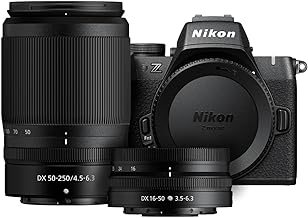
NikonTwo-lens kit
8.0OUT OF 10
Image Quality8.2
Autofocus8.0
Video Ability7.5
Ease of Use8.5
This Nikon two-lens bundle gives you the most versatile starter kit in this lineup. The Z50 II comes with both the 16-50mm f/3.5-6.3 zoom and the 50-250mm f/4.5-6.3 telephoto zoom, covering everything from wide-angle landscapes to distant wildlife. The camera has a 20.9-megapixel APS-C sensor, which is slightly lower resolution than competitors but still plenty for large prints.
Nikon’s interface is clean and beginner-friendly, with easy color presets that let you dial in looks without editing later. The wireless photo sharing works simply through the Nikon SnapBridge app. The body includes a 2.36-million-dot electronic viewfinder and a tilting touchscreen LCD. Aggregated buyer reviews mention the comfortable grip and good ergonomics for smaller hands.
Flaws but not dealbreakers. The 20.9MP sensor is lower than the 24.2MP Canon and Sony options, so cropping is less flexible. The two-lens kit means you’ll need to swap lenses to cover the full range, which isn’t ideal for fast-moving situations. There’s no in-body stabilization, so you rely on lens VR (which the 50-250mm has, but the 16-50mm does not).
If you prefer a single zoom that covers wide to telephoto without swapping, the
Sony a6400 with 18-135mm is a better fit for quick shooting.
⚠Compatibility: Nikon Z50 II uses the Nikon Z-mount. You can adapt F-mount lenses with an optional FTZ adapter.
Pros
- ✓Two-lens kit gives you wide to telephoto reach (16-250mm equivalent).
- ✓Comfortable grip and logical controls for beginners.
- ✓Easy color presets simplify in-camera looks.
- ✓Wireless photo sharing via SnapBridge app works reliably.
Cons
- ✕20.9MP sensor is lower resolution than competitors.
- ✕No in-body stabilization; kit lens 16-50mm has no VR.
- ✕Requires lens swapping to access full zoom range.
AF System
Hybrid phase/contrast
Lens Included
16-50mm + 50-250mm
Best for: Beginners who want to explore different focal lengths without immediately buying more lenses.
Buying Guide: Sensor Size, Autofocus, Lenses, and Video
Choosing the right mirrorless camera comes down to a few big decisions. Here's what matters most for real-world photography.
How important is sensor size?
Sensor size directly affects image quality, especially in low light. Full-frame sensors (like in the Sony a7 III) collect more light, giving you better dynamic range and shallower depth of field. APS-C sensors are smaller but still deliver excellent results for most users.
The Canon R50, Sony a6400, and Nikon Z50 II all use APS-C. For most beginners and hobbyists, an APS-C camera is more than enough. If you shoot a lot of indoor events, portraits, or night scenes, the full-frame a7 III justifies its higher budget.
Autofocus: phase-detect vs. contrast-detect
A fast autofocus system is what makes a camera feel responsive. Phase-detection AF (found on every camera here except the Canon R100) uses dedicated pixels to measure focus distance instantly. The Canon R50 and Sony a6400 models use hybrid systems that track faces and eyes reliably.
The budget Canon R100 relies on contrast-detection only, which is slower and often hunts in low light. If you photograph kids, pets, or anything moving, skip the R100 and get at least the R50 or a6400.
Kit lenses: what do you really get?
Every camera here ships with a kit lens. The Canon and basic Sony lenses (16-50mm and 18-45mm) cover a standard wide-to-normal zoom range, fine for everyday snapshots. The Sony 18-135mm gives you true telephoto reach without swapping lenses, making it ideal for travel.
The Nikon Z50 II's two-lens bundle is the most flexible, but requires carrying and changing lenses. For most buyers, the Sony 18-135mm kit offers the best balance of versatility and convenience.
Do I need 4K video?
All six cameras record 4K video, but not equally. The Sony a6400 models offer 4K with full pixel readout (no crop), which gives the widest field of view. The Canon R50 records 4K with a crop, and the Canon R100 is limited to 24fps.
If you plan to vlog or shoot video regularly, prioritize the Sony a6400 or the Canon R50 for their articulating screens and better video features. If video is secondary, any of the six will work fine for casual clips.
To see how these factors play out on real picks, compare the Canon EOS R50 Mirrorless Camera 18-45mm, Sony Alpha a6400 Mirrorless Camera 18-135mm and the Sony Alpha a6400 Mirrorless Camera reviewed above.
Who Should NOT Buy Best Mirrorless Camera for Photography
A mirrorless camera is a great tool, but it's not the right tool for everyone. Here are the kinds of buyers who should think twice before buying one of these cameras.
If your primary work is shooting concerts, nightclubs, or astrophotography, an APS-C mirrorless camera will struggle. No matter how good the sensor, a crop sensor can't match the light gathering of a full-frame model. If your budget allows, the Sony a7 III is your best option here.
If it doesn't, consider looking at a used full-frame DSLR like a Nikon D750 instead. A DSLR vs mirrorless comparison can help you weigh the trade-offs.
You Shoot Fast Sports or Action Regularly
While the Sony a6400 models can shoot 11fps, none of these cameras are optimized for fast sports. The buffer fills quickly, and continuous autofocus tracking, while good, isn't at the level of a dedicated sports body like a Sony a9 or Canon EOS R3. If your main subject is fast-moving athletes or birds in flight, you'll want a camera with a deeper buffer and faster readout speeds.
You Want a Pocket Camera for Travel
These are all interchangeable-lens cameras with lenses that stick out. They are smaller than DSLRs but not pocketable. If you want something you can slip into a jeans pocket, look at a premium compact like a Sony RX100 series or a high-end smartphone.
A travel-friendly action camera might also fit your needs better.
Final Verdict
The Canon EOS R50 Mirrorless Camera 18-45mm is our pick for the best mirrorless camera for photography overall. It offers the best combination of modern autofocus, 4K video, ease of use, and a complete starter bundle at a fair price. It's the one we'd recommend to most people moving up from a phone.
Want better low-light performance and shallower depth of field? Get the Sony a7 III. It's a full-frame powerhouse that will serve you for years.
Need a longer zoom in a single lens? The Sony a6400 with 18-135mm is your best bet. Just want the absolute cheapest entry point?
The Canon R100 gets you there, but know its autofocus is limited.
Before you buy, make sure a mirrorless camera is actually what you need. If you fall into one of the "Who Should NOT Buy" groups above, consider a different tool entirely. If you're in the right place, any of these six cameras will capture great photos.
FAQ
What's the best Mirrorless Camera for Photography overall?
The Canon EOS R50 with 18-45mm lens is our top pick. It combines a 24.2MP APS-C sensor, reliable Dual Pixel AF II, 4K video, and a bundle that includes a memory card and bag. It's the most balanced option for most beginners.
Is a mirrorless camera better than a DSLR?
For most people today, yes. Mirrorless cameras are smaller, lighter, and have faster autofocus for video and stills. DSLRs still offer longer battery life and more affordable used lenses.
Check a detailed comparison of DSLR vs mirrorless for your specific needs.
Do I need a full-frame camera?
Not unless you regularly shoot in very low light or need the shallowest depth of field. APS-C sensors are excellent for 90% of photography. The Sony a7 III is a full-frame option here if you need it, but the APS-C models will serve you well.
What lens should I buy first?
Stick with the kit lens for a few months. It's versatile enough to learn on. After that, a fast prime like a 35mm f/1.8 or 50mm f/1.8 is the best upgrade for portraits and low light.
How many megapixels do I need?
24 megapixels is plenty for large prints and cropping. The Nikon Z50 II has 20.9MP, which is still fine for prints up to 16×24 inches. More megapixels matter mainly if you crop heavily or make billboard-sized prints.



















[…] you're just posting to Instagram or YouTube, 4K is plenty. You can see the difference in our guide to mirrorless cameras for photography for a deeper comparison of sensor […]
[…] at a mirrorless camera instead. Our guide to the best mirrorless cameras for photography covers options that deliver professional results in a still-portable […]
[…] can't match the flexibility of a mirrorless or DSLR system. You can check out our guide on mirrorless cameras for photography for a step up in quality, or look at the DSLR vs mirrorless camera comparison to decide which […]