5 Best AI Glasses for Everyday Use: Top Smart Picks
The best AI glasses for everyday use blend hands-free help, clear sound, useful cameras, and comfortable all-day wear.
You may want to capture a family moment, hear turn-by-turn help, or translate a menu without reaching for your phone. That is where AI glasses can help. They look like normal eyewear, yet they may add a camera, open-ear audio, voice control, and smart tools to your daily routine. I reviewed the main features, likely use cases, comfort points, and limits of these five models. My goal is simple: help you choose the Best AI Glasses for Everyday Use without getting lost in bold claims or confusing tech terms.

AI Smart Glasses with Camera,8MP…
【1080P HD Video & 8MP Photo Capture】AI smart glasses with a built-in 8MP HD camera that support 1080P video recording and high-definition photo capture. Equipped with anti-shake algorithm, recording glasses…

AI Smart Glasses with Camera,…
【13MP HD Capture & 4K EIS Video】AI smart glasses with camera capture clear 13MP photos and smooth 4K videos with EIS stabilization from a first-person view. Designed for travel, outdoor…

SGUKZF AI Smart Glasses with…
【4K EIS Anti-Shake Video Recording & Photo Capture】Smart glasses with camera let you capture your world from a first-person view, with a built-in 4K camera and EIS anti-shake stabilization. Capture…
8MP AI Smart Glasses With Photochromic Lens

This model aims to cover the main reasons people buy smart glasses. It combines an 8MP camera, 1080p video recording, an AI voice assistant, object recognition, and Bluetooth audio. The photochromic lens is a useful touch for people who move between indoor and outdoor spaces. Instead of changing glasses each time the light shifts, the lens is designed to react to changing light levels.
The feature list makes this pair a strong starting point for casual users. You can use it for short clips, hands-free calls, music, and voice questions while keeping your phone in your pocket. Real-time translation and object recognition may also help during travel or daily errands, but results can depend on the app, network, language, and lighting. I would view this as a flexible daily gadget rather than a full replacement for a phone or professional camera.
Pros:
- 8MP camera supports casual photos and video
- 1080p recording fits everyday memory-making
- Photochromic lens suits mixed indoor and outdoor use
- AI assistant enables hands-free voice control
- Object recognition may help with quick visual questions
- Bluetooth audio keeps sound near the wearer
- Translation tools may assist during travel
Cons:
- 1080p video is less detailed than 4K footage
- AI tools may need a phone, app, or internet connection
- Battery life can vary with camera and audio use
- Photochromic lenses may not darken at the same speed in every setting
13MP AI Glasses With 4K EIS Video

This pair places image quality near the front of its feature list. It uses a 13MP camera and supports 4K video with electronic image stabilization, often called EIS. EIS can help reduce small shakes caused by walking or holding your head still during a recording. The photochromic lens adds daily flexibility for users who want one pair for changing light.
For travel clips, walks, events, and quick social posts, this model may appeal to people who care more about capture quality than basic audio alone. A higher video setting can create larger files, so storage and battery use deserve attention. I also suggest checking the companion app before buying, since phone support and export options affect how easy it is to save and share footage.
Pros:
- 13MP camera targets sharper still images
- 4K video can preserve more detail for cropping
- EIS may make walking clips look steadier
- Photochromic lens works across several light conditions
- Hands-free capture keeps both hands available
- Useful choice for travel and outdoor memories
- Discreet frame design may feel more natural than a handheld camera
Cons:
- 4K recording may use more battery and storage
- Stabilization cannot remove every motion blur or shake
- High-resolution video may require a capable phone app
- Camera use can attract attention in private places
SGUKZF AI Glasses With 4K EIS and Translation
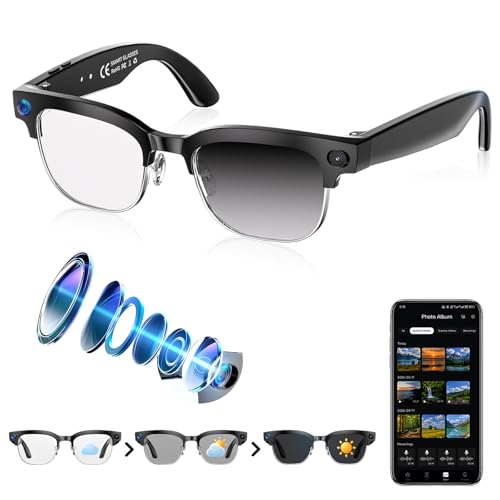
The SGUKZF model combines several travel-friendly tools in one frame. Its listed features include 4K EIS video and photo capture, real-time translation, object recognition, and open-ear Bluetooth audio. Open-ear sound lets you hear music or prompts without sealing your ears. That design can feel more aware than traditional earbuds when you walk, shop, or speak with someone nearby.
This model may suit users who want a broad feature set instead of one standout function. The camera supports richer video than a basic 1080p pair, while translation and recognition tools may add value on trips. Still, smart features often rely on software, a connected phone, and a stable network. I would test the app, voice commands, language support, and privacy controls soon after delivery, while the return window remains available.
Pros:
- 4K EIS video supports detailed hands-free clips
- Real-time translation may reduce language barriers
- Open-ear audio helps preserve awareness of nearby sounds
- Object recognition adds a practical visual tool
- Bluetooth supports calls, music, and spoken prompts
- Photochromic lenses can adapt to changing brightness
- Broad feature set suits travelers and curious early adopters
Cons:
- Many smart functions may depend on a companion app
- Open-ear audio is less private than sealed earbuds
- Translation accuracy can change with accents and background noise
- 4K use may shorten working time between charges
4K AI Glasses With Open-Ear Audio
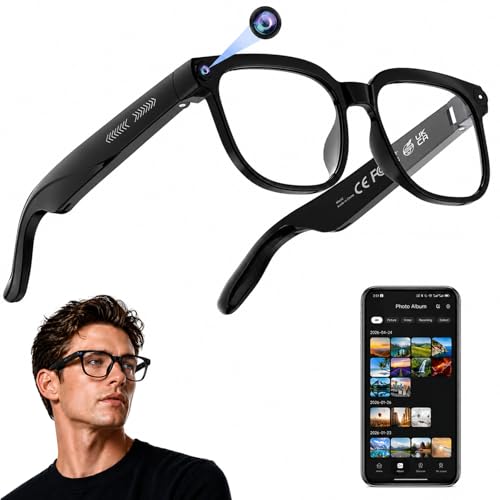
This transparent-lens model is built with travel and daily communication in mind. It lists 4K video and photo capture, real-time translation, an AI assistant, object recognition, Bluetooth, and open-ear audio. The transparent lens may appeal to buyers who need a clear everyday look rather than a dark sunglass style. That can make the glasses feel more suitable for offices, stores, museums, and indoor use.
The open-ear format is one of its most useful daily traits. I like this type of audio for voice prompts because it leaves the ear canal open and makes quick conversations easier. Sound quality and volume will still vary by fit, room noise, and frame design. If you plan to record in busy streets, remember that wind and traffic can affect both audio and voice commands.
Pros:
- 4K capture supports detailed photos and videos
- Transparent lenses fit indoor and office settings
- AI assistant offers hands-free access to commands
- Open-ear audio supports awareness around other people
- Translation tools may help during trips
- Object recognition adds another layer of daily utility
- Bluetooth connects the glasses to a compatible phone
Cons:
- Transparent lenses may not provide strong sun protection
- Open-ear sound can be harder to hear in loud areas
- Camera and AI features may require regular charging
- Some users may prefer a darker lens for outdoor use
AI Translation Glasses With Polarized Photochromic Lenses

This pair focuses on translation, comfort in bright conditions, and connected audio. The listing describes support for more than 100 languages, magnetic charging, polarized color-changing lenses, UV protection, and blue-light protection. Those features make it different from the camera-first models above. It may be a better match for someone who wants smart help during travel, driving, commuting, or business meetings.
Polarized lenses can reduce glare from flat surfaces such as roads and water, though they do not remove every bright reflection. The color-changing lens design may also help when moving between shade and sun. I would confirm the exact lens behavior, charging method, supported languages, and phone requirements before purchase. Translation glasses can be helpful, but they should support human conversation rather than replace patience, context, or a professional interpreter when accuracy matters.
Pros:
- Listed support for more than 100 languages
- Polarized lenses may reduce glare outdoors
- Photochromic lens design supports changing light
- Magnetic charging can make daily charging simple
- UV and blue-light protection add useful lens features
- Suitable for travel, commuting, and business use
- Bluetooth audio supports spoken translation and calls
Cons:
- Translation quality may vary by language and connection
- It may offer fewer camera tools than the 4K models
- Polarized lenses can affect some phone and dashboard screens
- Users should verify the protection rating before relying on it for intense sun
How AI Glasses Work in Daily Life
AI glasses are wearable computers shaped like ordinary frames. Depending on the model, they may include cameras, microphones, speakers, Bluetooth, touch controls, and a phone app. Some tasks happen on the glasses, while other tasks use a connected phone or cloud service. That split matters because the glasses may not work fully when the phone is far away or the internet is weak.
A camera can record a point-of-view clip or take a photo. Microphones can hear a voice command. Speakers can play music, calls, directions, or an AI reply. The result feels like a small helper near your face, but the experience depends on fit, battery power, app support, and a clear command.
In 2026, buyers should look past the word “AI.” Ask what the glasses can do today. Check whether the app supports your phone, whether the product receives firmware updates, and whether the maker explains how it stores photos or voice data. These details often matter more than a long feature list.
What I Look For in the Best AI Glasses for Everyday Use
Comfort and frame fit
Comfort comes first. A smart frame can have more weight than a standard pair because it contains a battery, camera, and electronics. Nose pads should sit firmly without pressure. The arms should not pinch your temples. If the frame slides while you walk, the camera view may tilt and the speakers may miss the best position.
I also look for a familiar shape. A frame that looks too unusual may stay at home, even if its technology is strong. The Best AI Glasses for Everyday Use should feel easy to wear for a walk, a trip to the store, or a full afternoon outside.
Camera quality and control
Camera numbers help, but they do not tell the whole story. Resolution can improve detail, yet lighting, lens quality, stabilization, and software also shape the final clip. A 4K mode may look impressive, but it can use more storage and power. A simple button or voice command also matters because missed moments cannot be recorded later.
Look for clear recording indicators. A small light or sound can help other people know when the camera is active. Never record in places where cameras are banned, and always respect local rules and personal privacy.
Open-ear audio
Open-ear audio sends sound toward the ear without sealing the ear canal. This can help users stay aware of cars, cyclists, coworkers, and family members. It is useful for short calls, music, navigation, and AI replies. It is not always ideal in a loud train station or beside heavy traffic.
Sound leakage can also affect privacy. If you hear sensitive work details, use a private headset instead. The Best AI Glasses for Everyday Use should fit your normal sound needs, not just look good in a product photo.
AI assistant and translation
Voice assistants can answer questions, set reminders, read information, or help with visual tasks. Translation features may read or speak another language. These tools can save time, but they are not perfect. Accents, slang, poor lighting, fast speech, and background noise can cause mistakes.
I suggest using AI as a guide. Confirm names, prices, addresses, medical details, and work facts before acting on them. For high-stakes tasks, a smart answer should never replace a qualified person.
Battery and charging
Camera use, Bluetooth audio, calls, and AI processing all use power. A pair may last much longer during light audio use than during repeated 4K recording. Charging time and the shape of the charging case matter too. Magnetic charging can be handy, but a lost cable or special case can make travel harder.
Before a trip, charge the glasses and phone together. Download any needed app updates. If the glasses store clips locally, leave enough space for new files. These small steps prevent the most common daily frustration: reaching for a smart feature and finding a dead battery.
Lens choice
Photochromic lenses can darken in bright light and become clearer indoors. They suit people who move between rooms, cars, sidewalks, and shops. The change may take time, and the result can vary by temperature and the type of light. A car windshield may also limit how much a photochromic lens reacts.
Polarized lenses can reduce glare outdoors. Clear lenses work better indoors and at night. If you need prescription lenses, confirm whether the frame supports prescription work and whether an eye-care professional must fit them. Do not assume every smart frame can accept custom lenses.
AI Glasses for Travel, Work, and Family Life
For travel
Travel is one of the clearest use cases. A camera can record a walking tour without holding a phone. Open-ear audio can provide a prompt while you look at a map. Translation may help with signs, menus, or short conversations. Still, download maps, carry a phone, and keep a backup plan.
At airports, museums, stores, and attractions, follow camera rules. Some locations ban recording. Other people may not want to appear in a video. A quick question before filming is a small act of respect.
For work and study
AI glasses may help with hands-free reminders, calls, and quick information. They can be useful for field work when your hands hold tools or materials. They may also help a student listen to a prompt while keeping notes on a desk. Yet recording coworkers, clients, or classrooms can create serious privacy issues.
Check company policy before using camera glasses at work. For meetings, visible consent is the safest approach. If a task involves private records, health information, or customer data, use approved equipment instead.
For parents and active users
Parents may enjoy hands-free clips during a walk or a child’s game. Cyclists, hikers, and travelers may like the ability to hear audio while staying aware. However, do not let a voice assistant distract you near traffic, water, stairs, or other hazards. Smart glasses should reduce phone handling, not reduce attention.
Privacy and Safety Tips Before You Buy
Camera glasses change the social setting around recording. A phone usually looks like a camera when you raise it. Glasses can look normal while recording, so clear signals and respectful use matter. Learn how the camera indicator works and do not cover it.
Read the privacy policy in plain terms. Find out whether recordings stay on the glasses, move to your phone, or upload to a cloud service. Check how to delete files and close the account. Use a strong phone password and keep the companion app updated.
Do not use AI glasses as a medical, legal, or emergency authority. Visual recognition can make a wrong guess. Translation can miss a key word. Navigation can lag. Treat the output as help, then confirm important information through a trusted source.
Also check local laws. Recording rules differ by state and location. Audio recording can need consent, especially in private conversations. When in doubt, ask before recording and turn off the camera.
How to Choose Your Best AI Glasses for Everyday Use
Start with your main task. If you want better clips, compare the 13MP and 4K options. If you want translation and glare control, the polarized translation model may make more sense. If you want a balanced feature set, the 8MP photochromic pair may offer a practical middle path.
Next, decide where you will wear them. Indoor users may prefer clear or transparent lenses. Outdoor users may want photochromic or polarized lenses. Commuters should focus on open-ear audio, comfort, battery life, and awareness. Travelers should check language support, app access, and offline limits.
Finally, check the return policy and current listing details. Product features can change through software updates. Amazon prices, stock, colors, and seller terms can also change. Read recent customer reviews for frame fit, battery behavior, app setup, and support. Those comments often reveal daily issues that a product title cannot show.
My Recommendation
For most shoppers, the 8MP AI Smart Glasses with a photochromic lens are the most balanced choice. They combine a useful camera, 1080p recording, Bluetooth audio, an AI assistant, recognition tools, and a lens suited to changing light. I see them as a sensible entry point for users who want everyday help without focusing only on maximum video resolution.
Choose the 13MP 4K model if image detail is your top goal. Pick the SGUKZF pair if translation, open-ear audio, and 4K capture all matter. The transparent-lens 4K model fits indoor travel and office use, while the polarized translation glasses suit glare, commuting, and language support. Each can compete for the Best AI Glasses for Everyday Use, but the right pick depends on the feature you will use most.
| Best for | Why |
|---|---|
| Everyday balance | 8MP photochromic glasses offer audio, AI tools, casual capture, and flexible lenses. |
| Travel and translation | SGUKZF and the polarized translation model focus on language help and open-ear use. |
| Video detail | The 13MP and 4K models target sharper clips with electronic stabilization. |
FAQs Of Best AI Glasses for Everyday Use
Do AI glasses work without a phone?
Some basic functions may work on the glasses, but advanced AI, translation, storage, and sharing often need a paired phone or internet connection. Check the exact app requirements before buying.
Are AI glasses safe to wear while driving?
They can distract you, especially when you use the camera, read prompts, or change audio. Follow local laws and keep your focus on the road. Never use a smart feature if it reduces safe driving.
Can AI glasses replace prescription glasses?
Not always. Some frames may accept prescription lenses, but you must confirm compatibility. Ask an eye-care professional to fit prescription lenses correctly.
Are photochromic lenses good at night?
They are usually designed to become clearer indoors, but check the product details. Do not assume a tinted lens is suitable for night driving.
How private are camera glasses?
Privacy depends on the camera light, app, storage method, and how you use the glasses. Tell people before recording, follow posted rules, and delete files you do not need.
Final Verdict: Which Should You Buy?
The 8MP photochromic model is my top all-around pick for the Best AI Glasses for Everyday Use. Choose the 13MP 4K pair for sharper clips, or the translation-focused models for travel and open-ear help.
Compare lens type, app support, battery needs, and privacy tools before ordering. The best AI glasses are the ones you will wear often, use safely, and understand clearly.