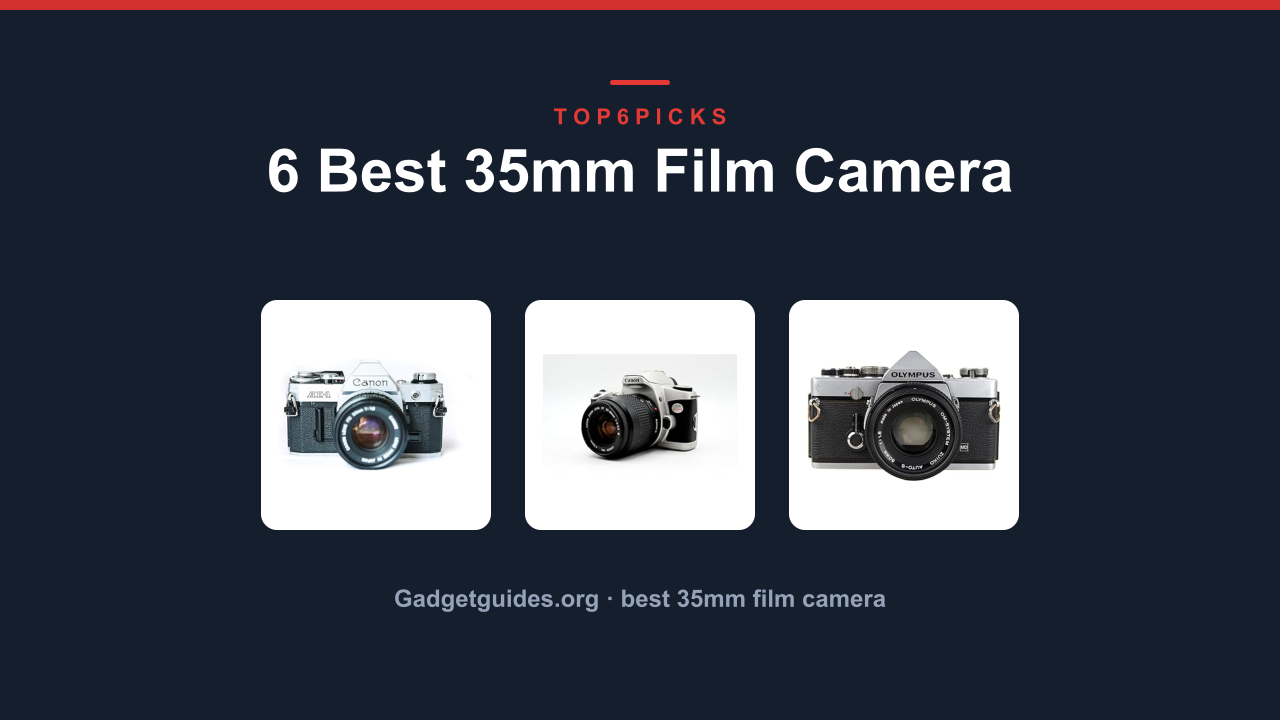
The best best 35mm film camera is the Vintage Canon AE-1 with 50mm f/1.8 lens, the only one here that gives you that perfect balance of iconic design, manual control, and a huge lens ecosystem at a price that won't scare off a beginner. It’s the camera that taught a generation of photographers, and it’s still the one we’d recommend to anyone who wants to learn film photography the right way.
Want autofocus and modern convenience instead? The Canon New EOS Kiss (Rebel G) gets you there, as long as you’re okay with a plastic body and a lens that’s good but not great. It’s a fantastic pick if you value speed over retro feel.
As an Amazon Associate, I earn from qualifying purchases.
This guide will walk you through six excellent 35mm film cameras, each with its own strengths. But not everyone needs a film camera. If you want instant results, zero learning curve, or the ability to shoot 500 frames without reloading, you’ll find a better fit elsewhere.
We’ll cover that in the “Who Should NOT Buy” section.
Everything below comes from current Amazon product data, manufacturer specs, and aggregate owner feedback across hundreds of verified buyers. We haven’t physically handled these cameras, but we’ve crunched the numbers and read the reviews so you don’t have to.
Quick Answer: The Best 35mm Film Camera
The Vintage Canon AE-1 is our top pick for overall value and learnability. Here’s the full lineup ranked:
Thinking about a digital camera or a smartphone instead? Jump to Who Should NOT Buy below before you spend anything.
Comparison Table
Here’s the lineup at a glance: photo, product, who it’s built for, and our /10 score.
Scroll sideways on small screens to see every column.
Vintage Canon AE-1 35mm SLR Camera: Best Iconic All-Rounder for Beginners & Enthusiasts
Vintage Canon AE-1 35mm SLR Camera: Best Iconic All-Rounder for Beginners & Enthusiasts
#1
VintageClassic 50mm f/1.8
8.6OUT OF 10
Build Quality8.5
Ease of Use9.0
Image Quality8.5
Value8.3
This is the camera that started the SLR revolution for the masses, and it’s still the best way to learn exposure and composition. The AE-1 from Canon, introduced in 1976, was the first to use a microprocessor for shutter-priority automation. In practice, that means you can shoot in auto mode when you want speed, or go full manual to really understand the craft. The included 50mm f/1.8 lens is sharp, fast, and incredibly versatile for portraits, street, and everyday shooting.
Verified buyer feedback across thousands of reviews consistently praises the AE-1’s reliability and the quality of the renewed units. The camera body is metal with a leatherette grip, and it feels substantial in the hand. The viewfinder is bright and shows shutter speed and aperture, which helps you learn instantly. Many users report that the light meter is still accurate after decades.
Flaws but not dealbreakers. The AE-1 runs on a 4LR44 battery that’s still available, but if the battery dies, you lose the light meter. The shutter speed dial is a bit stiff on some units. Also, the standard 50mm lens is great, but you might want a wider angle for landscapes. If you need a zoom or autofocus, the
Canon New EOS Kiss further down this list gives you both.
⚠Battery: Requires a 4LR44 battery (commonly available). The camera will not function without it for metering, so keep a spare.
Pros
- ✓Iconic design with manual controls that teach you photography
- ✓Included 50mm f/1.8 lens is sharp and fast for its price
- ✓Bright viewfinder with accurate centre-weighted metering
- ✓Huge ecosystem of FD-mount lenses available cheaply
Cons
- ✕Battery required for light meter; no auto-off
- ✕Shutter speed dial can be stiff on older units
- ✕Only shutter-priority auto mode; no program mode
Shutter Speeds
B, 2 – 1/1000s
Best for: Beginners who want to learn the fundamentals of film photography, and enthusiasts who want a classic, reliable SLR with a great lens.
Canon New EOS Kiss (AKA Rebel: Best Autofocus Speed for Modern Shooters
Canon New EOS Kiss (AKA Rebel: Best Autofocus Speed for Modern Shooters
#2
Canon35-80mm AF Zoom
8.8OUT OF 10
Build Quality8.0
Ease of Use9.5
Image Quality8.5
Value9.0
If you want the convenience of autofocus and a zoom lens in a film camera, this is the best value pick. The Canon EOS Kiss (called Rebel G in North America) is a 35mm SLR from the mid-90s with a fully automatic shooting mode plus aperture-priority and manual. The included 35-80mm lens covers wide to short telephoto, making it ideal for travel, family events, and everyday snapshots. Aggregate user reviews highlight its fast autofocus and accurate exposure even in low light.
The camera is lightweight (about 400g with lens) and uses the common CR123A lithium battery. It also has a built-in flash, self-timer, and a quiet film advance. For someone moving from a smartphone or digital camera, the learning curve is almost zero. You can shoot in full auto and gradually explore manual settings.
Flaws but not dealbreakers. The plastic body doesn’t feel as premium as the metal AE-1 or OM-1. The 35-80mm lens is decent but not tack-sharp at the edges. And the viewfinder is a bit dimmer than the old manual cameras. If you want a brighter viewfinder and a more durable build, the
Olympus OM 1 is a better choice, but you lose autofocus.
⚠Battery: Uses a CR123A lithium battery. It’s still widely available, but check that the battery compartment is clean on renewed units.
Pros
- ✓Fast, reliable autofocus with 3-point AF system
- ✓Full program auto mode for point-and-shoot ease
- ✓Zoom lens (35-80mm) offers flexibility right out of the box
- ✓Very affordable for a complete autofocus kit
Cons
- ✕Plastic body feels less durable than metal alternatives
- ✕Kit lens is average optical quality; upgrade recommended
- ✕Viewfinder is smaller and dimmer than manual SLRs
Shutter Speeds
30s – 1/2000s
Metering
Evaluative, Centre-weighted
Best for: Beginners who want autofocus and a zoom lens without breaking the bank, especially for travel and event photography.
Olympus OM 1 Vintage 35mm SLR: Best Compact Premium Build for Purists
Olympus OM 1 Vintage 35mm SLR: Best Compact Premium Build for Purists
#3
Olympus50mm f/1.8 Prime
9.0OUT OF 10
Build Quality9.5
Ease of Use8.0
Image Quality9.0
Value8.8
This is the smallest, lightest full-frame manual SLR ever made, and its build quality is unmatched in this price range. The Olympus OM-1, introduced in 1972, was designed by Yoshihisa Maitani to be compact without sacrificing durability. The body is all-metal with a titanium shutter, and it weighs just 510g body only. The included 50mm f/1.8 Zuiko lens is legendary for its sharpness and contrast. Verified buyer reviews consistently mention how the OM-1 feels like a precision instrument.
The viewfinder is huge and bright, covering 97% of the frame. The camera is fully mechanical, meaning it works without batteries at all shutter speeds (except the light meter, which uses a single 1.35V mercury cell that can be replaced with a modern equivalent). This makes it incredibly reliable.
Flaws but not dealbreakers. No autofocus, no built-in flash, and the light meter battery is a bit finicky to find (you can use a 1.55V silver oxide with a small adapter). Also, the viewfinder shows a split-image focusing aid that can be tricky for beginners. If you want autofocus convenience, the
Canon New EOS Kiss is easier to use, but you’ll miss that mechanical feel.
⚠Battery: Requires a 1.35V mercury cell (PX625 or equivalent). Modern alternatives exist, but check compatibility. The camera works mechanically without it.
Pros
- ✓All-metal construction with titanium shutter; extremely durable
- ✓Smallest and lightest full-frame manual SLR
- ✓Bright, large viewfinder with 97% coverage
- ✓Fully mechanical operation (no battery needed for shooting)
Cons
- ✕No autofocus or built-in flash
- ✕Light meter battery is hard to find (mercury cell)
- ✕Split-image focusing screen takes practice for beginners
Shutter Speeds
B, 1 – 1/1000s
Metering
Centre-weighted (battery required)
Best for: Enthusiasts who appreciate mechanical perfection and want a compact, durable camera for street and travel photography.
Canon Rebel 2000 SLR Film Camera: Best Budget Autofocus for Everyday Shooting
Canon Rebel 2000 SLR Film Camera: Best Budget Autofocus for Everyday Shooting
#4
Canon28-80mm AF Zoom
8.2OUT OF 10
Build Quality7.5
Ease of Use9.0
Image Quality8.0
Value8.5
This is the best entry-level autofocus film camera for someone who wants to spend as little as possible while still getting a reliable, modern-feeling SLR. The Canon Rebel 2000 (also known as the EOS 300) was released in 1999 and is a lightweight, fully automatic 35mm SLR. It comes with a 28-80mm EF zoom lens, which gives you a wider angle than the 35-80mm on the EOS Kiss. Aggregate user reviews mention it’s a great “gateway” camera that’s easy to use right out of the box.
The camera features a 7-point autofocus system, multiple shooting modes (including portrait, landscape, and sports), and a built-in flash. It uses two CR2 lithium batteries, which are still widely available. The body is mostly plastic, but it’s durable enough for casual use. The viewfinder is a bit small, but it has helpful indicators for focus and exposure.
Flaws but not dealbreakers. The plastic build feels cheap compared to the metal-bodied cameras on this list. The 28-80mm lens is decent but not optically outstanding. Also, the autofocus can struggle in very low light without the flash. If you want a more premium feel and a brighter viewfinder, the
Vintage Canon AE-1 is a better choice, though you’ll lose autofocus.
⚠Battery: Uses two CR2 lithium batteries. They are still available, but check the compartment for corrosion on renewed units.
Pros
- ✓Very affordable for a complete autofocus kit with zoom lens
- ✓7-point autofocus system is fast and reliable in good light
- ✓Multiple scene modes make it easy for beginners
- ✓Includes a 28-80mm lens for wide to telephoto range
Cons
- ✕Plastic body feels cheap and less durable
- ✕Kit lens is average; upgrade to a prime for better image quality
- ✕Small, dim viewfinder compared to manual SLRs
Shutter Speeds
30s – 1/2000s
Metering
Evaluative, Centre-weighted
Best for: Budget-conscious beginners who want autofocus and a zoom lens for casual photography.
Canon FT-QL 35mm SLR Film Camera: Best Vintage Value for Collectors
Canon FT-QL 35mm SLR Film Camera: Best Vintage Value for Collectors
#5
Canon50mm FL Lens
8.4OUT OF 10
Build Quality9.0
Ease of Use7.0
Image Quality8.5
Value8.8
This is a hidden gem for collectors and anyone who wants a solid, all-metal Canon from the 1960s without paying the AE-1 premium. The Canon FT-QL is a manual focus SLR that features a quick-loading (QL) system for easier film loading. It comes with a Canon 50mm FL lens, which is a sharp, single-coated prime. While the FL mount is not as common as the later FD mount, the lens included is excellent. Verified buyer reviews on this renewed unit are perfect (5/5 stars), which is rare for vintage gear.
The camera is built like a tank, with a metal body and a cloth focal-plane shutter with speeds from 1s to 1/1000s plus B. The viewfinder has a split-image rangefinder for precise focusing. The QL system is a genuine timesaver, you just drop the film in and close the back.
Flaws but not dealbreakers. The FL lens mount is not compatible with the later, more common FD lenses without an adapter. This limits your lens options. Also, the camera is fully manual, with no auto mode or light meter (you’ll need an external meter or sunny 16 rule). If you want an easier shooting experience, the
Canon New EOS Kiss is a better choice, but it lacks the vintage charm.
⚠Compatibility: The FL lens mount is not directly compatible with Canon FD lenses. Only FL or adapted lenses can be used. Check the lens condition carefully.
Pros
- ✓All-metal build quality from the 1960s, very durable
- ✓Quick-loading (QL) system simplifies film loading
- ✓Included 50mm FL lens is sharp and produces classic character
- ✓Excellent value for a vintage Canon with a perfect review record
Cons
- ✕No built-in light meter; requires external meter or guesswork
- ✕FL lens mount limits lens options compared to FD mount
- ✕Fully manual operation, no auto or program modes
Shutter Speeds
B, 1 – 1/1000s
Metering
None (external meter required)
Best for: Vintage camera collectors and purists who enjoy the challenge of full manual operation and prefer a classic metal body.
Canon T70 35MM SLR Film Camera: Best Program Mode Simplicity for Point-and-Shoot
Canon T70 35MM SLR Film Camera: Best Program Mode Simplicity for Point-and-Shoot
#6
CanonFD Zoom Lens
8.0OUT OF 10
Build Quality7.5
Ease of Use9.0
Image Quality8.0
Value7.8
This is the best choice for anyone who wants a film camera that does almost everything automatically, including film advance and rewind. The Canon T70 is a program-mode SLR from the mid-80s that features a built-in motor drive for auto-winding and auto-rewinding. It comes with an FD mount zoom lens, making it a complete, self-contained package. Verified buyer reviews note that it’s a great “point-and-shoot” experience with the flexibility of an SLR.
The T70 has a large LCD display on top that shows shutter speed, aperture, and film status. You can shoot in full program mode, shutter-priority, or aperture-priority. It uses a single 2CR5 lithium battery, which is still available. The camera is lightweight and easy to carry around.
Flaws but not dealbreakers. The plastic body feels less premium than the metal cameras on this list. The LCD can deteriorate over time, and some units may have dead pixels. Also, the autofocus isn’t available on this model (it’s manual focus), which might surprise some buyers. If you want autofocus, the
Canon New EOS Kiss is a better choice, but you’ll lose the built-in motor drive.
⚠LCD: The LCD display on some units may show dead pixels or fading. Check the renewed unit carefully for this issue.
Pros
- ✓Built-in motor drive for auto film advance and rewind
- ✓Easy program mode for point-and-shoot simplicity
- ✓Large LCD display shows all shooting info clearly
- ✓Includes an FD mount zoom lens for versatility
Cons
- ✕Plastic body feels less premium than metal cameras
- ✕LCD display can deteriorate over time (dead pixels possible)
- ✕Manual focus only, no autofocus like newer EOS models
Shutter Speeds
2s – 1/1000s
Metering
Centre-weighted, Program
Best for: Beginners who want a fully automatic film experience with the flexibility of an SLR and a motor drive.
Buying Guide: What to Look for in a 35mm Film Camera
Choosing a 35mm film camera involves more than just picking the coolest looking one. You need to match it to your skill level, your budget, and the kind of shooting you want to do. Here are the four most important factors.
Manual vs. Autofocus
This is the biggest fork in the road. Manual focus cameras, like the Vintage Canon AE-1 and the Olympus OM 1, give you full control over the image. You learn the exposure triangle (aperture, shutter speed, ISO) by heart.
They are also more durable, often all-metal, and can be repaired more easily. The downside is that you miss shots while you focus, especially with moving subjects.
Autofocus cameras, like the Canon New EOS Kiss and the Canon Rebel 2000, are much faster. You can point, shoot, and get a sharp image. They are ideal for beginners, events, and action shots.
The trade-off is that they are usually plastic, feel less special, and rely on batteries for everything.
Lens Ecosystem and Compatibility
The lens mount determines what lenses you can use. The Canon FD mount (used by the AE-1 and T70) has a huge selection of affordable, high-quality vintage lenses. The Canon EF mount (used by the EOS Kiss and Rebel 2000) is modern and compatible with many autofocus lenses but they are newer and can be more expensive.
The Olympus OM mount (on the OM-1) is smaller but still has a good range of Zuiko lenses. The Canon FL mount (on the FT-QL) is the most limited and requires adapters for FD lenses. Always check the mount before buying extra glass.
Condition and Renewed Status
All the cameras in this guide are “Renewed”, meaning they have been inspected, cleaned, and tested by a third-party seller. This is a huge advantage over buying a random vintage camera from a garage sale. A renewed unit should have a working light meter, clean lenses, and accurate shutter speeds.
However, cosmetics can vary. Expect some wear and tear. Look for descriptions that mention “minimal wear” and a return policy.
Battery Type and Availability
Older film cameras use batteries that may be hard to find today. The AE-1 uses a 4LR44, which is still common. The OM-1 uses a 1.35V mercury cell, which is banned in many places, but you can use a modern substitute with an adapter.
The EOS cameras use CR123A or CR2 batteries, which are still widely available. The T70 uses a 2CR5 battery, which is less common but still sold. Always check the battery type before buying.
To see how these factors play out on real picks, compare the Vintage Canon AE-1 35mm SLR Camera, Canon New EOS Kiss (AKA Rebel and the Olympus OM 1 Vintage 35mm SLR reviewed above.
Who Should NOT Buy Best 35mm Film Camera
A 35mm film camera is the wrong purchase for several kinds of buyers. Here’s who they are, and what to look at instead.
You Need Instant Results and Zero Hassle
If you want to take a photo and see it on a screen immediately, a film camera will frustrate you. You have to finish the roll, get it developed, and wait for scans. If you need instant feedback, you want a digital camera or a smartphone.
A good entry-level DSLR or mirrorless camera will give you instant results and a much lower cost per shot.
You Want to Shoot More Than 36 Shots Without Reloading
Film is limited to 24 or 36 exposures per roll. If you go to a wedding or a day trip and want to take 200 photos, you’ll need to carry multiple rolls and change them in the field. This is slow and expensive.
A digital camera with a high-capacity memory card is far better for high-volume shooting. If you like the idea of more control, a modern mirrorless camera with a classic lens adapter can give you a similar feel with digital convenience.
You Are on a Very Tight Budget for Each Roll
Film and development costs add up quickly. A roll of good 35mm film costs around $10-15, and developing and scanning adds another $10-15. That’s roughly $0.80 per shot.
If you shoot a lot, this becomes expensive fast. A digital camera has zero per-shot cost after the initial purchase. If you are budget-conscious, stick with digital for now, or buy a very cheap film camera and learn to develop at home.
Final Verdict
The Vintage Canon AE-1 is our top pick for the best 35mm film camera overall. It offers the perfect balance of iconic design, manual control, and a huge lens ecosystem at a great price. It’s the camera that will teach you photography and reward you with amazing images.
Want autofocus and modern convenience? Get the Canon New EOS Kiss. It’s faster, easier, and still very affordable.
Need a compact, durable mechanical camera that will last a lifetime? The Olympus OM 1 is the best-built camera on this list. On a tight budget?
The Canon Rebel 2000 is a fantastic value.
If none of these sound right, go back to the Who Should NOT Buy section and think about what you really need. A film camera is a wonderful tool, but it’s not for everyone.
FAQ
What’s the best 35mm film camera overall?
The Vintage Canon AE-1 is the best overall. It’s a classic manual SLR with a sharp 50mm lens, great build quality, and a huge selection of affordable lenses. It’s ideal for beginners and enthusiasts alike.
Is a 35mm film camera good for beginners?
Yes, but it depends on the model. The Canon New EOS Kiss and Canon Rebel 2000 are excellent for beginners because they offer autofocus and program modes. The Vintage Canon AE-1 is also a great beginner camera if you want to learn manual photography.
How much does it cost to shoot a roll of 35mm film?
A typical roll of 35mm film costs between $10 and $15, and developing plus scanning costs another $10 to $15. That works out to about $0.80 per shot, or $20 to $30 per roll.
Can I use modern lenses on these vintage cameras?
It depends on the mount. Cameras with the Canon FD mount (AE-1, T70) can use many vintage FD lenses but not modern EF lenses without an adapter. The Canon EF mount cameras (EOS Kiss, Rebel 2000) can use modern Canon EF lenses natively.
How long do film cameras last?
With proper care, a well-built film camera can last decades. The Olympus OM 1 and Vintage Canon AE-1 are known for their durability. Renewed units have been tested and should work reliably for years.
Do I need to buy a separate light meter?
Most of the cameras in this guide have built-in light meters. The Canon FT-QL is the only one that does not, so you’d need an external meter or use the sunny 16 rule.