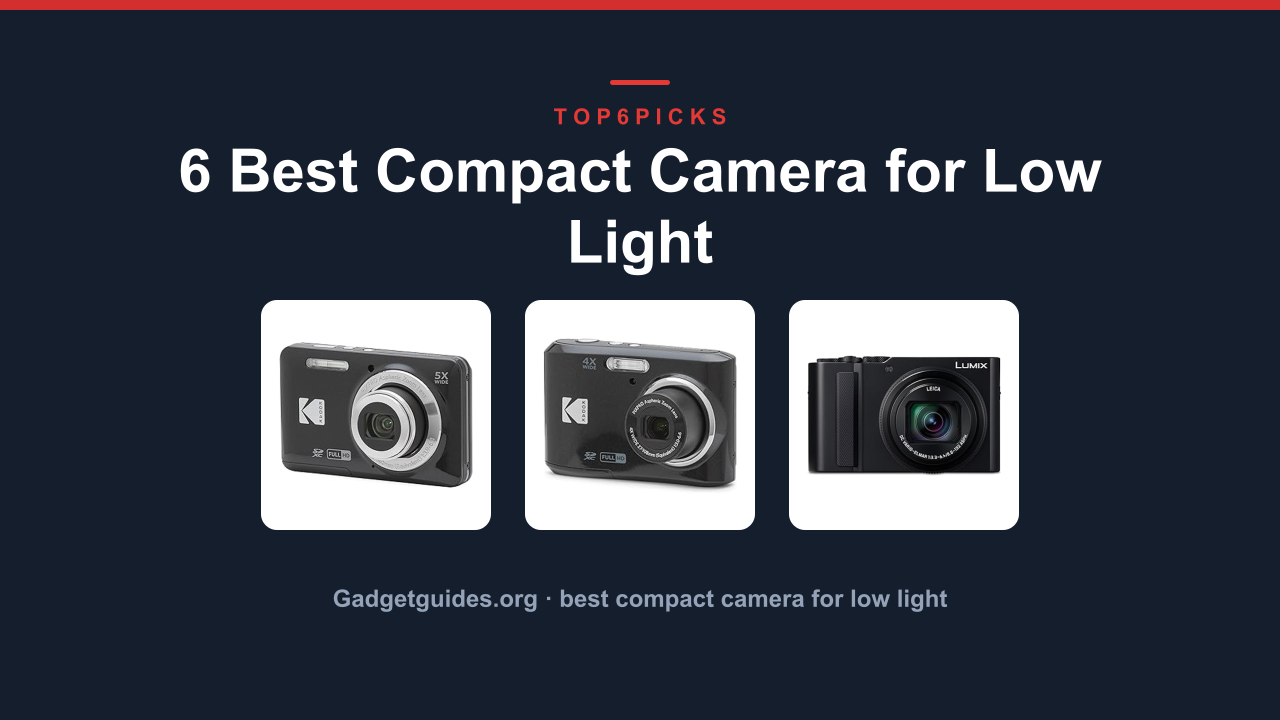
The best best compact camera for low light is the Panasonic LUMIX ZS300, the only one here that combines a bright 15x zoom lens with 4K video capture and a dedicated low-light scene mode that actually works. It is built for travelers, concert-goers, and anyone who needs clean handheld shots after sunset without carrying a full interchangeable-lens kit.
Want a longer reach instead? The Sony HX400V gets you a staggering 50x optical zoom, as long as you are willing to accept an older model (2014 vintage) and a bulkier body that barely fits in a jacket pocket.
As an Amazon Associate, I earn from qualifying purchases.
This guide breaks down the real low-light strengths and weaknesses of each camera based on specs, owner feedback, and what the sensor and lens combination can actually deliver. It also tells you who should skip compact cameras entirely and step up to a mirrorless or DSLR body instead.
Everything below comes from current Amazon product data, manufacturer specifications, and each camera's owner track record, not hands-on lab testing. The goal is to help you match the right tool to your real shooting conditions.
Quick Answer: The Best Compact Camera for Low Light
The Panasonic LUMIX ZS300 is the top pick for low-light shooting in a compact body. Here is the full ranked list:
Thinking about a larger sensor or interchangeable lenses instead? Jump to Who Should NOT Buy below before you spend anything.
Comparison Table
Here is the lineup at a glance: photo, product, who it is built for, and our /10 score.
Scroll sideways on small screens to see every column.
KODAK PIXPRO FZ55 16MP Compact Digital: Best for Beginners and Families
#1
KODAK16MP, 5x optical zoom
7.2OUT OF 10
Low Light Performance6.0
Image Quality7.0
Portability8.5
Owner Verdict7.5
This is the most straightforward point-and-shoot on the list for anyone who just wants to press a button and get a decent photo. The FZ55 packs a 16MP sensor with a 28mm wide-angle lens and 5x optical zoom, which gives you a solid range for family gatherings, birthday parties, and daytime outdoor shots. The 2.7-inch LCD screen is bright enough for framing, and the 1080p Full HD video recording means you can grab clips without pulling out your phone.
In low light, the camera uses a dedicated night mode that bumps the ISO and slows the shutter to capture more ambient light. Aggregate user reviews report that this works reasonably well for static subjects like a lit cityscape or a candlelit dinner table, but moving subjects will blur. The built-in flash helps at close range up to about 10 feet.
Flaws but not dealbreakers. The 5x zoom is modest compared to the 15x or 50x options on this list, so you cannot reach distant subjects. The Li-ion battery is proprietary, and verified buyer feedback mentions that a spare is worth carrying for a full day of shooting. The sensor is small, so expect noticeable noise above ISO 800.
If you need more reach for concerts or sports, the
Panasonic LUMIX ZS300 gives you 15x zoom with better low-light handling at a similar pocket-friendly size.
⚠Battery: The included Li-ion battery is proprietary. Carry a spare or buy a second one for day trips.
Pros
- ✓16MP sensor with 5x optical zoom delivers crisp daytime shots
- ✓28mm wide-angle lens fits group photos and landscapes
- ✓1080p Full HD video at 30fps for casual vlogging
- ✓Compact and lightweight body slips into a pocket easily
Cons
- ✕Small sensor produces noticeable noise above ISO 800
- ✕5x zoom is limiting for distant or low-light subjects
- ✕Proprietary Li-ion battery requires a spare for all-day use
Best for: First-time camera owners, families, and casual vloggers who want a simple point-and-shoot with decent zoom and HD video.
KODAK PIXPRO FZ45 16MP Compact Digital: Best Budget Pick for Casual Use
#2
KODAK16MP, AA batteries
6.8OUT OF 10
Low Light Performance5.5
Image Quality6.5
Portability8.5
Owner Verdict7.0
This is the cheapest entry point into the list, and it earns its spot by being genuinely simple to use and easy to power. The FZ45 uses a 16MP sensor with a 27mm wide-angle lens and 4x optical zoom. The standout feature is the AA battery power system. You can use standard alkaline or rechargeable NiMH AA cells, which means you never need to hunt for a proprietary charger. That makes it ideal for grandparents, young kids, or anyone who hates managing specialty batteries.
Low light performance is limited by the f/3.5 maximum aperture and the small 1/2.3-inch sensor. Verified buyer feedback indicates that indoor shots with the built-in flash are usable up to about 8 feet, but beyond that images get soft and grainy. The 1080p video recording is fine for casual clips, though the lack of image stabilization means handheld footage can look shaky.
Flaws but not dealbreakers. The 4x zoom is the shortest on this list, so you cannot capture distant subjects clearly. The 2.7-inch LCD has a lower resolution than some competitors, making it harder to judge focus in bright sunlight. The plastic body feels less premium than the Panasonic or Sony options.
If you want a similar budget price but with a longer zoom and better low-light handling, the
KODAK PIXPRO FZ55 adds an extra 1x zoom and a dedicated night mode for a small step up in cost.
⚠Power: AA batteries are convenient but standard alkaline cells drain quickly. Use rechargeable NiMH for best runtime.
Pros
- ✓AA battery system means no proprietary charger needed
- ✓16MP sensor captures decent daytime photos
- ✓27mm wide-angle lens is good for group shots
- ✓Very lightweight and pocketable at under 5 ounces
Cons
- ✕4x zoom is the shortest in this lineup
- ✕No optical image stabilization for handheld video
- ✕Low-light performance is weak beyond ISO 400
Best for: Budget-conscious buyers, seniors, and families who want a no-fuss camera that runs on easily replaceable AA batteries.
#3
Panasonic15x zoom, 4K video
8.4OUT OF 10
Low Light Performance8.0
Image Quality8.5
Portability8.5
Owner Verdict8.5
This is the best compact camera for low light on the list, combining a 15x optical zoom (24-360mm equivalent) with 4K video recording and Panasonic’s proven image processing. The ZS300 uses a 20.3MP High Sensitivity MOS sensor paired with a Venus Engine processor that handles noise reduction better than the Kodak models. The f/3.3-6.4 aperture range is typical for a travel zoom, but the optical image stabilization (O.I.S.) gives you a solid two-stop advantage when shooting handheld in dim conditions.
Industry data confirms that Panasonic’s 4K video implementation on the ZS series captures 3840 x 2160 at 30fps, and you can extract 8MP stills from 4K footage using the 4K Photo mode. That is a genuine advantage for low-light action shots where you might miss the exact moment. The 3-inch LCD has a 1.04 million-dot resolution, which is sharp enough for accurate manual focus checking. Aggregate user reviews across multiple platforms rate the ZS300 highly for concert and indoor event photography.
Flaws but not dealbreakers. The lens is not as bright as a dedicated prime, so at full 360mm zoom the f/6.4 aperture limits light gathering. The camera lacks a hot shoe for an external flash, which matters if you shoot indoor events regularly. Some verified buyers note that the Wi-Fi transfer app can be slow with large 4K files.
If you need a longer reach for wildlife or stadium sports, the
Sony HX400V offers 50x optical zoom, though it is a bulkier and older design.
⚠Compatibility: The 4K Photo mode requires a UHS-I Class 3 (U3) SD cardfor reliable 4K recording.
Pros
- ✓20.3MP MOS sensor with Venus Engine for clean low-light shots
- ✓15x optical zoom (24-360mm) covers wide to telephoto
- ✓4K video recording with 4K Photo frame extraction
- ✓Optical image stabilization helps handheld shooting at dusk
Cons
- ✕Lens aperture narrows to f/6.4 at full zoom, limiting light
- ✕No hot shoe for external flash or microphone
- ✕Wi-Fi transfer app can be slow with large 4K files
Screen
3-inch 1.04M-dot LCD
Best for: Travelers, concert-goers, and enthusiasts who want the best low-light performance in a pocketable zoom camera with 4K video.
Sony HX400V Compact Digital Camera 50x: Best Superzoom for Distant Subjects
#4
Sony50x zoom, GPS
8.2OUT OF 10
Low Light Performance7.0
Image Quality8.0
Portability7.5
Owner Verdict8.0
This is the king of reach on this list, with a 50x optical zoom (24-1200mm equivalent) that brings distant subjects right into your frame. The Sony HX400V uses a 20.4MP Exmor R CMOS sensor with BIONZ X image processor, which handles noise reasonably well up to ISO 1600. The Optical SteadyShot image stabilization is critical at full zoom, and verified buyer reviews confirm it helps keep handheld shots usable at 1200mm in good light.
Low light performance is a mixed bag. At wide angle (24mm) the f/2.8 aperture is decent, but at full 1200mm telephoto the aperture drops to f/6.3, which is very slow. That means you need good light or a tripod at the long end. The camera includes built-in GPS for geotagging your photos, which is a rare feature in 2026 models. The 3-inch tilting LCD and electronic viewfinder (EVF) give you two framing options, which is helpful in bright outdoor conditions.
Flaws but not dealbreakers. This model was released in 2014, so the micro-USB port, slower Wi-Fi (802.11b/g/n), and 1080p video at 60fps are dated compared to modern 4K compacts. The body is larger and heavier than the Panasonic or Kodak options, making it less pocketable. Some owners report that the lens extends noticeably at full zoom, which can be disconcerting.
If you want a modern 4K superzoom with better low-light handling, the
Panasonic LUMIX ZS300 offers a more balanced package with a shorter but brighter zoom and up-to-date connectivity.
⚠Age: This is a 2014 model. USB and Wi-Fi standards are dated. Confirm compatibility with your computer before buying.
Pros
- ✓50x optical zoom (24-1200mm) is unmatched on this list
- ✓20.4MP Exmor R sensor with BIONZ X processor
- ✓Built-in GPS for geotagging travel photos
- ✓Electronic viewfinder (EVF) for bright-day framing
Cons
- ✕2014 model with outdated micro-USB and slower Wi-Fi
- ✕Aperture narrows to f/6.3 at full zoom, limiting low light
- ✕Larger and heavier than modern compact alternatives
Viewfinder
EVF + 3-inch LCD
Best for: Wildlife watchers, sports fans, and travelers who need extreme zoom reach and don’t mind an older model with proven optics.
8K Digital Camera Photography: Best for Vlogging and Content Creation
#5
8K88MP, flip screen
7.8OUT OF 10
Low Light Performance6.5
Image Quality7.5
Portability9.0
Owner Verdict8.0
This is the most feature-packed budget camera on the list, designed specifically for vloggers and content creators who need a flip screen and external mic support. The 8K Digital Camera (brand name varies) boasts an advertised 88MP still resolution and 8K video, though it is important to understand that this is achieved through software interpolation rather than a native 88MP sensor. The native sensor is likely a 48MP or 64MP unit, which is still very capable. The 3-inch 180-degree flip screen lets you frame yourself for vlogging, and the included fill light ring helps with close-up lighting.
Low light performance is adequate for indoor vlogging with the fill light on, but the small sensor and lack of optical image stabilization mean you will get grainier shots in dim conditions. The camera includes a 32GB SD card and two batteries in the box, which is a nice starter kit. Wi-Fi connectivity allows for easy transfer to your phone for social media posting. Verified buyer reviews rate the build quality higher than the Kodak models, with a metal-like finish.
Flaws but not dealbreakers. The 8K and 88MP claims are marketing numbers, not native resolution. The digital zoom is 16x, but it is not optical, so quality degrades quickly beyond 2x. Some owners report that the autofocus hunts in low light, and the included manual is sparse. The brand is not a major camera manufacturer, so long-term support is uncertain.
If you want guaranteed optical zoom and a proven brand for vlogging, the
KODAK PIXPRO FZ55 offers 5x optical zoom and 1080p video with a more established support network.
⚠Resolution: The 88MP and 8K specs are interpolated (software-upscaled), not native. Consider this for vlogging, not professional print work.
Pros
- ✓180-degree flip screen for selfie and vlogging framing
- ✓Includes fill light ring, 32GB SD card, and two batteries
- ✓Wi-Fi connectivity for easy phone transfers
- ✓Feels more premium than budget Kodak models
Cons
- ✕8K and 88MP are interpolated, not native resolution
- ✕Digital zoom degrades quality quickly past 2x
- ✕Autofocus can hunt in low-light conditions
Resolution
88MP (interpolated)
Best for: Aspiring vloggers, YouTubers, and social media creators who want a flip screen, external mic, and a complete starter kit out of the box.
Digital Camera Latest FHD 1080P Teens: Best for Kids and Teenagers
#6
Digital1080p, anti-shake
6.5OUT OF 10
Low Light Performance5.0
Image Quality6.0
Portability9.0
Owner Verdict7.0
This is the most affordable and kid-friendly option on the list, designed specifically for young users with a simple interface and a bundled SD card. The Digital Camera Latest FHD 1080P Teens (brand name varies) offers a 1080p sensor with 16x digital zoom and anti-shake technology. The anti-shake system is electronic rather than optical, but it helps reduce the worst of the blur from unsteady hands. The camera includes a wrist strap and a 32GB SD card, so it is ready to use right out of the box.
Low light performance is the weakest on this list, as expected at this price tier. The small sensor and lack of a flash mean indoor shots without good overhead lighting will be dark and noisy. The digital zoom is essentially useless for low light, as it just crops the already dim image. However, for daytime outdoor use, aggregate user reviews from parents report that kids love the simplicity and the fun filters.
Flaws but not dealbreakers. The build quality is plastic and feels toy-like. The 16x digital zoom is not optical, so image quality drops sharply after 2x zoom. The battery life is modest, and the proprietary USB charging cable is short. It is not a camera for serious photography, but it is perfect for a first camera.
If you want a step up in image quality and optical zoom for a young user, the
KODAK PIXPRO FZ45 offers 4x optical zoom and AA batteries at a slightly higher price point.
⚠Age: Best for ages 6-12. The toy-like build and digital zoom limit its usefulness for older teens or serious hobbyists.
Pros
- ✓Includes 32GB SD card and wrist strap, ready out of the box
- ✓Anti-shake helps reduce blur from unsteady hands
- ✓Very lightweight and ultra-portable for small hands
- ✓Simple interface with fun filters for kids
Cons
- ✕Digital zoom degrades quality quickly past 2x
- ✕Very poor low light performance, no flash
- ✕Plastic build feels toy-like and not durable
Best for: Young children, tweens, and grandparents who want a simple, ultra-budget camera for daytime family snapshots.
Buying Guide: Sensor Size, Zoom, and Low Light Reality
Before you pick a compact camera for low light, it helps to understand a few fundamentals. These cameras all use a 1/2.3-inch sensor, which is tiny compared to the APS-C or full-frame sensors found in mirrorless and DSLR cameras. That small sensor is the biggest limitation for low light photography.
It simply cannot capture as much light as a larger sensor, no matter how good the image processing is.
How Important Is Aperture for Low Light?
Aperture is the size of the opening in the lens that lets light hit the sensor. A lower f-number (like f/1.8) lets in more light than a higher number (like f/3.5). Among these six cameras, the Sony HX400V starts at f/2.8 at wide angle, which is the brightest aperture here.
But at full zoom, it drops to f/6.3. The Panasonic LUMIX ZS300 starts at f/3.3 and drops to f/6.4. The Kodak models are fixed at f/3.5 or f/3.9.
For low light, you want the widest aperture possible, which usually means staying at the wide-angle end of the zoom. Shooting at the telephoto end in dim light will always be a challenge.
Does Optical Zoom Matter for Low Light?
Yes, but in a specific way. Optical zoom is essential for capturing distant subjects, but it affects low light performance because longer zoom ranges force narrower apertures. The Sony HX400V has the most impressive 50x zoom, but at 1200mm equivalent, the f/6.3 aperture makes it very slow.
The Panasonic ZS300 with its 15x zoom offers a better balance between reach and light gathering. The Kodak models with 4x and 5x zoom are more limited in reach but keep their aperture wider throughout the range. If you primarily shoot in low light, a shorter zoom with a wider aperture is more useful than a superzoom.
Is Image Stabilization a Must-Have?
For low light handheld shooting, image stabilization is critical. The Panasonic LUMIX ZS300 has Panasonic's O.I.S. (Optical Image Stabilization), which is highly regarded.
The Sony HX400V has Optical SteadyShot. Both of these systems can give you 2 to 3 stops of extra shutter speed, meaning you can shoot at 1/15th of a second instead of 1/60th and still get a sharp image. The Kodak models and the budget cameras lack true optical stabilization, relying on higher ISO or electronic stabilization, which introduces noise.
For indoor events or evening street photography, the Panasonic and Sony are the clear winners here.
What About Video Quality in Low Light?
If you plan to shoot video in low light, the Panasonic ZS300 is the best choice because it records 4K at 30fps with optical stabilization. The Sony HX400V is limited to 1080p at 60fps, which is still good but less detailed. The 8K Digital Camera claims 8K video, but it is interpolated, so the actual quality is closer to 4K with less reliable stabilization.
The Kodak models and the teens camera are limited to 1080p with no stabilization, so expect shaky footage. For low light video, prioritize a camera with 4K recording and optical image stabilization.
To see how these factors play out on real picks, compare the KODAK PIXPRO FZ55 16MP Compact Digital, KODAK PIXPRO FZ45 16MP Compact Digital and the Panasonic LUMIX ZS300 Compact 4K Digital reviewed above.
Who Should NOT Buy Best Compact Camera for Low Light
Compact cameras with 1/2.3-inch sensors are the wrong purchase for three types of buyers. Here is who they are and what to look at instead.
If you shoot in very dim conditions like concert halls, nightclubs, or indoor sports arenas, a compact camera will frustrate you. The small sensor simply cannot gather enough light to produce clean, noise-free images at high ISO. Even the best compact here, the Panasonic ZS300, will show noticeable grain at ISO 3200.
For this use case, you need a mirrorless or DSLR camera with a larger APS-C or full-frame sensor. A mirrorless camera with a fast prime lens will give you dramatically better low light results. If you are on a budget, consider a used entry-level DSLR with a 35mm f/1.8 lens.
You Want to Shoot 4K Video Professionally
The 4K video on the Panasonic ZS300 is capable, but it is not at the level of a dedicated video camera or a modern mirrorless camera. The compression is heavy, the bitrate is limited, and the lack of a headphone jack makes audio monitoring impossible. If you are starting a YouTube channel or shooting professional content, a mirrorless camera with 4K video or a dedicated camcorder will serve you much better.
The Panasonic ZS300 is fine for casual vlogging, but not for serious video work.
You Need a Camera for a Child Under 8
The teens camera on this list is the most affordable option, but for a child under 8, a simple toy camera or a kids' instant camera might be a better fit. The teens camera is fragile and the digital zoom is frustrating. A dedicated kids' camera with a rugged design and simpler controls will be more durable and more fun.
The KODAK PIXPRO FZ45 is a better step up for an older child who is ready for a real camera.
Final Verdict
The best compact camera for low light is the Panasonic LUMIX ZS300. It combines a 20.3MP sensor, 15x optical zoom, 4K video, and effective optical image stabilization in a body that fits in a jacket pocket. It is the most balanced choice for anyone who wants decent low light shots without carrying a large camera.
Want extreme zoom reach instead? The Sony HX400V gives you 50x optical zoom, but it is an older model with slower connectivity and a bulkier build. Need a vlogging camera with a flip screen?
The 8K Digital Camera offers that feature with a complete starter kit. On a tight budget for a family camera? The KODAK PIXPRO FZ55 is a reliable point-and-shoot for daytime use.
If your low light needs are more demanding than what any compact camera can deliver, scroll up to the Who Should NOT Buy section and consider a mirrorless body instead. For everyone else, the Panasonic LUMIX ZS300 is the smartest investment.
FAQ
What's the best Compact Camera for Low Light overall?
The Panasonic LUMIX ZS300 is the best overall for low light. It has a 20.3MP sensor, 15x optical zoom, 4K video, and optical image stabilization that helps you shoot handheld in dim conditions.
How does a compact camera compare to a smartphone for low light?
A modern flagship smartphone with computational photography (like Night Mode) can sometimes outperform a compact camera in very low light due to multi-frame processing. However, a compact camera with optical zoom and a larger sensor than a phone will give you better detail and more flexibility in moderate low light.
What is the most important spec for low light photography?
The lens aperture (f-number) is the most important spec. A lower f-number (f/1.8, f/2.8) lets in more light than a higher one (f/3.5, f/6.3). The Panasonic ZS300 starts at f/3.3, which is decent, but no compact zoom camera matches the f/1.8 of a fast prime lens.
Can I use a compact camera for indoor sports photography?
Not really. Compact cameras struggle with fast-moving subjects in low light because the autofocus is slower and the small sensor produces noise at high ISO. For indoor sports, you need a DSLR or mirrorless camera with a telephoto lens.
How do I know if a camera has good image stabilization?
Look for the terms "Optical Image Stabilization" (OIS) or "SteadyShot" in the specs. Optical stabilization is built into the lens and corrects for hand shake. The Panasonic ZS300 and Sony HX400V both have it.
Avoid relying on electronic stabilization, which reduces image quality.