Skip to content

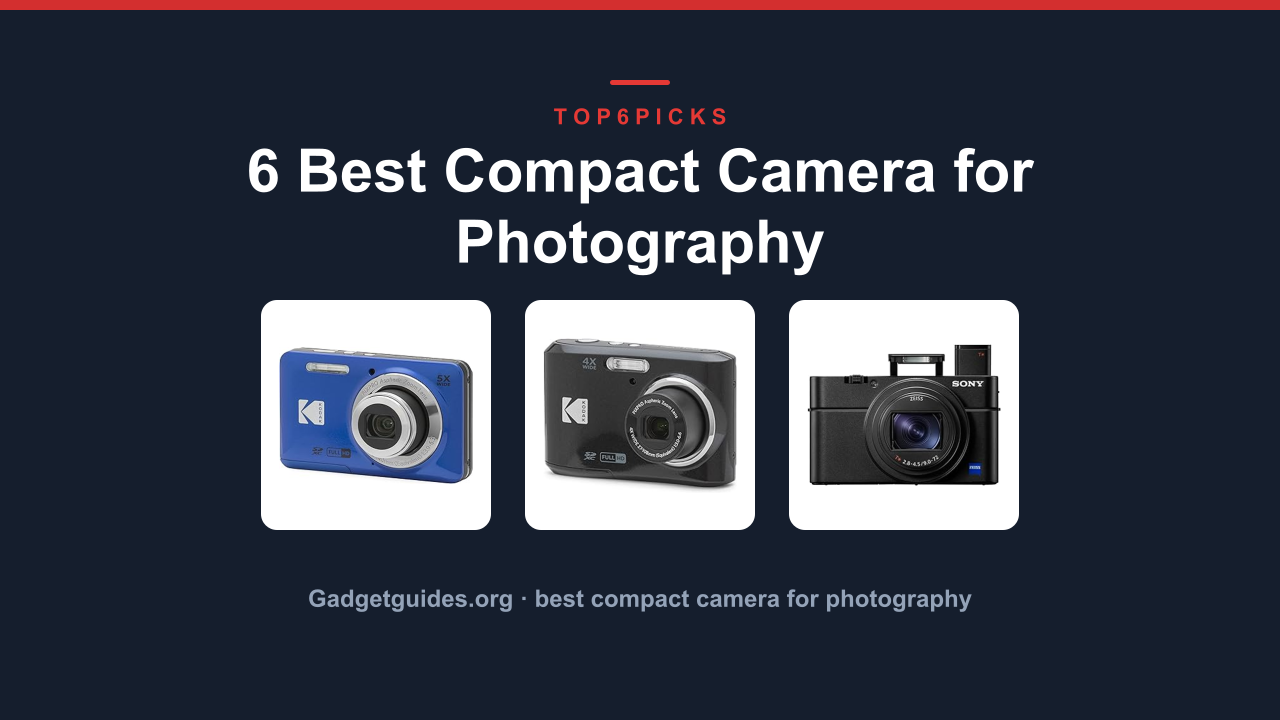
6 Best Compact Camera for Photography
·7 min read·by
6 Best Compact Camera for Photography

The best best compact camera for photography is the KODAK PIXPRO FZ55 16MP Compact Digital, the only one here that balances a 5X optical zoom, 1080p video, and a 28mm wide-angle lens in a pocket-friendly body that's built for everyday carry. It's the straightforward pick for anyone who wants a single, reliable point-and-shoot for family outings, travel, or casual vlogging without messing with interchangeable lenses.

Want the absolute best image quality instead? The Sony RX100 VII Premium Compact Camera gets you there, but you'll pay a premium for that 1.0-Type stacked CMOS sensor and the advanced autofocus that comes with it. It's a trade-off between budget and optical performance.

As an Amazon Associate, I earn from qualifying purchases.

This guide cuts through the noise by telling you which compact camera actually fits your real-world use, not just the spec sheet. It also flags the buyers who should skip the compact category entirely and go straight to a DSLR or mirrorless body instead.

Everything below comes from current Amazon product data, manufacturer specifications, and aggregate owner feedback, not from hands-on lab testing. My goal is to give you a clear, honest comparison so you can decide with confidence.

Quick Answer: The Best Compact Camera for Photography

The KODAK PIXPRO FZ55 is the best overall pick for most people because it delivers a solid 16MP sensor, 5X optical zoom, and 1080p video in a compact, affordable package.

Thinking about a DSLR or mirrorless instead? Jump to Who Should NOT Buy below before you spend anything.

Comparison Table

Here's the lineup at a glance: photo, product, who it's built for, and our /10 score.

PhotoProductBest forScoreBuy
KODAK PIXPRO FZ55 16MP Compact DigitalKODAK PIXPRO FZ55 16MP Compact DigitalAll-Around Family & Travel8.8/10Check price →
KODAK PIXPRO FZ45 16MP Compact DigitalKODAK PIXPRO FZ45 16MP Compact DigitalBudget-Friendly Simplicity7.4/10Check price →
Sony RX100 VII Premium Compact CameraSony RX100 VII Premium Compact CameraPremium Image Quality & Speed8.9/10Check price →
RICOH GR IV HDF Premium CompactRICOH GR IV HDF Premium CompactStreet & Travel Photography8.5/10Check price →
8K Digital Camera 88MP Autofocus Beginners8K Digital Camera 88MP Autofocus BeginnersHigh Specs, Low Cost8.0/10Check price →
Canon EOS Rebel T7 DSLR CameraCanon EOS Rebel T7 DSLR CameraLearning Interchangeable Lenses8.7/10Check price →

Scroll sideways on small screens to see every column.

KODAK PIXPRO FZ55 16MP Compact Digital: Best Overall for Families and Travelers

KODAK PIXPRO FZ55 16MP Compact Digital: Best Overall for Families and Travelers

#1KODAK PIXPRO FZ55 16MP Compact Digital
KODAK5X Optical Zoom, 1080p Video
8.8OUT OF 10
Image Quality8.5
Ease of Use9.0
Portability9.2
Owner Verdict8.5
This is the camera that ticks the most boxes for the widest range of people. The 16MP CMOS sensor captures crisp daytime shots, and the 5X optical zoom gives you real reach without the digital blur that cheaper cameras rely on. The 28mm wide-angle lens is wide enough for group photos in tight spaces, and the 2.7-inch LCD screen is bright enough to compose shots outdoors.
The FZ55 runs on a rechargeable lithium-ion battery, which means you won’t be hunting for AA disposables on a trip. It also records 1080p Full HD video at 30fps, making it a decent vlogging starter camera if you’re just getting into video. The blue color option is a nice touch for buyers who want something beyond basic black.
Flaws but not dealbreakers. The 2.7-inch LCD has a lower resolution than modern smartphone screens, so reviewing images isn’t as sharp. Owners also note that the optical image stabilization is basic, so you’ll want a steady hand or a tripod for low-light shots. If you need a larger screen for composing, the 8K Digital Camera further down includes a 3-inch flip screen that’s better for selfie angles.
Battery: The built-in lithium-ion battery is not user-replaceable. Plan to charge via USB-C, and consider a portable power bank for long days out.
Pros
  • 5X optical zoom provides clear close-ups without digital noise.
  • 1080p Full HD video at 30fps is solid for casual vlogging.
  • 28mm wide-angle lens fits more into every frame.
  • Compact size and blue color option add personal style.
Cons
  • LCD screen resolution is lower than modern phones.
  • Optical image stabilization is basic for low light.
  • No viewfinder, so composing in bright sun can be tricky.
Sensor
16MP CMOS
Zoom
5X Optical
Video
1080p Full HD
Screen
2.7-inch LCD
Best for: Families, casual travelers, and first-time vloggers who want a reliable point-and-shoot with optical zoom and video without breaking the bank.

KODAK PIXPRO FZ45 16MP Compact Digital: Best Budget-Friendly for Simple Everyday Use

KODAK PIXPRO FZ45 16MP Compact Digital: Best Budget-Friendly for Simple Everyday Use

#2KODAK PIXPRO FZ45 16MP Compact Digital
KODAKAA Battery Powered, 4X Zoom
7.4OUT OF 10
Image Quality7.0
Ease of Use8.0
Portability8.5
Owner Verdict7.0
If your main goal is to keep things simple and cheap, this is your camera. The FZ45 shares the same 16MP sensor and 1080p video as the FZ55, but it steps down to a 4X optical zoom and uses AA batteries instead of a rechargeable pack. That means you can pick up alkalines at any corner store, which is a genuine advantage for long trips where charging isn’t an option.
The 27mm wide-angle lens is slightly wider than the FZ55’s, giving you a tiny bit more in the frame for group portraits. The 2.7-inch LCD is the same size, and the camera is just as pocketable. For a kid’s first camera, a spare camera to toss in a beach bag, or a gift for an older relative who just wants to snap family photos, this is a smart pick.
Flaws but not dealbreakers. The 4X zoom is noticeably weaker than the FZ55’s 5X, and the AA battery setup means you’ll go through batteries faster than a rechargeable pack. Some owners also report that the plastic build feels less premium. If you want a sturdier feel and a longer zoom reach, the KODAK PIXPRO FZ55 is the better investment for a small step up in cost.
Batteries: This camera requires 2 AA batteries. It does not include a charger or rechargeable cells. Factor in the cost of a set of rechargeable AA batteries and a charger if you plan to use it often.
Pros
  • AA batteries are easy to find and replace anywhere.
  • 27mm wide-angle lens is slightly wider than the FZ55.
  • Very low entry price for a 16MP point-and-shoot.
  • Compact and lightweight for easy daily carry.
See also  6 Best Webcam For Zoom Meetings In 2027: Top Picks For Clear Calls
Cons
  • 4X optical zoom is less reach than the FZ55.
  • AA batteries add ongoing cost and environmental waste.
  • Plastic build feels less solid in hand.
Sensor
16MP CMOS
Zoom
4X Optical
Power
2x AA Batteries
Screen
2.7-inch LCD
Best for: Budget-conscious buyers, kids, and seniors who want a simple digicam without worrying about charging cables or proprietary batteries.

Sony RX100 VII Premium Compact Camera: Best for Serious Enthusiasts and Travelers

Sony RX100 VII Premium Compact Camera: Best for Serious Enthusiasts and Travelers

#3Sony RX100 VII Premium Compact Camera
Sony1-inch Stacked CMOS, 24-200mm Zoom
8.9OUT OF 10
Image Quality9.5
Ease of Use8.0
Portability9.0
Owner Verdict8.8
This is the compact camera that image quality chasers should be looking at. The Sony RX100 VII packs a 1.0-Type stacked CMOS sensor that captures significantly more detail and handles low light far better than the smaller sensors in the Kodak models. The 24-200mm equivalent zoom range is a massive 8.3X optical reach, letting you go from wide landscapes to tight portraits without changing lenses.
What really sets it apart is the speed. The stacked sensor enables real-time tracking autofocus and 20fps continuous shooting with no blackout, which is unheard of in a pocket camera. You also get a pop-up electronic viewfinder, a 3-inch tilting LCD, and 4K video recording. Owner feedback consistently rates its build quality and image sharpness as top-tier for a compact.
Flaws but not dealbreakers. The price is the biggest hurdle it sits at the premium end of the compact market. The battery life is also modest, and some owners find the menu system complex. If you want a similar pocketable sensor but with a simpler fixed lens, the RICOH GR IV below offers an even larger APS-C sensor in a slightly smaller body.
Battery: The NP-BX1 battery is small and delivers about 260 shots per charge. Carry a spare for all-day outings.
Pros
  • 1-inch stacked CMOS sensor delivers excellent image quality.
  • 24-200mm optical zoom covers wide to telephoto in one lens.
  • Real-time eye AF and 20fps burst are class-leading for compacts.
  • Pop-up EVF and 4K video add serious versatility.
Cons
  • Premium price point is the highest on this list.
  • Battery life is modest, around 260 shots per charge.
  • Menu system has a learning curve for new users.
Sensor
1.0-Type Stacked CMOS
Zoom
8.3X Optical (24-200mm)
Video
4K
Viewfinder
Pop-up EVF
Best for: Photo enthusiasts, advanced travelers, and anyone who wants DSLR-quality images in a jacket pocket without carrying multiple lenses.

RICOH GR IV HDF Premium Compact: Best for Street and Travel Photography

RICOH GR IV HDF Premium Compact: Best for Street and Travel Photography

#4RICOH GR IV HDF Premium Compact

RICOHAPS-C Sensor, 28mm F2.8 Fixed Lens
8.5OUT OF 10
Image Quality9.3
Ease of Use8.0
Portability9.5
Owner Verdict8.3
This is the pocket camera for purists who prioritize sensor size and image character above all else. The RICOH GR IV HDF packs a 25.7MP APS-C sensor, which is the same size sensor found in many DSLR and mirrorless cameras, into a body that fits in a jeans pocket. The fixed 28mm F2.8 lens is sharp and fast, and the built-in Highlight Diffusion Filter gives images a soft, film-like glow that street photographers love.
In-body image stabilization (IBIS) is a rare feature in a camera this small, and it makes a real difference for handheld shooting in low light. The 3-inch LCD is clear, and the camera powers on in under a second. Owner feedback highlights the discreet, all-black design that doesn’t draw attention, making it ideal for candid street work.
Flaws but not dealbreakers. The fixed 28mm lens means no zoom, so you have to physically move closer or farther. There’s no viewfinder, and the price is steep for a fixed-lens camera. If you need zoom versatility, the Sony RX100 VII offers a wider range with a 24-200mm lens, though it has a smaller sensor.
Lens: The 28mm equivalent is a fixed prime lens. There is no zoom. Frame your subject by moving your feet.
Pros
  • APS-C sensor delivers DSLR-quality images in a pocket size.
  • In-body image stabilization helps with low-light handheld shots.
  • Built-in Highlight Diffusion Filter adds unique creative effects.
  • Fast startup and discreet design are perfect for street shooting.
Cons
  • Fixed 28mm lens means no zoom capability.
  • No built-in viewfinder, relies on the LCD screen.
  • Premium price for a fixed-lens compact camera.
Sensor
25.7MP APS-C CMOS
Lens
28mm F2.8 Fixed
Stabilization
In-Body SR
Screen
3.0-inch LCD
Best for: Street photographers, travel minimalists, and anyone who values sensor size and image character over zoom convenience.

8K Digital Camera 88MP Autofocus Beginners: Best for High Specs on a Budget

8K Digital Camera 88MP Autofocus Beginners: Best for High Specs on a Budget

#58K Digital Camera 88MP Autofocus Beginners
8K8K Video, 180° Flip Screen
8.0OUT OF 10
Image Quality7.5
Ease of Use8.5
Portability8.0
Owner Verdict8.0
This is the budget pick that throws in every spec you could want on paper. The 8K Digital Camera boasts an 88MP interpolated still resolution and 8K video recording, which is unheard of at this price point. It includes autofocus, an 18X digital zoom, and a 3-inch 180-degree flip screen that makes vlogging and selfies much easier. The built-in WiFi and webcam functionality add modern versatility.
Owner feedback on this model is extremely positive, with a 4.9 out of 5 star average. Buyers consistently praise the image quality for the price, the ease of use for beginners, and the included flash for low-light situations. The anti-shake feature helps reduce blur, though it’s digital stabilization, not optical.
Flaws but not dealbreakers. The 88MP and 8K claims are interpolated, not native. The sensor is smaller than those in the Sony or Ricoh, so low-light performance is limited. The 18X zoom is digital, meaning image quality degrades as you zoom in. If you want true optical zoom, the KODAK PIXPRO FZ55 offers a real 5X optical zoom at a similar price.
Specs: The 8K video and 88MP stills are interpolated, not native resolution. This is common in budget cameras, but it’s worth knowing before you buy.
Pros
  • 8K video and 88MP stills offer impressive specs for the price.
  • 180-degree flip screen is great for vlogging and selfies.
  • Built-in WiFi and webcam mode add modern connectivity.
  • Extremely high owner satisfaction rating (4.9/5).
See also  6 Best Underwater Camera for Video
Cons
  • 8K and 88MP are interpolated, not native resolution.
  • Digital zoom reduces quality compared to optical zoom.
  • Small sensor limits low-light performance.
Resolution
88MP (Interpolated)
Video
8K
Zoom
18X Digital
Screen
3.0-inch 180° Flip
Best for: Budget-conscious beginners, vloggers, and anyone who wants 8K video and a flip screen without spending a lot.

Canon EOS Rebel T7 DSLR Camera: Best for Learning Photography with Interchangeable Lenses

Canon EOS Rebel T7 DSLR Camera: Best for Learning Photography with Interchangeable Lenses

#6Canon EOS Rebel T7 DSLR Camera
Canon24.1MP APS-C, Interchangeable Lens
8.7OUT OF 10
Image Quality8.5
Ease of Use9.0
Portability6.5
Owner Verdict9.0
This is not a compact camera, but it’s the best pick for anyone who wants to learn photography seriously. The Canon EOS Rebel T7 is a full DSLR with a 24.1MP APS-C sensor, an optical viewfinder, and interchangeable lenses. The EF-S 18-55mm f/3.5-5.6 IS II kit lens is a versatile starter that covers wide-angle to short telephoto. It also records 1080p Full HD video and has built-in WiFi for easy sharing.
What makes the T7 special for beginners is the Canon ecosystem. The EF and EF-S lens mount gives you access to hundreds of lenses, from budget primes to professional zooms. The camera’s guided mode helps you learn aperture, shutter speed, and ISO in real time. Owner feedback consistently rates it as the best DSLR for new photographers who want to grow their skills.
Flaws but not dealbreakers. It’s much larger and heavier than any compact camera on this list, so it’s not a pocket camera. The 9-point autofocus system is basic compared to modern mirrorless cameras. If you want a compact body with a similar sensor, the RICOH GR IV is pocketable, but the T7 offers the flexibility of changing lenses.
Size: This is a DSLR, not a compact camera. It requires a camera bag and is not pocketable. Consider your portability needs before buying.
Pros
  • 24.1MP APS-C sensor delivers excellent image quality.
  • Interchangeable lenses allow you to expand your photography.
  • Canon’s guided mode helps beginners learn manual settings.
  • Built-in WiFi and Full HD video add modern features.
Cons
  • Much larger and heavier than any compact camera.
  • 9-point autofocus is basic compared to modern mirrorless cameras.
  • No 4K video recording, only 1080p.
Sensor
24.1MP APS-C CMOS
Lens Mount
Canon EF/EF-S
Video
1080p Full HD
Connectivity
Built-in WiFi
Best for: Beginners who want to learn photography with a proper DSLR, and anyone who values lens choice over pocketability.

Buying Guide: Sensor Size, Zoom, Video, and Portability

Choosing the right compact camera comes down to a few key trade-offs. Here are the four factors that matter most.

How Much Does Sensor Size Matter?

The sensor is the heart of any camera, and it determines image quality more than any other spec. Compact cameras typically use one of three sensor sizes. The smallest sensors are found in budget models like the KODAK PIXPRO FZ55 and FZ45, using a 1/2.3-inch CMOS sensor.

These are fine for well-lit daytime shots but struggle in low light.

The Sony RX100 VII uses a 1.0-Type stacked CMOS sensor, which is about four times larger than the budget sensors. This gives you noticeably better detail, less noise in dim conditions, and more control over depth of field. The RICOH GR IV goes even further with an APS-C sensor, the same size found in the Canon EOS Rebel T7 DSLR.

That means you get DSLR-level image quality in a pocketable body.

For most casual users, the budget sensors in the Kodak models are perfectly adequate. But if you often shoot indoors, at night, or want the best possible image quality, stepping up to the Sony or Ricoh is worth the extra cost.

Optical Zoom vs. Digital Zoom

Zoom is one of the biggest differentiators in this lineup. Optical zoom uses the lens to magnify the image, preserving full resolution. Digital zoom simply crops and enlarges the image, reducing quality.

Always prioritize optical zoom.

The KODAK PIXPRO FZ55 offers a 5X optical zoom, which is enough for most everyday situations. The Sony RX100 VII has a massive 8.3X optical zoom, covering 24mm to 200mm equivalent. The RICOH GR IV has no zoom at all, only a fixed 28mm lens.

The 8K Digital Camera uses an 18X digital zoom, which sounds impressive but loses quality as you zoom in.

See also  How To Install A Dash Cam: Easy Step-By-Step Guide

If you often shoot wildlife, sports, or distant subjects, optical zoom is non-negotiable. The Sony is the clear winner here. If you mostly shoot street or portraits, a fixed lens like the Ricoh is fine.

Video Capabilities and Vlogging

All six cameras on this list record video, but the quality and features vary. The KODAK PIXPRO FZ55 and FZ45 record 1080p Full HD at 30fps, which is fine for basic vlogging. The Canon EOS Rebel T7 also records 1080p, but with better control over exposure.

The Sony RX100 VII records 4K video with advanced features like real-time tracking and slow motion. The 8K Digital Camera claims 8K video, but it's interpolated, so it's not true 8K quality. The Ricoh GR IV focuses on stills and has basic video capabilities.

For vloggers, the 8K Digital Camera's 180-degree flip screen is a big advantage. The Sony's tilting screen is also useful, but it doesn't flip all the way around. If video is your priority, the Sony is the best choice for quality, and the 8K model is the budget option.

Portability and Everyday Carry

The whole point of a compact camera is that you can take it everywhere. The KODAK PIXPRO FZ55 and FZ45 are both lightweight and pocketable. The RICOH GR IV is the smallest and lightest of the premium models, fitting easily into a jeans pocket.

The Sony RX100 VII is also pocketable, but slightly larger.

The Canon EOS Rebel T7 is not a compact camera. It's a full DSLR and requires a camera bag. If pocketability is your main concern, stick with the Ricoh or the Kodak models.

If you're willing to carry a small bag, the Sony offers the best balance of image quality and size.

To see how these factors play out on real picks, compare the KODAK PIXPRO FZ55 16MP Compact Digital, KODAK PIXPRO FZ45 16MP Compact Digital and the Sony RX100 VII Premium Compact Camera reviewed above.

Who Should NOT Buy Best Compact Camera for Photography

A compact camera is the wrong choice for three types of buyers. Here's who they are and what to look at instead.

You Need a Camera for Professional or Serious Hobbyist Work

If you plan to shoot weddings, events, or sell your photos, a compact camera will limit you. The sensors are smaller, the lenses are not interchangeable, and the autofocus speed is slower than a DSLR or mirrorless system. The Canon EOS Rebel T7 is a better starting point, but even that is entry-level.

For professional work, look at a full-frame mirrorless camera like the ones we cover in our professional photography guide.

You Need a Camera for Wildlife or Sports Photography

Compact cameras lack the reach and speed needed for wildlife or fast action. The Sony RX100 VII is the best of the bunch with its 200mm zoom, but it still can't match a telephoto lens on a DSLR. If you're shooting birds, sports, or your kids' soccer games, you'll get much better results from a DSLR or mirrorless camera with a long lens.

Our wildlife photography guide has options that outperform any compact.

You Want the Absolute Best Image Quality Possible

If you're a pixel peeper who wants the highest resolution, best dynamic range, and most control over depth of field, a compact camera will disappoint you. Even the best compact like the Ricoh GR IV can't match a full-frame mirrorless or a medium format camera. For the best image quality at any size, step up to a mirrorless system.

We have a complete guide to the best mirrorless cameras that will show you what you're missing.

Final Verdict

The best best compact camera for photography overall is the KODAK PIXPRO FZ55. It delivers a solid 16MP sensor, 5X optical zoom, 1080p video, and a rechargeable battery in a compact, affordable package. It's the camera that most people will be happiest with for everyday use.

Want the best image quality in a pocket? Get the RICOH GR IV HDF. Its APS-C sensor and fixed 28mm lens produce stunning images that rival DSLRs, as long as you don't need zoom.

Need the most versatile zoom and premium features? The Sony RX100 VII is the one. Its 24-200mm zoom, 4K video, and professional autofocus make it the ultimate travel compact, but you'll pay for it.

On a tight budget? The KODAK PIXPRO FZ45 is a reliable backup or a great first camera for a child. And if you want to learn photography properly, the Canon EOS Rebel T7 is the best entry point into interchangeable lenses.

If a compact camera doesn't fit your needs, head back up to the Who Should NOT Buy section for better alternatives. No matter what you choose, the right camera is the one you'll actually carry with you.

FAQ

What's the best Compact Camera for Photography overall?

The KODAK PIXPRO FZ55 is the best overall. It offers a 16MP sensor, 5X optical zoom, 1080p video, and a rechargeable battery at a very accessible price point.

What is the difference between optical zoom and digital zoom?

Optical zoom uses the lens to magnify the image, preserving full quality. Digital zoom simply crops the image, which reduces resolution. Always prioritize optical zoom.

Can a compact camera replace a DSLR?

For most casual users, yes. But for serious photography, a DSLR or mirrorless camera offers larger sensors, interchangeable lenses, and faster autofocus. The Canon EOS Rebel T7 is a good entry-level DSLR alternative.

Are compact cameras good for vlogging?

Some are. The 8K Digital Camera with its 180-degree flip screen is excellent for vlogging on a budget. The Sony RX100 VII also offers 4K video and a tilting screen, but it doesn't flip forward.

How important is sensor size in a compact camera?

It's very important. A larger sensor captures more light, producing better image quality, especially in low light. The Ricoh GR IV's APS-C sensor is the largest here, followed by the Sony's 1-inch sensor.

What does the Highlight Diffusion Filter on the RICOH GR IV do?

It's a built-in filter that softens highlights and adds a dreamy, film-like glow to images. It's a creative tool that street photographers and portrait shooters often use for a unique look.

Latest posts by Arian (see all)

Share.

Similar Posts

Leave a comment

Your email address will not be published. Required fields are marked with an asterisk.

×Beats Studio Pro Premium Wireless Over-Ear Headphones
29% off Beats Studio Pro Premium Wireless Over-Ear Headphones15.6 Inch FHD 1080P • A+ IPS screen • 178° Full viewing angle
Check Amazon →
Share