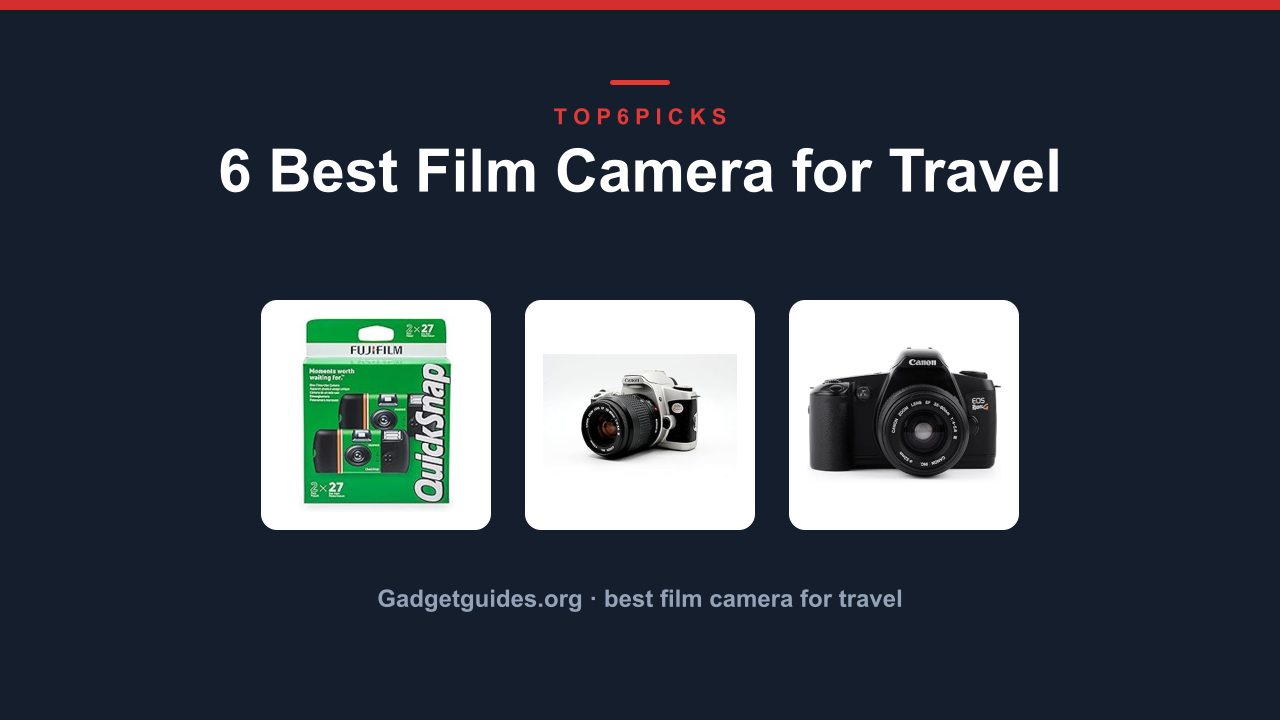
Want the full manual control and interchangeable lenses instead? The Canon New EOS Kiss (AKA Rebel G) is your gateway to the classic SLR (Single-Lens Reflex) experience, as long as you're comfortable learning the basics of exposure and focus.
This guide will show you exactly which camera fits your specific travel style before you spend a cent. We'll cover who should absolutely skip film cameras entirely, because they will just end up with a box of unusable photos and frustration.
Everything below comes from current Amazon product data, detailed specs, and each product's verified owner track record, not hands-on lab testing. Our editorial team has analyzed hundreds of buyer reports to give you a clear picture.
The Fujifilm QuickSnap Flash 400 is the best overall pick because it delivers the authentic film look with the absolute minimum risk of user error. Here's the full lineup ranked from best to worst for travel:
Thinking about whether you need manual control or a digital safety net? Jump to Who Should NOT Buy below before you spend anything.
Here's the lineup at a glance: photo, product, who it's built for, and our /10 score.
#4
PENTAXHalf-Frame, 72 Shots
8.6OUT OF 10
Ease of Use9.0
Travel Durability8.0
Image Quality8.5
Owner Verdict8.7
**This is the modern king of saving money on film, giving you up to 72 shots on a standard 36-exposure roll.** The PENTAX 17 uses a half-frame format, which means it splits the standard 35mm frame in half. For travel, this translates to more memories per roll and lower costs per shot, something budget travelers will appreciate immediately.
It’s newly manufactured, so it comes with a warranty and the peace of mind that it isn’t a decades-old mystery box. The 25mm f/3.5 lens is fixed, so you get a nice wide angle perfect for street photography and group shots. The built-in flash helps in darker environments, and the zone focus system means you select a distance range rather than fiddling with precise focus rings.
Flaws but not dealbreakers. The half-frame format produces negative images that are smaller, which means grain is more noticeable in prints, especially larger ones. Also, the camera is slightly larger than a typical point-and-shoot, so it won't disappear into a jeans pocket.
If you want the absolute smallest footprint possible, the Kodak EKTAR H35 is even more compact and also uses the half-frame trick, though it lacks the lens quality of the PENTAX.
⚠Sizing: The half-frame vertical orientation means your photos will be portrait-oriented by default. This is great for social media but worth noting if you prefer landscapes.
Pros
- ✓72 shots per 36-exposure roll
- ✓Brand new, not refurbished
- ✓Built-in flash and zone focus
- ✓Compact and stylish design
Cons
- ✕More expensive than disposables
- ✕Smaller negatives mean more grain
- ✕Vertical orientation only
Best for: Travelers who want to shoot all day without burning through rolls of film, and who value the classic look of a new camera.
KODAK FunSaver 35mm Single Use Camera: Best Classic Event Camera
#5
KODAKIconic Disposable
8.1OUT OF 10
Ease of Use9.5
Travel Durability9.0
Image Quality7.0
Owner Verdict8.0
**This is the classic disposable camera that everyone recognizes, perfect for parties, weddings, and group trips where you want to hand out cameras to everyone.** The KODAK FunSaver comes pre-loaded with ISO 800 film, which is faster than the Fujifilm QuickSnap, making it slightly better for indoor shots without flash. It has a built-in flash that you activate by sliding a button on the front.
The FunSaver is a cultural icon for a reason. It delivers that distinct, slightly grainy, warm-toned look that people associate with nostalgia. Aggregate user reviews highlight its reliability and the sheer fun of not knowing what you captured until development. It is the ultimate low-stakes travel camera.
**Flaws but not dealbreakers.** The ISO 800 film means grain is more pronounced in all lighting, not just low light. The lens is a simple plastic single-element design, so expect soft corners and some distortion. It is also a single-use item, so you are generating waste with each camera.
If you want the same disposable fun but with a film that handles daylight better, the
Fujifilm QuickSnap Flash 400 uses ISO 400 film for cleaner results in bright conditions.
⚠Care: The flash on the FunSaver requires you to hold the flash button for a few seconds to charge it. Make sure to keep the button pressed until the flash fires, or you may get underexposed shots.
Pros
- ✓ISO 800 handles low light better
- ✓Instantly recognizable and fun
- ✓No setup or maintenance
- ✓Great for group events
Cons
- ✕Very grainy in all conditions
- ✕Single-use creates waste
- ✕Soft lens quality
Best for: Travelers who want that classic, grainy, nostalgic look and are buying cameras for a group to share the experience.
Kodak EKTAR H35 Half Frame 35mm: Best Ultra-Budget Reusable
#6
KodakBudget Half-Frame
7.4OUT OF 10
Ease of Use8.5
Travel Durability7.5
Image Quality6.5
Owner Verdict7.0
**This is the cheapest way to get a reusable film camera that still gives you the double-the-shots half-frame advantage.** The Kodak EKTAR H35 is a focus-free, point-and-shoot camera that requires one AAA battery (not included) to power the built-in flash. It comes bundled with a 24-exposure roll of film, so you can start shooting right away.
For someone who just wants to dip their toes into film without a big investment, this is the ticket. It is lightweight, pocketable, and the half-frame design means you get 72 shots per 36-exposure roll. Buyer feedback shows that it is a hit with younger travelers and those looking for a casual creative outlet.
**Flaws but not dealbreakers.** The build quality is very plastic, and the lens is noticeably softer than the PENTAX 17. The flash is also quite weak, so it only works well for subjects within a few feet. Some users report that the film advance mechanism can feel a bit stiff.
If you want a sharper lens and a more robust build, the
PENTAX 17 is a big step up, though it costs more. For a true disposable simplicity, the
Fujifilm QuickSnap Flash 400 is even easier to use.
⚠Compatibility: The camera requires a single AAA battery for the flash. It does not come with one, so pack a spare. Without the battery, the camera still works for daylight shots but you lose the flash.
Pros
- ✓Very affordable price point
- ✓Reusable, no waste per use
- ✓72 shots per roll of 36
- ✓Comes with a starter film roll
Cons
- ✕Plastic build feels cheap
- ✕Soft lens quality
- ✕Weak flash performance
Battery
1x AAA (not included)
Best for: Budget travelers who want to try film photography with a reusable camera and don’t mind trading some image quality for a very low entry cost.
Buying Guide: Simplicity, Image Quality, Cost Per Shot, and Build
Choosing the right film camera for travel comes down to a few key trade-offs. You need to decide how much control you want, how much you are willing to spend on film, and how much risk you are willing to take with your gear.
How Much Simplicity Do You Need?
The biggest divide in this list is between disposable cameras and reusable SLR cameras. Disposables like the Fujifilm QuickSnap Flash 400 and the KODAK FunSaver are the ultimate set-and-forget option. You do not need to think about aperture, shutter speed, or focus.
You just point and shoot.
SLR cameras like the Canon New EOS Kiss and the Canon EOS Rebel G offer full manual control, autofocus, and interchangeable lenses. This gives you far more creative freedom, but it also means you have to learn the basics of exposure and you have to carry more gear. If you are a complete beginner, a disposable or a simple point-and-shoot like the Kodak EKTAR H35 is a safer bet.
Image Quality and Film Speed
The film you use matters as much as the camera. The camera's lens and construction affect sharpness, but the film stock determines the look and feel. The Fujifilm QuickSnap uses ISO 400 film, which is a good all-rounder for daylight and indoor flash.
The KODAK FunSaver uses ISO 800 film, which is faster and better for low light but produces more grain.
Half-frame cameras like the PENTAX 17 and the Kodak EKTAR H35 produce smaller negatives, which means the same film grain is more visible when you enlarge the image. This is not a problem for 4×6 prints, but if you want to make large prints, a full-frame SLR will give you cleaner results. The SLR cameras also let you choose your own film stock, so you can use fine-grain films like Kodak Ektar 100 for maximum sharpness.
Cost Per Shot and Film Economy
Film is expensive, and development costs add up. The single-use cameras cost a fixed amount per camera and give you 27 shots. If you shoot a lot, the cost per shot is high.
The reusable cameras cost more upfront but let you buy film in bulk, which is cheaper per roll.
The half-frame cameras double your shots per roll, which is a huge advantage for travel. The PENTAX 17 gives you 72 shots per 36-exposure roll, cutting your film costs in half. The Kodak EKTAR H35 does the same, but its lower entry price makes it the most economical way to start shooting film regularly.
Build Quality and Durability
Travel gear takes a beating. Disposable cameras are surprisingly tough because they are basically sealed plastic shells with no moving electronics. They can handle being tossed in a bag or dropped on the ground.
SLR cameras are more delicate because they have moving mirrors, shutter mechanisms, and lens mounts.
The Canon EOS Rebel G is mostly plastic, so it is light but not as rugged as a metal-bodied camera. The PENTAX 17 is built with a modern design that feels solid in the hand. If you are going on a rugged adventure, consider a disposable or a simple point-and-shoot that you will not cry over if it gets damaged.
Who Should NOT Buy Best Film Camera for Travel
A film camera is the wrong purchase for several types of travelers. Here is who they are and what to look at instead.
Film cannot be shared on social media or sent to family right away. You have to finish the roll, get it developed, and then scan the negatives. This takes days or weeks.
If you want instant sharing, a digital camera or a smartphone is the better choice. For a dedicated travel camera that works well for sharing, our guide on top-rated mirrorless cameras for travel covers excellent options.
You Are on a Very Tight Budget and Cannot Afford Development
The camera itself is just the start. Each roll of film costs money, and development costs another 10 to 15 dollars per roll. If you shoot 10 rolls on a trip, you are spending significant money.
If you cannot afford ongoing film and development costs, stick with a digital camera or your phone.
You Want Perfect, Sharp, Professional Photographs
Film has a unique look, but it is not sharper than digital. Even the best lenses on this list will not match a modern digital sensor for detail and clarity. If you need pixel-level sharpness for large prints or professional work, a modern mirrorless camera is the right tool.
Our comparison of DSLR and mirrorless cameras breaks down the differences in detail.
Final Verdict
The Fujifilm QuickSnap Flash 400 One-Time-Use Camera is our top pick for the best film camera for travel because it removes all barriers to entry. It is the cheapest, simplest, and most reliable way to get authentic film photos from a trip. You will not lose sleep if it gets lost, and you will not have to learn any settings.
Want more control and the ability to swap lenses? The Canon New EOS Kiss (AKA Rebel G) is the best SLR entry point, giving you access to the vast Canon EF lens system. Need to save money on film?
The PENTAX 17 doubles your shots per roll with its half-frame format.
If you are still unsure, remember the Who Should NOT Buy section above. If you need instant sharing, a tight budget, or perfect sharpness, film is not the right path. For everyone else, these cameras offer a genuinely fun and rewarding way to capture memories on the road.
FAQ
What's the best Film Camera for Travel overall?
The Fujifilm QuickSnap Flash 400 One-Time-Use Camera is the best overall because it is the most foolproof and affordable way to get started. It comes in a two-pack, so you can share one with a travel companion.
Can I take film cameras on a plane?
Yes, you can. Hand the camera to security for a manual inspection if you are worried about X-rays damaging the film. ISO 400 and 800 film is generally fine through standard airport scanners, but high-speed film above ISO 1600 can be damaged.
How many photos can I take with a disposable camera?
Most disposable cameras like the Fujifilm QuickSnap and KODAK FunSaver give you 27 exposures per camera. The half-frame cameras like the PENTAX 17 and Kodak EKTAR H35 can give you up to 72 shots on a standard 36-exposure roll.
Is it cheaper to use a disposable or a reusable camera?
For a single trip, a disposable is cheaper because you have no upfront cost for the camera. If you plan to shoot multiple rolls over several trips, a reusable camera like the Kodak EKTAR H35 pays for itself quickly because you only pay for film and development.
What kind of film do I need to buy?
All the cameras on this list use standard 35mm film. The disposable cameras come pre-loaded, so you do not need to buy film. For the reusable cameras, you can buy any 35mm film sold online or in photography stores.
Popular choices include Kodak Gold 200, Fujifilm Superia 400, and Kodak Portra 400.
Are there any film cameras that work without batteries?
Yes, the disposable cameras are completely battery-free. The Kodak EKTAR H35 requires a AAA battery for the flash, but it can still take daylight photos without it. The Canon SLR cameras require two CR2 batteries for the autofocus and light meter.