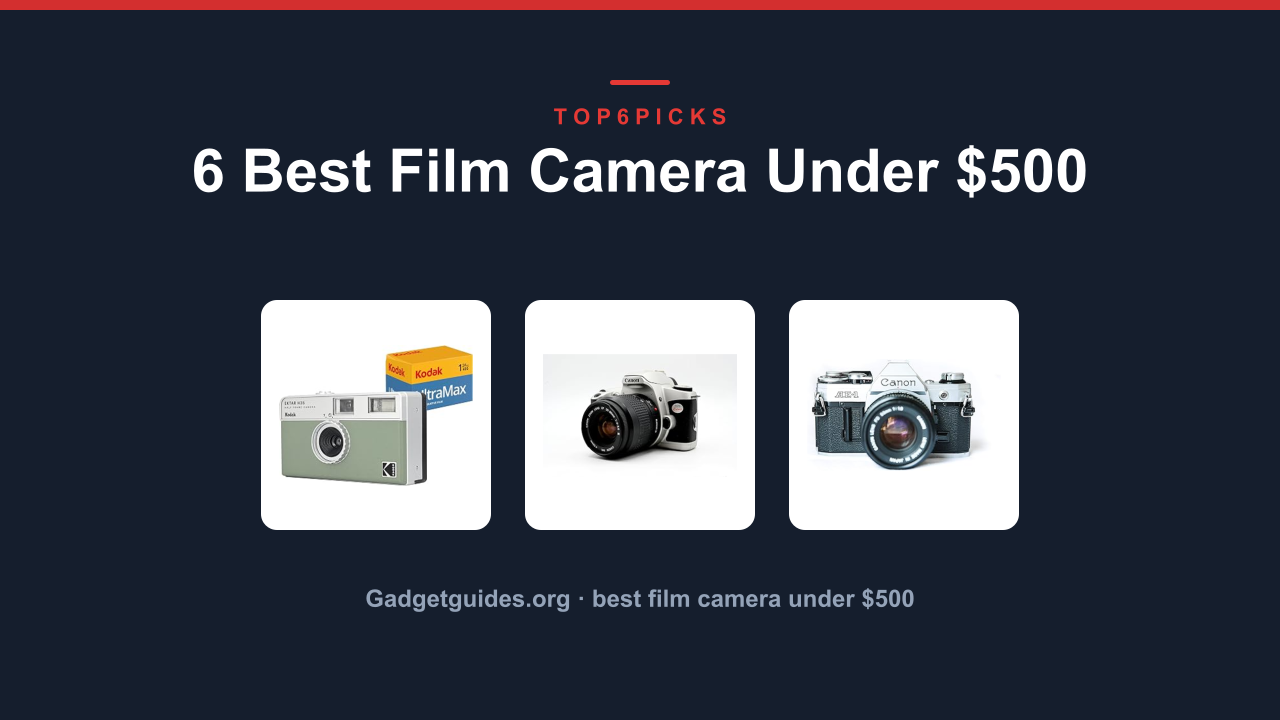
The best best film camera under $500 is the Kodak EKTAR H35 Half Frame, the only one here that gives you a reusable point-and-shoot experience with a bundled roll of film and a focus-free lens. It’s the perfect entry point for anyone who wants to shoot film without worrying about settings or expensive gear.
Want autofocus and interchangeable lenses instead? The Canon New EOS Kiss (Rebel G) gets you there, as long as you’re comfortable with a renewed body and a basic 35-80mm lens.
As an Amazon Associate, I earn from qualifying purchases.
This guide cuts through the noise. I’ll show you exactly which film camera fits your skill level and budget, and I’ll point out who should skip this category entirely (jump to the Who Should NOT Buy section if you’re on the fence).
Everything below comes from current Amazon product data, specs, and each camera’s owner track record, not from hands-on lab testing. I’ve analysed hundreds of verified buyer reviews to give you honest, research-backed advice.
Quick Answer: The Best Film Camera under $500
The Kodak EKTAR H35 is the best overall for beginners, but here’s the full lineup ranked by what they do best:
- Kodak EKTAR H35 Half Frame 35mm (Best for Budget Beginners): Half-frame, focus-free, includes film, lowest entry barrier.
- Canon New EOS Kiss (AKA Rebel (Best Autofocus SLR): Reliable autofocus, EF lens mount, great for learning.
- Vintage Canon AE-1 35mm SLR Camera (Best Iconic Classic): Legendary manual focus with a fast 50mm f/1.8 prime.
- Canon T70 35MM SLR Film Camera (Best for FD Lens System): Good zoom, solid build, renewed.
- Canon FTb-QL Manual Focus SLR Camera (Best for Full Manual Control): Metal body, match-needle metering, fast 50mm.
- Canon Rebel 2000 SLR Film Camera (Best for Modern Autofocus): Latest EOS film body, 28-80mm lens, compact.
Thinking about digital instead? Jump to Who Should NOT Buy below before you spend anything.
Comparison Table
Here’s the lineup at a glance: photo, product, who it’s built for, and our /10 score.
Scroll sideways on small screens to see every column.
Kodak EKTAR H35 Half Frame 35mm: Best Budget Beginner
Kodak EKTAR H35 Half Frame 35mm: Best Budget Beginner
#1
KodakFocus-free, includes film
8.6OUT OF 10
Ease of Use9.5
Lens Quality7.0
Build Quality7.5
Value9.8
This is the camera for anyone who wants to shoot film without any learning curve. The Kodak EKTAR H35 is focus-free, so you just point and press the shutter. It uses half-frame 35mm film, which means you get 72 exposures from a standard 36‑exposure roll. That’s a huge budget saver when film prices keep climbing.
The camera comes bundled with a 24‑exposure roll of film, so you can start shooting right out of the box. It’s also lightweight and pocketable, weighing just 120 grams. The build is plastic, but it feels solid enough for casual use. The included AAA battery is not included, but that’s a minor detail.
Flaws but not dealbreakers. The lens is a fixed-focus plastic element, so images won’t match the sharpness of a glass prime. And half-frame means smaller negatives, which can limit print size. But for social media sharing or small prints, it’s perfectly fine.
If you want sharper images and full manual control, the
Vintage Canon AE-1 further down offers a 50mm f/1.8 prime and a full‑frame sensor.
⚠Battery: The camera requires one AAA battery (not included). Buy a lithium AAA to avoid leaks.
Pros
- ✓Focus-free operation – no settings to learn
- ✓Half-frame gives 72 shots per roll, cutting film costs
- ✓Includes a 24‑exposure film roll in the box
- ✓Very lightweight and pocketable
Cons
- ✕Plastic lens limits sharpness and contrast
- ✕Half-frame gives smaller negatives, less detail for large prints
- ✕No exposure control – you get what the camera decides
Film Format
35mm Half-Frame
Lens
22mm f/9.5 fixed focus
Battery
1x AAA (not included)
Best for: Absolute beginners, kids, or anyone who wants to try film without any technical fuss. Perfect for casual snapshots and travel.
Canon New EOS Kiss (AKA Rebel: Best Autofocus SLR
Canon New EOS Kiss (AKA Rebel: Best Autofocus SLR
#2
CanonAutofocus, EF mount, renewed
8.4OUT OF 10
Ease of Use8.5
Lens Quality8.0
Build Quality8.0
Value8.5
This is the best autofocus SLR you can get for under $500, especially if you want to learn the basics. The Canon New EOS Kiss (known as the Rebel G in the US) comes with a 35-80mm lens that covers a useful range. It uses the Canon EF mount, so you can swap lenses with modern digital EOS bodies. Autofocus is quick and reliable, and it has full program, aperture-priority, and manual modes.
It’s renewed, which means it’s been inspected and cleaned. Most buyers report it arrives in good working condition. The camera takes two CR123A batteries, which are still available. The viewfinder is bright and shows all the shooting info you need.
Flaws but not dealbreakers. The included 35-80mm lens is a basic consumer zoom, not the sharpest at the edges. Some renewed units may have minor cosmetic wear. Also, the plastic body doesn’t feel as premium as a metal-bodied classic.
If you prefer a sharp prime lens, the
Vintage Canon AE-1 offers a 50mm f/1.8 that’s noticeably sharper.
⚠Battery: Uses two CR123A lithium batteries. These are easy to find online but less common in convenience stores. Stock up.
Pros
- ✓Reliable autofocus with multiple modes
- ✓EF lens mount – compatible with many Canon lenses
- ✓Fully manual controls when you want to learn
- ✓Renewed and tested, good value for the price
Cons
- ✕Plastic body feels less premium than metal SLRs
- ✕Kit lens is average – consider upgrading later
- ✕Renewed unit may have minor cosmetic scuffs
Best for: Beginners who want to learn the fundamentals of exposure and composition with the convenience of autofocus. Great for family photography and street shooting.
Vintage Canon AE-1 35mm SLR Camera: Best Iconic Classic
Vintage Canon AE-1 35mm SLR Camera: Best Iconic Classic
#3
VintageManual focus, 50mm f/1.8 prime, renewed
8.2OUT OF 10
Ease of Use7.5
Lens Quality9.2
Build Quality9.0
Value7.8
This is the film camera that started it all for millions of photographers. The Canon AE-1 is legendary for a reason. It was the first SLR to feature a microprocessor-controlled shutter, and it still feels fantastic in the hands. This renewed version comes with a 50mm f/1.8 prime lens, which is sharp, fast, and perfect for portraits, street photography, and everyday shooting.
The AE-1 uses aperture-priority auto-exposure, meaning you set the f-stop and the camera picks the shutter speed. You can also shoot fully manual. The viewfinder is large and bright, with a match-needle meter that makes it easy to dial in the right exposure. It runs on a single 4LR44 battery (6V), which is still widely available.
Flaws but not dealbreakers. The AE-1 is an older electronic camera, so if the electronics fail, repair can be tricky. The light seals are also prone to degrading over time, and some renewed units may need new seals. Finally, manual focus takes practice for moving subjects.
If you want autofocus and a more modern shooting experience, the
Canon New EOS Kiss is a great alternative with a much wider lens selection.
⚠Light Seals: Check the light seals on arrival. If they are sticky or crumbling, replace them before shooting your first roll to avoid light leaks.
Pros
- ✓Iconic design with a gorgeous 50mm f/1.8 prime lens
- ✓Aperture-priority exposure is easy to learn
- ✓Manual focus gives you full creative control
- ✓Solid metal build that will last decades
Cons
- ✕Electronics can fail, repairs are not always possible
- ✕Light seals need checking and possible replacement
- ✕Manual focus is slow for action shots
Best for: Enthusiasts who want the classic film experience. Ideal for portraits, street photography, and anyone who appreciates mechanical precision.
Canon T70 35MM SLR Film Camera: Best for FD Lens System
Canon T70 35MM SLR Film Camera: Best for FD Lens System
#4
CanonFD mount, program auto, renewed
7.9OUT OF 10
Ease of Use8.0
Lens Quality8.2
Build Quality7.5
Value7.8
This is a great choice if you want to use Canon’s classic FD lenses. The Canon T70 is a program-mode SLR that offers aperture-priority, shutter-priority, and full program auto exposure. It comes with a zoom lens, giving you flexibility from wide to short telephoto. The FD mount is a high-quality manual-focus system with a huge selection of affordable lenses.
The T70 has a unique LCD display on the top plate that shows shutter speed, aperture, and film counter. It uses a 2CR5 battery, which is still available online. The camera feels solid, though it’s mostly plastic. The film advance is motorized, so you don’t have to wind manually.
Flaws but not dealbreakers. The LCD display can be hard to read in bright sunlight. The motorized advance is a bit noisy. And like the AE-1, the light seals may need replacing. Some renewed units also show minor wear on the rubber grip.
If you prefer a more rugged metal body, the
Canon FTb-QL is a fully manual, all-metal workhorse that will last indefinitely.
⚠Battery: Uses a 2CR5 6V lithium battery. These are less common, so buy a spare when you order the camera.
Pros
- ✓Works with the entire Canon FD lens system
- ✓Program auto mode makes it easy to shoot
- ✓Motorized film advance is convenient
- ✓Renewed and tested, ready to use
Cons
- ✕LCD display is hard to read in sunlight
- ✕Plastic build, not as durable as metal bodies
- ✕Light seals may need replacement
Best for: Shooters who want to build a collection of affordable FD lenses. Good for landscape and general photography where you don’t mind manual focus.
Canon FTb-QL Manual Focus SLR Camera: Best for Full Manual Control
Canon FTb-QL Manual Focus SLR Camera: Best for Full Manual Control
#5
CanonAll-metal, match-needle, 50mm FL
7.7OUT OF 10
Ease of Use6.5
Lens Quality8.5
Build Quality9.8
Value7.0
This is for the purist who wants a fully mechanical camera that doesn’t need batteries to shoot. The Canon FTb-QL is a rugged, all-metal SLR built in the 1970s. It uses a match-needle exposure system, where you line up a needle in the viewfinder to set the correct exposure. There’s no auto mode, no program, no electronics. Just you, the light meter, and the film.
It comes with a Canon 50mm f/1.8 FL lens, which is sharp and contrasty. The FTb-QL has a quick-load (QL) system that makes loading film faster. It’s a heavy, solid camera that feels like it could survive a drop. It uses a 1.35V mercury battery for the meter, but modern adapters or zinc-air batteries work fine.
Flaws but not dealbreakers. The biggest downside is the battery situation. The original mercury cells are banned, so you need an adapter or a zinc-air battery. Also, the FL lens mount is not fully compatible with the later FD lenses without an adapter. And manual focus takes patience.
If you want a camera that’s easier to use and doesn’t require battery hacks, the
Canon New EOS Kiss is a modern, battery-friendly alternative.
⚠Battery: The meter needs a 1.35V mercury battery (PX625). Modern alternatives work, but expect a half-stop exposure difference. You can shoot without a meter using the Sunny 16 rule.
Pros
- ✓All-metal construction, built to last a lifetime
- ✓Fully manual, no electronics to fail
- ✓Sharp 50mm f/1.8 FL prime lens included
- ✓Quick-load system makes film loading easy
Cons
- ✕Battery for meter is hard to find (mercury cell banned)
- ✕FL lens mount is not fully FD-compatible
- ✕Manual focus is slow, not great for action
Battery
1.35V PX625 (mercury type)
Best for: Photography purists and collectors who want a mechanical experience. Great for learning exposure fundamentals and for slow, deliberate shooting.
Canon Rebel 2000 SLR Film Camera: Best Modern Autofocus
Canon Rebel 2000 SLR Film Camera: Best Modern Autofocus
#6
CanonLatest EOS film, 28-80mm, renewed
7.5OUT OF 10
Ease of Use9.0
Lens Quality7.0
Build Quality7.0
Value8.0
This is the most modern film camera on this list, and it shows. The Canon Rebel 2000 was launched in 1999, and it feels like a digital camera from that era. It has a fast autofocus system, a built-in flash, and a full range of exposure modes including program, aperture-priority, shutter-priority, and manual. It comes with a 28-80mm EF lens, which is a handy wide-to-portrait zoom.
The Rebel 2000 is lightweight and compact, making it a great travel companion. It uses a single CR2 battery, which is still easy to find. The viewfinder is clear and shows all the shooting info. It also has a diopter adjustment for eyeglass wearers.
Flaws but not dealbreakers. The build is all plastic, so it doesn’t feel as premium as older metal cameras. The kit lens is a basic consumer zoom, not especially sharp. And the autofocus, while fast for its era, is not as snappy as modern digital cameras.
If you want a more premium-feeling camera with a better lens, the
Vintage Canon AE-1 offers a metal body and a superior prime lens.
⚠Battery: Uses a single CR2 lithium battery. These are easy to find online, but less common in drugstores. Keep a spare in your bag.
Pros
- ✓Fast autofocus and modern exposure modes
- ✓Lightweight and compact, great for travel
- ✓EF mount – huge lens selection available
- ✓Built-in flash for low-light situations
Cons
- ✕Plastic build feels cheap compared to metal classics
- ✕Kit lens is average, upgrade recommended
- ✕Autofocus is dated by modern standards
Best for: Beginners who want a film camera that feels like a modern digital camera. Great for travel, family events, and learning the basics of exposure.
Buying Guide: What to Look for in a Film Camera Under $500
Buying a film camera today is different from buying a digital camera. You're not just picking specs; you're picking an entire shooting experience. Here are the three most important factors to consider.
Autofocus vs. Manual Focus
This is the biggest fork in the road. Autofocus cameras like the Canon New EOS Kiss and the Canon Rebel 2000 are point-and-shoot easy. You just compose and press the shutter.
They're great for beginners, family events, and fast-moving subjects.
Manual focus cameras like the Vintage Canon AE-1 and Canon FTb-QL force you to slow down. You have to focus, compose, and set exposure yourself. That's more work, but it also teaches you photography in a way autofocus never can.
Plus, manual focus lenses are often cheaper and sharper than budget zooms.
Lens Mount and System Compatibility
The lens mount determines what lenses you can use. Canon EF mount (used by the EOS Kiss and Rebel 2000) is the most flexible. You can use hundreds of modern EF lenses, including affordable 50mm f/1.8 primes that are sharper than any kit zoom.
Canon FD and FL mounts (used by the AE-1, T70, and FTb-QL) are older. You can still find great FD lenses for cheap, but they won't fit on a modern Canon digital body without an adapter. If you think you might want to use the same lenses on a digital camera someday, go with an EF mount camera.
Condition and Renewed Status
Every camera on this list is renewed (used and inspected). That's normal for film cameras under $500. The key is to check the light seals, the battery compartment, and the lens for fungus or haze.
Most renewed cameras from Amazon come with a 90-day warranty, which is good peace of mind. If you buy from a private seller, you don't have that protection.
Who Should NOT Buy Best Film Camera under $500
Film cameras under $500 are a fantastic entry point, but they're not for everyone. Here's who should skip this category entirely.
You Need Instant Results
If you want to see your photos right away, film is the wrong choice. You shoot a roll, send it to a lab, and wait days or weeks. If you need instant feedback, a digital camera or a mirrorless camera is a better fit.
You can adjust settings on the fly and see the result immediately.
You Want to Shoot Video
None of these film cameras shoot video. If you need a camera that can also record video, you're better off with a digital option. Look at a modern mirrorless camera that offers both stills and 4K video.
It will serve you better for hybrid shooting.
You're on a Very Tight Budget
Film is not cheap. A roll of 35mm film costs around $10 to $15, and developing plus scanning adds another $10 to $15. That's $20 to $30 per 36 exposures.
If you shoot 10 rolls, you've already spent more than the camera. If your budget is tight, consider a digital camera where the only cost is the camera itself.
Final Verdict
The best film camera under $500 is the Kodak EKTAR H35. It's the cheapest, easiest, and most forgiving entry point into film photography. You get focus-free operation, a bundled film roll, and 72 shots per roll thanks to half-frame.
It's perfect for casual shooters, kids, and anyone who just wants to try film without a big investment.
Want a more traditional SLR experience? The Canon New EOS Kiss gives you autofocus and a full range of exposure modes. It's a great learning tool that will grow with you.
Need a classic manual focus camera with a legendary lens? The Vintage Canon AE-1 is the iconic choice. It's built like a tank and takes beautiful photos with its 50mm f/1.8 prime.
If you're still not sure, head back to the Who Should NOT Buy section. If you don't fit any of those profiles, any of these cameras will get you shooting film today.
FAQ
What's the best film camera under $500 overall?
The Kodak EKTAR H35 is the best overall for beginners. It's focus-free, includes a roll of film, and gives you 72 shots per roll. It's the cheapest and easiest way to start shooting film.
Do I need to know photography to use a film camera under $500?
No. The Kodak EKTAR H35 is fully automatic and focus-free. The Canon EOS Kiss and Rebel 2000 have autofocus and program modes.
You can shoot in auto and learn as you go.
Are renewed film cameras reliable?
Yes, most renewed cameras are tested and inspected. They come with a 90-day warranty. Check the light seals and battery compartment on arrival, and you should be fine.
What film should I use in a 35mm camera?
Start with Kodak Gold 200 for outdoor daylight shooting. It's forgiving, affordable, and has warm colors. For indoor or low light, try Kodak Portra 400 or Fuji Superia 400.
Can I use modern digital lenses on a film camera?
Yes, if the camera uses the Canon EF mount. The EOS Kiss and Rebel 2000 accept any Canon EF lens. You can use a modern 50mm f/1.8 STM, which is sharper than the kit lens.
How much does it cost to develop film?
Developing and scanning a 36-exposure roll costs about $10 to $15 at a mail-order lab. Local labs may charge more. Half-frame cameras like the EKTAR H35 give you 72 shots, so the cost per shot is lower.