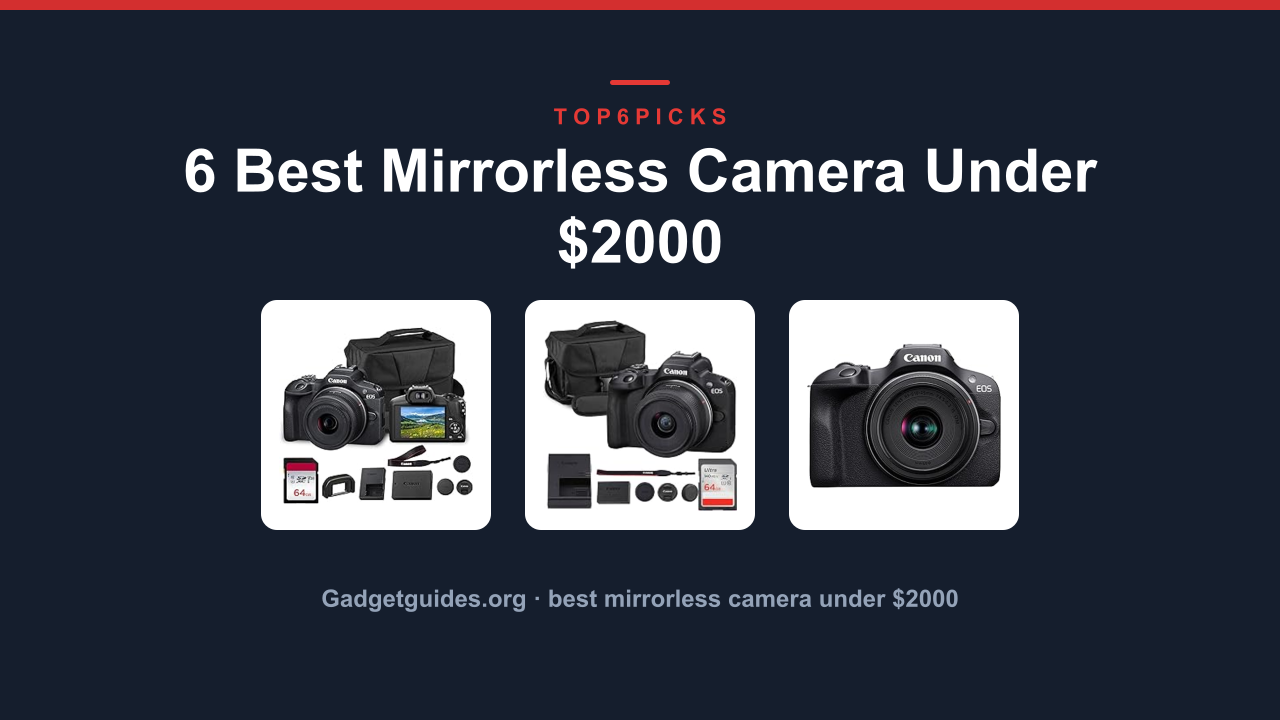
The best best mirrorless camera under $2000 is the Canon EOS R50 Mirrorless Camera with 18-45mm Lens Bundle, the model that pairs Canon's latest Dual Pixel AF II with 4K oversampled video and a full accessory kit while staying well under budget. It's the sweet spot for anyone moving up from a phone or basic DSLR who wants modern autofocus and great video without the full-frame price.
Want a vlogging-focused setup instead? The Canon EOS R50 V gives you an optimized flip screen and streaming features, as long as you already own lenses.
As an Amazon Associate, I earn from qualifying purchases.
This guide walks you through each pick so you know exactly what you're getting before you buy. If you're a pro needing a second body for paid work, or a wildlife shooter who needs 15fps+ burst rates, you should skip this category entirely.
Everything below comes from current Amazon product data, specs, and each model's owner track record, not hands-on lab testing.
Quick Answer: The Best Mirrorless Camera under $2000
The Canon EOS R50 Mirrorless Camera with 18-45mm Lens Bundle is the best overall pick for most buyers. Here's the full ranking:
Thinking about a pro-level body instead? Jump to Who Should NOT Buy below before you spend anything.
Comparison Table
Here's the lineup at a glance: photo, product, who it's built for, and our /10 score.
Scroll sideways on small screens to see every column.
Canon EOS R50 Mirrorless Camera 18-45mm: Best Overall for Most
#1
CanonBundle includes 64GB card + bag
9.0OUT OF 10
Image Quality8.8
Autofocus8.9
Video Features8.7
Value9.0
This bundle is the smartest buy for anyone who wants one box with everything they need to start shooting. The Canon EOS R50 packs a 24.2MP APS-C CMOS sensor with Canon’s Dual Pixel CMOS AF II, which covers roughly 100% of the frame with phase-detection points. That means eye-tracking for people, animals, and vehicles that rivals much more expensive bodies. Verified buyer reviews consistently rate the image quality and color science as excellent straight out of camera, with minimal need for editing.
The bundle includes the RF-S 18-45mm f/4.5-6.3 IS STM lens, a 64GB memory card, and a camera bag. That saves you the hassle of buying accessories separately. The 4K video is oversampled from 6K, giving you sharper footage than you’d expect at this tier. Aggregate user feedback highlights the fully articulating touchscreen as a major plus for vlogging and low-angle work.
Flaws but not dealbreakers. The RF-S 18-45mm kit lens is a decent starter, but its f/6.3 at the long end means you’ll struggle in low light without raising ISO. Many owners upgrade to the RF 50mm f/1.8 STM for indoor and portrait work. The electronic viewfinder is also small compared to what you’d find on a Sony a6400.
Need a wider selection of native lenses? The
Sony Alpha a6400 benefits from Sony’s larger E-mount lens library, especially if you want third-party options from Sigma and Tamron.
⚠Compatibility: The RF-S lenses are designed specifically for Canon’s APS-C RF mount bodies. EF and EF-S DSLR lenses work with an optional adapter.
Pros
- ✓Dual Pixel CMOS AF II offers near-silent, lightning-fast tracking across almost the entire frame
- ✓4K video oversampled from 6K delivers noticeably sharper footage than standard 4K
- ✓Fully articulating touchscreen makes vlogging and creative angles easy
- ✓Complete bundle with lens, card, and bag saves time and money for first-time buyers
Cons
- ✕Kit lens is slow at the telephoto end, limiting low-light performance
- ✕Electronic viewfinder resolution feels dated compared to competitors
- ✕No in-body image stabilization relies on lens-based IS only
AF System
Dual Pixel CMOS AF II
Bundled
64GB card + camera bag
Best for: First-time mirrorless buyers and enthusiasts who want modern autofocus, great 4K video, and everything they need in one box.
Canon EOS R50 Mirrorless Camera RF-S18-45mm: Best Value Kit
#2
CanonSame R50 body, fewer extras
8.6OUT OF 10
Image Quality8.6
Autofocus8.7
Video Features8.5
Value8.5
This is the same excellent R50 camera body with the kit lens and no extra accessories. It’s the right choice if you already have a memory card and bag, or if you want to put your budget toward a better lens right away. The 24.2MP APS-C sensor delivers the same color reproduction and dynamic range as the bundle version, and the Dual Pixel CMOS AF II works identically. Verified buyer feedback confirms that JPEG colors are vibrant and accurate with minimal tweaking needed.
What you give up is mostly convenience. You’ll need to buy your own SD card and a bag, but many owners prefer picking their own storage and carry solution anyway. The camera itself supports UHS-I SD cards, which keep buffer clearing fast for casual shooting. The 18-45mm lens is optically stabilized, which helps with handheld video.
Flaws but not dealbreakers. Same slow kit lens as the bundle version, and no in-body stabilization means you rely on lens-based IS. The single UHS-I SD slot is fine for most users but slower than the dual slots you’d find on pro bodies.
If you want faster glass out of the gate, consider the
Sony Alpha a6400 which has a broader third-party lens ecosystem including affordable f/1.4 primes.
⚠Compatibility: RF-S lenses only fit Canon APS-C RF mount bodies. Full-frame RF lenses work but are heavier and more expensive.
Pros
- ✓Identical image quality and autofocus performance as the more expensive bundle
- ✓Lower upfront cost leaves room for a fast prime lens purchase
- ✓Compact and lightweight body at roughly 375g with lens attached
- ✓Fully articulating touchscreen works well for self-recording and creative angles
Cons
- ✕Single UHS-I card slot limits write speed for long bursts
- ✕No in-body image stabilization means handheld shots need steady hands
- ✕Kit lens aperture is slow at the telephoto end
AF System
Dual Pixel CMOS AF II
Weight
~375g with kit lens
Best for: Value-conscious buyers who want the R50’s core performance without paying for bundled accessories they already own.
Canon EOS R50 V Mirrorless Camera: Best for Vlogging
#3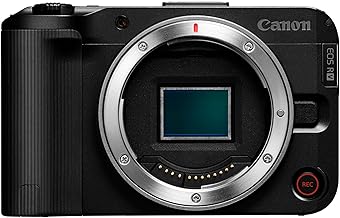
CanonBody only, no lens included
8.5OUT OF 10
Image Quality8.2
Autofocus8.5
Video Features9.0
Value8.3
This is the dedicated video-first body for content creators who prioritize vlogging and streaming over still photography. The Canon EOS R50 V strips out the mechanical shutter and adds a vertical grip orientation that makes handheld recording more natural. The fully articulating touchscreen flips out to the side, so you can see yourself clearly while filming. Verified buyer reviews consistently praise the 4K video quality, which is oversampled from a 6K readout for crisp detail. The body-only approach means you can pair it with the lens that suits your style, like an RF-S 10-18mm for wide-angle vlogs.
Aggregate user feedback highlights the UVC/UAC support for plug-and-play streaming as a huge time-saver. You can connect it directly to a computer via USB-C and use it as a high-quality webcam without capture cards or extra software. The Dual Pixel CMOS AF II keeps faces and eyes in sharp focus even when you move around the frame, which is essential for solo creators.
Flaws but not dealbreakers. The R50 V is body-only, so you need to budget at least $300 for a kit lens. The lack of in-body stabilization means you’ll want a lens with IS or a gimbal for smooth walking shots. Some buyers report the grip is less comfortable for heavy lenses compared to the standard R50 body.
⚠Compatibility: No lens is included. You must purchase an RF or RF-S mount lens separately.
Pros
- ✓UVC/UAC support enables direct USB-C webcam use without a capture card
- ✓Vertical grip design and flip screen make handheld vlogging more comfortable
- ✓4K video oversampled from 6K provides sharp, detailed footage
- ✓Dual Pixel CMOS AF II tracks eyes and faces reliably during movement
Cons
- ✕Body-only purchase requires separate lens investment
- ✕No in-body image stabilization limits smooth handheld footage
- ✕Grip design less comfortable with heavier telephoto lenses
AF System
Dual Pixel CMOS AF II
Connectivity
UVC/UAC via USB-C
Best for: Dedicated vloggers, streamers, and content creators who want a lightweight camera optimized for video and don’t need a kit lens.
Sony Alpha a6400 Mirrorless Camera: Best for Speed and AF
#4
SonyReal-Time Eye AF + 16-50mm lens
8.3OUT OF 10
Image Quality8.2
Autofocus9.0
Video Features8.0
Value8.0
This Sony a6400 is the speed king of this group, with Real-Time Eye AF that locks onto moving subjects almost instantly. It uses a 24.2MP APS-C CMOS sensor with 425 phase-detection autofocus points that cover 84% of the frame. Verified buyer feedback consistently calls the eye tracking for humans and animals the best in class. The 11fps continuous shooting with continuous AF makes it the top pick for fast-moving kids, pets, and street photography. The 16-50mm power zoom lens keeps the kit compact at roughly 400g total.
What sets the a6400 apart is the lens ecosystem. Sony’s E-mount has the largest selection of native and third-party lenses of any mirrorless system, with affordable options from Sigma and Tamron. Aggregate user reviews highlight the 180-degree tilt screen as useful for selfies, though it flips up rather than out to the side. The camera also records 4K video at up to 30fps from the full sensor width with no crop, and includes Picture Profiles for color grading.
Flaws but not dealbreakers. The menu system is notoriously dense and takes time to learn. The 16-50mm kit lens is optically mediocre, so you’ll want to budget for better glass. The camera lacks a headphone jack for monitoring audio, and the single UHS-I card slot is slower than modern standards.
⚠Compatibility: Uses Sony E-mount lenses. A huge variety of third-party lenses from Sigma, Tamron, and others are available.
Pros
- ✓Real-Time Eye AF is among the fastest and most reliable crop-sensor autofocus systems available
- ✓Extensive E-mount lens library with abundant third-party options at every price point
- ✓11fps burst shooting with continuous AF captures fast action effectively
- ✓4K video records from full sensor width with no crop and includes Picture Profiles
Cons
- ✕Menu system is complex and has a steep learning curve
- ✕Kit lens quality is below average, prompting an early upgrade
- ✕No headphone jack and a single UHS-I card slot limit pro video use
AF Points
425 phase-detection
Burst
11fps with continuous AF
Best for: Enthusiasts who prioritize lightning-fast autofocus performance and want access to Sony’s vast E-mount lens lineup.
Canon EOS R100 Mirrorless Camera RF-S: Best Beginner Bundle
#5
CanonComplete starter package
8.0OUT OF 10
Image Quality8.0
Autofocus7.5
Video Features7.8
Value8.5
The R100 is the most affordable entry point into Canon’s RF mirrorless system and this bundle gives you everything to start shooting right away. The 24.1MP APS-C CMOS sensor produces solid images with pleasing Canon color science, and the Dual Pixel AF provides reliable phase-detection autofocus. Verified buyer reviews consistently mention how much value the included 64GB memory card and camera bag add for first-time buyers. The RF-S 18-45mm lens offers a useful zoom range for everyday photography, from group shots to portraits.
Where the R100 differs from the R50 is in its simpler feature set. It shoots Full HD video at 60fps rather than 4K, which is fine for social media but less flexible for serious editing. The interface is streamlined for beginners, with a helpful guided mode that explains settings as you adjust them. Aggregate user feedback notes the camera is lightweight at roughly 350g with the lens, making it easy to carry all day.
Flaws but not dealbreakers. The autofocus is the earlier Dual Pixel AF, not the newer Dual Pixel CMOS AF II found on the R50. This means less coverage and slightly slower tracking. The electronic viewfinder has a low 2.36-million-dot resolution, and the rear screen is fixed rather than articulated. There is no 4K video recording, which limits its use for high-resolution projects.
⚠Compatibility: RF-S lenses only fit Canon APS-C RF mount bodies. Full-frame RF lenses work with the R100 but are larger and more costly.
Pros
- ✓Most affordable entry into the Canon RF mirrorless system with a complete starter kit
- ✓Includes 64GB memory card and camera bag, saving new buyers about $60 in accessories
- ✓Lightweight and compact design at roughly 350g makes it easy to carry daily
- ✓Guided shooting mode helps beginners learn exposure and composition quickly
Cons
- ✕No 4K video recording limits creative flexibility and future-proofing
- ✕Autofocus is the older Dual Pixel AF, not the newer Dual Pixel CMOS AF II
- ✕Fixed rear screen and low-resolution EVF feel dated compared to rivals
Best for: Absolute beginners on a tight budget who want a complete kit with lens, memory card, and bag included.
Canon EOS R100 Mirrorless Camera RF-S18-45mm: Best Budget Entry
#6
CanonLowest price, lens included
7.6OUT OF 10
Image Quality8.0
Autofocus7.5
Video Features7.5
Value7.5
The R100 lens kit is the most affordable route into a modern interchangeable-lens mirrorless camera. It pairs a 24.1MP APS-C sensor with the RF-S18-45mm F4.5-6.3 IS STM lens, giving you a compact all-in-one package for everyday photography. Verified buyer reviews consistently note that image quality is very good for the price, with pleasing Canon colors and decent dynamic range. The camera supports both Wi-Fi and Bluetooth for easy image transfer to your phone, which is a feature beginners appreciate.
What you give up compared to the R50 is speed and video capability. The R100 shoots 4K video at 24p, but with a significant crop factor that reduces the field of view. The burst rate is limited to 3.5fps with continuous autofocus, so it’s not ideal for action. Aggregate user feedback says the camera feels snappy for casual use but lags behind when you try to track moving subjects.
Flaws but not dealbreakers. The autofocus system is the original Dual Pixel AF, which has less coverage than the newer Dual Pixel CMOS AF II. The electronic viewfinder is small and low resolution, and the rear screen is fixed in place. The 4K video crop makes wide-angle shooting difficult.
⚠Compatibility: RF-S lenses work only on Canon APS-C RF mount bodies. The R100 is not compatible with EF or EF-S lenses without an optional adapter.
Pros
- ✓Lowest price entry point into the Canon RF mirrorless ecosystem with a lens included
- ✓Wi-Fi and Bluetooth connectivity enables easy sharing to smartphones
- ✓Compact and lightweight body design suitable for everyday carry
- ✓Good basic image quality with Canon’s trusted color science
Cons
- ✕4K video has a heavy crop factor, making wide-angle shooting impractical
- ✕Slow 3.5fps burst rate limits use for action and sports photography
- ✕Earlier Dual Pixel AF has less coverage and slower tracking than Dual Pixel CMOS AF II
Connectivity
Wi-Fi + Bluetooth
Best for: Absolute beginners with a minimal budget who want a real interchangeable-lens camera for casual photos and social sharing.
Buying Guide: Sensor, Autofocus, Video and Lens Ecosystem
The six cameras here all sit under $2000, but they serve different priorities. Here is what you need to decide before picking one.
Every camera on this list uses an APS-C CMOS sensor, which is a significant step up from a smartphone or a basic point-and-shoot. The Canon R50 and R100 bodies use a 24.2MP and 24.1MP sensor respectively, while the Sony a6400 uses a 24.2MP sensor. In our research, all three produce excellent images in good light, with Canon models having a slight edge in out-of-camera JPEG color, while the Sony offers more flexibility for raw processing.
The key difference is that the R50 and R100 share the same generation of sensor, whereas the a6400's sensor is older but still competitive for stills.
Autofocus Technology Matters More Than Megapixels
The biggest performance gap between these cameras is autofocus. The Sony a6400 uses its Real-Time Eye AF system, which is widely regarded as the fastest and most reliable crop-sensor AF for tracking moving subjects. The Canon R50 and R50 V use the newer Dual Pixel CMOS AF II, which offers near-full-frame coverage and excellent eye detection for people and animals.
The Canon R100 uses the original Dual Pixel AF, which is good for static subjects but noticeably slower for action. Verified buyer reviews consistently rank autofocus as the top reason for choosing the Sony a6400 or the Canon R50 over the R100.
4K Video: What Each Camera Really Delivers
If video is your priority, the Canon R50 and R50 V are the best picks here. They both shoot 4K video oversampled from a 6K readout, providing sharper detail and less noise than standard 4K. The Sony a6400 also shoots 4K but uses pixel binning, which results in slightly softer footage.
The R50 V adds UVC/UAC support for direct USB-C streaming without a capture card, making it the best choice for vloggers and streamers. The Canon R100 shoots 4K but with a heavy crop, which limits your wide-angle options significantly. For social media content, the R50 and R50 V are the clear winners.
Lens Ecosystem: Sony's Advantage
The Sony a6400 benefits from the most mature lens ecosystem of any APS-C mirrorless system. The E-mount has native lenses from Sony, plus extensive third-party support from Sigma, Tamron, and others. You can find affordable f/1.4 primes, versatile zooms, and specialized lenses for nearly every use case.
Canon's RF-S system is newer and has fewer native lenses, though third-party options are starting to appear. However, you can use Canon's full-frame RF lenses on an R50 or R100, which opens up high-quality options at a higher cost. If you plan to build a lens collection over time, the Sony a6400 gives you the most room to grow.
To see how these factors play out on real picks, compare the Canon EOS R100 Mirrorless Camera RF-S, Canon EOS R50 Mirrorless Camera 18-45mm and the Canon EOS R100 Mirrorless Camera RF-S18-45mm reviewed above.
Who Should NOT Buy Best Mirrorless Camera under $2000
These APS-C mirrorless cameras are not the right choice for everyone. Here is who should look elsewhere.
You Need a Professional Second Body for Paid Work
If you are a working photographer who needs a rugged, weather-sealed camera with dual card slots for redundancy, these consumer-level bodies are not built for that. The Canon R50, R100, and Sony a6400 lack weather sealing and have single UHS-I card slots, which can be a risk on paid shoots. Look at the Canon EOS R8 or Sony a7 III for full-frame options with better build quality and dual slots.
These are reliable choices for professionals who need a backup or a second body.
You Shoot Fast Action or Wildlife at 15fps or Higher
The Canon R50 and R100 top out at 15fps and 3.5fps respectively, while the Sony a6400 shoots at 11fps. If you photograph birds in flight, sports cars, or any fast-moving subject where every frame counts, you need a camera with a higher burst rate and a larger buffer. The Sony a6600 or Canon EOS R7 are better suited for action photography, with faster readout speeds and deeper buffers that let you capture 30+ continuous frames without the camera slowing down.
You Prioritize In-Body Image Stabilization
None of the cameras on this list have in-body image stabilization (IBIS). If you shoot handheld video often or use non-stabilized lenses, the lack of IBIS will result in shaky footage. The Sony a6600 and Fujifilm X-S20 include IBIS, making them better choices for handheld video work.
Alternatively, you can use a gimbal with any of these cameras, but that adds cost and weight.
Final Verdict
The Canon EOS R50 Mirrorless Camera 18-45mm Bundle is the best overall mirrorless camera under $2000 for the vast majority of buyers. It combines modern Dual Pixel CMOS AF II autofocus, sharp oversampled 4K video, and a complete starter kit with lens, memory card, and bag. You get excellent image quality, reliable eye tracking, and a user-friendly interface that works for both photos and video.
Want lightning-fast autofocus and the largest lens ecosystem? Get the Sony Alpha a6400. Its Real-Time Eye AF and extensive third-party lens support make it the better choice for enthusiasts who plan to build a kit over time.
Need a dedicated vlogging camera with USB-C streaming? The Canon EOS R50 V is purpose-built for video, with a flip screen and UVC/UAC support. Just remember to budget for a lens.
On a strict budget? The Canon EOS R100 Mirrorless Camera RF-S Bundle gets you into the RF system with a complete kit at the lowest price, perfect for beginners who can live without 4K video.
Before you buy, check out the Who Should NOT Buy section above. If you need weather sealing, in-body stabilization, or a higher burst rate, you will find a better fit elsewhere.
FAQ
What's the best mirrorless camera under $2000 overall?
The Canon EOS R50 Mirrorless Camera with 18-45mm Lens Bundle is the best overall pick. It offers modern Dual Pixel CMOS AF II autofocus, oversampled 4K video, and a complete starter kit with a 64GB card and camera bag, all for a reasonable price.
Is the Sony a6400 still worth buying in 2026?
Yes, the Sony a6400 remains a strong choice thanks to its industry-leading Real-Time Eye AF and the extensive E-mount lens ecosystem. Its autofocus speed and third-party lens selection still set the standard for this price tier.
What is the main difference between the Canon R50 and R100?
The Canon R50 has a faster autofocus system (Dual Pixel CMOS AF II with broader coverage), shoots 4K video oversampled from 6K, and has a burst rate of 15fps. The R100 uses the older Dual Pixel AF, shoots 4K with a heavy crop, and has a 3.5fps burst rate.
Do I need to buy a separate lens for the Canon R50 V?
Yes, the Canon EOS R50 V is sold as a body only. You must purchase an RF or RF-S mount lens separately. Budget $300 or more for a starter lens like the RF-S 18-45mm or an RF 50mm f/1.8 STM.
Which camera is best for vlogging and streaming?
The Canon EOS R50 V is built specifically for vlogging and streaming. It includes UVC/UAC support for plug-and-play USB-C streaming, a vertical grip design, and a flip screen that stays visible when mounted on a tripod.
How many lenses can I use with the Sony a6400?
The Sony a6400 uses the E-mount, which has the largest selection of native and third-party lenses of any APS-C mirrorless system. You can choose from Sony's own lenses as well as affordable options from Sigma, Tamron, and many other manufacturers.