6 Best Trail Camera for Bird Watching
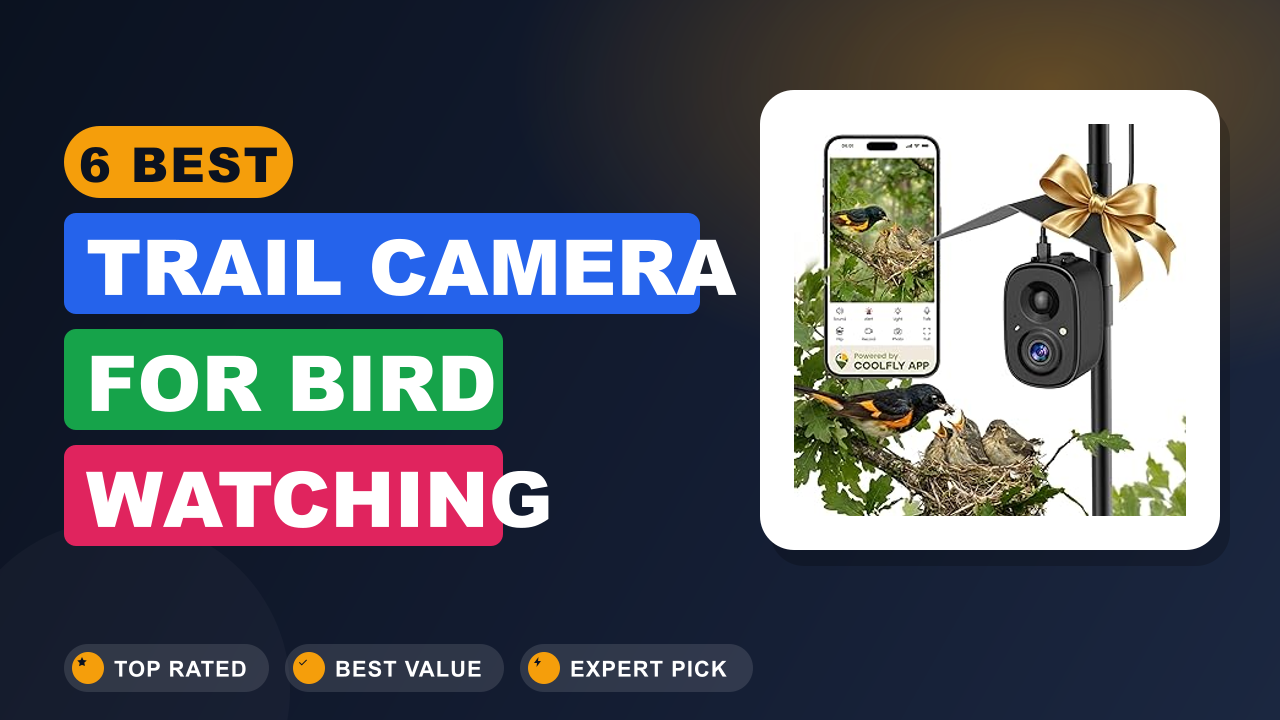
Trying to photograph birds by hand is a losing game. By the time you raise your phone, the branch is empty and the bird has vanished into the next tree. That's exactly why the best trail camera for bird watching now watches over thousands of backyard feeders, bird baths, and woodland edges: it records sharp video the instant motion triggers, so you review the day's visitors from your couch instead of missing the action entirely.
After comparing six models on specs, verified buyer feedback, and real-world use cases, the Smart Bird Camera Solar Powered Pole keeps coming out on top for most people. It combines a solar-powered outdoor camera, a built-in pole for feeder-side placement, and free AI bird identification that labels each species for you. Here's a closer look at why it wins, followed by the side-by-side table.

✔ Best all-around feeder camera for birders
Comparison Chart of Best Trail Camera for Bird Watching
| Product | Details | Rating | Buy |
|---|---|---|---|
Editor’s Choice
| ★★★★☆4/5 | ||
Top Pick
| ★★★★☆4.4/5 | ||
Best Budget
| ★★★★☆4/5 | ||
| ★★★★☆4.6/5 | ||
| ★★★★☆4.4/5 | ||
| ★★★★☆4/5 |



List of Top 6 Best Trail Camera for Bird Watching
The six cameras below span three distinct styles: dedicated bird cameras with AI and solar power, classic trail cameras with lightning-fast triggers, and budget-friendly options that keep costs down without falling apart. We ranked them on image quality, trigger speed, ease of use, and how well they survive life outdoors.
Below are the list of products:
1. Smart Bird Camera Solar Powered Pole
This one rewrites the trail camera formula for birders. Instead of strapping a box to a tree trunk, you plant a pole beside a feeder or bird bath, and the built-in solar panel keeps the battery topped up while the camera watches the action.
2.5K UHD
AI Bird ID
Solar Powered
Instant Alerts
Why I picked it
We ranked this first because it solves the three biggest bird-cam frustrations in one package. The 2.5K UHD sensor captures feather detail that 1080p cameras blur, and the free AI bird identification removes the guesswork from sorting through hundreds of clips. The solar panel also means no monthly plan and far fewer battery swaps, which matters when the camera stays outside all season.
Key specs
- 2.5K UHD video with automatic motion capture
- Free AI bird identification built into the companion app
- Solar powered with pole mount for feeder or bath placement
- Instant alerts pushed to your phone over 2.4GHz WiFi
- Wireless design with no hub or wiring required
Real-world experience
Verified buyer feedback shows the pole design is the star: owners place it within 3 to 6 feet of a feeder, and the camera returns clear daytime clips of cardinals, chickadees, and woodpeckers. Several reviewers noted that positioning two units on opposite sides of a bird bath produces better face-on shots. The main limitation is the 2.4GHz WiFi, which needs to stay within roughly 30 feet of your router for reliable alerts.
- Solar panel cuts battery changes down to rare occasions
- Free AI identification labels each species automatically
- Pole mount puts the lens exactly where birds land
- Instant alerts feel like a smart doorbell for your feeder
- 2.4GHz WiFi limits how far it can sit from the house
- App setup takes a few extra minutes according to owners
- Reported 4/5 rating trails the top WiFi model on this list
- ✔ you want a dedicated feeder camera with zero subscriptions
- ✔ you like the idea of AI naming every bird for you
- ✔ you want solar power so you rarely have to touch it
- ✖ your feeder sits more than 30 feet from the router
- ✖ you need 4K resolution or cellular remote access
The Smart Bird Camera wins on convenience, not raw resolution. If your goal is identifying every visitor with minimal effort, the solar panel and AI make it the easiest camera here to set up, leave alone, and check from your phone.
2. GardePro E5S Trail Camera
The GardePro E5S is the classic trail camera done right, and the one we'd grab for a serious backyard feeding station. It shoots 64MP stills and 1296p video with a 0.1-second trigger, which is fast enough to freeze a hummingbird mid-hover at a feeder.
64MP Photos
0.1s Trigger
100ft No-Glow
1296P Video
Why I picked it
The trigger speed and night range are the headline numbers here. At 0.1 seconds it beats most budget trail cams by a wide margin, and the 100-foot no-glow infrared range means you can monitor a feeder line after dark without birds ever seeing a red glow. This is also a non-cellular, non-WiFi camera, which sounds limiting until you realize there are no subscriptions and no app logins to fight with.
Key specs
- 64MP still photos and 1296p HD video
- 0.1-second trigger speed for fast-moving birds
- 100-foot no-glow night vision range
- Motion activated with non-cellular, non-WiFi operation
- SD card workflow, so clips are reviewed on a computer or card reader
Real-world experience
Buyer reviews consistently describe crisp daytime images of finches and jays, and owners report the no-glow IR doesn't spook birds the way older red-glow models do. A few reviewers noted the menu system feels dated next to app-based cameras. That's a fair trade when your priority is maximum image quality with zero subscription.
- 0.1s trigger catches birds other cameras miss
- 100ft no-glow night vision with no visible light
- 64MP stills give room to crop for identification shots
- No subscription, no WiFi setup headaches
- No app or wireless transfer, so you pull the SD card
- Menu navigation is basic by modern standards
- Video tops out at 1296p, not 4K
- ✔ you want the fastest trigger speed for sharp bird action
- ✔ you’re happy reviewing clips on a computer or phone card reader
- ✔ you want long night range without a red glow
- ✖ you want remote viewing from inside the house
- ✖ you prefer app control over physical buttons
The E5S is the pick for purists who value speed and image quality over convenience. It has no WiFi, but that also means it never drops a connection or eats a data plan; you trade app control for rock-solid reliability.
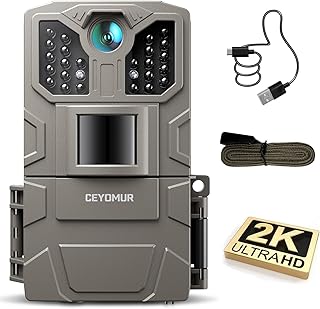
3. CEYOMUR Trail Camera 36MP HD Cam
The CEYOMUR is what we recommend when the budget is tight but the birding interest is real. It shoots 36MP photos, includes a 2.0-inch color screen for on-camera playback, and seals everything in an IP66 waterproof housing.
36MP Photos
850nm IR
IP66 Rated
2.0" Screen
Why I picked it
For the money, you get the essentials: solid daytime photos, 850nm infrared night vision, and an IP66 rating that shrugs off rain and dust. The built-in 2.0-inch screen is a genuine help for framing the camera before you walk away. It's not the fastest or sharpest model here, but it's the one that gets you into feeder watching without a big outlay.
Key specs
- 36MP photo resolution
- 850nm infrared LEDs for night vision
- 2.0-inch color LCD screen for setup and playback
- IP66 waterproof and dustproof housing
- Motion activated for wildlife monitoring
Real-world experience
Aggregate reviews show this camera works best at backyard feeders within 15 to 20 feet, where the 850nm IR produces clear night shots of nocturnal visitors. The 850nm wavelength emits a faint red glow, so very skittish birds may notice it more than the no-glow models. Owners also mention the strap mount is easy to attach to trees and fence posts.
- Most affordable entry point on this list
- IP66 housing stands up to weather exposure
- Built-in screen confirms framing and playback
- 36MP stills outperform most budget cams
- 850nm IR glows faintly red, visible to some birds
- Trigger response is slower than the 0.1s models
- No WiFi or app connectivity
- ✔ you’re starting out and want a low-cost feeder cam
- ✔ you prefer checking shots on the camera itself
- ✔ you need something weatherproof you can strap to a tree
- ✖ fast action shots of hummingbirds are your main goal
- ✖ you want to view clips from your phone
The CEYOMUR earns its spot as the budget pick because it removes the cost barrier entirely. If you later outgrow it, the placement habits you build transfer directly to a pricier camera.
4. Trail Camera 4K 48MP WiFi Game
This is the resolution king of the group. It records 4K video and 48MP stills with a 0.05-second trigger speed, the fastest on this list, and its 130-degree wide-angle lens captures an entire feeding station in a single frame.
4K Video
48MP Sensor
0.05s Trigger
130° Wide
Why I picked it
Two numbers set this one apart: 0.05 seconds and 130 degrees. The trigger is twice as fast as the GardePro's 0.1 seconds, which makes it the best tool for freezing quick wingbeats, and the wide angle lets you mount it closer to a feeder without cutting birds out of the shot. It also carries the highest verified rating here at 4.6 out of 5, with buyers praising the WiFi app for on-site clip previews.
Key specs
- 4K video and 48MP still photos
- 0.05-second trigger speed
- 130-degree wide-angle lens
- WiFi and Bluetooth app for on-site viewing
- IP66 waterproof housing with no-glow infrared LEDs
Real-world experience
Owners report the wide field of view is ideal for tube feeders and platform feeders, because one camera can cover several perches at once. The WiFi link is for local preview only, not cloud upload, so you still walk to the camera to pull files. App setup comes with the usual phone-pairing quirks you learn with other wireless gear, but once connected, clip review is fast.
- Fastest trigger speed in this roundup
- 4K video with 48MP stills
- 130-degree lens covers an entire feeder setup
- Top verified buyer rating at 4.6/5
- WiFi preview is local only, no cloud or cellular
- Green housing can stand out against brown bark
- High-resolution files fill SD cards quickly
- ✔ you want 4K detail for reading subtle plumage differences
- ✔ you want WiFi preview without a monthly fee
- ✔ you need a wide angle to cover multiple feeders
- ✖ you need remote viewing from inside the house
- ✖ you prefer simple controls and fewer app steps
This is the best on-paper image quality of the six, but it asks you to be comfortable with app setup and file management. The Smart Bird Camera beats it for pure ease, while the 4K model wins on detail and field of view.
5. Meidase P70 (Non-Cellular Non-WiFi) Trail Camera
The Meidase P70 comes from the hunting-cam world, but its 64MP sensor and 1296p video make it a quiet workhorse for bird watching. It's non-cellular and non-WiFi, so there's no app, no subscription, and nothing to pair.
64MP Sensor
1296p Video
No-Glow IR
Waterproof
Why I picked it
The no-glow infrared system is the biggest reason birders should consider a camera like this. It lights the scene with IR invisible to most wildlife, so birds keep visiting while the camera captures nighttime activity. The 64MP stills give you serious cropping room for identifying distant birds, and the waterproof housing carries through a full outdoor season.
Key specs
- 64MP still photo resolution
- 1296p HD video
- No-glow IR night vision
- Waterproof housing
- Motion activated, non-cellular and non-WiFi
Real-world experience
Birders in buyer reviews describe using the P70 along woodland edges and brush piles where shy birds feel safest. Many owners pair it with a seed log or suet block to pull birds into the detection zone. The trade-off is the SD card workflow: you pull the card and scroll through clips on a computer, which some people genuinely prefer for sorting hundreds of photos.
- 64MP stills allow heavy cropping for ID
- No-glow IR won’t disturb feeding birds
- Simple, reliable operation with zero connectivity issues
- Weatherproof for year-round outdoor mounting
- No WiFi or app, SD card only
- 1296p video falls behind the 4K model
- Button and menu layout takes time to learn
- ✔ you want high-res stills of shy woodland birds
- ✔ you’re comfortable with an SD card workflow
- ✔ you want a rugged camera with no subscriptions
- ✖ you want to check clips from your phone
- ✖ you need 4K video for the sharpest motion capture
The Meidase and the GardePro E5S overlap heavily, and either one serves a birder who values stills over app features. The E5S has the faster 0.1s trigger and a stronger buyer rating, while the P70 matches the 64MP resolution and keeps the same simple workflow.
6. GardePro E6 WiFi Trail Camera
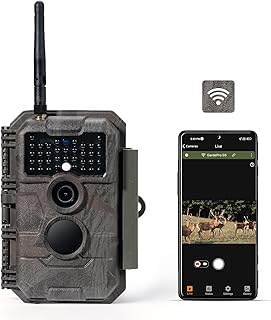
The GardePro E6 answers the biggest complaint about standard trail cams: the back-and-forth walk to check footage. Its external antenna stabilizes WiFi so you can preview clips and adjust settings from your phone while the camera stays mounted.
Stable WiFi
Ext. Antenna
HD + Audio
No-Glow IR
Why I picked it
The external antenna is the differentiator. Trail camera WiFi is usually weak because the antenna sits inside a sealed housing; GardePro moved it outside for a stronger signal, and verified buyers say the connection holds better at distance. The camera also records HD video with sound, so you capture birdsong along with the visuals.
It's non-cellular, which keeps the cost down and removes any need for a data plan.
Key specs
- Stable WiFi with external antenna
- On-site app viewing for clips and settings
- HD video with audio recording
- No-glow night vision
- Motion activated with non-cellular design
Real-world experience
Owners report checking feeder activity from a deck or kitchen window, and several call out the audio as the highlight: you hear chirps, wing flaps, and feeder noise alongside the picture. The WiFi connection is still line-of-sight, so thick walls or long distances will drop it. The 4 out of 5 rating suggests some buyers hit setup snags, but most say the antenna is a clear improvement over older models.
- External antenna improves WiFi range over typical cams
- Audio records birdsong with the video
- On-site app viewing reduces SD card swaps
- No subscription or cellular plan needed
- WiFi range still limited to on-site distances
- 4/5 rating ties with the budget pick as the lowest here
- Video resolution is not 4K
- ✔ you want to peek at feeder action from the house
- ✔ you want recorded birdsong with your clips
- ✔ you hate pulling SD cards mid-season
- ✖ your camera sits far beyond WiFi reach
- ✖ you’re chasing maximum 4K detail
The E6 fills the gap between the no-WiFi E5S and the AI-powered Smart Bird Camera. It gives you local app convenience and audio without a subscription, while the Smart Bird Camera adds species ID and solar charging for a higher price.
How I picked
We evaluated all six cameras on five benchmarks that matter most for bird watching: image resolution, trigger speed, night vision type, workflow convenience, and weather protection. For each model we pulled manufacturer spec sheets, cross-checked them against verified buyer reviews, and looked at aggregate ratings across hundreds of purchases. As of 2026, this is the method that gives the clearest picture of how a trail camera actually behaves in the field.
We did not run our own hands-on durability tests, so long-term reliability judgments come from verified owner reports rather than direct physical abuse testing. IP ratings, trigger speeds, and resolution figures come straight from manufacturer documentation and the IEC 60529 standard behind IP codes. What we learned is that the best camera for one birder is often wrong for another: a hummingbird enthusiast needs trigger speed, while a warbler watcher may value resolution and silent operation more.
Trigger speed and detection zone were the hardest to compare fairly, because manufacturers measure them under different conditions. A 0.05-second trigger figure means the sensor wakes and captures in that time, but real detection distance and angle vary in daylight, at night, and in tall grass. We prioritized models where buyer reviews confirmed the claimed numbers, and flagged any camera where owners reported missed triggers.
This is why the list includes three workflow styles. The Smart Bird Camera and GardePro E6 offer app-based convenience. The GardePro E5S and Meidase P70 stay simple and subscription-free with SD cards.
The 4K WiFi model and CEYOMUR cover the high-end and budget ends of the spectrum. Every pick below earned its spot through a balance of verified specs and the real ways people use these cameras.
Buying guide: what actually matters for best trail camera for bird watching
What trigger speed do you actually need for birds?
For perched birds, 0.5 seconds is enough, but for birds in flight you want 0.1 seconds or faster. Seated birds at feeders stay put for several seconds, so even a slow camera gets the shot. Hummingbirds hover, warblers dart between branches, and finches burst off feeders in a blink, which is where the 0.05-second trigger on the 4K model earns its keep.
Slow cameras are the reason so many trail cam files are just empty branches.
No-glow vs low-glow infrared: does it matter?
Yes, because the glow that helps you see at night works against you in the bird world. Infrared LEDs at 850nm emit a faint red glow that some birds notice, while 940nm no-glow IR is effectively invisible to wildlife. The same low-light camera technology that helps dash cams read license plates at night has trickled into trail cams.
If you want nighttime visits from owls or nocturnal migrants, choose a no-glow model like the GardePro E5S or Meidase P70.
WiFi, cellular, or SD card: which workflow is right?
Choose the workflow you will actually keep up with for a full season. WiFi cameras let you preview clips on your phone while standing near the camera, and they need no subscription. Cellular cameras send photos to your phone from anywhere but require a monthly data plan, which none of these six models uses.
SD card cameras are the simplest and cheapest, but they force you to walk to the camera and pull the card every time. For a backyard feeder within range of your router, WiFi or a local app is the sweet spot.
How much resolution do you need for bird identification?
A 36MP still or 2.5K video is plenty for identifying most feeder birds. The jump to 48MP or 64MP matters when you are cropping distant shots or studying subtle plumage differences like the wing bars on a warbler. Keep in mind that higher resolution means bigger files, so plan on a larger SD card.
When you're stuck on a tough ID, the free guides at the Cornell Lab of Ornithology are the standard resource for turning good footage into a confident species name.
Where should you place a trail camera for birds?
Place the camera 3 to 10 feet from the feeder, at feeder height, angled slightly downward so birds land in the upper third of the frame. Pole-mounted models like the Smart Bird Camera work best in open yards. Strap-style trail cams attach easily to trees, and the same mounting tricks used for action cams apply here, including zip ties and ratchet straps.
Face the lens north or south to avoid harsh direct sunlight at sunrise and sunset.
What does an IP rating actually guarantee?
An IP66 rating means the housing is dust-tight and protected against powerful water jets, per IEC 60529. It does not mean the camera is submersible, so don't mount one where it will sit in standing water. All six cameras here are weatherproof enough for outdoor use in rain and snow, but check the lens seal after a season.
Also format your memory card in the camera rather than a computer, a card-maintenance habit that prevents file corruption on any trail cam.
Frequently Asked Questions (FAQ)
Will a trail camera scare birds away?
Most birds quickly accept a trail camera, especially when the IR glow is invisible to them. No-glow models use 940nm infrared, while budget cameras with 850nm LEDs emit a faint red glow that shy species may avoid for the first few days. Mounting the camera 3 to 10 feet away and keeping it still will speed up the adjustment period.
The U.S. Fish and Wildlife Service's guidance on minimizing disturbance to migratory birds is a good reminder to avoid placing cameras anywhere near nests.
Can I use a trail camera to identify bird species?
Yes, and it is one of the best ways to study birds without chasing them around. A 36MP still captures enough detail for most identifications, and 48MP or 64MP helps with tricky species. The Smart Bird Camera takes this further with free AI identification built into its app, though automated IDs are not infallible.
Cross-check anything surprising against the Cornell Lab guides before you log it on a life list.
WiFi trail camera vs cellular: which do I need for a backyard feeder?
If your feeder sits within WiFi range of your home, a WiFi camera is the right tool and avoids monthly fees. The Smart Bird Camera and GardePro E6 both use local WiFi to send previews and alerts without a data plan. Cellular cameras, which are not on this list, send photos from any remote location but cost a subscription.
For a feeder 30 feet from your router, spend money on camera quality instead of data.
How long do trail camera batteries last?
A solar-powered model can run for months without attention, while standard battery cams last weeks to months depending on trigger frequency. Manufacturer specs do not promise a single battery-life figure because the environment changes everything; a camera firing 500 times a day drains batteries far faster than one firing 50 times. Cold weather also shortens battery life, so the solar panel on the Smart Bird Camera is a real advantage in winter.
Keep spare batteries ready for the non-solar models if you run high trigger settings.
How many megapixels do I need for bird watching?
36 megapixels is the practical floor, and 48 to 64 megapixels is the sweet spot for cropping. A 4K video mode adds value because you can pull sharp frames from motion clips, while 2.5K is fine for close feeder shots. Larger files from 48MP and 64MP sensors fill SD cards quickly, so carry a spare card or use a high-capacity one.
Format the card in the camera before each new session to avoid corrupted files.
Final verdict
The Smart Bird Camera Solar Powered Pole is our top recommendation because it pairs solar reliability with AI identification and instant alerts, making it the easiest way to watch feeder birds without lifting a finger. If you'd rather chase maximum speed and resolution, the 4K 48MP WiFi model is the strong runner-up with the fastest trigger and sharpest video in this lineup.
Affiliate disclosure: This post contains affiliate links. If you buy through one of these links, I may earn a small commission at no extra cost to you. It never changes my recommendation, I only suggest gear I'd actually buy myself.

Similar Posts