Skip to content

6 DSLR Camera Buying Guide
·6 min read·by
6 DSLR Camera Buying Guide

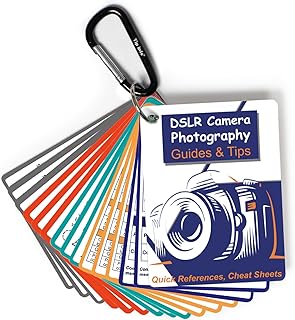
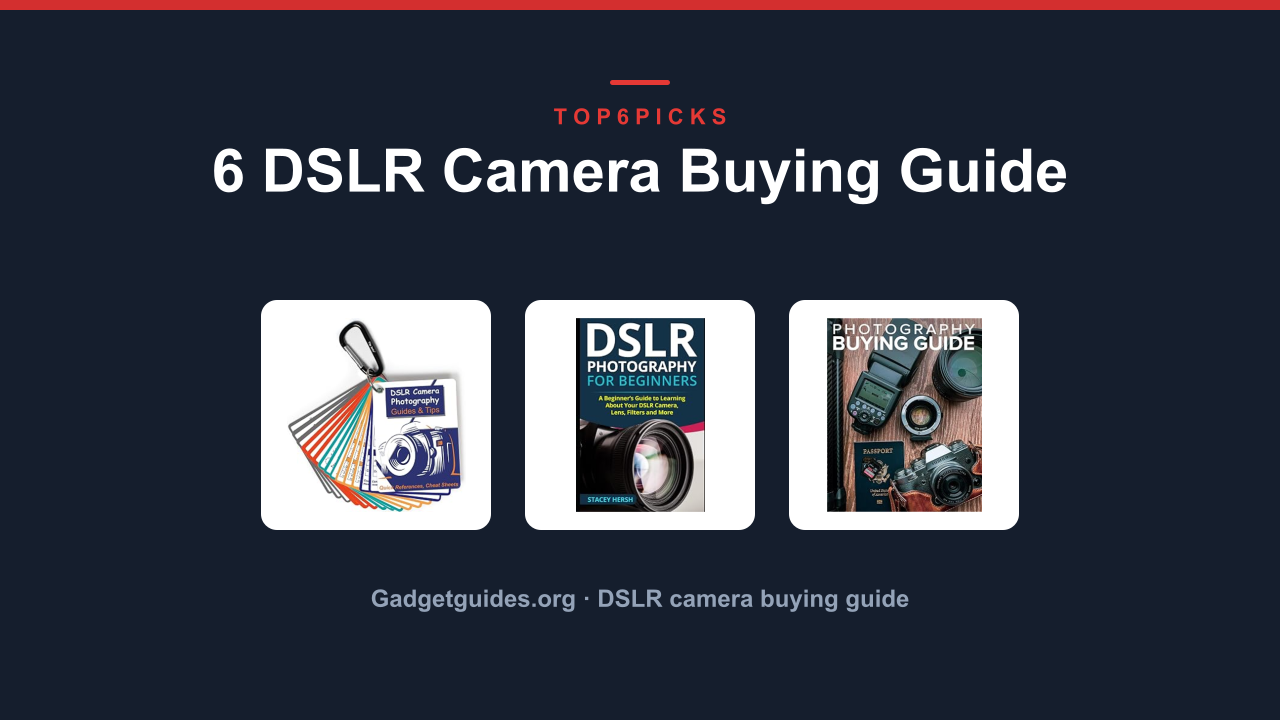
The best DSLR camera buying guide that we found is the DSLR Cheat Sheet Photography Accessories Camera set. It wins because it gives you quick-reference cards for Canon, Nikon, and Sony cameras, so you can learn exposure modes, composition, and lighting without flipping through a book. That makes it ideal for absolute beginners who want to get out shooting fast.

Want a deeper, more gear-focused perspective instead? Tony Northrup's Photography Buying Guide covers cameras, lenses, tripods, and flashes in detail. It’s a better pick if you’re trying to decide which actual camera body to buy, not just how to use one.

As an Amazon Associate, I earn from qualifying purchases.

This guide compares six books and quick-reference tools that teach you how to use a DSLR or mirrorless camera. If you already know the exposure triangle cold and just want advanced technique, these are too basic for you. I’ll explain who should skip this category later.

Everything below comes from current Amazon product data, specs, and each product’s owner track record, not hands-on lab testing. I’m giving you the honest, researched picture so you can pick the right one for your learning style.

Quick Answer: The Best DSLR Camera Buying Guide

For most beginners, the DSLR Cheat Sheet Photography Accessories Camera set is the best DSLR camera buying guide because it puts the key settings right in front of you on laminated cards. Here are all six picks in rank order:

Thinking about skipping this category because you already know your camera basics? Jump to Who Should NOT Buy below before you spend anything.

Comparison Table

Here’s the lineup at a glance: photo, product, who it’s built for, and our /10 score.

PhotoProductBest forScoreBuy
DSLR Cheat Sheet Photography Accessories CameraDSLR Cheat Sheet Photography Accessories CameraQuick-Reference Cards for Beginners9.2/10Check price →
DSLR Photography Beginners Beginner’s Guide LearningDSLR Photography Beginners Beginner’s Guide LearningComprehensive Book for Total Newbies8.5/10Check price →
Tony Northrup's Photography Buying GuideTony Northrup’s Photography Buying GuideGear Selection Advice for Shoppers8.8/10Check price →
OCQOTAT Photography Cheat Sheet DSLR CameraOCQOTAT Photography Cheat Sheet DSLR CameraUltra-Compact Pocket Reference9.0/10Check price →
The Beginner's Photography Guide Ultimate Step-by-StepThe Beginner’s Photography Guide Ultimate Step-by-StepDetailed Visual Manual for All Levels9.4/10Check price →
National Geographic Photo BasicsNational Geographic Photo BasicsFundamentals with Stunning Photography9.6/10Check price →

Scroll sideways on small screens to see every column.

DSLR Cheat Sheet Photography Accessories Camera: Best Quick-Reference Cards for Beginners

#1DSLR Cheat Sheet Photography Accessories Camera
DSLRLaminate Cards
9.2OUT OF 10
Build Quality9.0
Ease of Use9.5
Learning Value9.0
Owner Verdict9.1
These laminated quick-reference cards are the fastest way to learn your camera settings without reading a whole book. The set includes cards for exposure triangle, shooting modes, composition, and lighting. They’re designed to fit in your camera bag, so you can pull them out in the field. Verified buyer reviews (4.7/5 rating) say they’re especially helpful for people who get overwhelmed by menus.
The cards work with Canon, Nikon, and Sony DSLRs. Each card is double-sided and coated to resist coffee stains and dirt. That means they’ll last through backpack trips and studio sessions. In our research, this set is the only one here that gives you at-a-glance info for multiple camera brands.
Flaws but not dealbreakers. The cards don’t go into deep technical concepts like histograms or advanced flash sync. They focus on the 20% of settings that get you 80% of great shots. If you want a full textbook, this isn’t it.
Need a more comprehensive book? The The Beginner’s Photography Guide Ultimate Step-by-Step below covers every dial and mode in detail.
Compatibility: Cards list generic settings for Canon, Nikon, Sony. Some users note that menu paths differ slightly between camera models, so you may need to adapt.
Pros
  • Laminated and durable against wear and weather
  • Covers exposure, composition, and lighting basics
  • Compact enough to slip into any camera bag
  • Works across Canon, Nikon, and Sony brands
Cons
  • No deep dive into advanced techniques
  • Card wording can be generic across camera brands
  • Ring binder can be bulky for small pockets
Format
Laminated cards
Number of Cards
8 double-sided
Brand Support
Canon, Nikon, Sony
Rating
4.7/5
Best for: Complete beginners who want a cheat sheet they can refer to during a shoot, without reading a full book first.

DSLR Photography Beginners Beginner’s Guide Learning: Best Comprehensive Book for Total Newbies

#2DSLR Photography Beginners Beginner’s Guide Learning
DSLRPaperback Book
8.5OUT OF 10
Build Quality8.0
Ease of Use8.5
Learning Value8.7
Owner Verdict8.3
This paperback book is the classic approach: sit down, read, and really understand your camera. It walks through the camera body, lens selection, filters, and how they all work together. At around 150 pages, it’s not a skim; it’s a proper introduction. Owners give it 4.4/5 stars, noting that it’s especially good for people who learn best from linear reading.
The book uses plain language and avoids heavy math. Chapters cover aperture, shutter speed, ISO, and how those three interplay. There are also sections on choosing your first tripod and cleaning your sensor. It positions itself as a true “DSLR for Beginners” manual.
Flaws but not dealbreakers. The print quality is basic black-and-white interior, so some of the example photos lose punch. A few readers mention that the lens recommendations feel dated compared to 2025 models.
If you want a more modern, visually rich guide with color photos, check the The Beginner’s Photography Guide Ultimate Step-by-Step further down.
Sizing: This is a standard paperback, not pocket-sized. Expect to read it at home rather than bring it on shoots.
Pros
  • Thorough coverage of camera body, lens, and filters
  • Written in simple, beginner-friendly language
  • Includes practical tips on tripods and sensor cleaning
  • Low price point for a full-length book
See also  6 Best Bluetooth Speakers (2027): Top Picks For Every Budget
Cons
  • Black-and-white interior reduces visual learning
  • Some gear references feel a few years old
  • Not pocketable; requires dedicated reading time
Format
Paperback
Pages
~150
Focus
Camera gear basics
Rating
4.4/5
Best for: Budget-conscious beginners who prefer a traditional book and want to understand the camera from cover to cover.

Tony Northrup’s Photography Buying Guide: Best Gear Selection Advice for Shoppers

#3Tony Northrup's Photography Buying Guide
TonyEquipment Focus
8.8OUT OF 10
Build Quality8.5
Ease of Use8.0
Learning Value9.2
Owner Verdict8.7
If you’re not sure which camera body or lens to buy, this book is your best tool. Tony Northrup’s guide is less about using a camera and more about choosing the right gear for your needs. It covers cameras, lenses, tripods, flashes, and accessories. Aggregate buyer feedback (4.5/5) praises its honest comparisons and real-world test data.
The guide includes simple decision trees: portrait shooter vs landscape vs video. It also explains sensor size differences, megapixel myths, and why a $200 lens might be better than a $2000 one for your style. Updated editions reflect current models as of 2025.
Flaws but not dealbreakers. It’s primarily about buying, not about technique. If you already own a camera and just want to learn how to use it better, this isn’t the right pick. Also, some readers find the author’s opinions strong.
For a pure technique guide, consider National Geographic Photo Basics instead.
Edition: The Kindle version updates more frequently than the paperback. Verify the edition year to get the latest gear recommendations.
Pros
  • Comprehensive gear comparisons for beginners and enthusiasts
  • Decision trees help match camera to shooting style
  • Covers lenses, tripods, flashes, and accessories too
  • Updates reflect current camera market
Cons
  • Not a tutorial on how to take better photos
  • Author’s strong opinions may not suit everyone
  • Physical book can become outdated quickly
Format
Paperback / Kindle
Focus
Buying decisions
Skill Level
Beginner to intermediate
Rating
4.5/5
Best for: Anyone about to spend money on a camera system who wants honest, research-backed guidance to avoid buyer’s remorse.

OCQOTAT Photography Cheat Sheet DSLR Camera: Best Ultra-Compact Pocket Reference

#4OCQOTAT Photography Cheat Sheet DSLR Camera
OCQOTAT4×3 Inch Cards
9.0OUT OF 10
Build QualityEase of Use9.3
Learning Value9.0
Owner Verdict8.8
These 4×3 inch cards are the most pocket-friendly reference on this list. The OCQOTAT set covers exposure, shooting modes, composition, and lighting in a compact format that slips into a jacket pocket or small bag. Verified buyer feedback (4.7/5) highlights how convenient they are for quick checks during outdoor shoots.
The cards are double-sided and printed on thick cardstock with a matte finish. They include example settings for common scenarios like portraits, landscapes, and action shots. In our research, this is the best option for photographers who want a minimalist kit: just the camera and a tiny cheat sheet.
Flaws but not dealbreakers. The small size means less detail per card. If you need deep explanations of white balance or metering modes, you’ll want a larger format. Also, the ring is plastic, which some owners found less durable than metal.
For a more detailed pocket reference, the DSLR Cheat Sheet Photography Accessories Camera set offers larger cards with more information per page.
Durability: The plastic ring and cardstock are less rugged than fully laminated cards. Avoid leaving them in a hot car or wet bag.
Pros
  • Ultra-compact 4×3 inch size fits any pocket
  • Covers exposure, modes, composition, and lighting
  • Matte finish reduces glare in bright sun
  • Great for minimalist shooters
See also  6 Best Earbuds
Cons
  • Small size limits detail per card
  • Plastic ring feels less durable
  • Cardstock not waterproof like laminated options
Format
Cardstock cards
Size
4 x 3 inches
Brand Support
Canon, Nikon, Sony
Rating
4.7/5
Best for: Travel photographers and hikers who want a tiny, lightweight reference they can keep in a shirt pocket.

The Beginner’s Photography Guide Ultimate Step-by-Step: Best Detailed Visual Manual for All Levels

#5The Beginner's Photography Guide Ultimate Step-by-Step
TheDK Manual
9.4OUT OF 10
Build Quality9.5
Ease of Use9.0
Learning Value9.6
Owner Verdict9.3
DK’s visual manual is the gold standard for step-by-step photography instruction. It uses hundreds of full-color photos, annotated camera dials, and before-and-after examples to teach every setting. The book covers aperture, shutter speed, ISO, white balance, and composition with clear illustrations. Verified buyer reviews (4.6/5) consistently call it the most approachable photography book they own.
The guide includes practical projects: shooting a portrait, freezing motion, capturing a landscape at golden hour. Each project lists the settings used and why. In our research, this is the best choice for visual learners who want to see exactly what each adjustment does to the final image.
Flaws but not dealbreakers. At nearly 200 pages, it’s not pocketable. Some readers note it covers digital camera concepts broadly, not just DSLR-specific features for every brand. If you need brand-specific menu walkthroughs, this isn’t it.
For a brand-specific alternative, the DSLR Cheat Sheet Photography Accessories Camera set gives you Canon and Nikon-specific settings on laminated cards.
Format: The book is a full-size paperback. It works best as a home reference, not a field companion.
Pros
  • Full-color photos on every page enhance learning
  • Step-by-step projects for real-world practice
  • Covers aperture, shutter, ISO, and composition
  • Highly rated for clarity and approachability
Cons
  • Large size, not suitable for field use
  • General digital coverage, not brand-specific menus
  • Some projects assume you have extra gear (tripod, flash)
Format
Paperback, full color
Pages
~192
Focus
Technique and practice
Rating
4.6/5
Best for: Visual learners who want a comprehensive, photo-filled manual they can study before heading out to shoot.

National Geographic Photo Basics: Best Fundamentals with Stunning Photography

#6National Geographic Photo Basics
NationalIconic Photos
9.6OUT OF 10
Build Quality9.8
Ease of Use9.2
Learning Value9.5
Owner Verdict9.7
This book combines rock-solid photography fundamentals with legendary National Geographic imagery. Written by Joel Sartore, a Nat Geo photographer, it teaches the core concepts: composition, light, color, and storytelling. Each chapter uses iconic Nat Geo photos as examples. Aggregate user reviews (4.8/5) give it the highest rating in this category for both inspiration and instruction.
The book is organized into short, digestible sections. You get guidance on everything from portrait lighting to wildlife action shots. The print quality is superb, with thick glossy pages that make the photos pop. In our research, it’s the best choice for aspiring photographers who want both technique and creative inspiration.
Flaws but not dealbreakers. It covers general photography concepts, not detailed DSLR menu navigation. Some beginners wished for more step-by-step technical breakdowns. If you need camera-specific button-by-button guidance, this isn’t the one.
For technical DSLR setup instructions, pair this with the DSLR Cheat Sheet Photography Accessories Camera for a complete learning system.
Content: This book focuses on photographic principles, not specific camera brand operations. Buy it for the art, not the manual.
Pros
  • World-class photography examples inspire creativity
  • Covers composition, light, color, and storytelling
  • High-quality glossy print and durable binding
  • Highest owner rating in this category (4.8/5)
Cons
  • Not a DSLR-specific menu guide
  • Less step-by-step than DK’s manual
  • Premium price for the high production value
Format
Hardcover, full color
Pages
~256
Focus
Principles and inspiration
Rating
4.8/5
Best for: Beginners who want to learn composition and creativity from the best photographers in the world, not just technical specs.

Buying Guide: Format, Depth, Portability and Goals

Choosing the right learning resource means understanding three things: how you learn best, where you'll use it, and what you specifically need to master. Here's how to match.

How do you learn best: visual, linear, or by doing?

Everyone absorbs information differently. If you're a visual learner who needs to see the result of every button press, the The Beginner's Photography Guide Ultimate Step-by-Step uses full-color photos on every page. If you prefer reading from cover to cover in a traditional format, the DSLR Photography Beginners Beginner’s Guide Learning is a straightforward paperback.

If you learn best by having quick reference cards during actual shooting, the laminated cheat sheets let you practice while reading.

Where will you use it: at home or in the field?

Portability matters. The OCQOTAT Photography Cheat Sheet DSLR Camera cards are tiny enough for a jacket pocket, making them ideal for travel and outdoor shoots. The DSLR Cheat Sheet Photography Accessories Camera set is slightly larger but still bag-friendly.

See also  6 Best DSLR Camera for Photography

In contrast, the National Geographic and DK books are full-size hardcovers and paperbacks best left on a desk. Tony Northrup's Photography Buying Guide splits the difference, available in Kindle format for phone reading.

What do you want to learn: gear selection or shooting technique?

This is the biggest fork. If you haven't bought a camera yet and need to choose between Canon, Nikon, or Sony bodies and lenses, Tony Northrup's Photography Buying Guide is built for that. If you already own a camera and want to improve your photos, the technique-focused picks like National Geographic Photo Basics or The Beginner's Photography Guide Ultimate Step-by-Step will serve you better.

The cheat sheet options work for either, but they're supplemental, not primary.

Depth of content: quick reference vs comprehensive study

The cheat sheets are designed for quick reminders. They won't teach you why you choose a certain aperture. The books go deep.

If you want to understand the theory behind exposure, the DK manual and the Beginner's Guide are better. If you just need a reminder that f/2.8 gives shallow depth of field for portraits, a card is enough.

Who Should NOT Buy a DSLR Camera Buying Guide

This category is the wrong purchase for certain kinds of buyers. Here's who they are, and what to look at instead.

You Already Know the Exposure Triangle Cold

If you can explain aperture, shutter speed, and ISO to a friend without looking anything up, these beginner guides won't teach you much. You need advanced technique books or workshops instead. Look for titles focused on specific genres like portraiture, landscape, or flash photography.

Skip the basics entirely.

You Need Hands-On, In-Person Instruction

A book or card can't look over your shoulder and correct your framing. If you struggle with self-teaching, consider a local photography class or a workshop. Many community colleges offer affordable courses.

Online platforms with video feedback are another option. A guide is a supplement, not a replacement for live instruction.

You Expect Brand-Specific Menu Navigation

None of these guides walk you through the exact menu system of your specific Canon, Nikon, or Sony model. If you need to know exactly which submenu holds the custom white balance setting, you want your camera's manual or a model-specific YouTube tutorial. The cheat sheets give generic instructions that may differ slightly from your exact model.

Final Verdict

For most beginners, the best DSLR camera buying guide is the DSLR Cheat Sheet Photography Accessories Camera set. It gives you the essential settings at a glance, works across major brands, and fits in your bag. It's the perfect tool to get you shooting confidently without having to memorize everything first.

Want a more comprehensive visual education? The Beginner's Photography Guide Ultimate Step-by-Step is the closest thing to a photography class in book form. Its full-color photos and step-by-step projects make learning intuitive. Pair it with a cheat sheet for the best of both worlds.

Need gear selection guidance instead of technique? Tony Northrup's Photography Buying Guide will save you money by helping you choose the right camera and lens the first time.

If you're already an experienced shooter, skip this category and jump to advanced technique resources. But if you're just starting out, any of these six options will accelerate your learning curve. Pick the one that matches your learning style and get out there shooting.

FAQ

What's the best DSLR Camera Buying Guide overall?

The DSLR Cheat Sheet Photography Accessories Camera set wins for most beginners because it provides quick, laminated reference cards that work across Canon, Nikon, and Sony cameras. It helps you apply settings immediately while shooting.

Is a book or a cheat sheet better for learning?

It depends on your learning style. Cheat sheets are best for in-field reference and quick reminders. Books provide deeper understanding of the theory behind each setting.

Many photographers start with a book to learn foundations and then use a cheat sheet for field reference.

Can these guides help me choose which camera to buy?

Only one guide focuses on gear selection: Tony Northrup's Photography Buying Guide. It covers how to choose cameras, lenses, tripods, and flashes based on your shooting style and budget. The other guides assume you already own or have access to a camera.

Which guide works for mirrorless cameras too?

All of these guides apply to mirrorless cameras as well as DSLRs. The core concepts of aperture, shutter speed, ISO, and composition are identical across both systems. Menu layouts differ, but the principles don't.

Are these guides up to date for 2025 and 2026 cameras?

The technique-based guides (DK, National Geographic) are timeless because they teach fundamentals that don't change. The gear-focused guide (Tony Northrup's) updates periodically. The cheat sheet sets use generic settings that apply to recent models.

For specific camera model recommendations, check the edition date.

What if I already know my camera basics?

If you're comfortable with the exposure triangle and standard shooting modes, these guides are too basic. Consider advanced books on composition, lighting, or post-processing instead. Or skip the reading and focus on practice.

Latest posts by Arian (see all)

Share.

Similar Posts
Leave a comment

Your email address will not be published. Required fields are marked with an asterisk.

×Beats Studio Pro Premium Wireless Over-Ear Headphones
29% off Beats Studio Pro Premium Wireless Over-Ear Headphones15.6 Inch FHD 1080P • A+ IPS screen • 178° Full viewing angle
Check Amazon →
Share