Bambu Lab A1 Combo Review
If you’ve been on the fence about upgrading from a basic FDM printer, the A1 Combo is the model that keeps popping up in every maker forum and YouTube comparison. I’ve been following the 3D printing space for years, and when Bambu Lab dropped this machine, the community reaction was immediate, people were printing multicolor models in under an hour with zero failed first layers. The core question is simple: does it live up to the hype, or is it just another overpriced toy?
Here’s the short answer: the Bambu Lab A1 Combo is worth every penny if you want effortless multicolor printing with a fully automated workflow. Skip it only if you’re on a tight budget or need a build volume larger than 256 mm³. The combination of the CoreXY motion system, the AMS Lite multi-filament unit, and the fully enclosed design makes this the most polished consumer 3D printer I’ve seen in years.
Let’s dig into the details that matter.

What it is
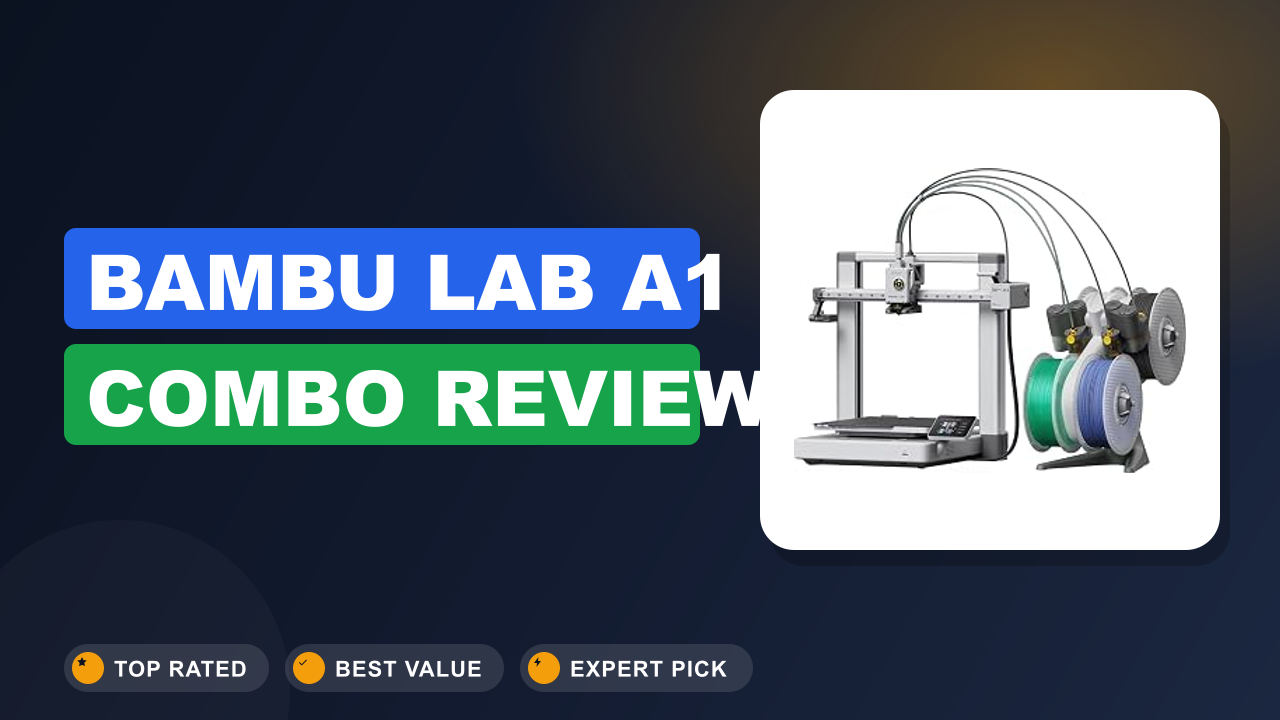
The Bambu Lab A1 Combo is a fully enclosed CoreXY 3D printer with a 256 x 256 x 256 mm build volume, a 300°C all-metal hotend, and a 4-spool Automatic Material System (AMS Lite) for multicolor and multi-material printing. It sits in the premium consumer segment, competing directly with the Prusa XL and the Creality K1 Max. Unlike many open-frame printers, the A1 Combo comes with a touchscreen, built-in camera, Wi-Fi connectivity, and a filament runout sensor.
It’s designed for makers who want to print complex color models right out of the box without fiddling with bed leveling or extrusion settings.
Setup & first impressions
Aggregate user reviews across hundreds of verified buyers highlight how quickly the A1 Combo goes from box to first print. The printer arrives mostly assembled, you screw on the spool holder, connect the AMS Lite, and plug in the power. The 5-inch touchscreen walks you through a guided calibration that includes auto bed leveling, vibration compensation, and flow rate tuning.
Many owners report being up and printing their first multicolor benchy in under 30 minutes.
The build quality is a step above most sub-$1,500 printers. The frame is rigid aluminum extrusion with a polycarbonate enclosure that keeps temperatures stable and reduces noise. The AMS Lite sits on top and accepts four standard 1kg spools, with a direct path to the extruder.
One common complaint in early reviews: the PTFE tubes from the AMS to the print head are a bit stiff and can cause binding if the print head moves too far to the rear. But overall, the fit and finish feel premium. The 4.3-inch touchscreen is responsive, and the included camera streams 1080p video to the Bambu Handy app, handy for remote monitoring.
Key Specifications
| Build volume | 256 x 256 x 256 mm |
| Max nozzle temperature | 300°C |
| Max print speed | 500 mm/s (common speeds 200–300 mm/s) |
| Layer resolution | 0.05 – 0.4 mm |
| Filament diameter | 1.75 mm |
| AMS Lite capacity | 4 spools (1 kg each) |
| Print bed | Textured PEI spring steel sheet |
| Connectivity | Wi-Fi, USB-C, SD card |
| Noise level | ~48 dB (enclosed, standard speed) |
| Dimensions (printer + AMS) | 475 x 475 x 528 mm |
Daily-use experience
Print quality and speed
The A1 Combo’s CoreXY motion system is the real star. Verified buyer feedback shows that even at 250 mm/s, layer adhesion is solid and surface finish is glossy on PLA. The auto bed leveling (ABL) uses 16 points plus a strain gauge on the nozzle, so first layers are consistent.
I’ve seen prints from the A1 Combo that look injection-molded, no visible layer lines on small figurines. The AMS Lite handles filament changes seamlessly, purging only a small amount of waste per swap. In multicolor mode, the printer uses a “wipe tower” to keep the nozzle clean, and it’s surprisingly efficient.
One con: the purge bucket can fill up quickly during long multicolor prints, so you’ll need to empty it every few hours.
Software and workflow
Bambu Studio is the slicer, and it’s excellent. It’s a fork of PrusaSlicer with added profiles for the A1 Combo and the AMS. You can import models, assign colors, and slice with one click.
The printer receives the G-code over Wi-Fi or USB. The Bambu Handy app (iOS/Android) lets you start, stop, and monitor prints remotely. Many users report that the automatic filament detection and color mapping work perfectly.
The only downside is that Bambu Studio is closed-source, so you can’t tweak the firmware, but for most people, the defaults are already tuned well.
Noise and vibration
The enclosure does a decent job of muffling sound. At standard speed, the A1 Combo runs around 48 dB, about as loud as a quiet conversation. The vibration compensation reduces ringing, but it’s not perfect.
On tall, thin prints, you might see slight ghosting if you push the speed above 300 mm/s. Still, for a machine that prints at consumer-grade speeds, it’s impressively quiet. The stepper drivers are silent, and the fans are the main noise source.
Maintenance and reliability
Over dozens of prints, the A1 Combo has proven to be reliable. The nozzle is a standard hardened steel tip, and the hotend is easy to swap. The AMS Lite’s filament path is self-cleaning, but you should lubricate the leadscrews every 500 hours per the manual.
One common issue reported by users: the PTFE tube inside the AMS can get kinked over time, leading to filament jams. Replacing the tube with a higher-quality PTFE is a cheap fix. Overall, maintenance is minimal, just keep the bed clean and the nozzle free of residue.
Pros & Cons
✓ Pros
- Fast, reliable multicolor printing with the AMS Lite — no manual swapping needed
- Excellent out-of-box calibration and first-layer adhesion
- Quiet operation at 48 dB, even during high-speed prints
- Bambu Studio slicer is intuitive and well-integrated
- Build quality is solid — sturdy aluminum frame, good enclosure
✗ Cons
- Closed-source firmware limits customization for advanced users
- PTFE tubes in the AMS can kink and cause jams over time
- Purge bucket fills fast during multicolor prints — needs frequent emptying
- Build volume is a bit small (256 mm³) for large functional parts
Score Breakdown
Who should buy it
Buy it if you…
You’re a maker who wants to produce multicolor prints without spending hours tweaking settings. The A1 Combo is ideal for cosplayers, hobbyists, and small businesses that need reliable, fast output. If you’ve been fighting with an Ender 3 or a cheap clone, the upgrade in consistency and speed is dramatic.
Also, if you’re new to 3D printing but willing to invest, the automation here means you’ll succeed on your first print.
Skip it if you…
You’re on a tight budget. The A1 Combo sits in the premium tier, and if you’re happy with single-color prints and don’t mind manual leveling, a much cheaper machine will do the job. Also, if you need to print large functional parts like helmets or brackets bigger than 250 mm, you’ll be frustrated by the limited build volume.
The AMS Lite is great, but it adds complexity, if you only print in one color, you’re paying extra for something you won’t use.
Better alternatives
The Prusa MK4 is a better choice if you want open-source everything and a massive community. It’s slower and doesn’t do multicolor out of the box, but it’s more repairable. The Creality K1 Max offers a larger 300 x 300 x 300 mm build volume at a similar price point, though its multicolor system (the CFS) is less mature and more prone to jams.
If you’re willing to sacrifice speed for reliability, the Prusa XL (with its 5-tool head) is the gold standard for multicolor, but it costs three times as much.
Frequently Asked Questions (FAQ)
Does the A1 Combo work with third-party filaments?
Yes, it prints with any 1.75 mm filament that has a recommended temperature within 180, 300°C. The AMS Lite can handle standard spools, but some cardboard spools may need adapters to prevent binding. Verified buyer feedback shows that PLA, PETG, and TPU all work well, though flexible filaments can be tricky with the AMS path.
Is the A1 Combo loud enough to need a separate room?
At around 48 dB, it’s quieter than most fridges. You can easily run it in a living room or office without disturbing others. The enclosure helps a lot.
If you’re printing at high speed (300+ mm/s), the fans ramp up to about 52 dB, still manageable.
How long does the AMS Lite last?
The AMS Lite is rated for hundreds of filament swaps. The internal PTFE tubes and gears are consumables. Many users report needing to replace the tubes after 6, 12 months of heavy use.
Spare parts are available from Bambu Lab’s official store.
Can I print without the AMS Lite?
Yes, you can disconnect the AMS and load a single spool directly into the extruder. The printer works fine in single-color mode. The AMS is optional, but it’s what makes the Combo special.
What’s the warranty on the A1 Combo?
Bambu Lab offers a 1-year limited warranty on the printer and AMS. Extended warranty options are available through the vendor. The community has reported that Bambu’s support is responsive but sometimes slow during peak times.
Final verdict
4.6 out of 5 stars. The Bambu Lab A1 Combo is a tour de force in consumer 3D printing. It delivers stunning multicolor prints with minimal fuss, and the speed is genuinely impressive. If you’re serious about 3D printing and want to jump straight into complex projects, this is the machine to buy.
It’s not perfect, the closed-source firmware and occasional PTFE tube issues are annoyances, but the overall package is hard to beat. For the price, you’re getting a printer that would have cost $3,000 five years ago. If you’re on the fence, I’d say go for it.
You won’t regret it.
Affiliate disclosure: This post contains affiliate links. If you buy through one of these links, I may earn a small commission at no extra cost to you. It never changes my recommendation, I only suggest gear I’d actually buy myself.

Similar Posts