When To Replace Vs Repair Your Furnace For Homeowners In Vermont
Your furnace is the last thing you want thinking about at 2 a.m. in a Vermont January. The outdoor temp has tucked below zero. The indoor thermostat won't budge past 58.
Deciding whether to repair or replace that furnace determines if you spend $400 today and risk another breakdown next month, or drop $6,000 now for a system that could last 18 years.
Most Vermont furnaces run at 78, 82% AFUE after year 12. A single cracked heat exchanger makes repair illegal in most towns. The decision comes down to three clear numbers: age, repair cost as a percentage of replacement, and heat exchanger integrity.
Let's walk through them.
Quick Answer
Replace your furnace if it's over 15 years old. Replace it if the repair costs more than 50% of a new unit. Replace it if the heat exchanger is cracked.
Repair it if the furnace is under 12 years old. Repair it if the repair is under $800 and the heat exchanger is sound. In Vermont's climate, the 50% rule is a hard floor.
Erring on the side of replacement avoids a mid-winter failure.
Image source: Bing (Web (fair-use with source credit))
The Real Cost of Guessing Wrong
Deciding late can cost more than the repair itself. A failed furnace in a Vermont cold snap means frozen pipes. Pipe damage averages $3,000 to $8,000 according to homeowner claims data.
Even a 24-hour outage while you wait for a service truck can cost hundreds in emergency fees, lost food, and lodging.
The hidden cost is efficiency loss. A 15-year-old furnace operating at 78% AFUE wastes about 22 cents of every fuel dollar. In a typical Vermont winter, that's $300 to $500 in unnecessary propane or oil every season.
Replace that with a 96% AFUE unit. You recoup the difference in three to five winters.
That's why the "patch it for now" mindset is dangerous here. A $1,200 repair on a 16-year-old furnace might get you through this winter. But it delays the inevitable.
You'll pay for that delay in fuel bills and anxiety.
Should You Repair or Replace? The Three Questions That Decide It
Start with three diagnostic questions. Answering them takes about ten minutes. You need a look at your furnace's nameplate, a recent service invoice, and the condition of the heat exchanger.
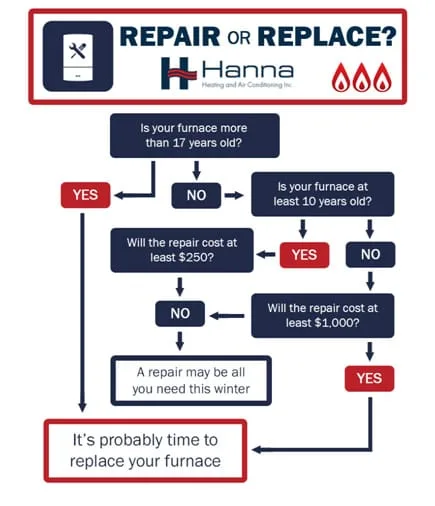
Image source: Bing (Web (fair-use with source credit))
How Old Is Your Furnace?
Check the serial number on the rating plate. It's usually on the inside of the blower door or near the gas valve. Most manufacturers encode the year in the first two digits or a date code.
If that's unclear, your service tech can tell you.
The useful life of a gas or propane furnace in Vermont is 15 to 20 years. Oil furnaces average 15 to 18 years. Under 12 years old?
Repair is almost always smarter unless the heat exchanger is bad. Between 12 and 15 years, it's a gray zone. Evaluate the next two questions.
Over 15 years? Replace. Parts availability and efficiency gains make it straightforward.
What Percentage of Replacement Cost Is This Repair?
Get a written estimate for the repair. Get a written quote for a comparable new furnace using the same fuel type with similar efficiency and installed with permits. Divide the repair cost by the replacement cost.
If the repair is under 30% of replacement, repair is usually worth it. Between 30% and 50%, consider the age. Older than 15?
Lean toward replace. Over 50%? Replace.
This rule holds up in Vermont because labor rates run $120 to $180 per hour. Emergency calls add a $150 to $300 premium. A $1,500 repair on a $6,000 replacement is exactly 25%.
That's a repair candidate if the furnace is reasonably young.
Is the Heat Exchanger Cracked or Rusted?
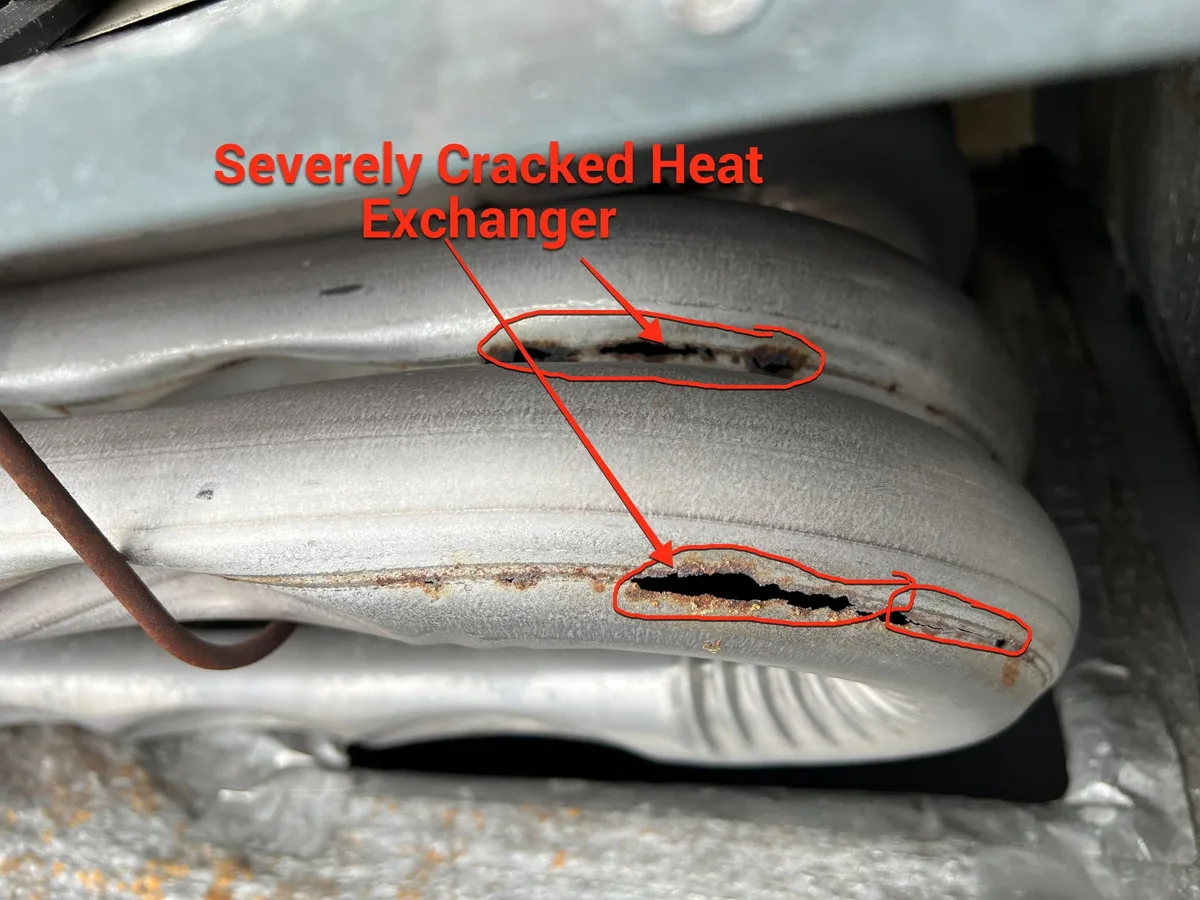
This is the only non-negotiable replacement trigger. A heat exchanger with any crack, hole, or significant rust pitting is a carbon monoxide hazard. In Vermont, most licensed technicians will condemn the furnace on the spot.
Do not repair a heat exchanger. It's unsafe and against code in most towns.
If you smell a faint metallic odor, see soot around the burner, or your carbon monoxide detector has gone off, stop using the furnace immediately. Call a licensed pro for a combustion safety test. If the heat exchanger is bad, the decision is made for you.
Vermont's Unique Factors That Change the Equation
What works in Florida or Ohio doesn't apply here. Vermont's climate, fuel mix, housing stock, and rebate programs shift the repair-replace balance.
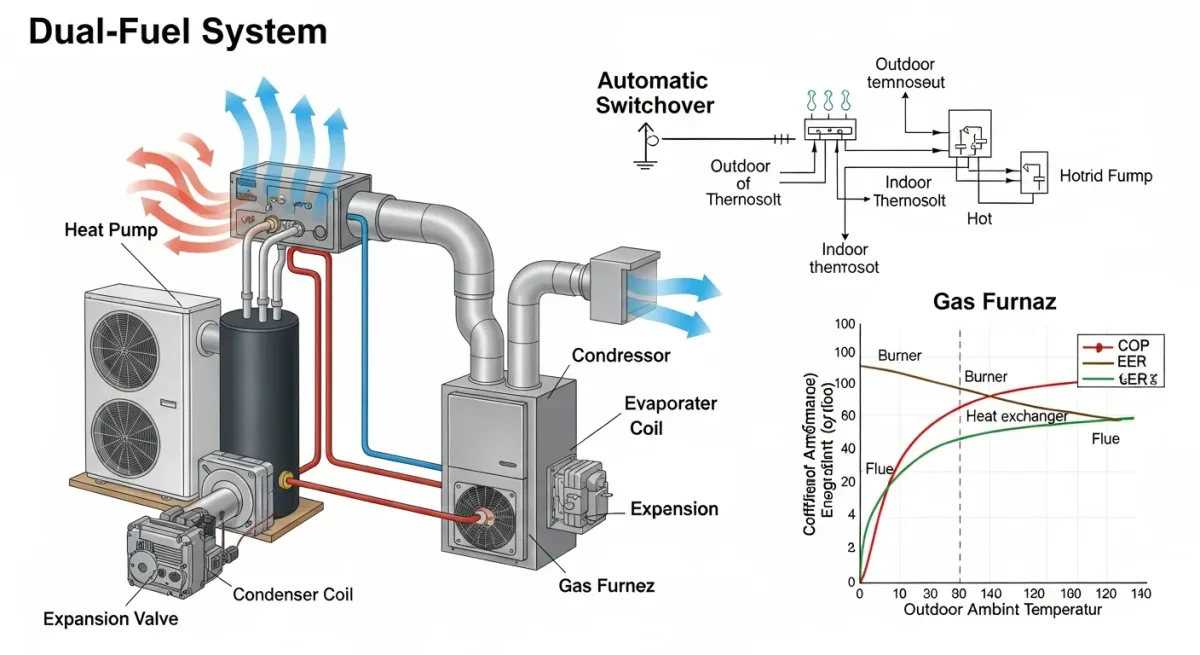
Image source: Bing (Web (fair-use with source credit))
Vermont's Brutal Climate and Heating Loads
We live in ASHRAE climate zones 5A and 6A. Design temperatures hit -10°F to -20°F. Your furnace has to run for hours without a hiccup.
Older single-stage furnaces that short-cycle or struggle to keep up are more likely to fail in extreme cold. A replacement with a two-stage or modulating furnace reduces strain and improves comfort.
Fuel Type Matters
Natural gas is cheapest in northwestern Vermont around Burlington. It's not available everywhere. Propane and oil dominate rural homes.
If you're on oil, consider switching to propane or a cold-climate heat pump when you replace. Efficiency Vermont offers incentives that can cover part of the conversion. Heat pumps alone can fail below -13°F.
A dual-fuel system with heat pump plus gas or propane backup is becoming popular.
Efficiency Vermont Rebates and Incentives
As of early 2026, Efficiency Vermont offers $300 to $600 for qualifying high-efficiency furnaces at 95% AFUE or higher. Additional incentives are available for heat pumps and duct sealing. Check Efficiency Vermont's current rebate page before you decide to replace.
Those dollars can tip a marginal repair into a replace decision.
The Problem with Older Housing Stock
Nearly 60% of Vermont homes were built before 1980. Many have undersized ductwork, poor insulation, and outdated electrical panels. A replacement furnace must be correctly sized using a Manual J load calculation.
Don't just swap for the same BTU rating. Oversizing leads to short cycling and lower efficiency. Insist your contractor runs the math.
The Cost Breakdown: Repairs vs. Replacement in Vermont
Here's what you're looking at in 2026 dollars based on contractor quotes and industry data across the state.
| Repair Item | Typical Cost (Parts + Labor) |
|---|---|
| Blower motor replacement | $400–$800 |
| Ignitor or flame sensor | $150–$350 |
| Gas valve | $600–$1,200 |
| Pressure switch | $200–$400 |
| Draft inducer motor | $500–$900 |
| Control board | $600–$1,100 |
| Replacement (new furnace installed) | Typical Cost |
|---|---|
| Gas furnace, 80% AFUE, basic single-stage | $3,500–$5,000 |
| Gas furnace, 95% AFUE, two-stage | $5,000–$7,500 |
| Propane furnace, 95% AFUE, modulating | $6,000–$9,000 |
| Oil furnace replacement | $5,500–$10,000 |
| Additional: permit, oil tank removal, duct mods | $500–$2,500 |
The 50% rule says: if your estimated repair cost exceeds half the replacement cost of a similar-efficiency unit, replace. In Vermont, lower that threshold to 40% if the furnace is over 12 years old. The risk of another failure during a cold snap is real.
Real Vermont Scenarios: What Works and What Fails
These are composite examples drawn from dozens of homeowner situations across the state.
Scenario 1: The 18-Year-Old Gas Furnace with a Cracked Heat Exchanger
A house in Stowe, 1,800 square feet, natural gas. The tech finds a hairline crack in the secondary heat exchanger. Repair cost is zero because it's not allowed.
Replacement quote is $6,200 for a 96% AFUE two-stage model. After a $450 rebate from Efficiency Vermont, net cost is $5,750. The homeowner recoups the difference in fuel savings within four winters.
Verdict: clear replace.
Scenario 2: The 12-Year-Old Propane Furnace with a Failed Blower Motor
A house in Randolph, 2,100 square feet, propane. The blower motor seizes. Repair cost is $650.
Replacement quote is $7,200 for a 95% AFUE unit. That's 9% of replacement cost. The furnace is only 12 years old.
Efficiency is still 82% AFUE. The heat exchanger is clean. Repair it.
Verdict: clear repair.
Scenario 3: The Oil Furnace in a Rental Property
A house in Bennington, rental unit, 1,400 square feet. The oil furnace is 22 years old. The burner assembly is failing.
The tank shows rust. Repair estimate is $1,800 for a new burner, tune-up, and tank patch. Replacement with propane furnace and new tank is $9,500.
The landlord opts for repair. Three months later, the tank leaks. Environmental cleanup costs $4,000.
Net result: cheaper to have replaced. Verdict: should have replaced.
Common Mistakes Vermont Homeowners Make
Even smart homeowners blow this decision. The mistakes repeat across the state. They all cost money or safety.
Ignoring Carbon Monoxide Detector Warnings
If your CO detector goes off, treat it as an emergency. A cracked heat exchanger or blocked flue can dump carbon monoxide into your living space. Do not reset the detector and hope it was a glitch.
Shut the furnace off. Open windows. Call a licensed technician for a combustion safety test.
Vermont law requires CO detectors in every home. They only work if you act on the alarm.
Patching a Heat Exchanger Instead of Replacing
Some homeowners ask a handyman to weld or seal a cracked heat exchanger. This is dangerous and illegal under Vermont mechanical codes. A heat exchanger crack can widen without warning.
The only safe option is a new heat exchanger or a new furnace. No reputable contractor will attempt a patch.
Choosing the Wrong Efficiency for Your Home Size
A 96% AFUE furnace sounds great. But if your Vermont home has leaky ductwork and poor insulation, the efficiency gain is wasted. Oversizing is another common error.
A furnace that's too large for the house short cycles, wears out faster, and never reaches peak efficiency. Always insist on a Manual J load calculation before buying.
Skipping the Permit and Load Calculation
Some contractors offer a no-permit, no-inspection deal to save time. That's a red flag. A permit ensures the installation meets Vermont fire and gas codes.
Without it, your homeowner's insurance may deny a claim if something goes wrong. Pay for the permit and the load calculation. It's a few hundred dollars that protects your investment.
Frequently Asked Questions
How long do furnaces typically last in Vermont?
Gas and propane furnaces average 15 to 20 years in Vermont's climate. Oil furnaces average 15 to 18 years. Proper maintenance with annual tune-ups and clean filters can extend that by a few years.
After 15 years, the risk of failure during a cold snap rises sharply.
Should I replace my old furnace with a cold-climate heat pump?
If your home has existing ductwork and you're on propane or oil, a dual-fuel system is worth considering. A cold-climate heat pump handles heating down to about -13°F. Below that, a gas or propane backup furnace takes over.
Efficiency Vermont offers rebates for heat pumps. The upfront cost is higher, but fuel savings can offset it over time.
What rebates are available for furnace replacement in Vermont?
Efficiency Vermont offers $300 to $600 for qualifying high-efficiency gas or propane furnaces at 95% AFUE or above. Additional rebates apply for heat pumps, duct sealing, and smart thermostats. Check their website for the current year's amounts.
Some local utilities also offer their own incentives.
Can I DIY a furnace repair in Vermont?
Simple tasks like changing an air filter are fine. Anything involving gas, electrical, or heat exchanger work requires a licensed Vermont HVAC technician. Gas work without a license is illegal here.
Improper repairs can void the furnace warranty, cause carbon monoxide leaks, or lead to house fires. Save the DIY for painting.
So, What's the Verdict?
Run through the three questions: age, repair cost percentage, and heat exchanger condition. If your furnace is over 15 years old, the repair is over half the cost of a new one, or the heat exchanger is bad, replace it. If it's under 12 years old, the repair is cheap, and the heat exchanger is sound, repair it.
In between those extremes, tilt toward replacement for any Vermont home where a mid-winter failure would be a crisis. The peace of mind alone is worth the difference. Book a licensed technician for a full inspection before any decision.
That $150 visit could save you thousands.

Similar Posts