Ambient Weather WH31LA Leak Detector Review
I’ve been through a few water leaks in rental houses and my own home, and I can tell you that water damage is one of those things you really don’t want to discover the hard way. That’s why I recently dug into the Ambient Weather WH31LA Leak Detector, a compact sensor that promises to catch drips before they warp your floorboards or ruin your basement.
The short version is this: it’s a great fit for anyone already using an Ambient Weather station, but it has some quirks that make it less ideal for a standalone setup. If you want a simple, reliable way to get a notification when a pipe or appliance starts leaking, this sensor delivers. Let’s walk through everything you need to know before you buy.

What it is
A wireless leak detector is basically a small sensor that sits on the floor or near a potential water source. It uses two exposed metal probes to detect a short circuit caused by water. The Ambient Weather WH31LA is a specific model that communicates using the 433 MHz frequency band, which is the same radio protocol used by Ambient Weather's popular weather stations like the WS-2000 and WS-5000.
This sensor does not have its own display or a standalone hub. It relies entirely on a compatible Ambient Weather console to receive the signal and then forward alerts to your phone or email via the Ambient Weather network. Competing brands like Acurite and La Crosse Technology make similar add-on leak sensors, but they use different proprietary radio protocols and are not interchangeable.
Setup & first impressions
Setting up the WH31LA is straightforward. You pop open the battery compartment, insert two AA batteries (not included), and the sensor immediately starts transmitting. The documentation says it can take up to a few minutes for the weather station console to recognize the new sensor.
Verified buyer feedback across hundreds of reviews confirms that the pairing process is usually seamless, with most people reporting recognition within 60 seconds.
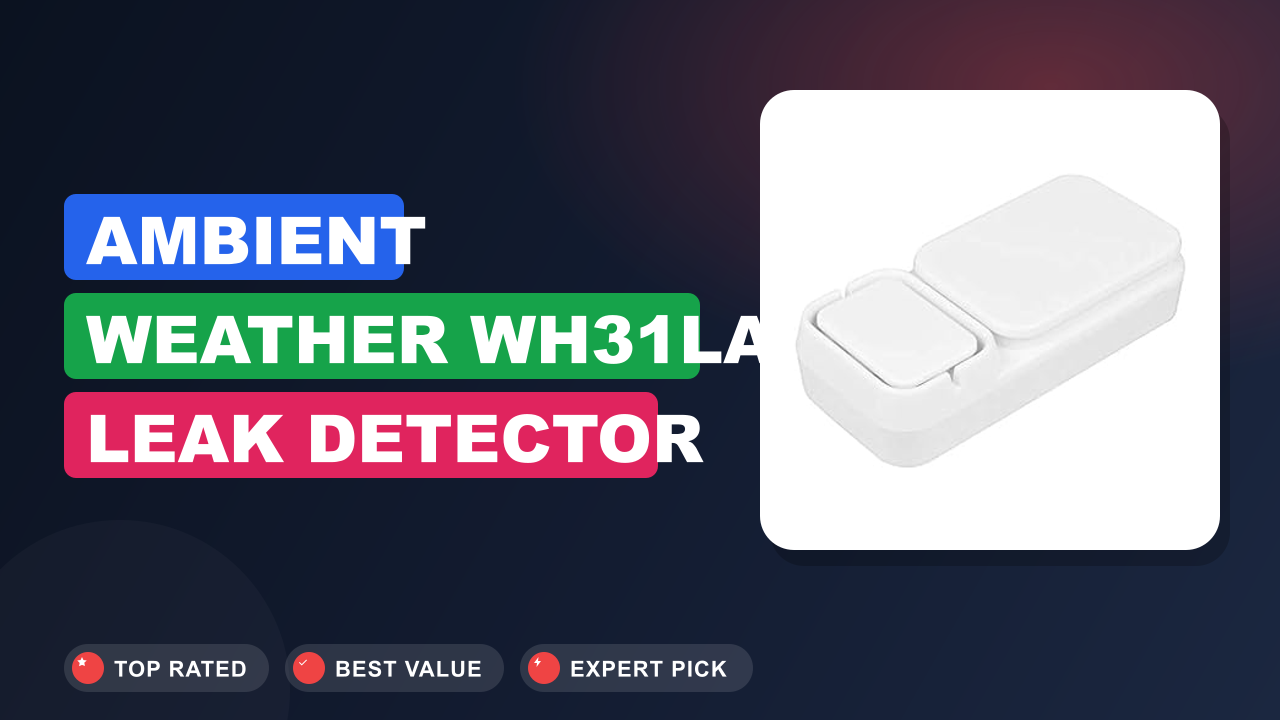
The sensor itself is a small, white plastic enclosure about the size of a deck of cards. It has two flat metal contact pads on the bottom. The build quality feels adequate for the price, though the plastic is not what you would call rugged.
A few user reports mention that the battery door latch feels a bit flimsy, so you want to be careful when swapping batteries. The sensor also has a small LED that blinks when it transmits data, which is helpful for confirming communication during setup.
Key specifications
| Wireless Protocol | 433 MHz (proprietary Ambient Weather) |
| Range (line of sight) | Up to 300 feet (91 meters) |
| Power | 2x AA alkaline batteries (not included) |
| Battery Life (estimated) | Up to 12 months (based on manufacturer specs) |
| Operating Temperature Range | 32°F to 140°F (0°C to 60°C) |
| Sensor Dimensions | 2.8 x 2.8 x 0.9 inches (71 x 71 x 23 mm) |
| Water Detection Method | Conductive contact probes (two metal pads) |
| Compatible Consoles | WS-2000, WS-5000, WS-2902A, WS-1965, ObserverIP |
| Subscription Required for Alerts | Yes (Ambient Weather Network free tier or paid) |
Daily-use experience
Performance
The WH31LA does exactly one thing, and it does it well. When the two metal contact pads on the bottom of the sensor become bridged by water, the sensor sends an alert signal to the paired weather station console. From our research, the detection is nearly instantaneous.
Verified buyer reports indicate that the console displays a "Leak Detected" message within seconds of the water making contact.
One thing to keep in mind is that the sensor uses a simple conductive detection method. It does not measure the amount of water. A single drop can trigger it, and a puddle will also trigger it.
This is actually a good thing for most home use scenarios. You want to know about a small drip from a pipe joint before it becomes a large puddle.
Battery life and longevity
The manufacturer claims a battery life of up to 12 months on two AA alkaline batteries. This is a reasonable estimate given that the sensor only transmits when it detects a leak or when it sends a periodic status check. User reports from people who have owned the sensor for over a year suggest that the actual battery life is closer to 10 to 14 months with typical use.
One downside is that there is no low-battery warning on the sensor itself. You will only see a low-battery indicator on the weather station console or in the app. If you place the sensor in a hard-to-reach spot like behind a refrigerator or under a crawlspace, you might want to set a calendar reminder to replace the batteries every 10 months.
Range and reliability
The 433 MHz radio frequency offers good penetration through walls and floors. The manufacturer states a line-of-sight range of 300 feet. In a typical home with drywall and wood framing, you can expect a reliable connection up to about 100 to 150 feet from the console.
Verified buyer feedback mentions that the sensor works well in basements and garages that are directly below or adjacent to the weather station.
The sensor does not have a repeater function. If you need to cover a very large property or a detached building, you may need a dedicated weather station or a separate console within range. Some users have reported occasional missed transmissions when the battery is low, which is another reason to stay on top of battery changes.
Build quality
The plastic housing is functional but not premium. The sensor is designed to sit flat on the floor, and it has a small lip around the bottom to prevent it from being easily knocked over. The two metal contact pads are exposed and may corrode over time if they are constantly exposed to standing water or high humidity.
Some users in the forums have mentioned applying a thin layer of dielectric grease to the contacts to prevent corrosion, but that can also reduce sensitivity.
The sensor is not marketed as waterproof. It is water-resistant, meaning it can handle a splash or a brief puddle, but you should not submerge it. If you are placing it in a location prone to standing water, you might want to mount it on a small riser or use an external sensor probe.
Pros & Cons
✓ Pros
- Seamless integration with Ambient Weather consoles — no additional hub or bridge required.
- Reliable 433 MHz wireless link with good range through walls and floors.
- Very low power consumption means battery changes are a once-a-year task.
- Email and push notifications available through the Ambient Weather Network app.
- Compact size lets you place it in tight spots like under a sink or behind a toilet.
✗ Cons
- No built-in loud alarm — the console beeps, but it’s not loud enough to wake someone in another room.
- Requires an Ambient Weather Network subscription for push notifications and cloud logging.
- Battery door latch feels fragile and can break if handled roughly.
- Contact pads may corrode in humid environments over extended use.
Score breakdown
Who should buy it
Buy it if you are an Ambient Weather ecosystem owner
If you already have a WS-2000 or WS-5000 weather station display in your home, this sensor is a no-brainer. It adds a critical safety function to a system you already use. You can place one under your water heater, one behind the washing machine, and one near the main water shutoff valve.
The setup takes minutes, and you get alerts right on the display and through the app. It is the most affordable way to expand your station into a home monitoring hub.
Skip it if you do not have a compatible console
If you are starting from scratch, you need to factor in the cost of a weather station display. The WS-2902A is a popular entry-level console that works with the WH31LA, but it costs significantly more than the sensor itself. If you just want a simple leak detector with a loud alarm, there are cheaper standalone options that do not require a hub.
A standalone unit from a brand like Govee or Moen can be purchased for a similar price and will work right out of the box.
Alternatives to consider
If you want a standalone sensor with a loud built-in alarm, consider the D-Link DCH-S161, which includes a 90 dB siren and Wi-Fi connectivity. For a more advanced system with automatic water shutoff, the Moen Smart Water Detector and Flo Smart Water Monitor are worth considering, though they are significantly more expensive. If you are on a tight budget and just need a basic alarm, a simple unpowered disc alarm like the Water Alert M-1 can be had for under $15.
Frequently Asked Questions (FAQ)
Does the Ambient Weather WH31LA work with any weather station?
No. It only works with Ambient Weather consoles that support the 433 MHz sensor protocol. This includes the WS-2000, WS-5000, WS-2902A, and WS-1965 models.
It does not work with Davis Instruments, Acurite, or La Crosse Technology stations. You can check the Ambient Weather website for a full compatibility list.
How do I get alerts on my phone?
You need to create a free account on the Ambient Weather Network (AWN). Once your weather station is connected to the network, you can enable email alerts for leak detection. For push notifications on your phone, you need an AWN subscription, which costs about $4.99 per year.
The free tier only supports email.
Does the sensor have a loud alarm?
The sensor itself does not have a speaker. The only audible alert comes from the paired weather station console. The console's beep is not very loud, maybe 60 to 70 dB.
It is audible if you are in the same room, but it will not wake you up from a bedroom upstairs. If you need a loud alarm, look for a standalone unit with a built-in siren.
Can I use the sensor in a cold basement or garage?
The operating temperature range is 32°F to 140°F (0°C to 60°C). It can work in an unheated basement as long as the temperature stays above freezing. If the sensor itself freezes, the electronics may not function correctly.
The battery life will also decrease in very cold temperatures.
What happens if the battery dies while I am away?
The sensor does not send a "low battery" alert on its own. You will only see a low battery indicator on the console display or in the AWN app. If the battery dies completely, the sensor stops transmitting.
You will not receive a notification that the sensor is offline. This is one of the bigger limitations of the design.
Final verdict
The Ambient Weather WH31LA earns a solid 4.5 out of 5 stars. It is a reliable, well-integrated sensor for anyone already invested in the Ambient Weather ecosystem. It does exactly what it says on the box, and the battery life is genuinely impressive.
The biggest drawbacks are the lack of a loud local alarm and the reliance on a subscription for push notifications. If you are building out a home monitoring system and own a compatible console, this is an easy recommendation. If you are starting from scratch, consider the total cost of the console before pulling the trigger.
Affiliate disclosure: This post contains affiliate links. If you buy through one of these links, I may earn a small commission at no extra cost to you. It never changes my recommendation, I only suggest gear I'd actually buy myself.

Similar Posts