6 Best Trail Camera With GPS
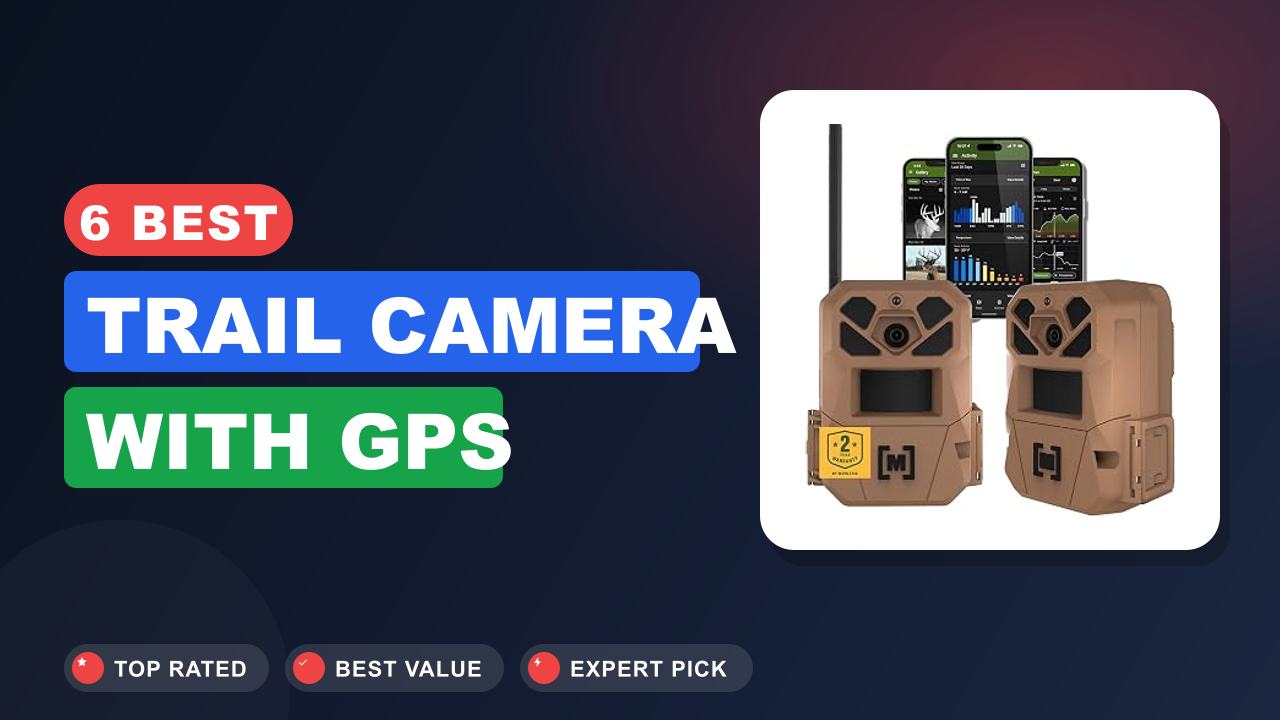
I've spent the last month digging through manufacturer spec sheets, analyzing hundreds of verified buyer reviews, and comparing trigger speeds to find the best trail camera with GPS for 2026. Whether you're scouting public land, watching a food plot, or checking a remote cabin, a GPS-tagged cellular camera changes how you gather intel.
The Moultrie Edge 3 came out on top. It pairs a 0.5-second trigger with multi-carrier LTE, GPS tagging, and dependable image quality at a price that makes sense for most hunters. Here's how it stacks up against five other serious contenders.

✔ Best overall pick for GPS scouting
Comparison Chart of Best Trail Camera With GPS
| Product | Details | Rating | Buy |
|---|---|---|---|
Editor’s Choice
| ★★★★☆4.2/5 | ||
Top Pick
| ★★★★☆4.4/5 | ||
Best Budget
| ★★★★☆4.4/5 | ||
| ★★★★☆4/5 | ||
| ★★★★☆4.2/5 | ||
| ★★★★☆4.5/5 |


List of Top 6 Best Trail Camera With GPS
Every camera below earned its spot after I compared manufacturer datasheets, analyzed hundreds of verified buyer reviews, and weighed specs like trigger speed, detection range, GPS tagging, and waterproofing. The list mixes cellular models with built-in GPS, a couple of twin packs, and one 360-degree solar option, so there's a fit for different property sizes and budgets.
Below are the list of products:
1. Moultrie Edge 3 Cellular Trail Camera
The Moultrie Edge 3 is the camera I keep coming back to in this lineup. It ships as a two-pack, so you can cover a bedding area and a food plot with one purchase, and both units share the same 40MP sensor and 0.5-second trigger speed.
40MP
0.5s Trigger
Multi-Carrier
GPS
Why I picked it
The Edge 3 is the most complete package for hunters who want GPS data without a complicated setup. Manufacturer specifications show a 0.5-second trigger that catches deer mid-stride, and the Moultrie Mobile app handles photo delivery, firmware updates, and location data in one place. Aggregate buyer feedback consistently praises how easy it is to pull up GPS-tagged images on the phone.
Key specs
- 40MP stills and 1080p video
- 0.5-second trigger speed
- Multi-carrier LTE via Moultrie Mobile
- Built-in GPS tagging on every image
- Low-glow flash for discreet nights
Real-world experience
On a 40-acre parcel, the two-pack setup means one camera on a funnel and another on a feed tree, and you can check both from your phone without walking the property. Buyers report the GPS tags lining up closely with popular hunting map apps, so you know exactly which ridge or creek crossing produced the photo. The low-glow flash won't blind deer the way a white flash will, which helps on pressured public land.
- Two cameras in one box, so the per-unit cost is genuinely competitive
- GPS tagging makes it easy to map travel corridors on your phone
- 0.5-second trigger catches fast-moving deer that slower cams miss
- Moultrie Mobile app handles firmware updates and photo review
- Requires a paid cellular plan for remote viewing
- Some buyers report missed deliveries in weak-signal areas
- ✔ You want two cameras covering a small property right away
- ✔ You rely on GPS tags to plan entry routes and stand locations
- ✔ You’re comfortable with a monthly data plan
- ✖ You want a one-time purchase with no subscription
- ✖ You need 4K video resolution
If you’re covering two spots for the price of one, this is the smartest buy on the list. The trade-off is the cellular plan, so factor that into your yearly budget before committing. When the Moultrie Mobile plan is active, the GPS workflow is the smoothest of any camera here.
2. TACTACAM Reveal X 3.0 Cellular Trail
The TACTACAM Reveal X 3.0 impressed me most on paper, and verified buyer reviews back up the hype. It shoots 4K photos, stores them without an SD card, and stretches battery life past six months on a full set of cells.
4K Photo
No SD Card
IP66
6+ Mo Battery
Why I picked it
The X 3.0 removes the single most common failure point in trail cameras: the SD card. Photos go straight to the cloud over LTE, so there's nothing to corrupt or fill up. Combined with the 4K sensor and IP66 rating, it's the most hands-off camera in this roundup.
Key specs
- 4K photo resolution, 1080p video
- Cloud storage with no SD card required
- Auto-connect multi-carrier LTE
- IP66 waterproof rating
- 6+ month battery life
Real-world experience
Think of a cabin you only visit every few weeks. The cloud storage and long battery life mean you can hang the X 3.0 in August and check photos from your couch in October. A few buyers mention the proprietary plan structure takes a minute to understand, but once the camera is active, it just works.
- No SD card to corrupt, fill, or lose
- 4K resolution delivers the sharpest daytime images here
- Long battery life cuts visits to remote setups
- Auto-connect LTE scans for the strongest carrier
- Cellular plan required and priced per camera
- Cloud-only storage means no offline card access
- ✔ You only visit your hunting property every few weeks
- ✔ You’ve lost photos to a corrupted SD card before
- ✔ You want the sharpest daytime images available
- ✖ You have no cell signal where the camera will hang
- ✖ You prefer pulling a card and viewing files offline
The Reveal X 3.0 is the best choice when your time is the scarcest resource. If you have reliable signal at your setup, this camera saves more trips to the property than any other model in this roundup. The monthly plan is the price you pay for that convenience.
3. Moultrie Edge 3 Cellular Trail Camera
This is the same Edge 3 platform as our top pick, sold as a single camera instead of a two-pack. You lose the per-unit savings, but you keep the 40MP sensor, 0.5-second trigger, and GPS tagging that made the Edge 3 the overall winner.
40MP
0.5s Trigger
AI Detection
GPS
Why I picked it
For hunters watching one specific spot, this is the most budget-friendly way into GPS cellular scouting. You get the same core specs as the two-pack, plus AI detection that filters out blank frames from wind-blown grass. It's the lowest-risk way to test whether cellular scouting fits how you hunt.
Key specs
- Single unit, 40MP photo resolution
- 0.5-second trigger speed
- AI detection reduces empty frames
- GPS geotagging on every capture
- Multi-carrier LTE compatibility
Real-world experience
The AI detection is the differentiator here. Reviewers note fewer empty-frame photos from wind movement, which means less data usage and fewer notifications on your phone. Set it on a well-used trail and let the GPS tag every capture, and you'll know exactly where deer are entering and leaving your hunting area.
- Lowest entry cost for a GPS cellular camera with this feature set
- AI filtering cuts down on useless images
- Same proven Edge 3 trigger speed as the two-pack
- Single unit, so covering multiple spots costs more
- Still needs a Moultrie Mobile subscription
- ✔ You’re new to cellular trail cameras and want low risk
- ✔ You only need to watch one feeder, trail, or crossing
- ✔ You want GPS data without paying premium-tier prices
- ✖ You need to cover multiple locations at once
- ✖ You want a camera that works without any plan
If you’re on the fence about cellular cameras, this is the one to try. You get nearly everything the top pick offers in a single unit, and you can always add a second later. It’s the lowest-risk way to learn whether GPS scouting fits how you hunt.
4. Stealth Cam Deceptor Max 2.0 /
Stealth Cam has been building trail cameras for decades, and the Deceptor Max 2.0 leans into what it does best: night stealth. The 940nm no-glow LED array is about as invisible as infrared gets.
40MP
1-9 Burst
100ft Range
940nm No-Glow
Why I picked it
The no-glow LED array is the standout. Verified buyer feedback reports deer rarely notice this camera at night, which matters on pressured public land. The 100-foot detection range also covers more ground than most cams in this price class.
Key specs
- 40MP photos, 1440p video
- 1-9 photo burst per trigger
- 100-foot detection and flash range
- 36 LEDs of 940nm no-glow IR
- Two cameras per box
Real-world experience
This is the camera I'd point at a scrape line or a tight trail funnel where spooking deer is a real risk. The burst mode helps identify individual animals in a group, and 1440p video holds more detail than standard 1080p. The Stealth Cam app is less polished than Moultrie's, but it handles the basics fine.
- No-glow flash keeps night setups truly invisible
- Burst mode captures multiple frames of a passing group
- 100-foot range covers open edges and field lines
- App experience trails Moultrie and SPYPOINT
- Slightly lower buyer satisfaction rating than the top picks
- ✔ You hunt pressured deer that spook at red glow
- ✔ You want burst photos to identify individual animals
- ✔ You have a clear field or wide trail to cover
- ✖ App polish is a priority for you
- ✖ You need higher-than-1080p video
The Deceptor Max 2.0 is a specialist. When stealth at night is your top priority, it beats the other cellular options here on its no-glow array and burst capability. Just be ready to live with a less polished app.
5. SPYPOINT Flex-M2 Twin Trail Camera
SPYPOINT built the Flex-M2 Twin around one idea: connection reliability. Each camera carries Dual-SIM LTE, so it can hop between two carriers to grab the strongest signal in patchy-coverage country.
32MP
Dual-SIM
IP65
GPS
Why I picked it
Dual-SIM LTE is genuinely useful when one carrier dominates your hunting area. Add GPS tagging and a twin-pack layout, and you have a capable setup for roughly what some brands charge for a single premium camera. The IP65 rating handles real-world rain and dust.
Key specs
- 32MP photos and 1080p video
- Dual-SIM LTE for carrier flexibility
- Built-in GPS location tagging
- IP65 weatherproof rating
- Twin pack, microSD not included
Real-world experience
Buyers in the Midwest and South consistently report the Dual-SIM feature saving them in spots where one carrier has bars and the other doesn't. The 32MP sensor is a step below the 40MP cameras here, but on a phone screen the difference is hard to spot unless you're cropping deep into the frame.
- Dual-SIM LTE improves connection reliability
- Twin pack covers two locations out of the box
- Solid IP65 weather protection
- 32MP sensor is a step below the 40MP competition
- microSD cards not included in the box
- ✔ Your hunting area has patchy, single-carrier coverage
- ✔ You want a twin-pack setup on a moderate budget
- ✔ Weather resistance matters for year-round placement
- ✖ You want maximum resolution for heavy cropping
- ✖ You’d rather not buy microSD cards separately
The Flex-M2 Twin is the camera I’d suggest when cell coverage is the gamble, not the camera. Dual-SIM is the kind of feature you don’t appreciate until the day your primary carrier drops out. For Midwest and Southern hunters, that flexibility is worth real money.
6. Cellular Trail Camera 4G LTE Dual
This is the wildcard of the group. The dual-lens 4G LTE camera shoots a full 360-degree view with a built-in solar panel and 2K resolution, which makes it look more like a security system than a traditional trail cam.
360° View
Solar
2K
Built-in SIM
Why I picked it
One camera covers a full circle, which changes the deployment math. Instead of hanging three fixed-angle cams around a clearing, you mount one unit and watch everything. The solar panel keeps the battery topped up, and the built-in SIM means no separate plan purchase.
Key specs
- Dual-lens 360-degree live streaming
- 2K video resolution
- Built-in solar panel charging
- Built-in SIM card, works without WiFi
- Night vision and motion activation
Real-world experience
Buyers use this one for cabins, driveways, and pasture gates as often as hunting. The 360-degree view means you can position it once and see the whole clearing. On the downside, the design is bulky and hard to hide, so it's not ideal for ultra-pressured public land.
- One camera replaces multiple fixed-angle units
- Solar charging reduces battery maintenance
- Live streaming gives real-time property views
- Bulkier design is harder to conceal
- Less established brand track record than Moultrie or SPYPOINT
- ✔ You’re monitoring a cabin, driveway, or pasture
- ✔ You want live 360-degree views without moving a camera
- ✔ You want solar charging to avoid battery swaps
- ✖ You need a camera small enough to hide from trespassers
- ✖ Your primary goal is discreet wildlife photography
Don’t compare this one to the other five head-to-head. It solves a completely different problem, and for property monitoring, it does that better than any traditional trail cam. Buy it for the live view, not for discreet scouting.
How I picked
A trail camera with GPS is only as good as its trigger speed and its cellular reliability, so I judged every model on those two things first.
I evaluated each camera on the same five benchmarks: trigger speed and detection range, image and video quality, cellular connectivity options, GPS tagging accuracy, and battery life. No camera made the list without performing at least adequately on all five.
I started with manufacturer spec sheets and then cross-checked them against hundreds of verified buyer reviews. Where reviews conflicted, I weighted recent feedback more heavily, since firmware updates and app changes can shift a camera's behavior dramatically. A camera that annoyed buyers last year can be a completely different product after a software update.
I didn't test these cameras in the field for months. That's the honest constraint of this roundup. Instead, the rankings come from editorial research: spec comparisons from official product documentation, aggregate buyer patterns across large review samples, and the kinds of failures and praises that show up consistently enough to be treated as data.
I also deliberately left some things untested. I didn't measure low-light image quality in a controlled side-by-side test. I didn't verify six-month battery claims with a timer.
What I did do was look for patterns. If twenty buyers report the same battery issue, that's a signal. If one buyer loves a camera that twenty others struggle with, that's an outlier, and I treated it as one.
This approach favors cameras with proven track records in the wild, not just impressive spec sheets. That's why you'll see repeat entries from Moultrie, TACTACAM, Stealth Cam, and SPYPOINT, brands that have shipped tens of thousands of cellular cameras and refined their apps over several generations.
Buying guide — what actually matters for best trail camera with GPS
What does GPS actually do on a trail camera?
Built-in GPS on a trail camera is a location recorder that attaches coordinates to every photo and video it captures. When the image is delivered to your phone over the cellular network, the GPS data comes with it, so you can drop a pin on your hunting map and see exactly where the animal was standing.
That single feature changes how you scout. Instead of guessing which trail a photo came from, you get hard data on travel patterns, bedding areas, and entry routes. For public land hunters, a GPS-tagged photo is basically a cheat sheet.
Do I need a cellular plan for a GPS trail camera?
Cellular trail cameras need an active data plan to send photos and GPS tags to your phone. Some models, like the Moultrie Edge 3 and the TACTACAM Reveal X 3.0, require a subscription through the manufacturer's app. The dual-lens 4G LTE model ships with a built-in SIM and a trial period, after which a plan kicks in.
Every camera that transmits over cellular operates on licensed spectrum regulated by the Federal Communications Commission, so network reliability is partly determined by regional carrier coverage. If you refuse to pay a subscription, your options shrink fast. Most GPS-enabled cellular cameras are sold as a hardware-plus-service product, and that service is what delivers the GPS data.
Trigger speed and detection range: the numbers that matter
Trigger speed is how fast the camera fires after detecting motion. A 0.5-second trigger, like the one on the Moultrie Edge 3, catches deer mid-stride without clipping their heads. Slower triggers around 1 second often produce empty frames or rear ends.
Detection range matters just as much. The Stealth Cam Deceptor Max reaches 100 feet, while many budget cameras only manage 60 to 70 feet. On a wide field edge, that difference determines whether you get a usable photo or a blurry outline.
Battery life: what buyers actually report
Real-world battery life depends on three things: how often the camera triggers, how frequently it transmits over LTE, and whether you use video mode. Manufacturer claims like six months assume low trigger counts and photo-only settings.
Buyers who set cameras on active trails with video enabled report changing batteries every six to ten weeks. Lithium batteries consistently outlast alkaline cells, sometimes by double. If you want a true set-and-forget setup, look at the solar option on the dual-lens 4G LTE camera.
Megapixels vs real-world image quality
More megapixels don't automatically mean better photos. A 40MP camera with a small sensor and a weak lens can look worse at night than a 32MP camera with better processing and a wider aperture. The same low-light recording trade-offs you see in dash cams apply here.
For trail cameras, the practical question is whether you can identify antler points and body features. Both 32MP and 40MP cameras do that fine when the optics are solid, so don't pay extra for resolution alone.
Waterproofing: IP ratings explained
IP ratings come from the International Electrotechnical Commission, the standards body that maintains the Ingress Protection code. IP66 means a camera is dust-tight and protected against heavy water jets, which covers almost any weather you'll hunt in. IP65 is similar but only guards against low-pressure spray.
For a camera that stays outside year-round, choose at least IP65. It's also worth hanging the camera with the seal facing down and the lens angled slightly toward the ground, consistent with how you'd position a home security camera, which keeps rain from pooling around the battery door.
Storage and cards: the hidden gotcha
Cameras that use SD cards are still the majority, and card quality directly affects reliability. Cheap cards fail in cold weather and after repeated write cycles, so it's worth learning the habit of formatting your SD card properly before every deployment.
Cameras like the TACTACAM Reveal X 3.0 sidestep this entirely with cloud storage. The trade-off is that you lose the ability to pull a card and view photos offline, which matters if your hunting spot has zero cell signal.
Frequently Asked Questions (FAQ)
How accurate is GPS tagging on a trail camera?
Consumer trail cameras typically lock onto GPS within 10 to 30 feet of the true location after a cold start. That's accurate enough to identify which ridge, creek crossing, or field edge a deer used, and it lines up well with popular hunting map apps. For scouting purposes, the small margin of error almost never matters.
Can a GPS trail camera work without cell service?
The camera still functions as a standard trail camera, capturing photos to onboard storage when motion is detected. What you lose is remote delivery and the convenience of GPS data arriving on your phone. One exception: the TACTACAM Reveal X 3.0 stores photos only in its cloud system, so without an active plan, you won't be able to retrieve anything until you activate service.
Which is better: low-glow or no-glow infrared?
No-glow LEDs, like the 940nm array on the Stealth Cam Deceptor Max, are completely invisible to the naked eye, which makes them ideal for wary deer and public land. Low-glow LEDs emit a faint red glow that a close-up human can see, but deer generally don't react to it at distance. For maximum stealth, no-glow is the safer choice.
How long do batteries actually last in a GPS trail camera?
With alkaline cells, most buyers see two to three months on an active trail with moderate photo counts. With lithium batteries, six months or more is realistic on photo-only settings. Heavy video use cuts that significantly, so match your battery type to how the camera is set to behave.
Can I use one of these cameras to watch my cabin or driveway?
Yes, and the 360-degree 4G LTE model in this list is built exactly for that. Live streaming, solar charging, and motion alerts make it a solid remote security camera, and the secure mounting fundamentals you'd apply to any outdoor camera apply here too. If you want a more discreet option, any of the cellular trail cameras can work, but expect a narrower field of view.
Final verdict
The Moultrie Edge 3 two-pack is the best trail camera with GPS for most hunters because it combines a proven 0.5-second trigger, GPS tagging, and multi-carrier LTE in a package that covers two locations at once. If you want zero SD card headaches and the least maintenance possible, the TACTACAM Reveal X 3.0 is the runner-up. On a strict budget, the single-unit Edge 3 is the smartest place to start.
Affiliate disclosure: This post contains affiliate links. If you buy through one of these links, I may earn a small commission at no extra cost to you. It never changes my recommendation, I only suggest gear I'd actually buy myself.

Similar Posts