6 Best Dash Cam for Night Driving (2027): Top Picks for Safer Roads
The best dash cam for night driving combines clear low-light video, wide coverage, GPS, and reliable parking protection.
A dark road can change in one second. Glare from headlights, poor street lighting, rain, and tired drivers can hide key details. A good night dash cam acts like a quiet witness. It records license plates, road signs, lane changes, and sudden impacts when your eyes may miss them. I reviewed six strong options for 2026, focusing on night image quality, camera coverage, storage, Wi-Fi, parking mode, and daily ease of use.

4K Dash Cam Front and…
UHD 4K Front + 1080 Rear + 1080P Cabin Recording: Supports simultaneous triple-channel recording, delivering crystal-clear details for every driving scenario. Equipped with a 3.16″ IPS screen, it’s ideal for…

REDTIGER F7NP 4K Dash Cam…
[4K+1080P Front & Rear Recording] REDTIGER F7NP dash cam captures every detail with stunning 4K front and 1080P rear video. Featuring the advanced STARVIS 2 sensor plus the 170° front…

360 View 4 Channel Dash…
4-Channel Dash Cam for Complete Vehicle Coverage: This dash cam is equipped with four Full HD 1080P cameras, capturing footage of the front, rear, left, and right sides of your…
4K Front and Rear 3-Channel Dash Cam

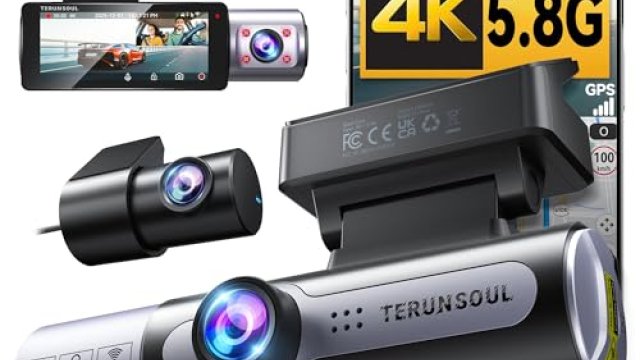
This 4K dash cam offers a useful mix of front, rear, and cabin coverage. The front camera records in 4K, while the other cameras add Full HD views around the vehicle. That layout helps cover a rear-end crash, a side event, or a dispute inside the car. For drivers who want broad protection without buying several separate cameras, this setup makes a lot of sense.
Its 5.8GHz Wi-Fi can make video transfers faster than older 2.4GHz systems. Built-in GPS adds speed and location data, while the 3.16-inch IPS screen helps with setup and quick playback. The included 128GB card saves you an extra purchase, and the 24-hour parking mode can watch the car while it sits. I also like the supercapacitor design because it is generally better suited to heat and cold than a standard battery.
Pros:
- Sharp 4K front recording for road details
- Three-camera coverage adds cabin and rear protection
- Includes a 128GB memory card
- Fast 5.8GHz Wi-Fi for video downloads
- Built-in GPS records route and speed data
- Large IPS screen makes setup easier
- 24-hour parking mode supports parked-car monitoring
Cons:
- The three-camera wiring takes more time to install
- Night quality from the rear and cabin cameras may not match the 4K front view
- A hardwire kit may be needed for full parking-mode use
REDTIGER F7NP 4K Front and Rear Dash Cam

The REDTIGER F7NP is a strong choice for drivers who want high detail from both ends of the vehicle. Its 4K front camera can preserve useful road information, while the rear camera helps document tailgating and impacts from behind. The STARVIS 2 sensor is especially important for night driving because sensor quality often matters more than a large resolution number alone. It can help the camera manage dark scenes, bright lamps, and mixed light.
This model also includes GPS and Wi-Fi, which are two features I consider essential on a modern dash cam. GPS can support a clearer incident record, and Wi-Fi lets you move clips to a phone without removing the card. The included card helps you start sooner, although I still recommend checking its capacity and replacing it with a high-endurance card when the manufacturer permits. It is a practical front-and-rear system for commuters, rideshare drivers, and highway users.
Pros:
- 4K front video captures fine road detail
- STARVIS 2 sensor supports better low-light recording
- Rear camera adds useful crash coverage
- GPS data can support an insurance claim
- Wi-Fi enables convenient phone access
- Memory card is included
- Good fit for regular highway and city driving
Cons:
- The rear camera needs cable routing through the cabin
- 4K files use more storage space than 1080p files
- Phone app performance can depend on your device and network settings
360-Degree 4-Channel Dash Cam

This four-channel dash cam is built for drivers who want more than a forward view. It records the front, rear, left, right, and interior areas through its multi-camera layout. That broad view can be valuable in crowded parking lots, urban traffic, and rideshare work. A 160-degree viewing angle helps cover more of the road, though wide views can make distant objects look smaller.
The camera uses WDR to balance bright and dark areas, which is helpful when headlights meet a nearly black road. Night vision and the interior camera add another layer of protection after sunset. GPS, 5G-band Wi-Fi, a 128GB card, and a supercapacitor round out the feature set. I see this as a coverage-first option for people who care about side evidence as much as front image sharpness.
Pros:
- Four-channel design gives wide vehicle coverage
- Side cameras help document lane and parking incidents
- Interior camera suits rideshare and family vehicles
- WDR helps manage headlights and dark roads
- Includes a 128GB memory card
- GPS records location and speed details
- Supercapacitor design is suitable for temperature changes
Cons:
- More cameras mean more installation work
- Side views may not provide the same detail as a dedicated 4K front camera
- The large coverage area can create more files to manage
galphi 4K Mini Front Dash Cam

The galphi 4K mini dash cam takes a simple approach. It focuses on a forward view in a small body, which can sit behind the rear-view mirror without creating a large blind spot. Its 4K recording mode aims to capture signs, road markings, and vehicle details during both day and night. This is a good match for drivers who want a clean installation instead of a large screen and several cameras.
Built-in 5GHz Wi-Fi makes clip transfers more convenient, and the included 32GB card lets you begin recording out of the box. A small camera can also attract less attention, which matters when you leave the car in public areas. However, buyers should check whether their chosen recording settings fill the card quickly. For basic front-facing protection, this mini model keeps the dashboard less cluttered.
Pros:
- Compact design keeps the windshield view clear
- 4K front recording supports detailed evidence
- 5GHz Wi-Fi helps with quick clip transfers
- 32GB card is included for initial use
- Simple front-only setup is easier to install
- Low-profile body attracts less attention
Cons:
- No rear camera is included
- The 32GB card may fill quickly with 4K video
- Small cameras may have smaller screens or fewer on-device controls
IIWEY N6 360-Degree 4-Channel Dash Cam

The IIWEY N6 stands out for its focus on full-area recording and infrared support. Its four-channel design can watch the road ahead, the rear, the sides, and the cabin. Eight IR lights are designed to improve interior visibility in dark conditions, which can help rideshare drivers and anyone who carries passengers at night. This is not just a forward-facing road camera; it is a complete record of the car’s surroundings.
The included 128GB card gives the system more room for multi-camera footage than a small starter card. That matters because four views create files faster than one view. I would still format the card in the camera and use a card rated for continuous recording. If your priority is coverage inside and around the vehicle rather than the smallest possible setup, the N6 offers a thoughtful feature package.
Pros:
- Four-camera coverage reduces blind areas
- Eight IR lights support dark cabin recording
- Useful for rideshare, taxi, and family vehicles
- 128GB card provides more starting storage
- 360-degree design can capture side events
- Strong choice for parked-car awareness
Cons:
- Installation is more complex than a single-camera model
- Infrared light helps the cabin more than distant road plates
- Four-channel recording can use storage very quickly
70mai M310 1296P QHD Dash Cam

The 70mai M310 is a budget-friendly option for drivers who want a compact camera with useful smart features. It records at 1296P QHD and uses a 130-degree field of view to cover the lane ahead. WDR and night vision help it handle common low-light problems, such as dark streets and bright headlights. It does not chase the highest resolution, but it aims for a balanced daily recording experience.
Built-in Wi-Fi connects the camera to the 70mai app on iOS and Android devices. Loop recording manages old files, while the parking monitor and time-lapse features support longer parked-car coverage when installed correctly. This model is especially appealing to new dash cam owners who want simple controls and a small footprint. It offers good everyday value, though drivers who need maximum license-plate detail may prefer a 4K model.
Pros:
- Affordable entry point for first-time buyers
- Compact design is easy to place behind a mirror
- QHD video is sharper than standard 1080p
- WDR and night vision support dark-road recording
- Built-in Wi-Fi works with iOS and Android apps
- Parking monitor and time-lapse add useful parked-car tools
- 130-degree view covers the forward road well
Cons:
- It does not include front-and-rear coverage by itself
- QHD video may show less fine detail than 4K footage
- Parking features may require an extra hardwire solution
My Recommendation
Choosing the best dash cam for night driving depends on the type of protection you need. I would choose the first 4K three-channel model for drivers who want front, rear, and cabin views in one package. The REDTIGER F7NP is a better fit for people who want strong front detail with a simpler two-camera layout. Its STARVIS 2 sensor gives it a clear advantage on dark roads and in mixed lighting.
The two 360-degree models suit rideshare drivers, taxi owners, and families who want side and interior evidence. The IIWEY N6 is especially appealing when dark cabin footage matters. The galphi mini works best for someone who wants a discreet front camera with 4K video. The 70mai M310 is the value pick for basic night coverage, easy app access, and a small design.
| Best for | Why |
|---|---|
| Best overall coverage | The 4K 3-channel model records the front, rear, and cabin while adding GPS, Wi-Fi, and a 128GB card. |
| Best night detail | The REDTIGER F7NP pairs 4K front video with a STARVIS 2 sensor for demanding low-light scenes. |
| Best budget choice | The 70mai M310 offers QHD video, WDR, night vision, Wi-Fi, and parking tools at a lower cost. |
What Makes the Best Dash Cam for Night Driving?
Night driving puts more pressure on a dash cam than daytime driving. A bright sky gives a camera plenty of light. A dark road gives it very little. At the same time, headlights can create white glare that washes out signs and license plates. The best dash cam for night driving must balance these extremes without turning the image into a noisy blur.
I look at the image sensor first. A larger or newer sensor can collect more light and preserve more detail. Sony STARVIS and STARVIS 2 sensors appear in many strong low-light cameras, but the sensor alone does not guarantee perfect footage. The lens, image processor, exposure settings, and glass quality also matter. A well-tuned 1440p camera can sometimes show a cleaner night image than a poorly tuned 4K camera.
High dynamic range is another key feature. WDR helps the camera deal with a bright headlight against a dark street. Without good dynamic range, the lamp may look like a large white star and the road around it may disappear. I also prefer cameras with a wide but controlled field of view. A view that is too wide can make objects at a distance look small and curved.
4K Versus 1440p and 1080p at Night
Many shoppers assume that 4K always wins. Resolution does help, especially when you need to zoom into a sign or plate. Yet night video needs light, and smaller pixels can struggle when a camera pushes for more resolution. A good 4K camera with a strong sensor and clear lens can deliver excellent results. A good QHD camera can still be the smarter buy if it handles dark scenes with less noise.
For most drivers, 1440p or 1296p provides a useful middle ground. It gives more detail than 1080p without creating files as large as 4K clips. If you drive on unlit rural roads or need the best chance of reading plates, I would lean toward 4K with a modern low-light sensor. If you mainly drive on lit city streets, QHD can offer a better balance of price, storage, and image quality.
Remember that resolution cannot defeat motion blur. If a car passes quickly at night, the plate may still be unreadable even in a high-resolution video. A faster shutter, good exposure control, and clean glass can matter just as much. Keep the windshield and lens free from dust, oil, and haze for the best result.
Why Front and Rear Coverage Matters
A front-only camera records what happens ahead. That is useful, but it leaves a large gap behind your vehicle. Rear impacts are common, and a rear camera can show whether another driver followed too closely or changed lanes into you. It can also document a hit-and-run in a parking lot when the rear of the car faces the traffic lane.
A rear camera does require extra work. You must route the cable along the headliner or trim, and the hatch or trunk area needs careful handling. Take your time and avoid pinching the wire. A clean installation protects the cable and keeps airbags clear. If you do not want that work, a front-only camera remains better than having no camera at all.
Three- and four-channel systems go even further. They can record the cabin and side areas, which helps rideshare drivers and people who carry passengers. These systems create more files and need more storage. Before buying, confirm that the package includes the needed camera cables, power accessories, and memory card support.
Night Vision, IR Lights, and WDR Explained
“Night vision” can mean different things in dash cam listings. Some cameras use better exposure and sensor tuning to record the road in color at night. Others use infrared lights, mainly for the cabin. Infrared is helpful inside a dark vehicle because it can show faces and movement without a bright white lamp. It usually cannot reveal distant road plates in the same way a high-quality color sensor can.
WDR stands for wide dynamic range. It tries to preserve detail in both bright and dark parts of a scene. This is useful when you leave a parking garage, meet oncoming traffic, or drive under street lamps. HDR may also appear in product descriptions and can work in a similar way through image processing. These features help, but they cannot replace a clean lens and sensible camera placement.
I recommend turning off any interior light that reflects on the windshield. Dashboard reflections can look like floating lights in night footage. Place the camera high and near the center of the windshield. This position gives a balanced view and keeps the horizon level. Test the view after sunset, not only during daytime setup.
Parking Mode for Night Protection
Parking mode can record an impact or movement while your car is parked. It is useful outside an apartment, at work, or in a busy shopping lot. Some cameras use motion detection. Others use impact detection, time-lapse, or a low-frame-rate standby mode. Each method has tradeoffs. Motion recording can miss a fast event, while impact recording may start only after the car moves.
Most parking modes need constant power. A standard cigarette-lighter socket may shut off when you turn off the engine. A compatible hardwire kit can supply power and may include low-voltage protection. That protection helps reduce the risk of draining the car battery. Installation should follow the vehicle and dash cam instructions, especially in cars with complex electrical systems.
Do not treat parking mode as a security guarantee. A camera may not see an event if the view is blocked, the battery loses power, or the impact occurs outside its field of view. Still, it can provide valuable evidence. I consider 24-hour parking mode a major benefit for people who park outdoors at night.
Storage and Memory Card Advice
Dash cams write video again and again. A normal low-cost memory card may fail sooner under this workload. I recommend a high-endurance microSD card that matches the camera maker’s supported capacity and speed. Format the card inside the camera before regular use. If the camera offers loop recording, it will overwrite old clips when the card becomes full.
Higher resolution and more channels consume storage faster. A front-only 1080p camera can store more hours than a four-channel 4K system. A 128GB card is helpful for multi-camera recording, but it does not remove the need to manage important files. Download accident clips as soon as possible and lock them if the camera supports file protection.
Check the card every few weeks. Look for missing clips, recording errors, or a camera that stops and restarts. A card can fail quietly, leaving you with a device that appears active but saves no usable video. Replacing a high-endurance card on a sensible schedule is a small cost for a device that records your daily drive.
Wi-Fi and GPS: Small Features With Big Value
Wi-Fi saves time after an incident. Instead of removing the card and finding an adapter, you can connect the camera to a phone app and save a short clip. Faster 5GHz or 5.8GHz Wi-Fi can reduce transfer time, though your phone must support the connection. Wi-Fi does not mean the dash cam provides internet access. It usually creates a direct local link between the camera and phone.
GPS adds location and speed information to a recording. This data can help show where an event happened and how the vehicle moved. It may also be useful when explaining a route to an insurer or lawyer. GPS data is not automatically proof that a driver was at fault, and speed readings can have a small margin of error. Use it as supporting information, not as the only evidence.
Make sure the GPS module has a clear view of the sky when possible. A camera tucked under heavy tint or metalized glass may take longer to lock onto satellites. Follow the installation guide and check that the speed display looks reasonable before relying on it.
How I Evaluate a Night Dash Cam
I do not judge a camera by resolution alone. I compare the full package: sensor type, field of view, exposure control, night mode, lens clarity, and file quality. I also check how much work the installation requires. A camera with excellent specifications is not useful if it blocks the driver’s view or loses power every night.
I give extra weight to easy controls. A clear screen can help you confirm the angle without guessing. Wi-Fi makes evidence sharing easier. A physical emergency button can protect a clip before loop recording overwrites it. These small details matter when you are standing beside a damaged car in the rain.
For safety, place the dash cam where it does not block your view. Keep cables away from airbags. Use the supplied mount and power adapter when possible. Before driving, confirm that recording has started and that the time and date are correct. Good habits turn a camera into dependable evidence.
Which Dash Cam Is Best for Different Drivers?
For a daily commuter, the REDTIGER F7NP offers a strong mix of detail and rear coverage. It makes sense for long highway drives, where plate detail and lane changes matter. The first three-channel model is better for someone who wants cabin coverage too. It provides more angles, but you must accept a more involved setup.
Rideshare drivers should consider a four-channel camera. Side and interior views can help clarify passenger disputes and traffic incidents. The 360-degree model with WDR and the IIWEY N6 both fit this role. The IIWEY’s IR lighting gives it a specific advantage for a dark cabin.
For a first-time buyer, the 70mai M310 is easy to understand. It offers QHD video, Wi-Fi, WDR, and parking features without an overly complex multi-camera system. The galphi mini suits buyers who prefer a low-profile 4K camera. It is a clean choice for a second car or a driver who only needs forward evidence.
Installation Tips for Clear Night Video
Start by cleaning the windshield with glass cleaner and a lint-free cloth. Clean the small lens as well. Mount the camera behind the mirror, close to the center of the car. Keep the lens inside the area swept by the wipers. A dirty or wet section of glass can ruin an otherwise sharp recording.
Set the camera angle so the road fills most of the frame, with a small amount of sky visible. Too much sky can make the camera darken the road. Too little sky can hide traffic lights and signs. Record a short test clip during the day and another at night. Check for dashboard reflections, windshield glare, and a level horizon.
When routing a rear cable, do not pull hard around trim or hinges. Leave enough slack near a hatch so the wire can move. Never place a cable over an airbag cover. If you are unsure about a hardwire installation, ask a qualified installer. A safe cable path matters more than a perfectly hidden wire.
Common Dash Cam Mistakes to Avoid
The first mistake is buying the highest resolution without checking night performance. A bright 4K label cannot fix poor exposure or a weak lens. The second mistake is using a cheap card that is not made for constant writing. The third is placing the camera too low, where the dashboard fills the frame and reflections hide the road.
Some drivers also forget to check the date and time. Incorrect timestamps can weaken the usefulness of a clip. Others never test parking mode after installation. Test it in a safe place and confirm that the camera saves an event when the car is off. Finally, do not wait until a crash to learn how the emergency-save button works.
FAQs Of Best Dash Cam for Night Driving
What is the best dash cam for night driving?
The REDTIGER F7NP is a strong choice for night detail because it combines 4K front video with a STARVIS 2 sensor. The three-channel 4K model is better if you also need rear and cabin coverage.
Is 4K necessary for night driving?
No. A good 1440p or QHD camera can record clear night video. Choose 4K when you want more detail, but also check the sensor, lens, WDR, and real-world low-light performance.
Do infrared lights help a dash cam see the road?
Infrared lights mainly help the camera see inside a dark cabin. They do not replace a strong color sensor for distant road scenes, signs, or license plates.
Does parking mode drain the car battery?
It can if the camera receives constant power without protection. Use a compatible hardwire kit with low-voltage cutoff, and follow the vehicle and camera instructions.
How large should a dash cam memory card be?
A 128GB card is a useful starting point for front-and-rear or multi-channel cameras. Always confirm the supported capacity and use a high-endurance card made for continuous recording.
Final Verdict: Which Should You Buy?
The REDTIGER F7NP is my top pick for the best dash cam for night driving because its 4K front view and STARVIS 2 sensor target the details that matter after dark. Choose the three-channel model for wider protection.
For budget buyers, the 70mai M310 remains a smart value. Any choice here can add peace of mind, but careful setup, clean glass, and reliable storage matter just as much as camera specs.

Similar Posts





















[…] low-glow for extra range. The physics behind these trade-offs is the same one that separates good low-light optics in other […]
[…] expectations for footage after sunset shaped how we judged each camera's IR range. If you're hunting pressured deer, go no-glow. […]