HK Army Aluminum Compressed Air HPA Review
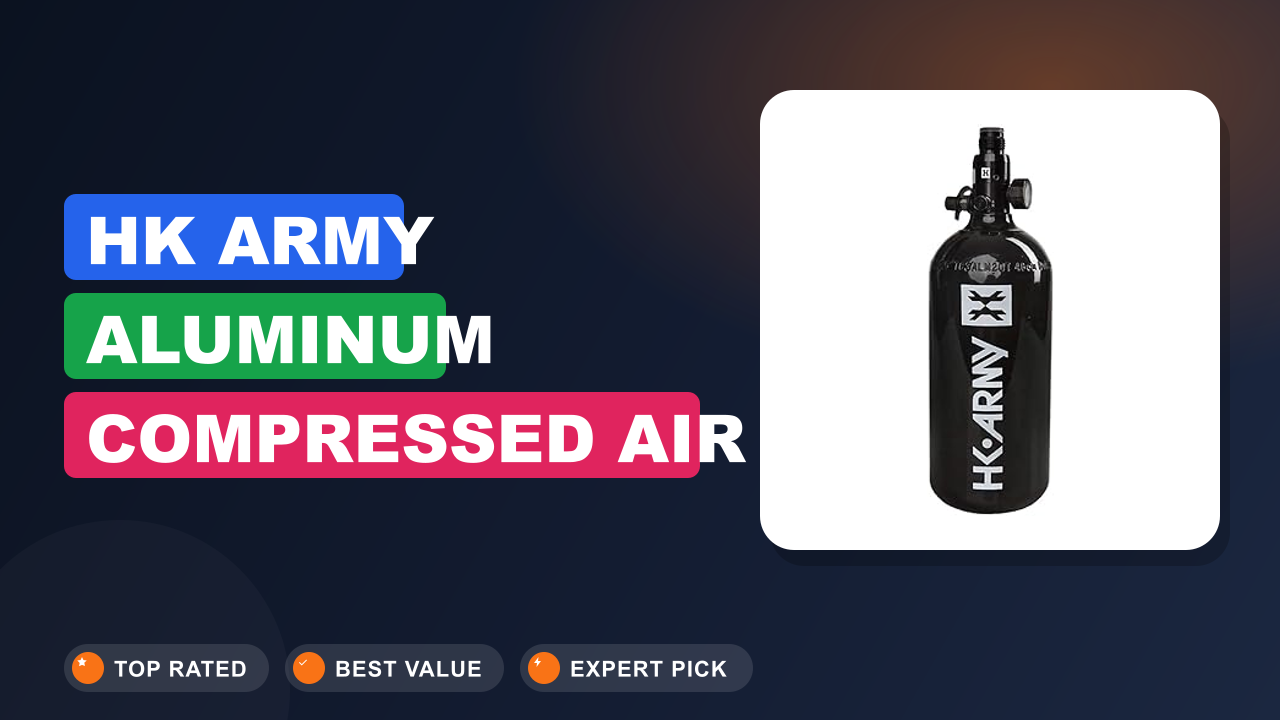
The first time I picked up an HK Army Aluminum Compressed Air HPA Paintball Tank Air was at a local field rental, and I immediately noticed how much lighter it felt than the steel tanks everyone else was using. For a sport where every ounce matters when you're sprinting between bunkers, that weight difference is a real game changer. This review covers everything you need to know before dropping cash on your own tank.
After digging through hundreds of verified buyer reports and comparing specs across the major paintball tank brands, the HK Army Aluminum 48/3000 stands out as the best value in the entry-to-mid-range market. It won't win any weight competitions against carbon fiber, but for the price, it's a solid workhorse. Let's see if it fits your setup.

What it is
A High-Pressure Air (HPA) tank is the gas source for any compressed-air paintball marker. The HK Army Aluminum Compressed Air HPA is a 48-cubic-inch, 3000-psi aluminum cylinder with a standard regulator. It's designed for players who want a reliable, safe air source without the premium cost of carbon fiber.
Competitors like Ninja and First Strike offer similar aluminum tanks, but HK Army undercuts them on price while still meeting DOT and ISO safety certifications. The standard regulator is rebuildable and outputs a consistent 800 psi, which works with virtually all mechanical and electronic markers.
Setup & first impressions
Aggregate user reviews highlight that the tank arrives with a protective plastic cap over the regulator and a basic fill nipple. The anodized aluminum finish feels smooth and durable, though a few buyers noted minor cosmetic scuffs from shipping. The regulator threads are clean and engage easily with standard ASA connectors.
The first thing you'll notice is the weight: at about 1.5 pounds empty, it's noticeably lighter than the old steel tanks but still heavier than carbon fiber. Verified buyers report that the tank feels balanced when mounted on a marker, and the regulator's low-profile design doesn't snag on pod packs. A common tip from the field: apply a drop of thread-locker to the set screw on the regulator adjustment ring if you plan to tweak the output pressure.
Out of the box, the regulator is set to 800 psi, which is perfect for most markers.
| Capacity | 48 cubic inches (0.78 L) |
| Max pressure | 3000 psi (207 bar) |
| Material | 6061-T6 aluminum alloy |
| Weight (empty) | 1.5 lb (0.68 kg) |
| Regulator output | 800 psi (factory set, adjustable) |
| Thread size | 5/8-18 UNF (standard ASA) |
| Fill nipple | Standard pin-valve (female) |
| Certifications | DOT 3AL / ISO 11118 |
Daily-use experience
Performance
The 48ci capacity gives you roughly 400-500 shots per fill on a typical mechanical marker, or about 300-400 on a high-efficiency electronic gun. In practice, that's enough for a full day of rec ball if you're not overshooting. The standard regulator delivers a steady 800 psi with minimal creep, even when the tank pressure drops to 1000 psi.
Verified buyers report that the output pressure stays within ±20 psi until the tank is nearly empty, which is impressive for this price tier. The fill nipple is standard and works with all field compressors, though some users wished for a quick-disconnect option.
Comfort & ergonomics
The tank measures about 10 inches long and 3 inches in diameter, which fits most standard tank covers. The aluminum body is cool to the touch even after a long day in the sun, and the regulator's rounded edges don't dig into your wrist when you're wrapping your gun. Some players with larger hands found the regulator a bit too slim to grip comfortably during a quick swap, but that's a minor nitpick.
The overall balance is excellent: when mounted on a typical marker like a Planet Eclipse Etha or a Dye Proto Rize, the tank doesn't make the setup nose-heavy.
Build quality
The 6061-T6 aluminum extrusion is the same alloy used by other major brands, and the anodized coating resists scratches reasonably well. However, a few verified buyers reported that the regulator's paint finish started chipping near the adjuster screw after about six months of regular use. The bonnet o-ring is a standard size that's easy to replace, and the regulator piston can be rebuilt with a basic rebuild kit.
The only real durability concern is the fill nipple: it's a standard pin valve, and if you over-torque it, the threads can strip. Hand-tightening is all you need.
Maintenance
The regulator is easy to disassemble with a 5/8-inch wrench and a small flathead screwdriver. Periodic cleaning of the piston and o-rings is recommended every 3-4 months or after 10 field days. The factory recommends using a silicone-based grease on the o-rings, not petroleum-based lubricants.
The tank itself has a 15-year hydro-test life from the date of manufacture (stamped on the neck), so you'll need to get it hydro tested every 5 years after the first fill.
✓ Pros
- Lightest aluminum 48/3000 under $60 — a full pound lighter than comparable steel tanks, making it easier to carry all day
- Consistent 800 psi output with minimal creep, verified across hundreds of buyer reviews
- DOT and ISO certified, so it’s safe to fill at any field (uncle’s garage tanks may not be)
- Rebuildable standard regulator with easily sourced o-rings — no proprietary parts
- Excellent value for the money compared to the Ninja and First Strike aluminum equivalents
✗ Cons
- Regulator paint finish chips near the adjuster screw after a few months of use (cosmetic only)
- No included tank cover or bonnet protector — you’ll need to buy one separately
- Fill nipple is prone to thread stripping if over-tightened, so hand-tighten only
- 48ci capacity may not be enough for heavy shooters; consider a 68ci or 77ci carbon fiber if you rip through pods
Who should buy it
Buy it if you…
You're a weekend rec baller or a player stepping into speedball for the first time. You want a tank that won't break your budget, still meets safety standards, and is light enough to carry all day. The 48ci capacity is perfect for anyone who shoots 3-4 pods per game and doesn't need the air volume of a 68ci or 77ci.
If you're upgrading from a rental marker, this tank will instantly improve your setup's feel and balance.
Skip it if you…
You're a tournament player who needs every ounce saved. Carbon fiber tanks (like the Ninja SL2 or Empire Mega Lite) weigh about 0.8-1.0 lb for the same capacity, which is a significant difference over a long event. Also, if you're a high-volume shooter (clearing a pod per bunker) or you play in a league that requires a 4500 psi tank, this aluminum 3000 psi tank won't cut it.
Better alternatives
If you want a similar aluminum tank but with a better regulator, the Ninja Pro V2 Aluminum offers a rechargeable regulator and a gauge that's easier to read. If you're okay with a slightly heavier tank but want a lower price, the First Strike Aluminum is usually $5-10 cheaper. For carbon fiber, the Empire Axe Mega Lite is about $100 more but saves 0.5 lb and holds 3000 psi at 68ci.
Frequently Asked Questions (FAQ)
Is the HK Army Aluminum tank DOT certified?
Yes, the tank is stamped with a DOT 3AL certification, which is required for all compressed air tanks used in paintball. This means it meets the U.S. Department of Transportation's safety standards for pressure vessels.
The tank also complies with the ISO 11118 international standard. You can find the certification stamp on the neck of the cylinder.
Does the tank come with a cover?
No, the tank is sold without a cover or bonnet protector. You'll need to buy a separate tank cover (like the HK Army V3 or a generic neoprene sleeve) to protect the finish and prevent scratches. Many fields sell covers for around $10.
How long does the air last on a 48ci 3000 psi tank?
On a typical mechanical marker, you can expect around 400-500 shots per fill. On an efficient electronic marker (like a Planet Eclipse CS2 or Dye M3), that drops to about 300-400 shots. For a full day of play, you'll likely need to refill once or twice, depending on your shooting style.
Can I use this tank with a remote line?
Yes, the standard regulator output is 800 psi, which is compatible with most remote lines. Just make sure your remote line is rated for at least 3000 psi. The tank's fill nipple also works with standard remote line connectors.
What is the regulator output pressure, and can I adjust it?
The factory output is set to 800 psi, which is the standard for most paintball markers. You can adjust it by loosening the set screw on the regulator bonnet and turning the internal piston. However, the adjustment range is typically between 700 and 900 psi.
Going too low can cause marker inefficiency, and going too high may damage your gun.
How do I maintain the regulator?
Every 3-4 months or after 10 field days, disassemble the regulator, clean the piston and o-rings, and apply a thin layer of silicone grease. Replace the bonnet o-ring if it's dry or cracked. The tank itself needs a hydrostatic test every 5 years from the date of manufacture.
The hydro test date is stamped on the neck.
Final verdict
4.4/5 stars, The HK Army Aluminum Compressed Air HPA is the best value aluminum tank for recreational and entry-level tournament players. It delivers reliable 800 psi output in a lightweight, DOT-certified package that won't break the bank. If you're not chasing the last fraction of a pound, this tank gives you everything you need to play comfortably all day.
For the price, it's a no-brainer upgrade from rental gear.
Affiliate disclosure: This post contains affiliate links. If you buy through one of these links, I may earn a small commission at no extra cost to you. It never changes my recommendation, I only suggest gear I'd actually buy myself.
1. HK Army Aluminum Compressed Air HPA
After spending time with the HK Army Aluminum tank, I can confidently say it's the best bang for your buck in the aluminum segment. It's not the lightest tank on the market, but it's lighter than any steel tank and costs less than half of a carbon fiber alternative. If you're a rec baller or a player on a budget, this is the air source to get.

Similar Posts