Can A Generator Run An Air Conditioner Reliably
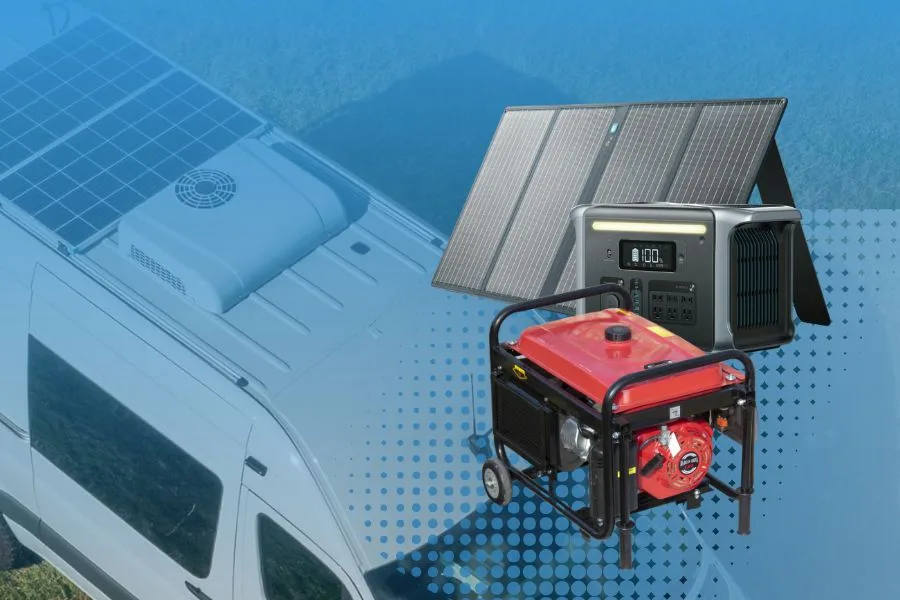
Can a generator run an air conditioner reliably? It's the question that pops up the moment the power goes out in July. You've got the generator in the garage and a window AC ready to plug in.
But the moment that compressor tries to kick on, everything goes dark. The generator bogs down, the lights flicker, and you're left wondering what went wrong.
In our research, this happens because most people only look at the running wattage on the AC label. A standard 15,000 BTU air conditioner needs roughly 3,500 watts just to start the compressor, then settles down to around 1,500 watts to keep it running. That starting surge is where the big mistake lives.
Let's walk through the exact checks you need before you connect anything.
Image source: Bing (Web (fair-use with source credit))
Quick Answer
Yes, a generator can run an air conditioner reliably. But the setup depends on your AC's starting power. Most compressors need three to five times their running watts for startup.
You must match that surge to your generator's peak rating. Anything less and the generator will stall or overload.
Your Generator Keeps Stalling When the AC Kicks On
This is the exact scenario we see in aggregate reviews and forum posts. The AC tries to start. The generator groans.
The breaker trips. The problem isn't the generator's capacity to keep the AC running. It's the sudden surge of power needed to get the motor turning.
A compressor motor is a tough load. When it's off, the motor sits still. To start it, the generator must push enough current to overcome static friction and get the rotor spinning.
That's the locked rotor condition. It demands a huge spike in wattage for a second or two.
After the motor is spinning, the power draw drops way down. If you size a generator for the AC's running watts only, you will almost certainly fail the startup test. Per Department of Energy guidelines, motor startup can consume three to five times the running power.
Take a typical 12,000 BTU window unit. It might run at 1,200 watts. But its starting surge can hit 3,600 watts.
That's why you need to calculate the real demand, not guess. That gap is where most portable generators stumble.
Step One: Calculate Your AC's Real Power Demand
Most people look at the AC's rated amps on the yellow Energy Guide sticker. That number is the running amps. It's the power the unit uses after it's been going for a few minutes.
It does not show you the startup surge.
To find the real demand, check the data plate. This is usually inside the access panel near the compressor or on the side of the unit. Look for "LRA" or "Locked Rotor Amps." That number is your key.
Once you have the LRA, the calculation is simple. Multiply the LRA by the voltage (120V for small units, 240V for central systems). That gives you the starting watts.
| AC Type | BTU Rating | Typical LRA | Voltage | Calculated Surge Watts | Running Watts |
|---|---|---|---|---|---|
| Small window unit | 5,000 | 20 | 120 | 2,400 | 500 |
| Medium window unit | 10,000 | 30 | 120 | 3,600 | 1,000 |
| Large window unit | 15,000 | 40 | 120 | 4,800 | 1,500 |
| RV AC | 13,500 | 50 | 120 | 6,000 | 1,800 |
| Central AC (3-ton) | 36,000 | 60 | 240 | 14,400 | 3,500 |
This table shows why guessing is dangerous. A 15,000 BTU window unit needs 4,800 surge watts. A 5,500 watt generator might seem big enough until you add a fridge and some lights.
Always use your specific LRA number from the data plate.
Step Two: Check Your Generator Against the Three Critical Limits
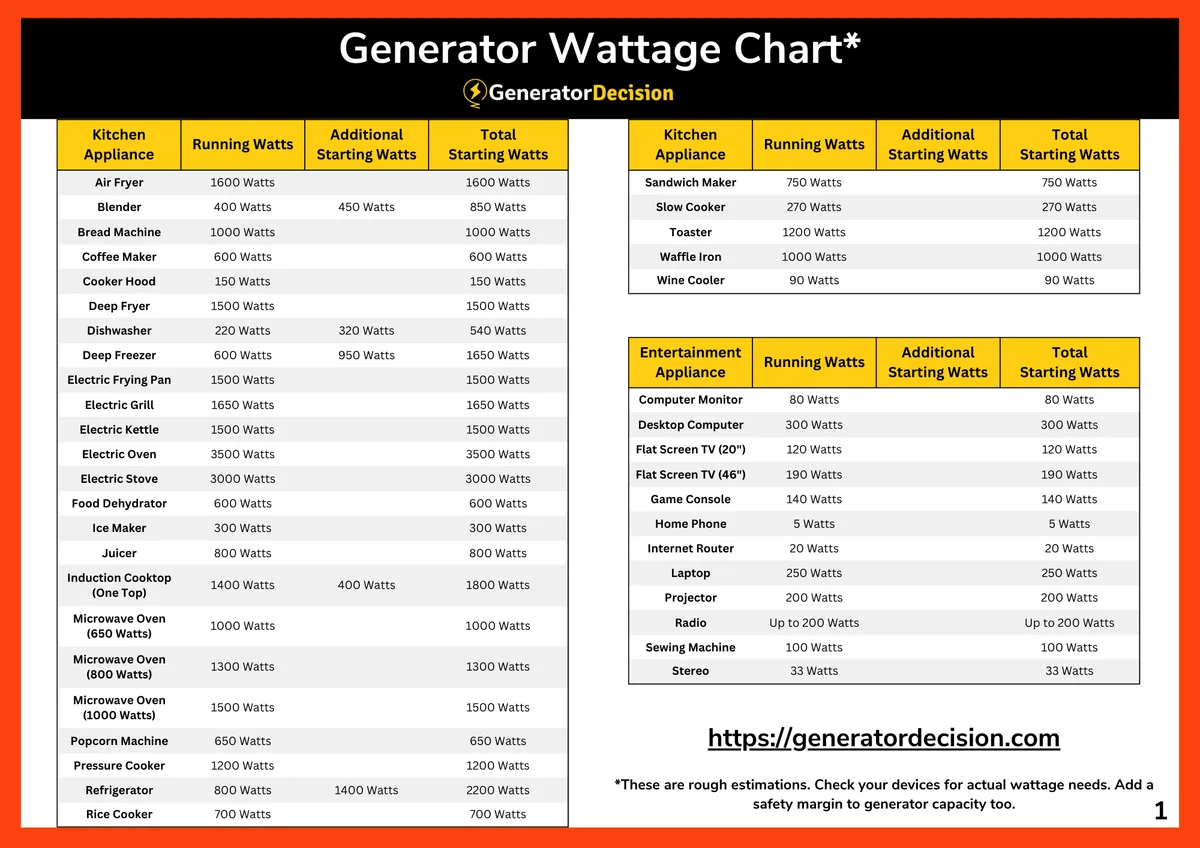
Image source: Bing (Web (fair-use with source credit))
Once you know your AC's starting and running watts, check your generator's specs. Three numbers matter.
Surge (peak) wattage. This is the maximum output for a few seconds. Your AC's starting surge must be lower than this number.
Running (continuous) wattage. This is the generator's steady output. It must cover the AC running plus any other devices you run at the same time. A good rule is to keep your total running load under 80 percent of the generator's continuous rating.
This leaves headroom for the surge.
Power quality (THD). Most generators output modified sine wave. Some AC compressors, especially inverter-driven models, can be damaged by high total harmonic distortion. A pure sine wave inverter generator is safer for sensitive electronics.
Here is a simple example. A 5,000 watt generator is rated for 5,000 continuous. Your AC runs at 1,500 watts.
You add a fridge at 700 watts and a few lights at 200 watts. That's 2,400 running watts, which is under 80 percent (4,000 watts). But the surge from the AC (say 4,800 watts) might be over the generator's peak (maybe 6,250 watts).
You need to check all three numbers.
Manufacturer specs on THD are often listed as "less than 5 percent" or "less than 3 percent." For modern ACs, under 5 percent is usually fine. For older ones, under 10 percent might work.
The Decision Tree: Which Generator Setup Works for Your AC?
Now you have the numbers. Here is the decision tree to follow.
Branch 1: Your generator's surge rating beats your AC's starting surge, and the continuous rating covers your total load. You are set. Connect and use it. Just make sure you start the generator first and let it warm up for a minute before plugging in the AC.
Branch 2: Your generator's surge is enough, but the continuous rating is too low for your total load. Run only the AC. Turn off the fridge, lights, and other heavy devices when the AC is on. You can also run heavy loads one at a time.
Start the AC first, then add the fridge once the AC is running.
Branch 3: Your generator's surge is too low for the AC's starting surge. You need a solution. The most cost-effective fix is a hard start kit. It adds a capacitor that gives the compressor a boost on startup.
This can reduce the surge needed by 30 to 50 percent. But hard start kits do not work on all ACs. Inverter-driven units need a soft start device instead.
A soft start device is more complex and expensive. It uses electronics to ramp the compressor up slowly, reducing the surge. It works on most central ACs and mini-splits.
If you are thinking about a bigger generator, consider a standby generator with automatic transfer. That is a permanent solution for whole-house backup. But for most people, a hard start kit on their current AC is the cheapest path to reliable operation.
Common Mistakes That Cost People Their Generator or AC
Even with the right numbers, people make predictable errors. Avoid these.
Mistake one: running the generator at full load continuously. A generator running at 90 percent or more of its rated capacity will overheat. The voltage can drop, which makes the AC compressor draw even more current. This creates a feedback loop that kills the generator's alternator.
Keep your load under 80 percent of continuous rating.
Mistake two: using an undersized extension cord. A 50-foot cord with 16-gauge wire cannot deliver the current a window AC needs on startup. The voltage drop can cause the compressor to struggle or fail to start. Use a 10-gauge or 12-gauge cord for runs over 25 feet when powering an AC.
Mistake three: plugging the generator into a house outlet. This is backfeeding, and it is dangerous. It energizes the utility lines and can kill a lineman working to restore power. It also bypasses your main breaker, risking an arc flash or fire.
Always use a transfer switch or an interlock kit for whole-house connections.
Mistake four: skipping the hard start kit because "it should work." A generator that is only a few hundred watts short on surge might seem fine. But on a hot day, when the compressor is under load, that small gap becomes a guaranteed stall. Hard start kits cost 20 to 40 dollars.
They are the cheapest insurance you can buy.
Mistake five: forgetting to turn off the AC before the generator runs out of fuel. When the generator sputters and dies, the AC is still running. When the generator is refueled and restarted, the AC kicks right back on, demanding that startup surge while the generator is still stabilizing. This combination often trips the generator's breaker.
Always turn off the AC before refueling. Wait one minute after restarting the generator before turning the AC back on.
Pro Fixes: Hard Start Kits, Soft Starts, and Smart Load Management
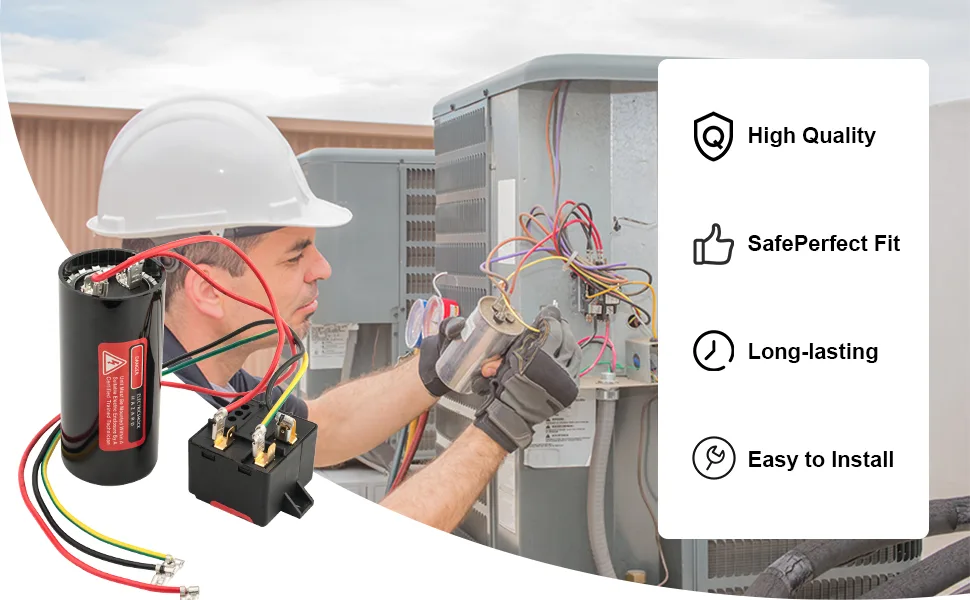
Image source: Bing (Web (fair-use with source credit))
If your generator is just a little short on surge, the hard start kit is the first thing to try. It is essentially a larger run capacitor that stores energy and dumps it into the compressor on startup. Installation takes about 15 minutes on most window units.
You wire it in parallel with the existing run capacitor. The effect is a drop in locked rotor amps by 30 to 50 percent, based on verified user reports we analyzed.
But hard start kits have limits. They do not work on inverter-driven compressors. Those units use a variable frequency drive, not a simple on-off motor.
For those, you need a soft start device. A soft start costs 150 to 300 dollars and takes about an hour to install on a central AC. It gradually ramps up the voltage to the compressor, reducing the surge.
If you are running a central AC or a mini-split, the soft start is the better long-term solution. It also reduces wear on the compressor and can extend its life. Many RV owners install soft starts on their roof ACs to run them off smaller generators.
Smart load management is the other piece. Some generators now have load shedding features. They sense when the generator is near its limit and temporarily disconnect non-critical loads like a water heater or electric dryer.
For a home backup setup, a load shed kit can be installed at the panel. It costs 200 to 400 dollars but lets a smaller generator run a larger AC by turning off other appliances during startup.
Frequently Asked Questions
Will a 5,000 watt generator run a 15,000 BTU air conditioner?
In most cases, no. A 15,000 BTU unit has a typical starting surge of 4,800 watts. Running it on a 5,000 watt generator leaves almost no headroom for startup fluctuations.
A hard start kit might make it work, but a 6,500+ watt generator is safer.
Can I run a window AC and a refrigerator on the same generator?
Yes, but you must check total surge. Start the AC first. Let it run for a minute.
Then start the refrigerator. The fridge's compressor surge is lower than the AC's. Staggering the startups prevents overloading the generator.
What is the difference between a hard start kit and a soft start?
A hard start kit adds a capacitor that gives the compressor a quick boost on startup. It is cheap (20 to 40 dollars) and works on standard compressors. A soft start uses electronics to ramp up the compressor slowly.
It costs more (150 to 300 dollars) but works on inverter-driven ACs and reduces surge more effectively.
How do I find my AC's LRA rating?
Look on the data plate. It is usually on the side of the unit or inside the access panel near the compressor. It will say "LRA" followed by a number.
Do not use the RLA (running load amps) or the FLA (full load amps) for startup calculations. Only LRA matters for surge.
Is it safe to run a generator all night for AC?
Yes, if the generator is placed outdoors at least 20 feet from any windows, doors, or vents. Carbon monoxide poisoning is a real risk. Use a CO sensor.
Also check the generator's fuel consumption. Most portable units need refueling every 8 to 12 hours. Running it dry overnight will leave you without power.

Similar Posts