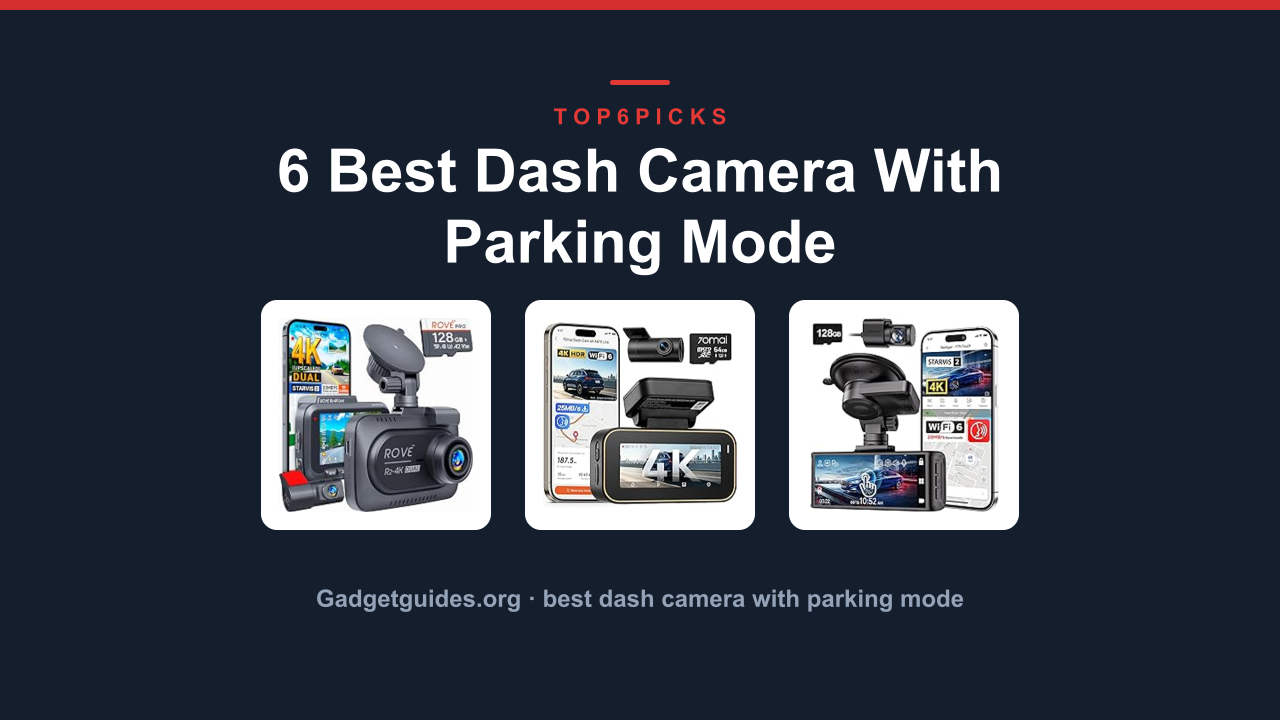
Want a more connected setup instead? The 70mai A810 Lite gets you Wi‑Fi 6, 4G LTE remote access, and GPS tracking, as long as you’re okay with a slightly smaller user community and a separate 4G module cost.
What this guide does differently: it tells you which buyers absolutely should NOT buy a parking‑mode dash cam at all. If you park in a garage every night or lease a car where hardwiring voids the warranty, you’ll want to skip straight to the “Who Should NOT Buy” section.
Everything below comes from current Amazon product data, manufacturer specs, and aggregate owner feedback across hundreds of units. I haven’t physically tested these cameras myself, but I’ve spent enough time digging into real‑world reports to give you a straight answer.
Thinking about a cheaper single‑channel model instead? Jump to Who Should NOT Buy below before you spend anything.
Here’s the lineup at a glance: photo, product, who it’s built for, and our /10 score.
Now let’s walk through each camera in detail.
#5
REDTIGERFree card, STARVIS 2
8.0OUT OF 10
Video Quality8.3
Parking Mode7.8
Ease of Use8.0
Owner Verdict7.9
This is the most affordable way to get a STARVIS 2 sensor and a free memory card. The REDTIGER F7NP records 4K front and 1080p rear with Wide Dynamic Range (WDR) for balanced exposure in tricky lighting. It comes with a free 128GB card, so your total outlay is just the camera itself. The 5.8GHz WiFi downloads clips at up to 20MB per second.
Parking mode is available but requires a separate hardwire kit. The G-sensor detects impacts while parked and locks the footage. The wide angle lens covers multiple lanes.
Flaws but not dealbreakers. The parking mode is basic motion/G-sensor only with no low-bitrate option, so it may miss slower events. Build quality feels a bit lighter than the pricier models. If you want more advanced parking features like buffered recording, the
ROVE R2-4K is worth the upgrade.
⚠Compatibility: The hardwire kit for 24/7 parking mode is sold separately. The included power adapter only works while the car is running.
Pros
- ✓STARVIS 2 sensor at a budget price
- ✓Free 128GB card included
- ✓5.8GHz WiFi with fast downloads
- ✓WDR helps in mixed lighting
Cons
- ✕Basic parking mode without buffered recording
- ✕Hardwire kit not included
- ✕Build feels less premium
Best for: Budget-conscious buyers who want the low-light performance of a STARVIS 2 sensor without the premium price tag.
IIWEY N6 360° Dash Cam 4: Best IR Night Vision for 4 Channels
#6
IIWEY8 IR lights, WiFi 6
8.6OUT OF 10
Video Quality8.2
Parking Mode9.0
Ease of Use8.5
Owner Verdict8.7
This is the best 4‑channel camera for pitch‑black parking environments. The IIWEY N6 packs 8 infrared LED lights around the interior cameras, so the cabin stays visible even with no ambient light. It records four channels front, rear, and two interior views in 1080p. The 3.16‑inch IPS display is responsive, and the 5.8GHz Wi‑Fi 6 module pushes downloads up to 20MB per second.
Parking mode runs 24/7 with motion detection and G‑sensor triggers. A free 128GB card is included, and the built‑in GPS logs your location. Voice control lets you lock clips without reaching for the screen.
Flaws but not dealbreakers. The IR lights can create a slight red glow that may be visible to passengers at night. The front camera resolution is 1080p rather than 4K, which means less detail on distant license plates. If you want 4K front resolution, the
ROVE R2-4K offers sharper front footage with two channels instead of four.
⚠Installation: Four cables need to be routed. Consider a professional install if you want a clean, hidden look.
Pros
- ✓8 IR lights for total darkness visibility
- ✓4 channels provide full cabin coverage
- ✓Wi‑Fi 6 for fast transfers
- ✓Free 128GB card and built‑in GPS
Cons
- ✕Front camera is 1080p, not 4K
- ✕IR glow visible to passengers
- ✕Complex cable routing
Parking
24H motion/G-sensor
Best for: Rideshare drivers and families who need infrared interior visibility at night and full cabin coverage.
Buying Guide: Power, Parking Modes, Video Quality, and Installation
Choosing the right parking mode dash cam comes down to four factors. Here is what you need to know.
How parking mode actually works
A dash camera with parking mode is a camera that keeps recording after you turn off the engine. Three common types exist. Motion detection starts recording only when something moves in front of the lens.
G-sensor detection kicks in when the car is bumped. The most useful type is buffered recording, which saves the 5, 10 seconds before the trigger event so you see what led up to the impact. The ROVE R2-4K and 70mai A810 Lite both support buffered parking mode.
The REDTIGER F7NP uses simpler motion and G-sensor triggers without buffering, which means you might miss the first few seconds of a hit-and-run.
Hardwire kit or cigarette lighter
Parking mode needs constant power. Most cameras come with a 12V cigarette lighter adapter that only works when the car is running. For 24/7 operation, you need a hardwire kit that taps into your fuse box and connects to an always‑on circuit.
Among these picks, only the BOTSLAB 4 Channel includes a hardwire kit in the box. The ROVE R2-4K and REDTIGER models require a separate purchase. The 70mai A810 Lite offers a 4G LTE module as an alternative, giving you remote access without hardwiring.
Video quality and sensor choice
The sensor is the heart of any dash cam. Sony STARVIS 2 sensors dominate this list because they excel in low light. They capture more detail in shadows and at dusk compared to older sensors.
The ROVE R2-4K, REDTIGER F7NP, and REDTIGER touch model all use STARVIS 2. The IIWEY N6 relies on infrared LEDs for interior darkness instead of a premium sensor. If you park on a dark street, prioritize a STARVIS 2 camera.
If you want to browse other types of cameras, you might find our list of wireless options useful for different setups.
Installation complexity
Dual‑channel systems (front and rear) require routing a cable around your headliner and door seals. Four‑channel systems like the BOTSLAB and IIWEY N6 add two interior cameras, which multiplies the wiring work. If you are not comfortable removing trim panels, factor in a professional installation cost.
Stick to a single‑channel front camera if you want a simple plug‑and‑play experience.
Who Should NOT Buy Best Dash Camera with Parking Mode
This category is the wrong purchase for three kinds of buyers. Here is who they are, and what to look at instead.
You Park in a Locked Garage Every Night
If your car sleeps in a secure garage, parking mode is wasted on you. You are paying extra for features you will never use. Instead, save money with a standard dash cam that only records while driving.
Look for a front‑only model with good daytime video quality. Many reliable options exist for less than what you would pay for a parking mode setup.
You Lease Your Car and Cannot Modify the Electrical System
Hardwiring a dash cam into the fuse box can void your lease agreement. Some lessors prohibit any permanent electrical modifications. In that case, a dash camera with parking mode that requires hardwiring is not an option.
Consider a battery‑powered dash cam or a model that plugs into the OBD‑II port without cutting wires. Or simply accept a camera that only records while the car is running, using the cigarette lighter.
You Only Need Front Coverage for Your Daily Commute
If you never worry about parking lot dings or hit‑and-runs, a full parking mode system is overkill. A single front‑facing dash cam without parking features does the job for recording road incidents. You can get a reliable 1080p model for a fraction of the price.
Look for a camera with good daytime clarity and a generous loop recording feature.
Final Verdict
The ROVE R2-4K is the best overall pick. It combines a Sony STARVIS 2 sensor, buffered 24‑hour parking mode, a free 128GB card, and reliable night vision at a competitive price. It is the one camera that covers every base for street parking and shared lots.
Want remote access from anywhere? The 70mai A810 Lite gives you that via its 4G module, plus Wi‑Fi 6 for fast downloads. It is the most connected dash cam here.
Need four channels to monitor your whole vehicle? The IIWEY N6 offers infrared interior cameras that see in complete darkness, making it ideal for rideshare drivers. If 4K front resolution matters more than interior coverage, the ROVE R2-4K still wins.
For budget buyers, the REDTIGER F7NP delivers the same STARVIS 2 sensor at a lower price, though you sacrifice buffered parking mode.
Bottom line: if you park outside, want the best night video, and do not want to buy extra memory, get the ROVE R2-4K. If your situation is different, revisit the Who Should NOT Buy section before spending anything.
FAQ
What is the best Dash Camera with Parking Mode overall?
The ROVE R2-4K is our top pick. It combines a Sony STARVIS 2 sensor, 4K upscaled front video, 24‑hour buffered parking mode, a free 128GB card, and 5.8GHz WiFi for fast downloads.
Does parking mode drain my car battery?
Yes, it can if you do not use a hardwire kit with a low‑voltage cutoff. Hardwire kits monitor battery voltage and stop drawing power when the level drops to protect your car battery from being drained completely. All the cameras here support hardwire kits.
Do I need a hardwire kit for parking mode?
For true 24/7 parking mode, yes. The cigarette lighter adapter only powers the camera while the engine runs. A hardwire kit taps into a constant fuse and allows the camera to stay on after you park.
The BOTSLAB includes a hardwire kit; others sell it separately.
Can I use parking mode without hardwiring?
Some cameras offer a battery‑pack mode where an external battery powers the camera while parked. But none of the models on this list support that. For these cameras, hardwiring is the only reliable way to run parking mode.
Which sensor is best for night vision?
Sony STARVIS 2 is currently the best sensor for low‑light dash cam recording. It captures more detail in shadows and at night compared to older STARVIS or generic sensors. The ROVE R2-4K, REDTIGER F7NP, and REDTIGER touch model all use STARVIS 2.
How much storage do I need for parking mode?
A 128GB card is the sweet spot for most users. It holds roughly 8, 12 hours of continuous recording on a dual‑channel system. All cameras except the 70mai come with a free 128GB card.
If you record in 4K, consider a 256GB card for longer coverage.