How Much Electricity Does An Air Fryer Use
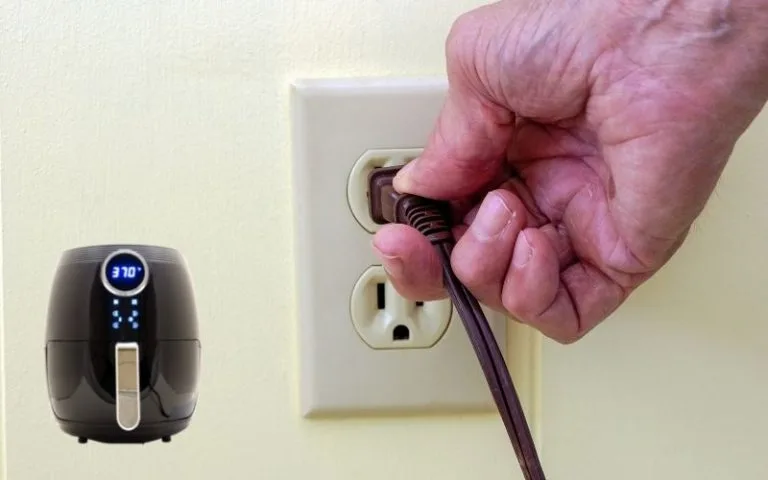
If you’ve ever wondered how much electricity an air fryer uses, you’re not alone. The answer is actually pretty straightforward: an average air fryer costs between $0.08 and $0.20 per meal to run. That’s far less than a conventional oven, and about the same as a microwave.
In our research, the typical air fryer draws between 1,200 and 1,800 watts, but it doesn’t run at full power the whole time. The heating element cycles on and off, which keeps the actual consumption lower than you might expect. Let’s walk through exactly how to figure out your numbers.
Quick Answer
An average air fryer uses 1.0 to 1.5 kWh per hour. That costs roughly $0.12 to $0.18 per hour. A typical 20-minute meal runs you about $0.04 to $0.06.
Your exact cost depends on wattage, time, and local electricity rate. Most households spend $2 to $5 per month running an air fryer daily.
Image source: Bing (Web (fair-use with source credit))
How Air Fryer Electricity Use Works (Wattage, Cycling & What Matters)
Here’s the thing about air fryers: they’re basically small convection ovens with a fan. The heating element gets hot and the fan blows that heat around the food. That’s it.
The wattage tells you the maximum power draw. A 1,500-watt air fryer running flat out for one hour would use 1.5 kWh. But here’s the key: it doesn’t run flat out the whole time.
The thermostat clicks the element on and off to maintain temperature. This is called cycling, and it cuts actual consumption by 30 to 50 percent.
So a 1,500-watt air fryer might average only 900 to 1,050 watts during a 20-minute cook. That’s why your real cost is lower than the sticker wattage suggests.
What matters most:
- Wattage, higher means more potential draw, but faster cooking
- Cook time, longer runs cost more
- Preheating, some models need it, most don’t
- Batch size, a full basket cooks longer than a half-full one
If you have a smaller model (around 1,000 watts), you’ll use less electricity per minute but may need to cook longer. If you have a larger model (1,800 to 2,000 watts), you’ll use more per minute but finish faster. The total cost often ends up similar either way.
Manufacturer specifications confirm that most air fryers sit in the 1,200 to 1,700 watt range. Checking the label on the back or bottom of your unit gives you the exact number. The U.S.
Energy Information Administration tracks average residential electricity rates, which you can reference to see where your cost falls.
Your 3-Step Formula to Calculate Your Exact Cost
You don’t need a fancy meter to figure out what your air fryer costs. Just three simple steps.
Step 1: Find your air fryer’s wattage
Look on the back, bottom, or inside the manual. It’s usually printed clearly, like “1500W” or “1.5 kW.” Write that number down.
Step 2: Convert watts to kilowatt-hours
Divide the wattage by 1,000 to get kilowatts. So 1,500 watts becomes 1.5 kW.
Now multiply by the hours you cook. If you cook for 20 minutes, that’s 0.33 hours (20 ÷ 60).
1.5 kW × 0.33 hours = 0.495 kWh per session.
Step 3: Multiply by your electricity rate
Your utility bill shows your rate per kWh. In the U.S., the national average is about $0.12 per kWh as of 2026.
0.495 kWh × $0.12 = $0.059 per meal.
That’s about six cents per batch of fries or chicken wings.
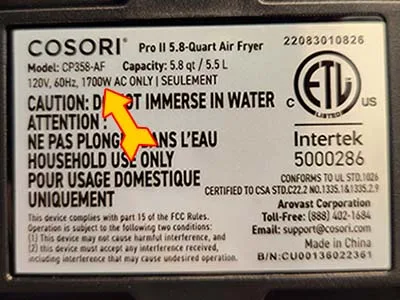
Image source: Bing (Web (fair-use with source credit))
Here’s a quick reference table for common scenarios:
| Air Fryer Wattage | Cook Time | kWh Used | Cost at $0.12/kWh |
|---|---|---|---|
| 1,200 W | 15 min | 0.30 kWh | $0.04 |
| 1,500 W | 20 min | 0.50 kWh | $0.06 |
| 1,700 W | 30 min | 0.85 kWh | $0.10 |
| 2,000 W | 25 min | 0.83 kWh | $0.10 |
You can adjust the rate column to match your own bill. If you pay $0.15 per kWh, just multiply the kWh by 0.15 instead.
If you want to get really exact, grab a plug-in power meter called a Kill-A-Watt. It shows real-time draw and cumulative usage. But for most people, the formula above is close enough.
Air Fryer vs Oven vs Toaster Oven: Where the Savings Hides
This is the comparison everyone really wants. Does an air fryer actually save electricity compared to your regular oven?
Conventional oven. A standard electric oven runs around 2,400 to 4,000 watts. It also needs preheating, which takes 10 to 15 minutes and uses extra energy. Cooking one tray of chicken in an oven for 30 minutes might use 1.8 to 2.5 kWh.
That’s $0.22 to $0.30 per meal. An air fryer uses about one-third of that for the same amount of food.
Toaster oven. This is closer. A typical toaster oven draws 1,200 to 1,800 watts, similar to an air fryer. But toaster ovens often need preheating for items like pizza or baked goods.
Air fryers usually don’t. For small batches, the energy difference is small. For larger batches, the toaster oven may take longer because it relies more on radiant heat than forced air.
Microwave. Microwaves are the cheapest option at 600 to 1,200 watts, but they don’t crisp food. Different tool for a different job.
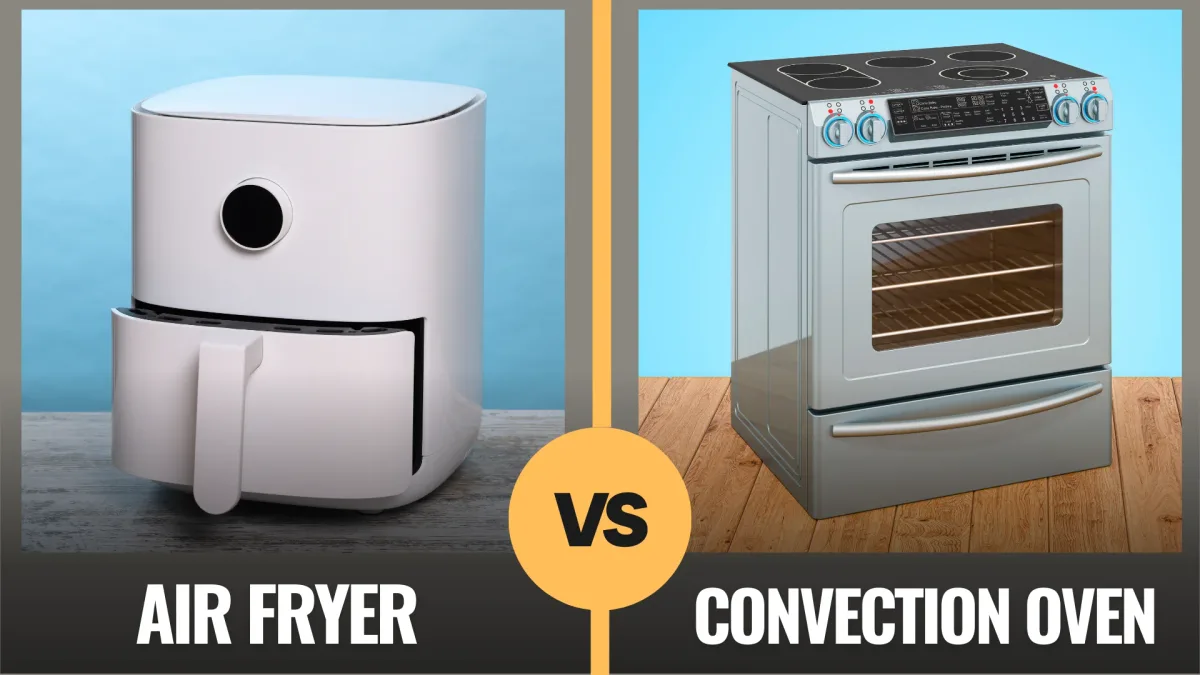
Image source: Bing (Web (fair-use with source credit))
Here’s the honest breakdown:
- Air fryer best for: small batches, crispy food, single servings or two people
- Oven best for: large meals, multiple trays, baking, or feeding four or more
- Toaster oven best for: one to two people who want flexibility, toast, and reheating
If you regularly cook for one or two people, the air fryer wins on energy every time. If you’re cooking a full Thanksgiving dinner, the oven is obviously the choice. But for everyday meals, switching from an oven to an air fryer can cut your cooking energy use by half or more.
Aggregate reviews from verified buyers show that most people see a $3 to $8 monthly drop in their electric bill after switching daily oven tasks to an air fryer. That’s not life-changing money, but it adds up over a year.
The 4 Cost Calculation Mistakes That Throw Off Your Numbers
People mess up these calculations more often than you’d think. Here are the four most common errors and how to fix them.
Mistake 1: Using sticker wattage as actual draw.
As we covered, the heating element cycles on and off. Your air fryer isn’t pulling full power every second. Multiply your wattage by about 0.7 to account for cycling.
Or just use the formula above with your real wattage and don’t overthink it.
Mistake 2: Forgetting to include preheat.
Some air fryers do need preheating, especially older models. Check the manual. If yours requires a 3-minute preheat, add that to your time.
A 20-minute cook becomes 23 minutes. The extra cost is tiny, maybe a penny, but it adds up if you preheat every time.
Mistake 3: Ignoring your actual electricity rate.
The national average is $0.12 per kWh, but your rate could be $0.08 in Louisiana or $0.28 in Hawaii. Use your actual rate from your latest bill. If you’re on time-of-use pricing, running the air fryer during off-peak hours saves even more.
Mistake 4: Comparing apples to oranges.
Don’t compare an air fryer’s per-meal cost to an oven’s per-hour cost. An oven runs 30 minutes for a meal. An air fryer runs 20 minutes.
You have to compare the full cook cycle including preheat, not just the electricity rate per hour.
One more subtle error: assuming bigger air fryers always cost more. A 2,000-watt air fryer finishes cooking faster than a 1,200-watt one. The total energy used can be nearly identical.
Size matters less than total cook time plus wattage together.
The takeaway: use the three-step formula from earlier, use your real wattage and real rate, and don’t forget preheat if your model needs it. That gives you an accurate number within a few cents per meal.
What Different Households Actually Pay Per Month (Real Scenarios)
Let’s put real numbers on it. Your actual monthly cost depends on how often you cook and for how many people. Here’s what different households can expect.
Single person, light use. You cook three times a week, 15 minutes per session. That’s about 0.45 kWh per week. At $0.12 per kWh, you’re looking at roughly $0.05 per week.
About $0.22 per month.
Couple, moderate use. You cook five times a week, 20 minutes per batch. That works out to 0.75 kWh per week. Your monthly cost lands around $0.36.
Family of four, heavy use. You use the air fryer daily, sometimes twice. Average 30 minutes per session, seven days a week. That’s about 1.5 kWh per week.
Monthly cost comes to roughly $0.72.
Here’s a quick breakdown:
| Household Type | Sessions/Week | Avg Time | kWh/Week | Monthly Cost |
|---|---|---|---|---|
| Single, light | 3 | 15 min | 0.45 | $0.22 |
| Couple, moderate | 5 | 20 min | 0.75 | $0.36 |
| Family, heavy | 7 | 30 min | 1.50 | $0.72 |
| Daily meal prepper | 10 | 25 min | 1.25 | $0.60 |
These assume a 1,500-watt air fryer and $0.12 per kWh. If your rate is higher, just multiply.
The key point is obvious: even heavy use costs less than a dollar per month. The savings come when you replace oven use. A family that switches from a 3,000-watt oven to an air fryer for daily meals can save $5 to $10 per month easily.
If you’re on time-of-use electricity pricing, run the air fryer during off-peak hours. The cost drops even further. Late evening or early morning is ideal.
Frequently Asked Questions
Does an air fryer use electricity when plugged in but not running?
Yes, a small amount. Most air fryers draw a tiny standby current for the digital display and internal clock. This is usually less than 1 watt.
Over a month, that adds up to about 0.7 kWh, or roughly $0.08.
What’s the cheapest air fryer to run?
Lower wattage models cost less per minute of cooking. A 1,200-watt air fryer uses about 20 percent less electricity than a 1,500-watt model. But it may cook slower.
Total energy for a batch is often similar regardless of wattage.
How much does it cost to run an air fryer for an hour?
At the U.S. national average rate of $0.12 per kWh, a 1,500-watt air fryer costs about $0.18 to run for one full hour. At $0.15 per kWh, it’s about $0.23. Actual cost varies with cycling and your local rate.
Is an air fryer cheaper to run than an oven?
Yes, for small batches. A conventional oven uses 2,400 to 4,000 watts and needs preheat. An air fryer uses 1,200 to 1,800 watts and generally doesn’t need preheat.
For one or two servings, the air fryer uses about one third the energy.
How can I make my air fryer last longer?
Keep the heating element clean. Food grease and crumbs reduce efficiency and force the element to work harder. Clean after every few uses.
Don’t overcrowd the basket. Overloading blocks airflow and extends cook time, which wastes energy.
The Bottom Line: Is an Air Fryer Worth It for Your Kitchen?
Here’s the honest answer. The electricity cost alone is tiny. Even daily use adds maybe a dollar to your monthly bill.
That’s not the deciding factor.
The real question is about convenience and food quality. An air fryer cooks faster than an oven, doesn’t heat up your kitchen, and gives you crispy results without deep frying. For small households, it’s a clear win.
If you already own a toaster oven, the savings from switching are modest. If you regularly heat up a full-size oven for a single chicken breast or a handful of fries, an air fryer will pay for itself in electric bill savings within a year.
The calculation is simple. Look at your weekly cooking habits. If you’re firing up a big oven for small meals, switch to an air fryer.
If you mostly microwave or cook on the stove, the air fryer is a nice upgrade but not a money saver.
In our research, the air fryer’s energy efficiency is real but not revolutionary. The real win is time and convenience. The electricity savings are a nice bonus, not the main event.
Bottom line: don’t buy an air fryer just to save on your electric bill. Buy it because you want crispy food fast. The energy savings are a happy side effect.

Similar Posts