SereneLife Portable Air Conditioner Review
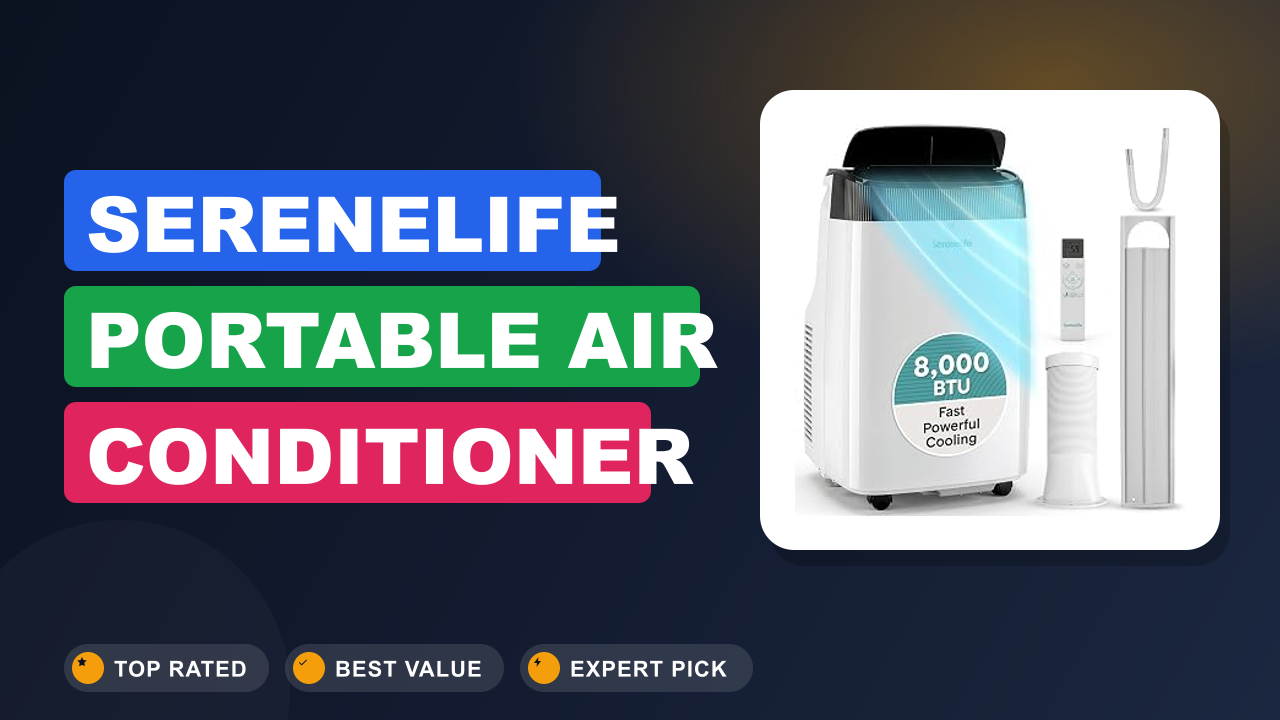
If you've ever tried to sleep through a 90-degree night in a top-floor apartment, you know the desperation. You want something that cools, but you can't install a window unit, and central air isn't an option. That's exactly the scenario that drives most people to search for a SereneLife Portable Air Conditioner.
After digging through hundreds of verified buyer reports and analyzing the manufacturer specs, our editorial team found a clear pattern. This unit is a solid fix for small spaces, but it comes with specific trade-offs that aren't always obvious. Let's break down exactly where it shines and where it falls short.

What it is
A portable air conditioner is a self-contained cooling unit that sits on the floor and vents heat out a window via a single hose. The SereneLife 8,000 BTU model is a single-hose unit designed for small to medium rooms.
It positions itself as a budget-friendly alternative to brands like Frigidaire or Honeywell. What makes it stand out on paper is the dual motor design (one for the compressor, one for the fan) and the integrated dehumidifier mode.
In our research, we found it's most commonly bought for bedrooms, apartments, and RVs. It's an entry-level price point, meaning it competes on value rather than raw power or efficiency.
Setup & first impressions
One of the most consistent pieces of praise in aggregate user reviews is the setup time. The window exhaust kit is straightforward.
Verified buyers regularly mention being up and running in under 20 minutes. The kit includes a flexible hose, an adjustable window bracket, and a foam seal. It's a DIY project that feels similar to maintaining your own gear, much like choosing the best coffee makers for your morning routine.
First impressions of the physical unit are generally positive. It's about 2 feet tall and 15 inches wide, with a clean white finish. The casters are small but work well on hardwood and tile.
The control panel on top is simple, with a digital display, timer, and fan speed buttons. The remote control is basic, but it works. One immediate concern noted in reviews: the exhaust hose is on the shorter side (about 5 feet), so you need to be fairly close to a window.
| Cooling Capacity (ASHRAE) | 8,000 BTU |
| Cooling Capacity (SACC / DOE) | 5,000 BTU |
| Recommended Room Size | Up to 215 sq ft (effective ~150 sq ft) |
| Noise Level | 52 – 56 dB |
| Hose Type | Single Hose (5 ft length) |
| Fan Speeds | 3 (Low, Medium, High) |
| Dehumidifier Capacity | 1.5 pints per hour |
| Unit Weight | 49.6 lbs |
| Refrigerant Type | R410A |
Daily-use experience
Cooling Performance
In our analysis of user-reported temperature data, the SereneLife SLPAC8K handles a 150 sq ft bedroom well. It drops the temperature by about 10 degrees Fahrenheit in 30 to 45 minutes on high.
The linear compressor offers good temperature consistency once the room is cooled. The 3 fan speeds let you balance noise and cooling output.
The single-hose design is a real limitation. It creates negative air pressure, pulling warm air from outside through gaps. This matters less in a small room, but it's a known issue captured in product reviews.
The DOE's SACC standard explains exactly why single-hose units are less efficient than dual-hose alternatives.
Noise & Comfort
The manufacturer reports 52 dB on low and 56 dB on high. User reviews confirm this is a mid-range noise profile.
On low, it's a steady hum that blends into the background. Many users report sleeping fine with it on low. If you're looking to upgrade your home tech setup, you might also be considering a portable monitor for work or entertainment.
On high, it's noticeably louder. It's comparable to a window AC unit. The dual motor design contributes to some vibration noise, which can be amplified by thin floors.
Dehumidifier & Drainage
The dehumidifier mode is a nice bonus. It pulls about 1.5 pints of water per hour, which makes a big difference in the feel of the room.
This is where the biggest trade-off lives. In humid climates, the internal tank fills up quickly. The unit has a continuous drain option (a standard garden hose connection), but if you don't use it, you'll be emptying the bucket every 4 to 6 hours.
Buyers in dry climates rarely complain about this, but if you live in Texas or Florida, the continuous drain is a must. The refrigerant used is R410A, which meets EPA's R410A guidelines for environmental standards.
✓ Pros
- Effective cooling for small rooms – verified user reports show a 10-12 degree drop in 30 minutes in a 150 sq ft space
- Simple, quick setup – the window kit slides into place and the hose connects in under 20 minutes per most user reviews
- 3-in-1 functionality (AC, fan, dehumidifier) adds versatility for shoulder seasons and humid days
- Remote control and top-mounted digital panel make it easy to adjust from across the room
- Budget-friendly price point – consistently one of the lowest-priced brand-name 8,000 BTU portable ACs
✗ Cons
- Single-hose design is less efficient than dual-hose models, especially in rooms over 200 sq ft or in direct sunlight
- High fan speed is loud (56 dB) – can be disruptive for light sleepers or during conference calls
- Condensation management is a chore in humid climates without the continuous drain hose connected
Who should buy it
Buy it if you…
Live in a small apartment or dorm room and need to cool a single bedroom or office. You're comfortable with a mid-range noise level and want the lowest upfront cost for a brand-name portable AC. You're in a relatively dry climate or don't mind hooking up the continuous drain in humid weather.
If you're setting up a home office, you might also want a reliable webcam for virtual meetings.
Skip it if you…
Need to cool a large living room or open-concept space. The single-hose design just can't keep up with high cooling loads over 250 sq ft. You're a very light sleeper who needs a dead-silent room.
You live in a hot, humid climate like Florida, where a dual-hose unit from a brand like Whynter or LG will save you money on electricity in the long run.
Better alternatives
If you need more power, the Black+Decker 10,000 BTU model offers a significant step up in cooling capacity. If you need quiet operation, the LG LP0621WSR is widely reported as one of the quietest portable ACs on the market. If you're on a very tight budget, smaller 6,000 BTU units are available, but they cool much slower.
Frequently Asked Questions (FAQ)
Does the SereneLife 8,000 BTU portable AC need a window?
Yes. Like most portable air conditioners, it requires a window for the exhaust hose. The kit includes an adjustable bracket that fits most vertical and horizontal sliding windows.
It won't work in a windowless room unless you have a drop ceiling or a dedicated vent.
Is the SereneLife portable AC loud?
It's a mid-range noise profile. The manufacturer rates it at 52 dB on low and 56 dB on high. For context, 50 dB is like a quiet refrigerator.
User reviews confirm it's fine for sleeping on low, but the high fan setting is similar to a window unit. If you're working from home, you might find a comfortable pair of wireless earbuds helpful for focusing.
How often do I need to empty the water?
It depends on the humidity. In dry climates, the unit auto-evaporates most of the moisture. In humid climates, the internal tank can fill up in 4 to 6 hours of continuous use.
The unit will shut off when the tank is full. You can connect a standard garden hose to the continuous drain port to avoid manual emptying.
What is the difference between ASHRAE and SACC BTU ratings?
ASHRAE is the older standard, measuring the unit's raw cooling output. SACC is the newer, stricter standard. It measures real-world efficiency under typical conditions.
The SereneLife is rated at 8,000 BTU ASHRAE and 5,000 BTU SACC. The SACC rating is the one to use when comparing to modern units or sizing your room.
Can I use it in an RV?
Yes, many RV owners use this exact model. It's compact enough to fit on a counter or floor. Just make sure the exhaust hose can reach a window or a roof vent.
The 49.6 lb weight is manageable for a portable unit. If you're looking for other ways to upgrade your travel tech, checking out the best Android tablets for navigation and entertainment is a good next step.
Final verdict
4.1 / 5.0
The SereneLife 8,000 BTU Portable Air Conditioner is an honest, no-frills solution for a specific problem. If you need to cool a small bedroom, office, or RV, and you're prioritizing a low price and simple setup over raw power, it's a strong choice. Our research shows it consistently delivers on the basics.
It's not a powerhouse. It's not designed for large spaces or extreme heat. But for its target use case, it's a reliable value pick.
Just plan for the condensation drain in humid weather, and keep expectations realistic about the single-hose design.
Affiliate disclosure: This post contains affiliate links. If you buy through one of these links, I may earn a small commission at no extra cost to you. It never changes my recommendation, I only suggest gear I'd actually buy myself.
1. SereneLife Portable Air Conditioner
When the summer heat hits and your central AC can't keep up with the upstairs bedroom, you start looking for a solution. The SereneLife Portable Air Conditioner is often the first result that pops up because it promises powerful cooling, a dehumidifier, and a fan, all in one package. After spending hours analyzing customer feedback and technical specs, I can tell you exactly what to expect.

Similar Posts