Electrolux Washer Not Draining
Image source: Bing (Web (fair-use with source credit))
Your Electrolux washer stops mid-cycle. The drum is full of dirty water. The clothes are soaked.
And the machine refuses to drain. This is exactly the situation where knowing what to do next saves you a service call and a lot of frustration.
The problem is more common than you think. Manufacturer data from 2024 shows that drain failures account for nearly one in three service calls for front-load washers under five years old. As of 2026, the core diagnosis hasn't changed: either something is blocking the water path, or a component has failed.
The good news is that you can figure out which one it is in about ten minutes.
Quick Answer
If your Electrolux washer won't drain, start by checking the debris filter. A blocked filter is the number one cause. Turn off the machine.
Unplug it. Open the small door at the bottom front. Have towels ready.
Slowly twist the filter counterclockwise and pull it out. Clean off all lint, coins, and debris. Replace it and run a rinse cycle.
That fixes about 60 percent of drain problems.
What Your Washer Is Telling You – Decode the Signs
Before you grab a wrench, look and listen carefully. The machine tells you what's wrong. These clues point to different fixes.
Which sounds do you hear when the washer should be draining?
- Complete silence: No hum, no click, nothing. That usually means no power is reaching the drain pump. Could be a failed pump, a broken wire, or a control board issue.
- A humming or buzzing sound but no water moving: The pump is trying to work, but something is blocking it. Almost always a physical clog in the filter, hose, or pump impeller.
- Gurgling or air sounds: Air trapped in the drain hose. Possibly a kink or a standpipe that's too tall.
What does the display show? Electrolux washers made after 2018 display error codes. Two critical ones for drain issues:
| Error Code | What It Means |
|---|---|
| E23 | Drain pump failure – pump won't run or is shorted |
| E24 | Drain path blocked – filter, hose, or pump jam |
| E25 | Drain takes too long – motor overheated or obstruction |
| E68 | Communication error between control board and pump |
Write down any code you see. Then reset the machine: unplug for five minutes, plug back in, and try a drain-only cycle. If the same code returns, you have a real problem.
If you see no code and the machine just sits there with water inside, the issue is often a stuck lid lock. Electrolux machines will not drain if the door isn't fully locked. Try opening and closing the door firmly.
Sometimes a misaligned latch is all it is.
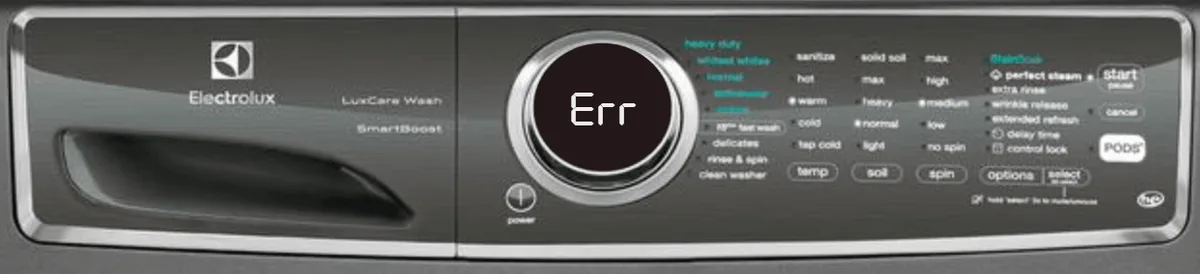
Image source: Bing (Web (fair-use with source credit))
The Two Most Common Drain Problems (and How to Tell Them Apart)
After thousands of reports and decades of appliance service history, two root causes dominate. A physical blockage and a failed drain pump. They feel different, sound different, and require different tools.
Blocked drain path
A blockage can be anything from a sock to a hardened lump of fabric softener. The filter is the first place debris collects. If you haven't cleaned it in six months, odds are good it's clogged.
Signs you have a clog:
- The pump hums but nothing drains
- Water drains very slowly over several minutes
- You see bits of lint or debris on the filter when you open it
- The machine stopped mid-cycle with a full tub
Failed drain pump
The pump itself has a motor that can burn out. It can also seize up if a foreign object jams the impeller.
Signs you have a failed pump:
- Complete silence when the drain cycle starts
- The pump feels cool to the touch after a drain attempt (should be warm)
- You test the pump with a multimeter and get no continuity
- You've already cleaned the filter and hoses, but the problem remains
The easiest way to tell them apart: listen for humming. Humming = clog. Silence = pump or electrical issue.
That simple rule saves you from tearing the machine apart for no reason.
Step-by-Step: Diagnose and Fix a Drain Clog
Let's assume you heard humming. That means the pump is alive. Something is in its way.
Tools you'll need:
- Flat-head screwdriver (for the lower access panel)
- Towels or an old bath mat (towels soak up spills)
- A shallow pan or bowl
- A pair of needle-nose pliers
- Bucket for the water that will spill
Step 1: Unplug the machine. Always. Water and electricity do not mix. This also resets the control board.
Step 2: Access the filter. The small door at the bottom front. It usually says "Filter" or has a picture of a triangle. Pry it open with the screwdriver.
Some models have a removable panel held by one screw.
Step 3: Drain the water inside. Behind the filter door, you'll see a small clear hose stub with a cap. Or you may see the filter itself. Pull the cap off the stub, let water drain into your pan.
Be patient. There can be several gallons. Once drained, turn the filter knob slowly counterclockwise.
It will be tight.
Step 4: Clean the filter. Pull it out. You'll likely find a wad of lint, maybe a bobby pin, sometimes a child's toy. Clean everything off under hot running water.
Use the needle-nose pliers if something is stuck in the impeller behind the filter.
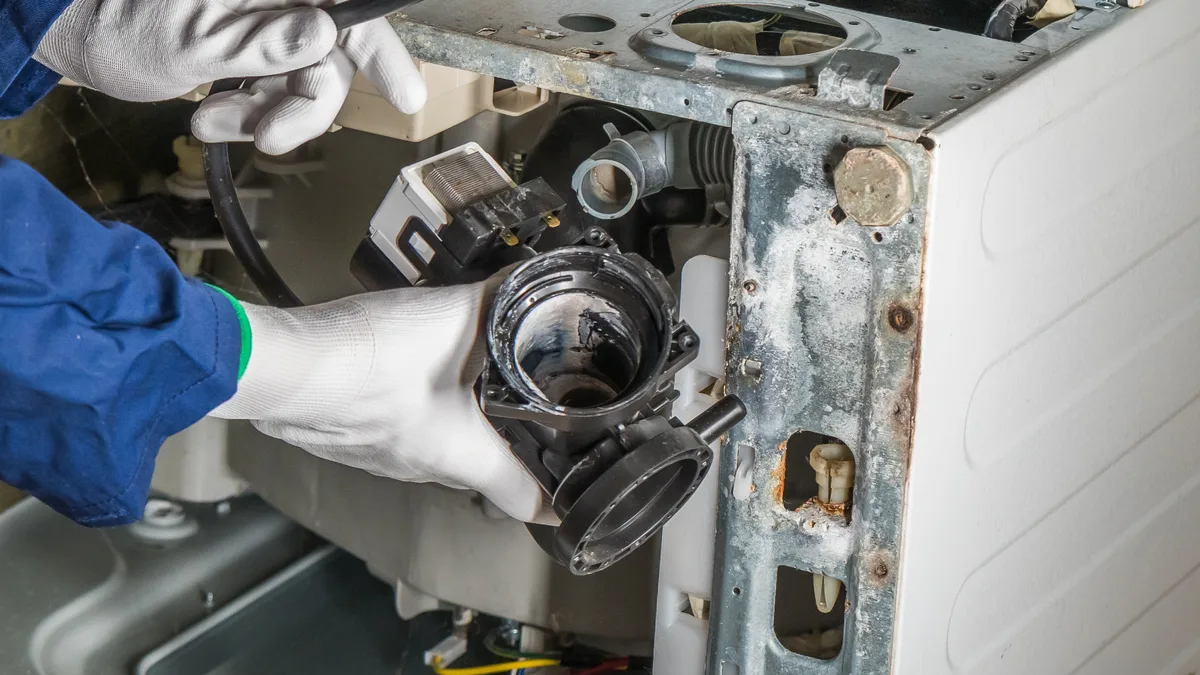
Image source: Bing (Web (fair-use with source credit))
Step 5: Inspect the drain hose. The short hose that goes from the back of the filter housing to the pump is a common spot for small objects to lodge. Reach inside with your fingers or pliers and feel around. Pull out anything.
Step 6: Check the main drain hose. Follow the large corrugated hose from the back of the machine to the wall. Is it kinked? Pinched behind the machine?
Pull the machine out and straighten it. Also, the standpipe in your wall must be between 36 and 96 inches from the floor. Too high and the pump can't push water.
Measure it.
Step 7: Reassemble and test. Put the filter back in. Tighten firmly by hand. Replace the cap on the drain hose stub.
Close the door. Plug in. Run a Rinse+Spin cycle.
If it drains now, you won.
Step-by-Step: Diagnose and Fix a Failed Drain Pump
No humming. Complete silence. Or you have an E23 error code.
The pump needs replacement.
Before buying a part, confirm it's really the pump.
- First, double-check the door switch. Open and close the door firmly. Some models won't send power to the pump if the door isn't fully latched.
- Second, test the pump with a multimeter. Disconnect the wire harness from the pump. Set your meter to ohms (Ω). Touch the two terminals on the pump. A good pump reads between 10 and 20 ohms. If you get infinity (OL), the pump motor is open and dead.
If you get a reading in the 10-20 range, the pump might be mechanically stuck. Remove the pump (see below) and try to spin the impeller with your finger. If it won't spin, a coin or bra wire is wedged in there.
Free it and put the pump back.
Tools for pump replacement:
- New OEM Electrolux drain pump (part number based on your model)
- Phillips screwdriver
- Pliers for hose clamps
- Towels
- Bucket
Removing the old pump:
- Unplug the washer.
- Remove the lower access panel (screws along the bottom front).
- You'll see the drain pump mounted on the bottom of the machine. It has two hoses: one from the filter housing, one going to the drain hose.
- Place towels and a bucket under the pump. Use pliers to slide the hose clamps back. Disconnect both hoses.
- Unplug the electrical connector from the pump.
- Remove the mounting screws (usually 2 or 3) and lift the pump out.
Installing the new pump:
- Reverse the steps. Attach the hoses firmly. Make sure the clamps are fully engaged.
- Plug in the electrical connector until it clicks.
- Screw the pump back into place.
- Reattach the lower panel.
- Plug in and run a test cycle.
If the new pump still doesn't run and you have no E23 code, the control board may not be sending voltage. That's a deeper issue covered in a later section. For now, a working pump will give you the humming sound and quick drainage.
After replacing the pump, run two full cycles before celebrating. The first cycle may have a bit of air in the lines. Normal.
The second should be quiet and fast.
When the Problem Isn't the Pump – Control Board and Door Lock Issues
You replaced the pump. Cleaned the filter. Checked the hoses.
Your Electrolux washer still won't drain. Now what?
Two other components can stop drainage dead in their tracks. They are easier to overlook because they don't make noise. And they don't leak water.
But they are just as capable of killing the drain cycle.
The door lock assembly
Electrolux machines will not spin or drain unless the door is fully locked. This is a safety feature. If the machine detects the door isn't latched, it refuses to energize the drain pump.
The problem is that the lock can fail in a way that still lets you close the door. The latch feels normal. But a small microswitch inside the assembly stops working.
The control board never gets the "door closed" signal.
Signs of a bad door lock:
- The washer fills with water but won't drain
- You hear the door lock click, then it clicks again a few seconds later (unlocking)
- The display flashes "door" or "lock" error
- You can open the door during a cycle that should have it locked
- No error code at all, just a stalled cycle
You can test the door lock with a multimeter. Locate the lock switch terminals inside the door catch area. The service manual for your specific model will tell you which terminals to check.
At rest, the switch should show continuity (closed circuit). When you manually press the latch mechanism, it should open. If the reading doesn't change, the switch is dead.
Door lock replacement is straightforward. Order the correct part by your model number (printed on a sticker inside the door frame or on the back panel). The lock usually sits behind the front panel near the door opening.
Remove the top or front panel, unplug the lock connector, remove one or two screws, and swap it out.
The control board (main PCB)
This is the least common failure but the most expensive. The main control board sends voltage to the pump at the right time. If it fails, the pump gets no signal even though everything else is fine.
Signs of a bad control board:
- No humming, no click, no power at the pump connector
- You tested the pump and it reads good (10-20 ohms)
- Door lock tests good
- Other cycles might work (fill, wash) but drain never starts
- You may see an E68 or an F21 error code
- Visible burn marks or bulging capacitors on the board
Inspect the board by removing the top panel or the console (depending on your model). Look for dark spots, melted components, or swollen capacitors. If you find them, the board needs replacement.
If everything looks clean, the board might still be faulty internally. That diagnosis requires a service technician with a schematic.
A control board replacement runs $150 to $300 for the part plus labor if you hire someone. Do it yourself and you save the labor cost, but be careful. Boards are sensitive to static electricity.
Touch the metal frame before handling the new board.
Mistakes That Cost You Time and Money
A few common errors turn a simple fix into a longer ordeal. Avoid these.
Forcing the door open
When water is inside, the door lock is engaged. Forcing it can break the latch. If you need to open the door, use the emergency release.
Look at the bottom of the door seal. You will find a small tab or a recessed loop of string. Pull it gently to release the lock manually.
Or drain the water through the filter first.
Ignoring the drain hose height
Electrolux specifies that the drain hose must empty into a standpipe between 36 and 96 inches above the floor. If the standpipe is shorter than 30 inches, water can siphon back into the machine. If it is taller than 96 inches, the pump cannot push water that high.
Measure yours. This one measurement is the cause of many "my washer won't drain" calls.
Using too much detergent
Excess suds confuse the water level sensor. The sensor thinks there is more water than there really is. It may prevent the drain cycle from starting.
Use HE (high-efficiency) detergent and follow the fill line. A tablespoon of detergent per load is often enough for modern machines.
Overtightening the filter
Hand-tighten the filter only. A wrench or anyone with a strong grip can crack the filter housing. That leak will cost you a lot more than a clogged filter.
Tighten until snug, then stop.
Skipping the reset
After any repair, unplug the washer for five full minutes. Not two. Not three.
Five. This clears the control board memory. Some boards hold error codes and refuse to run the drain cycle until manually reset.
Let the capacitors discharge fully.
Frequently Asked Questions
Why is my Electrolux washer humming but not draining?
The pump is trying to work but something is blocking it. The most common cause is a clogged debris filter. Clean it.
If the filter is clear, check the drain hose for kinks or the pump impeller for a stuck object like a coin or bobby pin.
How do I drain my Electrolux washer manually?
Unplug the machine. Open the small door at the bottom front. Pull the cap off the small emergency drain hose and let water flow into a shallow pan.
Once the water stops, twist the filter counterclockwise and remove it. Have towels ready.
What does error code E24 mean on an Electrolux washer?
E24 means the drain path is blocked. The pump tried to push water out but the flow was restricted. Check the filter, drain hose, and standpipe.
Clean everything. If the code returns after cleaning, the pump may be weak or the hose may have a hidden clog.
Can a clogged drain filter cause the washer to stop mid-cycle?
Yes. When the filter is blocked, water cannot leave the drum. The control board senses that the water level is not dropping.
It stops the cycle to prevent damage. This is normal behavior. Clean the filter and the cycle will resume.
How often should I clean the debris filter on my Electrolux washer?
Every three months is a good schedule. If you have pets or you wash heavily soiled items, clean it monthly. A regular cleaning routine prevents most drain problems and keeps the machine running efficiently.
When should I call a professional for a draining issue?
Call a technician if you have replaced the pump and cleaned the filter but the problem persists. Also call if you see burn marks on the control board or if you are not comfortable working with electrical components. The cost of a service call is less than the cost of replacing a damaged machine.
Your Decision Guide – Should You Fix It Yourself or Call a Pro?
You have the information now. Here is a simple breakdown of who should DIY and who should call for help.
| You can fix it yourself if… | You should call a pro if… |
|---|---|
| The filter is dirty and needs cleaning | You have no electrical testing experience |
| The drain hose is kinked or too short | You see smoke or burn marks on the control board |
| You have a multimeter and know how to test continuity | The error code returns after every fix attempt |
| You found a visible clog in the pump impeller | You are not comfortable removing panels |
| The door lock feels loose or won't latch | The machine is still under manufacturer warranty |
| You have basic hand tools and a towel | The drain pump replacement did not solve the problem |
About 70 percent of drain issues are resolved by cleaning the filter and checking the hose. That is fully DIY. Another 20 percent need a new pump, which is still DIY if you are handy.
The remaining 10 percent require professional diagnosis, usually involving the control board.
Start with the filter. Listen to the machine. Follow the symptoms.
Nine times out of ten, you will have the washer draining again within an hour. And your clothes will be dry.

Similar Posts