Samsung Washer Code 4c

Your Samsung washer stops mid-cycle, flashes 4c on the display, and leaves you with a drum full of wet clothes. You press Start again. It runs for a minute.
The same code comes back.
Here is what you need to know. According to Samsung service documentation, the 4c error means "water supply does not reach the proper level within a set time." The actual fix is almost always simpler than you think. We will walk through each branch of diagnosis in order.
Quick Answer
Samsung Washer Code 4c means the machine did not detect enough water entering the drum within a specific time window. The most common cause is clogged inlet filters at the back of the washer. Cleaning them takes five minutes and costs nothing.
If the filters are clean, check the pressure switch hose. Only after those two checks should you consider water valve or control board issues.
What the 4c Error Is Telling You
The 4c code is not a random glitch. It is a deliberate signal from the washer's control board.
Inside your machine, a water level sensor called a pressure switch monitors how much water is in the drum. When you start a cycle, the washer opens the water valves and waits. The sensor expects to see the water level rise to a certain height within roughly 30 to 60 seconds.
If that does not happen, the control board stops the fill attempt, initiates a short drain, and displays 4c.
Think of it this way. The washer is saying: "I tried to fill, but the water did not arrive on time."
That could mean the water never reached the machine at all. It could mean the water arrived, but the sensor did not register it. Or it could mean the sensor itself is lying to the control board.
Your job is to determine which scenario is happening. Each branch has a different fix. We start with the fastest, easiest check first.
The Quick Reset That Works More Often Than You'd Think
Before you pull any hoses or open any panels, try a full power reset.
Unplug the washer from the wall outlet. Wait a full five minutes. Not thirty seconds.
Not two minutes. Five minutes. During that time, the control board capacitors discharge completely and the memory resets.
Plug it back in. Select a normal cycle with no clothes inside. Let it run.
If the 4c code does not reappear, the issue was a temporary software hiccup. You are done.
If the error returns, the problem is hardware-related. Move to the next branch.
Important note: A reset clears the error code temporarily even if a real problem exists. Run a second complete cycle. If the error stays gone, great.
If it returns, you have an underlying issue that needs attention.
Decision Branch 1: Is Water Getting In?
This is the most basic question. It filters out a huge number of false leads.
Go to the back of your washer. You will see two hoses (blue and red) connecting to the machine. Follow them to the wall.
Check that both water supply valves are fully open. It sounds too simple, but a surprising number of 4c calls end with someone accidentally closing a valve during a move, cleaning, or plumbing repair.
If the valves are open, pull the washer away from the wall far enough to inspect the hoses. Look for kinks, sharp bends, or places where the hose is crushed between the machine and the wall. Even a partial pinch restricts flow enough to trigger the error.
Now listen. Start a cycle and put your ear near the back panel. Do you hear a humming sound from the water valves when the machine tries to fill?
That sound means the control board sent power to the valves, and the solenoids are clicking. If you hear nothing, the problem is electrical, not water-related.
Here is a quick reference table for Branch 1:
| Symptom | Likely Cause | Next Step |
|---|---|---|
| No water in drum, valves open, hoses straight | Clogged inlet filters | Move to Branch 2 |
| Water trickles slowly into drum | Partial clog at filters or low home water pressure | Move to Branch 2, also check home pressure |
| Humming valve sound but no water | Faucet off, kinked hose, or frozen hose | Fix faucet, straighten hose, thaw line |
| No humming sound from valves | Electrical failure: valve solenoid or control board | Move to Branch 4 |
| Code appears after a recent move | Hoses reconnected to wrong faucets, or valves not fully reopened | Double-check both connections |
If water flows freely into the drum and you still get the 4c code, the problem is not a supply issue. Skip to Branch 3.
Image source: Bing (Web (fair-use with source credit))
Decision Branch 2: Are the Inlet Filters Clogged?
This is the single most common cause of the 4c error on Samsung washers. And it is the easiest to fix.
Inside the connection point where each hose attaches to the back of the washer, there is a small mesh screen. That screen catches sediment, rust particles, and mineral deposits from your home water supply. Over time, those particles build up and restrict water flow.
The washer still gets some water, but not enough to trigger the pressure switch in time.
Here is how to check and clean them.
Turn off both water supply valves. Disconnect the hoses from the back of the washer by unscrewing the plastic nuts by hand. Keep a towel handy.
There will be a small amount of water left in the hoses.
Look inside the brass or plastic fitting on the back of the machine. You will see a small plastic insert with a fine mesh screen. In some models, that screen is flat.
In others, it is slightly domed. Pull it out gently with needle-nose pliers. If it is stuck, wiggle it side to side.
Do not force it.
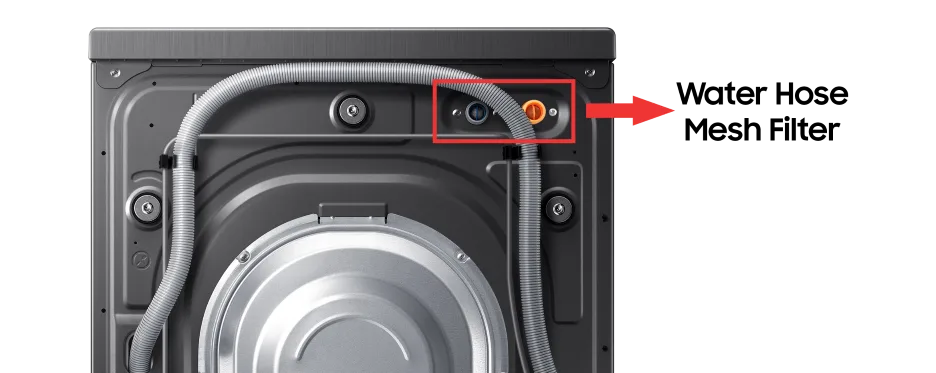
Image source: Bing (Web (fair-use with source credit))
Rinse the filter under running water. If you see visible debris or mineral buildup, scrub it gently with an old toothbrush. Do not use metal tools or harsh chemicals.
The screen is delicate.
Reinsert the filter. Hand-tighten the hose back onto the fitting. Repeat for the second hose.
Turn both valves back on. Run a cycle.
A few important details. Some Samsung models have filters only on the hot water side. Others have them on both.
Check both anyway. Also, some models do not have removable filters. In those, the screen is built into the hose fitting itself.
In that case, use a small brush to clean the screen in place.
If you clean both filters and the code returns, move to Branch 3.
Decision Branch 3: Is the Pressure Sensor Hose Blocked?
This is the branch that most homeowners miss. And it is the one that causes people to replace perfectly good water valves and control boards for no reason.
The pressure switch is a small circular device mounted near the top of the washer, usually on the back panel or top frame. It connects to the bottom of the tub via a thin, clear plastic hose. That hose carries air pressure from the bottom of the drum to the sensor.
As the water level rises, air pressure in the hose increases, and the sensor sends a signal to the control board.
If that hose gets blocked, kinked, disconnected, or cracked, the sensor cannot read the water level. So it reports to the control board: "No water detected." The board believes the sensor and throws the 4c code.
Here is how to check it.
Unplug the washer. Remove the top panel. On most Samsung front-load models, that means removing two or three screws at the back of the top cover, then sliding the cover forward and lifting it off.
Find the pressure switch. It is usually a round plastic disc about two inches in diameter. Follow the thin hose from the switch down to the tub connection.
Check for anything obvious first.
Make sure the hose is firmly connected at both ends. If it has popped off, push it back on. It should click fully into place.
Now look at the hose itself. Is it bent at a sharp angle that could trap water or air? Straighten it.
Is there debris inside? In rare cases, lint or detergent residue can work its way into the tube and block the air path. Disconnect the hose at the switch end and blow through it gently.
If the air flows freely, the blockage is cleared.

Image source: Bing (Web (fair-use with source credit))
Finally, test the switch itself. With the hose still disconnected, blow gently into the open end of the switch port. You should hear a distinct click.
That click is the diaphragm inside the switch responding to the air pressure. If you hear nothing, the switch may be stuck or faulty.
A stuck pressure switch can cause a false 4c error even when water fills the drum normally. The washer fills, the pressure hose fills with air, but the switch is mechanically jammed and never sends the "water detected" signal. The control board waits, then times out and shows 4c.
If the hose is clear and the switch clicks when you blow into it, put everything back together and move to Branch 4.
Decision Branch 4: Is the Water Valve or Control Board Faulty?
If you have checked the supply, cleaned the filters, and verified the pressure switch hose, but the 4c code still appears, the problem is likely electrical. Two components remain: the water valve assembly and the control board.
The water valve assembly sits behind the back panel of your washer. It contains two or three solenoids that open and close to let water in. Each solenoid controls one water path.
If a solenoid fails, the valve stays closed. No water enters the drum. The pressure sensor never detects a rise.
The 4c code appears.
How do you test a solenoid? With a multimeter set to resistance (ohms). Unplug the washer.
Remove the back panel. Locate the valve assembly. Disconnect the wire harness from the solenoid you want to test.
Touch the multimeter probes to the two terminals on the solenoid.
A working solenoid typically reads between 500 and 2000 ohms. Exact values vary by model. If you get a reading of zero (short circuit) or infinite (open circuit), the solenoid is dead.
Replace the entire valve assembly.
Do not replace individual solenoids. The valve assembly comes as one sealed unit. It costs roughly $40 to $80 depending on your model.
It takes about 20 minutes to swap.
If the solenoids test fine, the problem may be the control board. The control board sends power to the valves when it expects water. If the board fails, it never sends that signal.
You confirmed this in Branch 1 when you listened for the humming sound and heard nothing.
Control board failure is less common than valve failure. But it happens. Component stress over time, voltage surges, and moisture exposure can damage the board.
A replacement board costs $100 to $200. Installation is straightforward on most Samsung models. You unplug the old board, plug in the new one, and remount it.
One important note: Before replacing the control board, check the wire harness between the board and the valve assembly. A loose connection or chewed wire can mimic a board failure. Trace the wires visually.
Look for breaks, burns, or corrosion at the connector pins.
Here is a quick decision table for Branch 4:
| Test Result | Likely Fault | Part to Replace |
|---|---|---|
| No humming sound, solenoid reads infinite or zero | Failed solenoid | Valve assembly |
| No humming sound, solenoid reads 500-2000 ohms | Control board or wiring | Control board (check harness first) |
| Humming sound but no water flow | Mechanical blockage inside valve | Valve assembly |
| All tests pass, error returns intermittently | Control board or intermittent wiring | Control board |
Mistakes That Turn a 10-Minute Fix Into a $200 Service Call
Some mistakes are expensive. Some are dangerous. Here are the ones we see most often in aggregate repair reports.
Replacing parts without testing. Replacing the water valve because the error says "water supply" is tempting. But if the valve is fine and the pressure switch hose is disconnected, the new valve does nothing. Always test before you replace.
Overtightening hose connections. Hand-tighten the inlet hoses. Do not use pliers. Overtightening cracks the plastic fitting on the back of the washer.
That causes a slow leak that can damage your floor and void your warranty.
Ignoring the drain pump filter. A clogged drain pump filter can indirectly cause a 4c error. Here is how. If the washer cannot drain, the control board sees standing water in the drum.
When a new cycle starts, the board tries to fill. But the pressure sensor already detects water. The board gets confused.
It sometimes throws a 4c instead of the expected 5c (drain) error. Clean the drain pump filter every few months. It takes two minutes and prevents multiple error codes.
Using extension cords. Samsung washers need a direct wall outlet. Extension cords cause voltage drop. Low voltage can make the control board behave erratically and display false error codes.
Forgetting to check home water pressure. Samsung recommends 20 to 120 PSI. Below 20 PSI, the washer fills too slowly. The pressure sensor times out.
You get a 4c error even though everything is working fine. A simple water pressure gauge from a hardware store costs under $10. Attach it to an outdoor spigot or laundry sink faucet.
If your pressure is low, you need a plumber to check your home supply, not a new washer part.
When to Go DIY vs. Call a Samsung Technician
Not every 4c error is a DIY job. Here is a quick decision table to help you decide:
| Your Situation | Recommended Action |
|---|---|
| Error appeared after moving the washer | DIY: check hoses and filters first |
| Error appeared suddenly, no recent changes | DIY: run through Branches 1 through 3 |
| Error returns after cleaning filters and checking hose | DIY: test valve solenoids (Branch 4) |
| Washer under one year old | Call Samsung warranty service |
| No humming from valve, solenoids test fine | Call technician (likely control board) |
| Signs of water damage or corrosion | Call technician immediately |
| Not comfortable with multimeter or electrical testing | Call technician |
FAQs
Can I still use my washer with a 4c error?
No. The washer will not complete a cycle with this error active. It stops the fill process, drains briefly, and locks the door.
You cannot bypass the code. You must fix the underlying issue first.
Will a power reset clear the 4c code permanently?
Only if the error was caused by a temporary control board glitch. If the underlying issue persists (clogged filter, faulty valve, blocked pressure hose), the code returns on the next cycle. The reset is a diagnostic tool, not a permanent fix.
How much does it cost to fix a Samsung washer 4c error?
If the fix is cleaning the inlet filters, zero dollars. If you need a new water valve assembly, expect $40 to $80 for the part. A control board runs $100 to $200.
A service call adds $100 to $150 for the technician's visit. Total cost ranges from free to roughly $350 depending on the root cause.
Is the 4c error the same on all Samsung washer models?
The error code means the same thing across Samsung front-load and top-load models manufactured after roughly 2010. The diagnosis steps are identical. The exact location of the inlet filters and pressure switch may vary slightly by model, but the logic is the same.
Can low water pressure cause a 4c error?
Yes. Samsung specifies a minimum water pressure of 20 PSI. Below that threshold, the washer fills too slowly.
The pressure sensor does not detect the rising water level within the expected time window. The control board throws the 4c code. Test your home water pressure if you suspect this.
How often should I clean the inlet filters?
Every three to six months. More often if you have hard water, well water, or old plumbing. Mark it on your calendar.
Cleaning the filters prevents not just the 4c error but also slow fill times and poor wash performance.
Your Step-by-Step Decision Guide (Cheat Sheet)
Print this. Tape it to the wall near your washer. Follow the chain in order.
Step 1: Unplug washer for five minutes. Plug back in. Run a cycle.
Code gone? You are done.
Step 2: Check that both water supply valves are fully open. Straighten any kinked hoses.
Step 3: Disconnect inlet hoses. Remove and clean the mesh filters. Reconnect.
Run a cycle.
Step 4: If code returns, remove top panel. Check pressure switch hose for disconnection, kinks, or blockages. Blow through the hose.
Confirm the switch clicks when you blow into it.
Step 5: Test water valve solenoids with a multimeter. Replace valve assembly if a solenoid reads zero or infinite.
Step 6: If solenoids test fine but you hear no humming, check the wire harness. If harness is intact, replace the control board.
Step 7: If you have completed all six steps and the error persists, call a Samsung service technician. The problem is deeper than standard DIY diagnosis can safely reach.

Similar Posts