What Size Air Purifier Do I Need
People constantly ask, "What size air purifier do I need?" The answer feels simple, but it's not. Room square footage alone will steer you wrong. You also need ceiling height, airflow patterns, and a clear pollution target.
The missing piece is CADR, the Clean Air Delivery Rate. It measures how fast a purifier actually cleans the air. Per the AHAM Verifid program, smoke CADR is the number that matters most.
As of 2026, it's still the best sizing guide we have.
Image source: Bing (Web (fair-use with source credit))
Quick Answer
You need a smoke CADR that matches your room's volume and air change rate. For allergies, target 4.8 ACH. A 200 sq ft room with 8 ft ceilings needs 128 cfm.
That's a medium-sized unit, not a compact one.
Why Room Size Alone Gets It Wrong
The "Up To" Trap on Product Labels
Walk down the air purifier aisle and you'll see "covers up to 500 sq ft" on a box the size of a mini-fridge. That number sounds generous, but it has a catch. Most manufacturers calculate that coverage using only 2 air changes per hour (ACH).
That's the minimum needed to keep air reasonably fresh.
Here's the problem. Two ACH means the unit takes 30 minutes to cycle the entire room's air once. For allergies, wildfire smoke, or pet dander, that's far too slow.
The industry standard for effective allergy relief is 4.8 ACH. That cuts the cycle time to roughly 12 minutes.
The trap is easy to fall into. As of 2026, most mainstream brands still advertise coverage at 2 ACH. At 4.8 ACH, that same "500 sq ft" unit might only cover 200 sq ft.
A big number on the box makes you think you're getting more value.
Air Changes Per Hour: The Real Sizing Rule
ACH is the number you've never heard of but absolutely need. It tells you how many times the purifier can completely filter all the air in a room in one hour. Every reputable air purifier publishes its CADR numbers.
CADR is measured in cubic feet per minute (cfm) and comes in three ratings: smoke, dust, and pollen.
The smoke CADR is the one that matters most. It's the strictest test because smoke particles are the smallest and hardest to capture. If a unit handles smoke well, it will handle dust and pollen even better.
The AHAM Verifid program independently tests these numbers. Look for that certification on the box.
| Use Case | Recommended ACH | Why |
|---|---|---|
| General freshening | 2 ACH | Light dust, minimal allergies |
| Allergy relief | 4.8 ACH | Pollen, pet dander, mold spores |
| Wildfire or heavy smoke | 6+ ACH | Rapid particle removal |
| Bedroom use | 4.8 ACH | Better sleep quality |
How to Calculate the Right Air Purifier Size for Your Room
Step 1: Measure Length, Width, and Ceiling Height
Grab a tape measure. Write down the room's length and width in feet. Then measure the ceiling height from floor to the highest point.
Standard ceilings are 8 feet. Many homes have vaulted ceilings or basements with lower clearance.
Don't skip this step. A 10 x 12 room with 8 ft ceilings has a volume of 960 cubic feet. The same room with 10 ft vaulted ceilings jumps to 1,200 cubic feet.
That's a 25% difference, and it changes the size purifier you need.
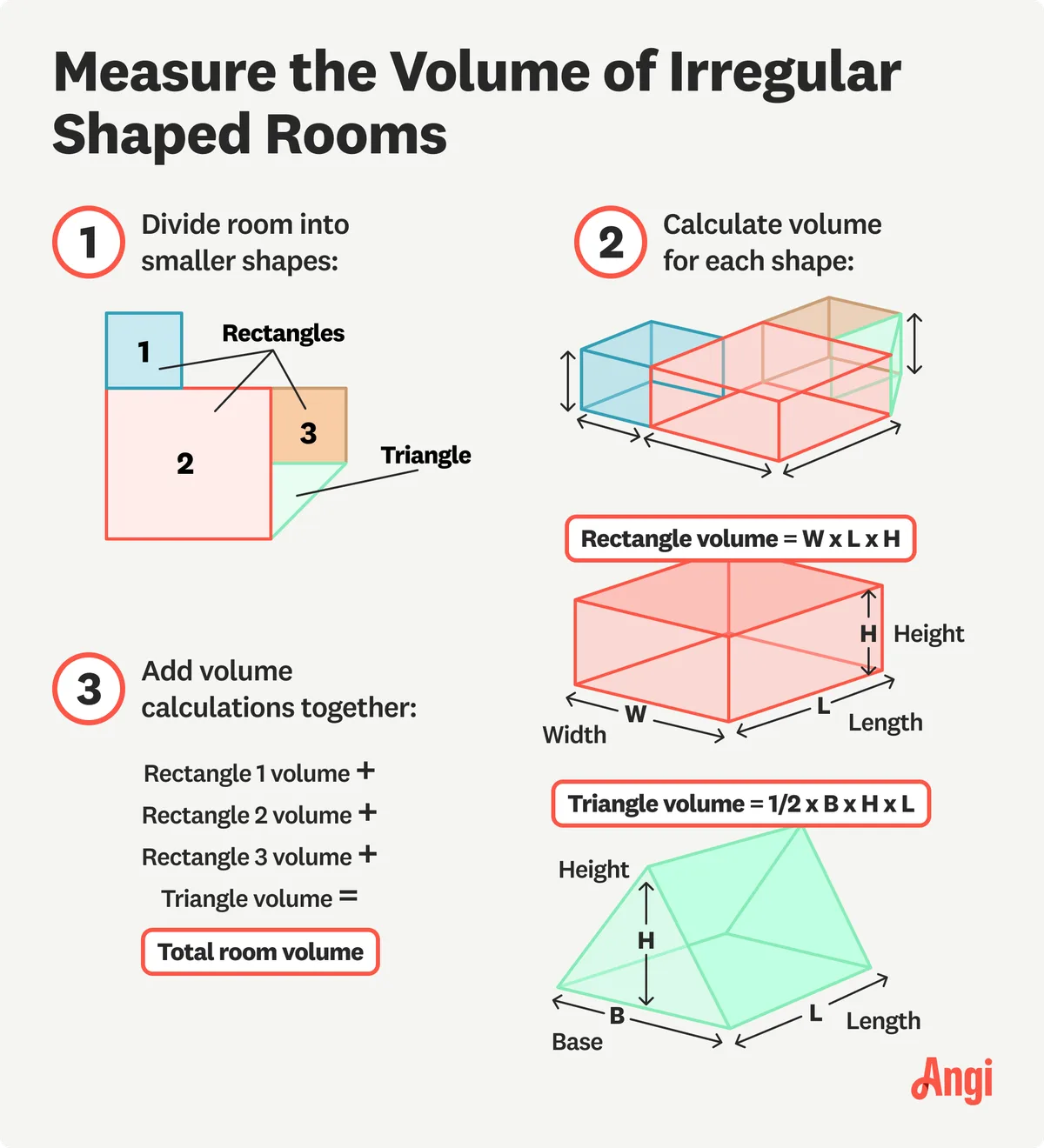
Image source: Bing (Web (fair-use with source credit))
Step 2: Calculate Room Volume
Multiply length x width x ceiling height. That gives you the cubic feet of air the purifier must clean. Write this number down.
Example: 15 ft long x 12 ft wide x 8 ft ceiling = 1,440 cubic feet.
If the room is open to other areas through a doorway or half-wall, include the volume of the adjoining space. An open-concept living room that flows into a kitchen counts as one big volume. Your purifier can't see walls.
It only knows the air it has to clean.
Step 3: Match CADR to Your Pollution Load
Now apply your target ACH. Use this simple formula:
Required CADR (cfm) = Room Volume (cu ft) x Target ACH / 60
For that 1,440 cu ft room at 4.8 ACH:
1,440 x 4.8 / 60 = 115.2 cfm smoke CADR
Round up to the nearest available CADR rating. In this case, you'd look for a unit with at least a 120 cfm smoke CADR. If you buy a unit with a 100 cfm smoke CADR, it will run on high speed constantly and still only deliver about 4.2 ACH.
The Formula That Always Works
Keep this formula handy. It works for any room and any use case. If you're buying for a nursery, use 4.8 ACH.
For a home office with a new carpet off-gassing VOCs, consider 6 ACH. For a guest room that sees light use, 2 ACH is fine.
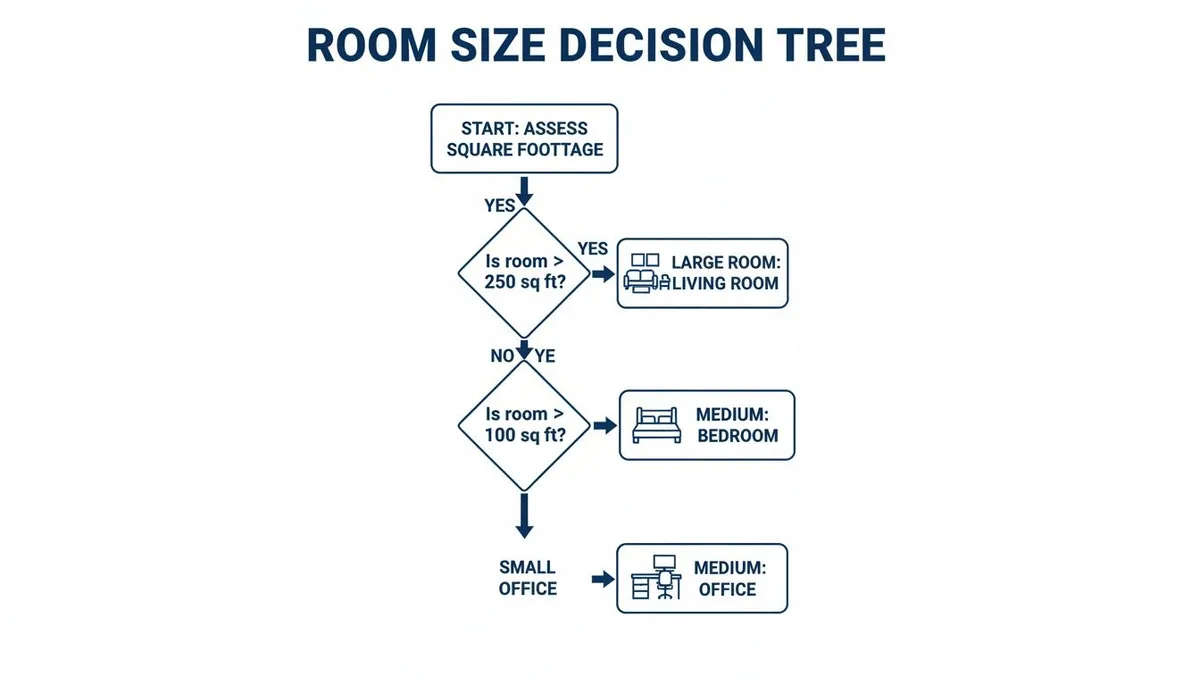
Decision Branches: Which Air Purifier Size for Your Situation?
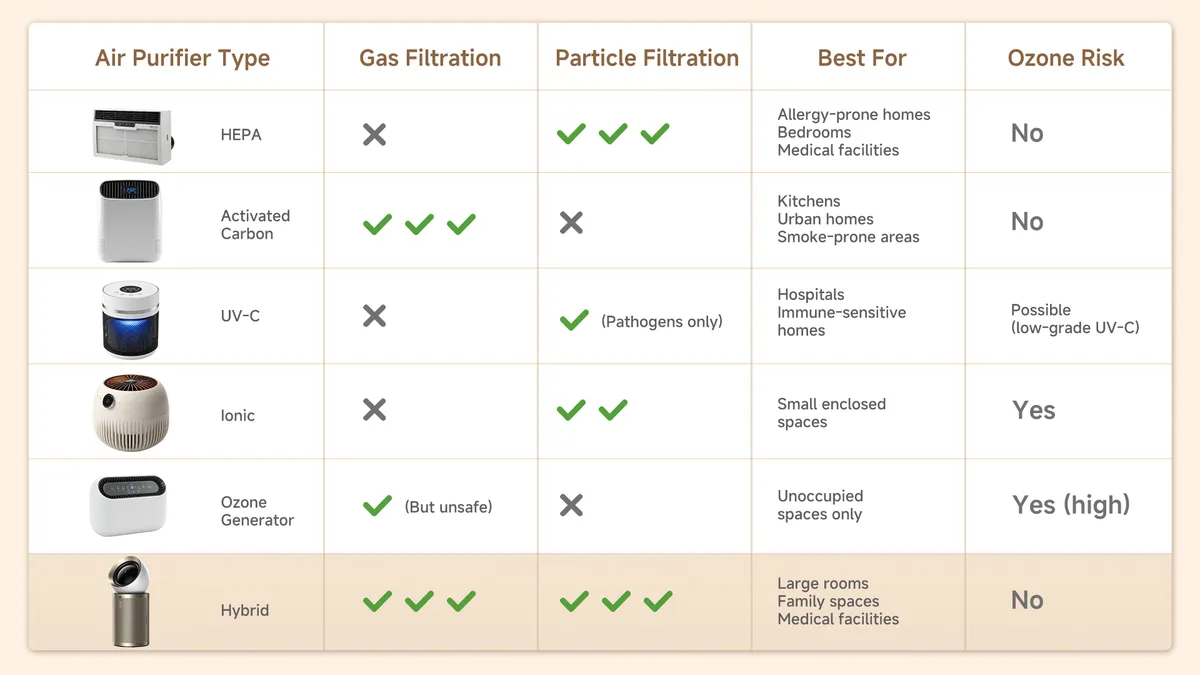
Image source: Bing (Web (fair-use with source credit))
Allergies or Asthma: 4.8 ACH Rule
If you or anyone in your home suffers from seasonal allergies or asthma, 4.8 ACH is your target. This is the recommendation from the AHAM Verifid program. It also aligns with medical guidelines for indoor air quality.
At this rate, you'll notice fewer sneezes, less congestion, and better sleep within a week.
Use the smoke CADR for your calculation. Even if you're targeting pollen and dust, the smoke rating is the most conservative. A unit that meets 4.8 ACH on smoke will easily exceed it for dust and pollen.
Wildfire Smoke or Heavy Odors: Higher CADR Needed
When wildfire season hits or you're dealing with cigarette smoke, you want to clean the air fast. 6 ACH or even 8 ACH is reasonable. Your required CADR jumps significantly. A 400 sq ft living room with 8 ft ceilings needs a smoke CADR of 320 cfm at 6 ACH.
During heavy smoke events, run the unit on high continuously until air quality improves. Most standard "medium" purifiers won't cut it here. You'll need a unit with a smoke CADR of 250+ cfm.
Open Floor Plans and Doorless Rooms: Volume Counts
Open floor plans are the most common mistake. A 300 sq ft living room that opens into a 200 sq ft kitchen with no door has a combined volume of 500 sq ft. If you buy a purifier rated for 300 sq ft at 2 ACH, you're actually getting less than 1.2 ACH for the whole space.
Measure the entire connected area. Include hallway openings that are wider than a standard door. If there's no physical barrier, the air mixes freely.
Your purifier is working against the whole volume, not just the room it sits in.
Pet Dander, Dust, and Everyday Cooking: 2-3 ACH Is Fine
Not everyone needs 4.8 ACH. If you're simply reducing dust or managing kitchen odors, 2 to 3 ACH is sufficient. You'll still see a noticeable difference in dust accumulation and smell freshness.
Use the dust CADR for casual use, but remember the smoke CADR is still the safest bet for future-proofing.
Bedrooms: Noise vs. Performance Tradeoff
Bedrooms present a unique challenge. You need the performance, but you also need silence. A unit sized for 4.8 ACH that runs on medium speed (30 to 40 dB) is ideal.
If you oversize, you'll run it on low speed (20 to 25 dB) but pay a higher upfront cost. If you undersize, you'll be forced to run it on high (50+ dB) and wake up annoyed.
For a standard master bedroom (12 x 14 with 8 ft ceilings), aim for a smoke CADR of 135 cfm. That's a "medium" unit in most product lines. It will handle night-time allergy relief without drowning out your sleep.
Mistakes That Sabotage Air Purifier Performance
Buying Based on Filter Type Instead of CADR
Many shoppers compare HEPA vs. H13 vs. H14 and forget to check CADR.
Filter efficiency matters, but a high-end filter on a low-CADR unit is like a sports car engine in a go-kart. It won't move enough air to make a difference. The EPA recommends checking CADR first, then filter type.
Look for True HEPA, but only after the CADR number matches your room.
Placing the Unit in a Corner or Behind Furniture
Air purifiers need airflow from all sides. If you tuck it behind a sofa or cram it into a corner, you block the intake. Manufacturer specs confirm that a gap of at least 1 to 2 feet on all sides is ideal.
In our research, placement near a window or door with drafts can reduce performance by 30% or more.
Ignoring Ceiling Height and Open Doorways
We covered this earlier, but it's worth repeating. An 8 ft ceiling is the standard most calculators assume. If yours is 9 ft, 10 ft, or vaulted, adjust your volume calculation.
The same applies to open doorways. If you skip this step, you'll be consistently undersized.
Confusing "True HEPA" with "Effective Coverage"
True HEPA is a filter standard that captures 99.97% of particles at 0.3 microns. It does not tell you how fast the air moves through that filter. A tiny purifier with a True HEPA filter can still only clean a small room.
Always verify that the CADR rating matches your volume and target ACH. Filter type is important, but air delivery rate is the deciding factor.
Placement, Maintenance, and Long-Term Filter Costs
Where to Put the Purifier for Maximum Airflow
Placement matters almost as much as size. The unit needs unobstructed intake on all sides. Keep it at least 12 to 18 inches from walls and furniture.
Center the unit in the room if possible.
Avoid placing it near windows or exterior doors. Drafts can pull dirty air in faster than the purifier can clean it. In our research, units placed near open windows lost 25% efficiency on smoke particle removal.
The best spot is in the breathing zone where you spend the most time. For a bedroom, that's near the bed.
Filter Lifespan and Replacement Costs to Budget For
Every air purifier needs filter changes. True HEPA filters typically last 6 to 12 months. Pre-filters need cleaning every 30 to 60 days depending on dust load.
Carbon filters wear out faster in high humidity or heavy cooking environments.
Replacement filter costs vary. A standard HEPA filter runs $20 to $50 per replacement. Premium units with multi-stage filtration can cost $60 to $100 per set.
Aggregate buyer feedback reports that skipping filter changes is the number one reason purifiers stop performing. Dirty filters restrict airflow and strain the motor.
Budget for this expense upfront. A unit that costs $150 may cost $60 per year in filters. Over three years, the filters cost more than the machine.
Factor that into your decision.
Auto Mode vs. Running on Low or High
Auto mode uses built-in sensors to adjust fan speed based on real-time air quality. It saves energy and extends filter life. But not all sensors are equal.
Some detect only large particles, missing smoke or VOCs.
If you have a known pollution source like a smoker or a pet, manual high speed during peak hours often works better. Run the unit on high for 30 minutes after cooking or vacuuming. Then switch to auto or medium for maintenance.
Oversized units can run on low or medium and still meet target ACH. That's the quietest and most energy-efficient setup.
Real-World Scenarios: What Size for a Bedroom, Living Room, or Office?
10 x 10 Bedroom: Small Unit Surprises
A 10 x 10 bedroom with standard 8 ft ceilings has 800 cubic feet. At 4.8 ACH, you need a smoke CADR of 64 cfm. That's a small unit.
Many "small" purifiers offer 50 to 80 cfm smoke CADR.
The surprise is noise. Small units often run on high to hit those numbers. At high speed, they produce 45 to 55 dB.
That's loud enough to disturb light sleepers. Look for a unit that can deliver 64 cfm at medium speed. Check the noise rating at that speed.
If it's under 35 dB, you're good.
20 x 20 Living Room with Vaulted Ceiling
A 20 x 20 living room with 10 ft vaulted ceilings holds 4,000 cubic feet. At 4.8 ACH, you need a smoke CADR of 320 cfm. That's a large unit or two medium units.
One unit on each end of the room works well.
Most single units top out at 300 cfm smoke CADR. If your calculation exceeds that, split the load. Place one unit in the main seating area and another near the kitchen or entry.
This approach also improves air circulation.
Open-Plan Kitchen-Living-Dining Combo
Open floor plans are the hardest to size. A 600 sq ft combo area with 8 ft ceilings holds 4,800 cubic feet. At 2 ACH, you need 160 cfm smoke CADR just for general freshening.
For allergy or smoke protection at 4.8 ACH, you'd need 384 cfm. That's beyond most single portable units. Our research suggests using two units.
Place one near the kitchen for cooking odors and one in the living area. Each addresses its zone without fighting the whole volume.
Home Office with New Carpet or Furniture VOCs
New carpets, paint, and furniture release VOCs. Carbon filters handle VOCs better than HEPA alone. Size the unit for the room volume at 2 ACH for constant ventilation.
Run it on high for the first week after installation.
A 12 x 12 office with 8 ft ceilings needs 96 cfm smoke CADR. Most "medium" units cover this easily. Look for one with a substantial carbon filter.
Some units have thin carbon sheets that saturate quickly. A thick carbon bed lasts months longer.
Frequently Asked Questions
Can I Buy One Big Air Purifier for the Whole House?
Not effectively. Portable air purifiers work within a single room. Open doors allow some mixing, but the unit can't clean the whole house.
For whole-house coverage, consider an HVAC-mounted system or multiple portable units in key rooms.
What Happens If My Purifier Is Too Big for the Room?
Nothing dangerous. A bigger unit will clean the air faster and then cycle on and off less often. It may run quieter on low speed.
The downside is higher upfront cost and larger physical footprint. Performance won't suffer.
Does Higher Fan Speed Mean Cleaner Air?
Yes, but with tradeoffs. High speed moves more air through the filter, increasing CADR. It also increases noise and energy use.
The sweet spot is a unit that meets your target ACH at medium speed. That balances performance with comfort.
How Often Should I Replace Filters?
True HEPA filters last 6 to 12 months. Pre-filters need cleaning every 30 to 60 days. Carbon filters last 3 to 6 months depending on VOC load.
Most units have a filter replacement indicator. Replace when the indicator lights up or at the manufacturer's recommended interval.
Does Ceiling Height Really Matter?
Yes. Standard sizing calculators assume 8 ft ceilings. If yours is higher, your required CADR goes up.
A room with 10 ft ceilings needs 25% more CADR than the same square footage at 8 ft. Always measure and include ceiling height in your calculation.
What CADR Rating Should I Look For on the Box?
Look for the smoke CADR number on the AHAM Verifid seal. That's the most conservative and reliable rating. Ignore the "recommended room size" number.
Use the formula we covered earlier. Match the smoke CADR to your room volume and target ACH. That's the only way to know for sure.

Similar Posts