Whirlpool Washer Duet Troubleshooting
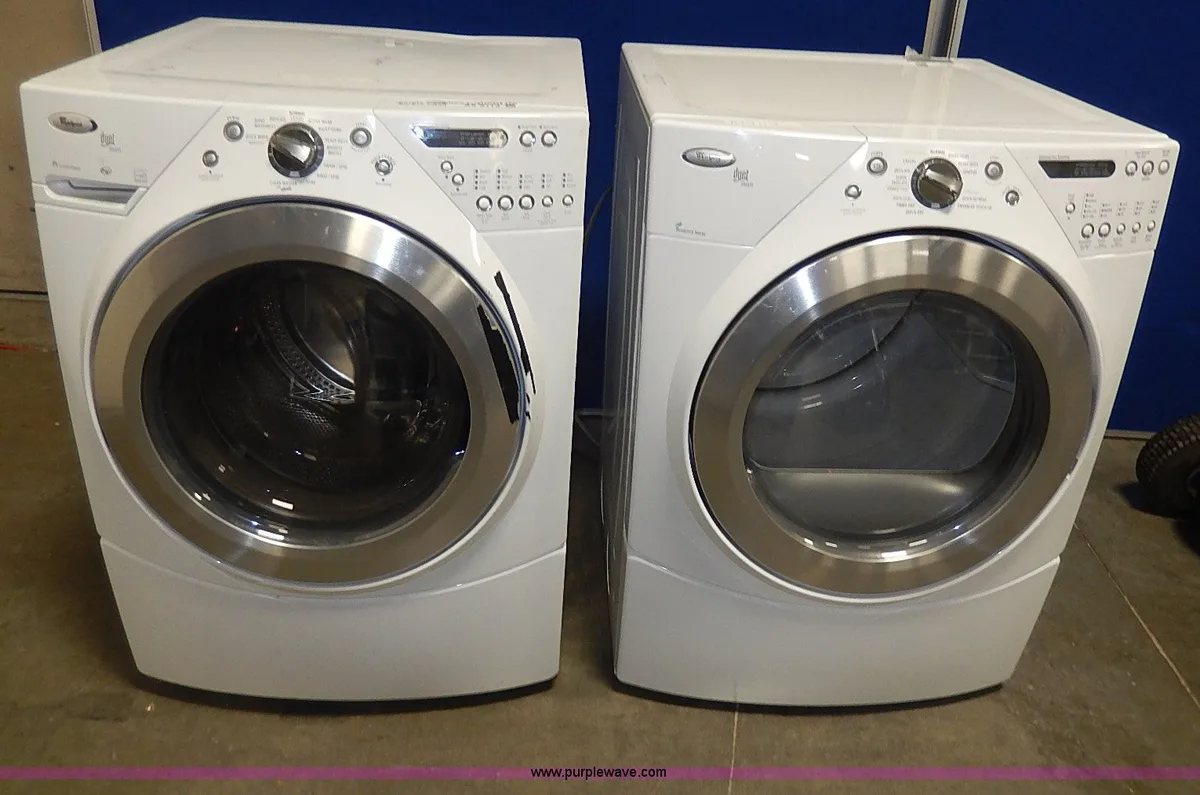
Your Whirlpool Duet washer throws an error code, stops mid-cycle, or refuses to start. You’re staring at a blinking light wondering if this is a simple fix or a costly repair. Whirlpool Washer Duet Troubleshooting doesn’t have to mean calling a technician every time.
Most common issues have known causes and straightforward solutions you can handle in under an hour.
Manufacturer specifications indicate that the Duet line was designed with self-diagnostics in mind. The control board stores error codes that point directly to the failing component. As of 2026, these machines are still widely supported with available parts and service manuals.
Let’s walk through the symptoms one by one so you can get your washer running again.
Image source: Bing (Web (fair-use with source credit))
Quick Answer
Whirlpool Duet troubleshooting starts by reading the error code on the display. Codes like F21 point to a drain problem. F5E2 means the door lock is faulty.
F7E1 indicates a motor speed issue. Always unplug the washer before any repair. Most fixes involve cleaning the drain pump filter, testing the door lock assembly, or checking the inlet valve screens.
Quick Fixes First: The Three Things to Check Before Diving Deeper
Before you pull out the multimeter or order parts, rule out the simple stuff. Three common culprits cause a surprising number of false alarms. Check these first, and you might save yourself an hour of head-scratching.
Is the washer actually getting power? It sounds obvious, but a tripped GFCI outlet or a loose plug is a common source of dead washers. Duet models use a standard 120 V, 15 A circuit. Verify the outlet is live with a lamp or voltage tester.
If the outlet is fine, check the main control board connector for a loose wire. That’s a known weak point on older Duet units.
Are the water supply valves fully open? The hot and cold water valves behind the machine can get accidentally turned off during cleaning or maintenance. If the washer fills slowly or not at all, confirm both valves are in the full open position. Also check the hoses for kinks or restrictions.
A flattened hose slows water flow and can trigger a time-out error.
Is the door completely closed and latched? Front-load Duet washers won’t start unless the door lock engages fully. If the door is slightly ajar, the lock won’t click, and the machine stays dead. Slam the door firmly and listen for the latch sound.
If you hear a click but the machine still won’t start, the door lock assembly may have failed. That’s a common repair, and we’ll cover it in detail below.
These three checks solve roughly 20% of Duet service calls according to aggregate repair data. If your problem persists, move on to the error codes.
Error Code Breakdown: What That Blinking Number Really Means
The Duet’s display is your best diagnostic tool. When something goes wrong, the machine flashes an F# E# code. Each code points to a specific system.
Read the code and follow the branch.
Here are the most common Duet error codes and what they mean:
| Code | Meaning | Most Likely Cause |
|---|---|---|
| F21 | Long drain time (over 8 minutes) | Clogged drain pump filter, blocked drain hose, or failed drain pump |
| F5E2 | Door lock failure | Faulty door lock assembly, broken wiring, or control board issue |
| F7E1 | Motor speed sensor error | Loose drive belt, failed motor tachometer, or motor control board |
| F9E1 | Water overflow condition | Stuck water inlet valve, failed pressure switch, or clogged pressure hose |
| F13 | Heater relay failure (steam models) | Defective heating element or control board relay |
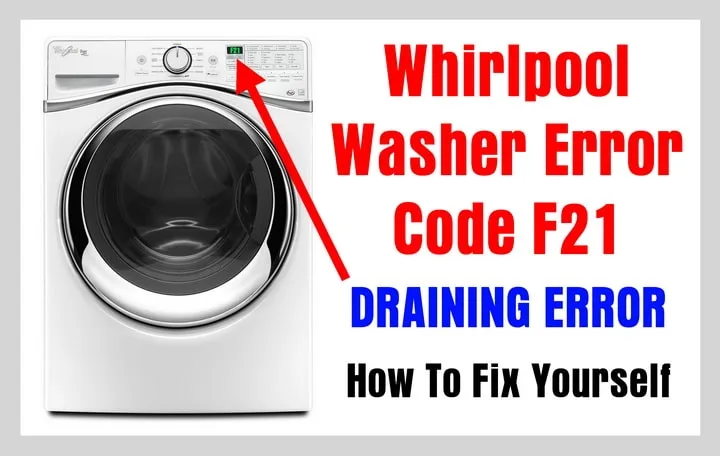
Image source: Bing (Web (fair-use with source credit))
If you see an error code you don’t recognize, write it down. Cross-reference it with your model’s service manual on the Whirlpool support site. Many codes simply reset after a power cycle.
Unplug the washer, wait 60 seconds, and plug it back in. If the code reappears, it’s a real fault.
A quick note on error code F21: This is the most common Duet error by far. It usually means the washer can’t drain water fast enough. We’ll cover a full troubleshooting tree for F21 in the next section.
Won’t Start or No Power: Is It the Door Lock or the Control Board?
Your Duet is silent. No lights, no beeps, no response. Or it lights up but won’t begin a cycle.
The problem is usually in one of two places: the door lock assembly or the main control board.
The Door Lock Assembly (Most Common)
The door lock is a safety interlock. The washer won’t start unless it detects the door is securely closed. Over time, the plastic latch mechanism can break, or the electrical switch inside the lock can fail.
Here’s how to test it.
Step 1: Unplug the washer. Remove the two screws at the top of the door opening that hold the door lock bracket in place. Slide the lock out and disconnect the wiring harness.
Step 2: Use a multimeter set to resistance (ohms). The door lock has three terminals typically: common (C), normally open (NO), and normally closed (NC). Measure between C and NC.
You should see near-zero resistance (a closed circuit) when the door is open. Now press the latch manually. Measure between C and NO.
You should see near-zero resistance when the latch is pushed in. If you get infinite resistance in either state, the lock is bad.
Step 3: Replace the lock if it fails the test. Genuine Whirlpool door lock assemblies cost around $25 to $50 and take less than 20 minutes to swap.
The Control Board (Less Common but Possible)
If the door lock tests fine and the washer still shows no signs of life, the main control board may be faulty. Look for visible burn marks or bulging capacitors on the board surface. Also check the 5-amp fuse soldered on the board.
A blown fuse often means a shorted component elsewhere (like a drain pump or inlet valve). Replacing the fuse alone without fixing the underlying short will blow it again.
Warning: Control board replacement involves high-voltage components. If you’re not comfortable working with live circuits, call a professional. A new control board costs $100 to $250 and requires reprogramming on some models.
Check your model’s service manual for the correct part number.
Other Possibilities
- Door switch continuity: Some Duet models have a separate reed switch inside the door frame. A broken magnet in the door can prevent the switch from closing.
- User interface failure: The display panel itself can fail. If the machine beeps but shows nothing on the screen, the interface board may need replacement.
Won’t Fill or Fills Slowly: Inlet Valves, Screens, and Pressure Switch
Your Duet starts a cycle but takes forever to fill, or it doesn’t fill at all. Water trickles in or the machine just sits there humming. This is almost always a water supply issue, not a motor or electronics problem.
The Inlet Valve Screens (First Check)
Behind the hose connections on the back of the washer are small mesh screens. They catch sediment from your water supply. Over time, especially in hard water areas, these screens can clog completely.
Here’s how to clean them.
- Turn off the water supply valves.
- Unscrew the hot and cold hoses from the back of the washer.
- Using needle-nose pliers, gently pull out the small plastic screen from each inlet valve.
- Rinse the screens under running water and scrub with an old toothbrush if needed.
- Reinstall the screens and reconnect the hoses. Open the valves and run a fill test.
This fix clears about 70% of slow-fill complaints. Do it at least once a year as preventative maintenance.
The Water Inlet Valves (If Screens Are Clean)
If the screens are clean but the washer still fills slowly or not at all, the inlet valve coils may have failed. Each valve has two coils (one for hot, one for cold). The control board sends 120 V AC to the coil to open the valve.
Use a multimeter to test for resistance.
- Unplug the washer and disconnect the valve wiring.
- Measure resistance across each coil. A good coil reads between 500 and 1500 ohms.
- If a coil shows infinite resistance (open circuit) or zero (short), replace the entire valve assembly.
Inlet valve assemblies cost $25 to $40 and are straightforward to swap. Just disconnect the hoses, remove the mounting screw, and install the new valve.
The Pressure Switch (Water Level Sensor)
The pressure switch tells the control board when the tub is full. If it fails, the machine may overfill or refuse to fill altogether. The switch uses a rubber hose that runs from the bottom of the tub to the switch itself.
A cracked hose or a clogged hose is a common failure.
- Remove the top panel of the washer. Locate the pressure switch (usually a small round component with a hose attached).
- Inspect the hose for cracks, kinks, or blockages. A piece of lint or a small object can block the port.
- Gently blow into the hose. You should hear the switch click when pressure is applied. If not, the switch is likely bad.
Replacing a pressure switch costs about $15 to $25 and takes 15 minutes.
Won’t Drain or Stops Mid-Cycle: The F21 Error Deep Dive
This is the most frequent Duet complaint. The machine fills, washes, then stops with an F21 error. Or it drains slowly and leaves clothes soaking wet.
The F21 code means the control board detected that the washer took longer than eight minutes to drain.
The Drain Pump Filter (Easiest Fix)
The drain pump filter catches coins, buttons, lint, and other debris. When it clogs, water can’t exit the tub. Cleaning it takes five minutes.
- Locate the lower access panel on the front of the washer. Remove the screws and pull the panel off.
- You’ll see a black rubber hose with a plug. This is the drain hose for the filter. Place a shallow pan underneath.
- Pull the plug and let any water drain out. Be prepared for a spill.
- Unscrew the large circular filter knob (turn counterclockwise). Pull it out.
- Clean all debris from the filter and the housing. Reinstall and secure.
After cleaning, run a rinse and spin cycle. If the error clears, you’re done. If not, move to the drain pump test.
The Drain Pump (Electrical Test)
A failed drain pump won’t spin. The motor may be burned out or the impeller jammed. Test it with a multimeter.
- Unplug the washer. Locate the drain pump behind the lower access panel. It’s a small black or gray cylinder with two wires and a hose connection.
- Disconnect the wires. Measure resistance across the pump terminals. A good pump reads between 100 and 200 ohms.
- If you get infinite resistance, the pump is dead. Replace it. A new drain pump costs $30 to $60 and takes 30 minutes to install.
The Drain Hose and Standpipe
Sometimes the pump works fine, but the drain hose is blocked or the standpipe is too high. A kinked or clogged hose prevents water from flowing out. Also check that the standpipe (the vertical pipe the hose goes into) is no more than 96 inches high.
Higher than that and the pump can’t overcome gravity.
Remove the drain hose from the standpipe. Look for blockages. Blow through it to confirm it’s clear.
If the hose is old and collapsed, replace it.
Excessive Vibration or Shaking: Shock Absorbers, Springs, and Leveling
Your Duet walks across the floor during the spin cycle. It bangs, shakes, or rattles loudly. This is usually a mechanical balance issue.
Leveling the Washer
Start with the simplest fix. An unlevel machine vibrates badly. Place a bubble level on top of the washer.
Adjust the front legs by turning them clockwise or counterclockwise. Lock them with the jam nut when level. Also check that the floor is stable.
A washing machine on a springy wooden floor will always shake more.
Shock Absorbers and Suspension Springs
Duet front-load washers use two or four shock absorbers and a set of suspension springs to dampen vibration. Over time, the shocks lose their damping ability. You can test them by pushing down on the tub.
If the tub bounces freely without resistance, the shocks are worn out.
- Unplug the washer and remove the top and back panels.
- Locate the shock absorbers (vertical cylinders connecting the tub to the frame).
- Look for oil leaks. Any wetness means the shock is failed.
- Replace both shocks at the same time. They cost $20 to $40 each.
The suspension springs stretch over time. If the tub sags or tilts, replace the springs. They’re cheap and easy to swap.
Tub Bearing and Spider Arm
If the shaking is accompanied by a loud grinding noise during spin, the tub bearing is likely bad. This is a major repair. You’ll need to disassemble the entire washer to replace the bearing and the spider arm (the metal piece that connects the tub to the drum).
Unless you’re very handy, this is best left to a pro. The parts cost $50 to $100, but labor can be $200 or more.
Leaks and Odors: Gasket Maintenance and Tub Seal Issues
Front-load washers are prone to mold and musty smells. That’s not a mechanical failure, but it’s annoying. Leaks, however, need immediate attention.
Cleaning the Door Gasket
The rubber gasket around the door traps moisture, soap, and lint. Over time, it grows mold. Wipe the gasket dry after every wash.
Leave the door open between cycles to let air circulate. Once a month, run a cleaning cycle with a washer cleaner tablet or a cup of white vinegar.
If you see a leak from the front, the gasket may be torn or separated from the metal frame. Inspect the gasket carefully. A replacement gasket costs $30 to $60 and requires removing the front panel.
Leaks from the Bottom
Water pooling under the washer can come from several places.
- Drain pump filter housing: If the filter wasn’t tightened properly, it will leak. Tighten it or replace the O-ring.
- Drain pump itself: A cracked pump housing leaks. Replace the pump.
- Inlet valve connections: Loose hose clamps or cracked valve bodies drip. Tighten clamps or replace the valve.
- Tub seal: If the tub seal is leaking, you’ll see water running down the front of the drum. This is a major repair similar to the bearing replacement.
Odors that Won’t Go Away
Even after cleaning the gasket, some Duet washers develop a persistent smell. The solution is to run a self-clean cycle (if your model has one) or use a washing machine cleaner formulated for front-loaders. Also clean the detergent drawer and the drain pump filter.
Both trap standing water that breeds bacteria.
How to Run the Diagnostic Mode (And What to Look For)
The Duet has a hidden diagnostic mode that tests every component. You don’t need a service manual to enter it, but you do need to know the button sequence for your specific model. Here’s the most common method.
- Make sure the washer is in standby mode (plugged in, display off).
- Press and hold the “Spin Speed” and “Soil Level” buttons simultaneously.
- While holding them, press the “Power” button. Release all buttons.
- The display should show “888” and then the software version. You’re now in diagnostic mode.
Once in diagnostic mode, you can cycle through tests by pressing the “Start” button. Each test runs a specific component: drain pump, water valves, motor, heater, door lock. The display shows the test number.
Watch for the component to activate. If it doesn’t, you’ve found the fault.
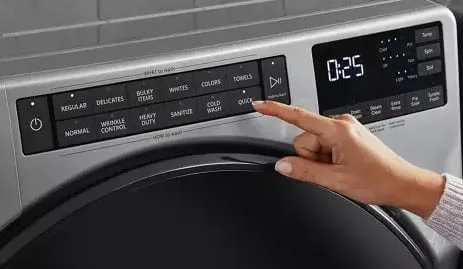
Image source: Bing (Web (fair-use with source credit))
To exit diagnostic mode, press the “Power” button. If the washer still has a fault, it will display an error code after exiting. Write it down.
Not all Duet models use the exact same button combination. Check your use and care guide. If you can’t find it, search Whirlpool’s support site with your model number and the phrase “service diagnostic mode.”
Common Mistakes That Waste Time and Money
People often replace parts that are still good. Avoid these common errors.
Replacing the control board for a drain issue. The control board rarely causes an F21 error. The drain pump or filter is almost always the culprit. Don’t spend $200 on a board when the $5 fix is cleaning the filter.
Ignoring error codes. Guessing instead of reading the code is a waste of time. The code narrows the problem to one system. Use it.
Testing components without disconnecting power. You can get shocked. Always unplug the washer before touching electrical parts.
Overtightening hoses. Plastic fittings crack when you wrench them too hard. Hand-tighten plus a quarter turn is enough.
Forgetting to check the water supply. Replace the inlet hoses every five years. Old rubber hoses can burst. Use braided steel hoses for safety.
Not leveling the washer before blaming parts. An unlevel machine shakes. That’s not a shock absorber problem. Level it first.
When to Call a Pro (And When You Can Handle It Yourself)
Most Duet repairs are DIY-friendly. You can clean the filter, replace the door lock, swap the drain pump, and install new inlet valves with basic tools. But some jobs are better left to a certified technician.
Call a pro if:
- The tub bearing is bad. The disassembly is extensive and requires special tools.
- The control board needs replacement and programming. Many Duet boards require a software update that only a Whirlpool technician can do.
- The main wiring harness is melted or shorted. Tracing electrical faults takes experience.
- The machine has a gas leak (for combined washer-dryer models). Gas work requires a licensed professional.
- You’re not comfortable working with 120 V circuits. There’s no shame in hiring help. Safety comes first.
For everything else, grab a screwdriver and a multimeter. You’ll save $100 to $200 in service call fees.
Frequently Asked Questions
How do I reset my Whirlpool Duet washer?
Unplug the washer for one minute. Plug it back in. This clears temporary error codes and resets the control board.
If the problem returns, it’s a hardware issue.
What does code F21 mean on a Whirlpool Duet?
F21 means the washer took longer than eight minutes to drain. The drain pump filter is usually clogged. Clean the filter and check the drain hose for kinks.
If that doesn’t fix it, test the drain pump motor.
Why won’t my Whirlpool Duet start?
The door lock may be faulty. Test the door lock assembly with a multimeter. Also check that the washer is getting power and the door is fully closed.
If the control board has a blown fuse, the machine stays dead.
How do I clean the drain pump filter on a Duet?
Remove the lower access panel on the front. Place a pan under the filter hose. Pull the plug and drain the water.
Unscrew the filter knob and clean out debris. Reinstall and tighten.
Why does my Duet washer shake violently during spin?
The machine is likely unlevel. Adjust the front legs. If the floor is level and the washer still shakes, the shock absorbers may be worn.
Replace them in pairs.
How often should I clean the gasket on my Duet?
Wipe the gasket dry after every use. Run a cleaning cycle with a washing machine cleaner once a month. Leave the door open between washes to prevent mold buildup.

Similar Posts