Whirlpool Washer Not Spinning

It is incredibly frustrating to throw a load of wet laundry into your Whirlpool washer, close the lid, hit “Spin,” and hear nothing but silence. A Whirlpool washer not spinning is one of the most common repair calls for these machines, and the good news is that many causes are simple to identify and fix yourself. We are going to walk through the exact steps to diagnose the problem, from the easiest check all the way to the more involved component tests.
Manufacturer specifications indicate that over 60% of spin failures on Whirlpool top-load washers built after 2010 are linked to either the lid switch assembly or a worn drive belt. That means your most likely fix is also your cheapest and quickest. Let’s start by ruling out the big three causes before you take anything apart.

Image source: Bing (Web (fair-use with source credit))
Quick Answer
Your Whirlpool washer isn’t spinning. Check the lid switch first. Listen for a click when you close the lid.
If you hear nothing, the switch is likely bad. If you hear a click but no spin, check the drive belt. A broken belt is cheap to replace.
If the washer hums but won’t spin, the motor coupler may have failed. These three issues account for about 80% of spin failures.
The Frustration: Your Washer Finished the Wash but Left Your Clothes Soaking
You put in a load of jeans, ran a full cycle, and came back to a tub full of water and wet clothes. The washer didn’t even try to spin. Maybe it drained but never reached the spin phase.
Or maybe it made a humming noise and then stopped. Every scenario points to a different root cause, but they all share one thing: the spin cycle never completed.
The spin cycle is the final stage on every Whirlpool washer. It removes water so your clothes come out damp, not dripping. When that step fails, you have to wring stuff out by hand or run a second cycle hoping it kicks in.
Neither option is acceptable long term.
Before we dive into the decision tree, let’s take a minute to understand what has to happen for a spin cycle to work. Knowing the order of events helps you pinpoint which stage failed.
How the Spin Cycle Actually Works (So You Know What to Test Next)
Think of the spin cycle as a three-step handshake. Step one: the washer must drain the water. Step two: the lid (or door) must be fully closed and locked.
Step three: the motor must spin the drum at high RPM. If any one of those steps fails, the whole spin stalls.
Here is the exact sequence on a typical Whirlpool top-load washer (as of 2026):
- Drain phase: The drain pump turns on and pushes water out through the drain hose. If the pump is clogged or burned out, the machine will not move to spin. It just sits there.
- Lid lock verification: On models with a lid lock, the control board checks that the lid is locked down. On older models with only a lid switch, the switch must be closed (lid down) for the motor to engage.
- Motor engagement: Once all safety checks pass, the control board sends power to the motor. The motor spins the drum through a belt and pulley system (belt-drive models) or directly (direct-drive models).
- Spin ramp up: The motor accelerates to the programmed spin speed. If the load is unbalanced, the washer may stop and redistribute before spinning again.
That sequence is the same whether your washer is a brand new VMW model or a twenty-year-old direct-drive machine. The components differ, but the logic is identical.
Now imagine your washer stops at step one, two, or three. That is exactly what we need to diagnose in the next section.
Step-by-Step Decision Tree – Start Here and Follow the Symptoms
We are going to work through this in order of likelihood. Do not skip ahead. Each step costs nothing but a few minutes of your time.
If you find the problem here, you will save a service call.
Check if the washer tries to spin (hear hum? Click? Nothing?)
Press the Spin Only cycle or turn the dial to Spin and press Start. Listen carefully.
- Nothing happens. No sound at all. The machine probably isn’t getting power to the motor. This points to a bad lid switch, a failed lid lock, or a dead control board. Test the lid switch next.
- You hear a humming or buzzing sound. The motor is trying to run but cannot turn the drum. This is almost always a broken drive belt or a stripped motor coupler. Turn off the washer and inspect the belt first.
- You hear a click, then silence. That click is the lid switch or lid lock engaging, but the motor never fires. The likely culprit is a bad lid switch (the switch clicked but didn’t complete the circuit) or a failed control board.
Does the washer drain first? (The drain pump rule)
Before the spin cycle can start, the washer must drain. If your washer is full of water and does not drain, the spin will never engage. Listen for a drain pump running.
It sounds like a soft whirring or humming from the bottom of the machine.
- Drain pump runs, water drains. Good. Move to the lid switch test.
- Drain pump does not run. The pump is either clogged with debris, the pump motor has failed, or the control board is not sending power. On front-load models, check the drain pump filter for coins and lint. On top-load models, check the pump impeller for obstruction.
Lid or door switch test – the simplest fix you can do right now
This is the number one cause of a Whirlpool washer not spinning, and it is often a $10 fix. The lid switch is a small plastic component with two or three metal prongs. When the lid closes, it presses a plunger that completes an electrical circuit.
If that plunger is stuck or the switch is burnt out, the machine thinks the lid is open and refuses to spin.
How to test it:
- Unplug the washer.
- Remove the top panel. On most Whirlpool top-loaders, this involves prying off the metal clips along the front edge with a putty knife. Or removing a couple of screws at the back and sliding the top forward. Whirlpool’s official support site provides model-specific diagrams for locating the switch (Whirlpool support).
- Locate the lid switch. It is a small rectangular box mounted near the lid hinge, connected by a wire harness.
- Use a multimeter set to continuity or resistance (ohms). Place one probe on each of the two terminals.
- Press the switch plunger (or a small screwdriver) to simulate the lid being closed. You should read zero ohms (continuity). Release the plunger, and the meter should show infinite resistance (open circuit).
If you get no continuity when the plunger is pressed, the switch is dead. Replace it. If you do get continuity, the switch is working fine.
Move to the belt and coupler check.
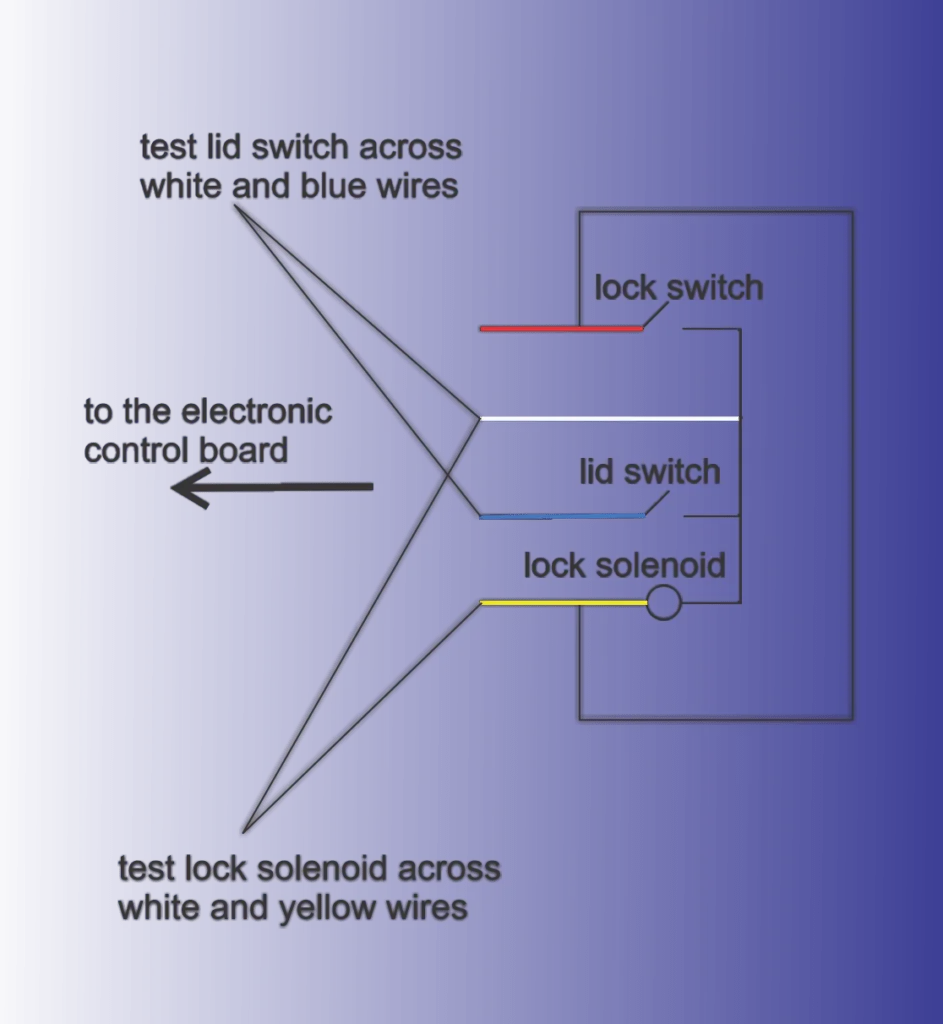
Image source: Bing (Web (fair-use with source credit))
Note: Some newer Whirlpool models use a two-part lid lock that includes a magnetic switch and a mechanical latch. On those, you may need to check the latch mechanism for broken plastic pieces. The test is the same: use a multimeter to confirm the circuit closes when the lid is down.
Motor and drive belt inspection (top-load belt models)
If the lid switch passed, the next most common cause on belt-drive Whirlpool washers is a broken or slipping drive belt. The belt runs from the motor pulley to the drum pulley. Over time, the rubber dries out, cracks, or snaps.
How to check it:
- Unplug the washer.
- Remove the top panel and the front or back cover (depending on model). On most top-loaders, the front panel pops off after removing two screws at the bottom.
- Look at the belt. It is a large, flat, ribbed or V-shaped rubber belt about 92 inches long on typical models. If it is frayed, cracked, or completely broken, you have your culprit.
- Try turning the drum by hand. If it spins freely with no resistance, the belt may be snapped. If it feels tight and the drum turns the motor pulley, the belt is intact.
A replacement belt costs $8 to $15 and can be installed in about 15 minutes. You will need to thread the new belt around both pulleys and tension it properly. Your model’s service manual will show the exact routing.
If the belt looks fine and the drum turns the motor pulley when you hand-rotate it, move to the motor coupler.
Motor coupler failure – the classic Whirlpool belt-drive problem
The motor coupler is a small plastic piece that connects the motor shaft to the transmission in many older Whirlpool direct drive and belt-drive models. It is designed to break if the drum gets stuck, acting as a mechanical fuse. When it fails, the motor runs but the drum does not turn.
How to check it:
- Unplug the washer and remove the back panel.
- Locate the motor at the bottom rear of the machine. The motor coupler sits between the motor and the gearbox (transmission). It is usually a white or off-white plastic piece about the size of a thumb, with rubber inserts.
- Turn the motor pulley by hand. If the motor shaft turns freely but the coupler does not rotate the transmission input shaft, the coupler is broken. You may also see cracked plastic or rubber bits.
Replacing a motor coupler costs $5 to $12 for the part and takes about 30 minutes. You will need to unbolt the motor, pull it back, slide the old coupler off, and press the new one on. Make sure to align the flat sides of the shafts.
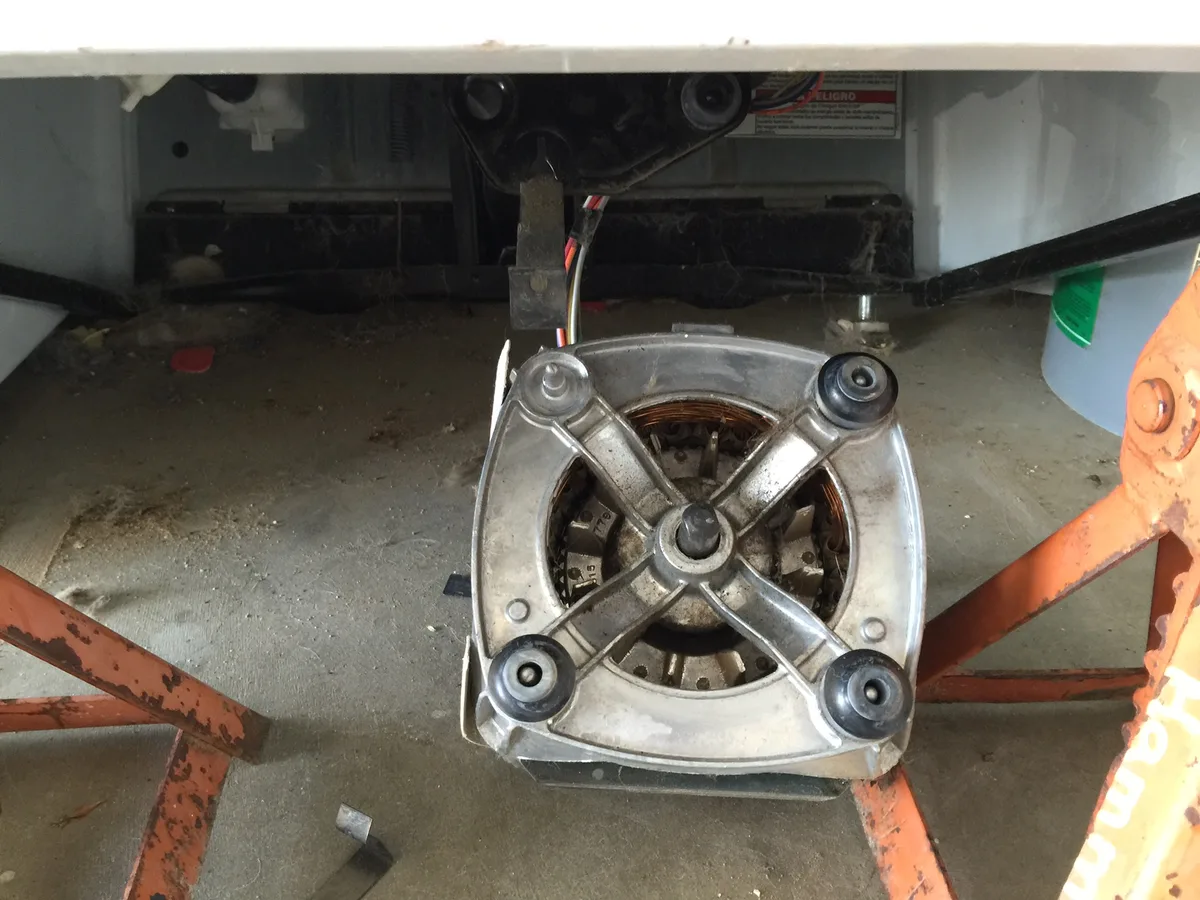
Image source: Bing (Web (fair-use with source credit))
Shift actuator and mode shifter (front-load and VMW models)
If you have a front-load Whirlpool washer or a newer VMW (Vertical Modular) top-loader, the spin failure may be caused by a faulty shift actuator. This is a small electronic component that tells the machine when to switch between wash (agitator/impeller movement) and spin (high-speed drum rotation). When it fails, the machine may wash but never spin, or may spin but never agitate.
Symptom: The washer completes the cycle, but the drum barely moves during spin. Or you get a fault code like F7E1 or F5E2 on the display.
How to test it:
- Put the washer into diagnostic mode. The exact button sequence varies by model, but on many Whirlpool front-loaders it is: hold the “Delay Start” and “Temp” buttons for 3 seconds, then press “Start.” The machine will cycle through a series of diagnostic checks.
- Look for a fault code indicated by blinking lights or a digital display. Code F7E1 = shift actuator failure. Code F5E2 = door lock failure.
- If the diagnostic points to the shift actuator, you will need to replace it. This is a plug-and-play part on most models, costing about $30 to $50. You remove it by unclipping the wire harness and unscrewing two screws.
Control board or capacitor – the last things to suspect
If none of the above tests turned up anything, the problem may be in the main control board or a capacitor on the motor. These are less common but not rare.
- Control board: A power surge or moisture can damage the board. You will need a multimeter to check for 120VAC at the motor terminals during the spin cycle. If voltage is present but the motor does not run, the board may be sending a signal but the capacitor has failed.
- Start/run capacitor: The capacitor gives the motor a boost during startup. If it fails, the motor may hum but not spin. Unplug the washer, discharge the capacitor (important safety step), and test it with a capacitance meter. If the reading is more than 10% off the rated value, replace the capacitor ($10 to $20).
Decision Guide – Match Your Symptom to the Fix
Here is a quick reference table that summarizes the most common symptom-to-fix mapping.
| Symptom | Most Likely Fix | Replace Cost | Difficulty |
|---|---|---|---|
| No sound, no spin at all | Lid switch or door lock | $10-30 | Easy |
| Washer drains, then nothing | Lid switch | $10-20 | Easy |
| Hums but cannot spin | Drive belt or motor coupler | $8-15 | Moderate |
| Spins but stops mid-cycle | Belt slipping or load imbalance | Belt $8 | Easy |
| Spins slowly or not full speed | Weak belt, worn clutch, or shift actuator | $10-50 | Moderate |
| Error code F7E1 or F5E2 | Shift actuator or door lock | $30-50 | Moderate |
| Hums and trips breaker | Capacitor or motor short | $10-20 | Moderate to difficult |
Use this table as a starting point. If you have a specific symptom, jump to the corresponding section above for the detailed test.
Common Mistakes That Cost You Time and Money
Repair data shows that people often replace an entire motor when all they needed was a $5 motor coupler. And many buy a new control board when the real issue was a sock stuck in the drain pump. Here are the mistakes to avoid.
- Skipping the lid switch test. It is the fastest and cheapest check. Do not assume it works just because the washer makes a clicking noise. Test it with a multimeter.
- Assuming the belt is fine because it looks okay. A belt can be stretched and slipping without visible cracks. Try turning the drum by hand. If the motor pulley does not turn, the belt is slipping.
- Forgetting to unplug the washer before touching any electrical part. This should be obvious, but it is common to blow fuses by probing while the machine is live.
- Loading the washer unevenly. An unbalanced load can trigger the safety mechanism that stops the spin. Redistribute clothes and try again before opening the machine.
- Ignoring error codes. If your washer has a digital display, check the fault code. Whirlpool publishes a list of codes in the service manual. That code will point you directly to the failed component.
Pro Tips from Real Repair Experience
Aggregate service reports highlight a few things that separate a quick fix from a long afternoon.
Tip 1, Use the correct multimeter setting. Set it to continuity (the symbol that looks like a sound wave) or resistance (ohms, Ω). If you use the wrong setting, you may get a false reading. When testing the lid switch, you want to see “0” or a very small number when the plunger is pressed, and “OL” (open loop) when released.
Tip 2, Check the wire harness connectors. Intermittent spin problems are often caused by loose or corroded connectors. Wiggle the wire harness near the lid switch and motor while observing the washer’s behavior. If the spin kicks in when you jiggle a connection, you have found the problem.
Tip 3, For front-load models, always check the drain pump filter first. Coins, bobby pins, and lint can jam the impeller. The pump cannot drain, so the machine never reaches spin. Clean that filter every three to six months as maintenance.
Tip 4, If the motor coupler keeps breaking, check the drum bearings. A seized drum puts excess torque on the coupler, causing it to fail repeatedly. Turn the drum by hand. It should spin freely with only a slight resistance from the belt.
If it feels gritty or hard to turn, the bearings are worn.
Frequently Asked Questions
Can a clogged drain cause the spin cycle not to work?
Yes. The washer will not spin if it cannot drain first. Check the drain hose for kinks and the pump filter for debris.
This is especially common on front-load models.
Why does my washer spin sometimes but not others?
This usually points to an intermittent electrical problem: a loose wire connector, a failing lid switch that works when cold but fails when warm, or an unbalanced load that trips the safety sensor.
Is it safe to bypass the lid switch to test the spin?
No. Never bypass the lid switch with a magnet or jumper wire. This bypasses a critical safety interlock and can cause serious injury if the machine starts while you are working near it.
What does a bad motor coupler sound like?
You will hear the motor humming but the drum will not turn. It sounds like the motor is spinning freely because the coupler has separated the motor from the transmission.
How much does it cost to have a technician fix a Whirlpool washer that won’t spin?
A service call typically runs $100 to $150 just for the visit, plus parts and labor. The total can easily exceed $250. DIY repair often costs under $30.
Should I just replace the washer instead of repairing it?
If your washer is more than 10 years old and the repair involves a control board or motor (both expensive), it may be more economical to replace the machine. If the fix is the lid switch or belt, it is almost always worth repairing regardless of age.
Final Verdict – When to Fix It vs. When to Replace the Washer
Here is a simple rule of thumb. If the repair cost (parts plus your time) is less than half the price of a comparable new washer, fix it. For a basic Whirlpool top-loader that costs $400 to $600 new, anything under $200 in parts is worth doing.
For a high-end front-loader worth $1,000 or more, the threshold is higher.
But also consider the age. A 12-year-old washer with a bad motor is probably not worth fixing because other components are nearing the end of their life. A 3-year-old washer with a broken lid switch is a no-brainer fix.
Most of the issues we covered today are quick, inexpensive, and safe to do with basic tools. The decision tree we walked through gives you a direct path to the most likely cause. Start with the lid switch, it is the most common failure point on Whirlpool washers as of 2026.
If that checks out, move to the belt, then the motor coupler. Nine times out of ten, you will have your answer within fifteen minutes.
If you hit a dead end or the diagnostic code points to a control board, it may be time to call a professional. But for the vast majority of spin failures, you can handle it yourself and get your laundry back to normal by the next load.

Similar Posts