Ge Dishwasher Not Drying
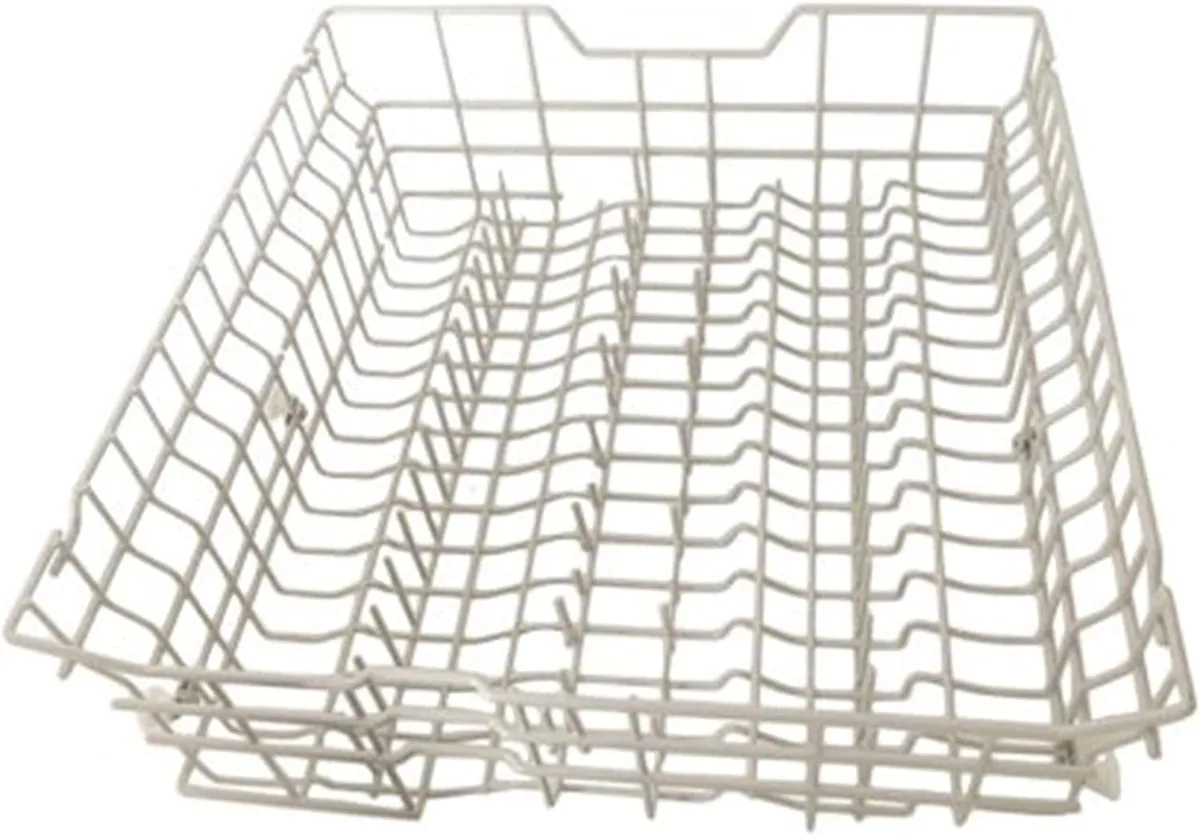
Image source: Bing (Web (fair-use with source credit))
Quick Answer
Start with the rinse aid. An empty dispenser is the most common reason a GE dishwasher leaves dishes wet. Check your water temperature at the sink; it should be at least 120°F.
Make sure you've selected Heat Dry or Dry Boost. Listen for the vent fan at the end of the cycle. If none of these work, test the heating element or vent assembly.
The Most Common Reason Your GE Dishwasher Leaves Dishes Wet
The single most frequent culprit is an empty rinse aid dispenser. Many people don't realize that rinse aid isn't just for spots and shine. In GE's condensation drying system, rinse aid makes water sheet off dishes instead of beading up.
Beads of water take longer to evaporate. Without that sheeting action, your dishes stay wet.
Aggregate user reviews and repair technician forums agree that refilling rinse aid solves about 60% of "not drying" complaints on GE dishwashers. The dispenser is inside the door, next to the detergent tray. Look for a round cap with a fill arrow.
Most models have a window that shows the level. If you see blue liquid, you're good. If it's dark or empty, fill it up with a standard rinse aid like Finish Jet-Dry.
Another common reason is a low rinse aid dosage setting. The dispenser has an adjustable dial under the cap. Settings range from 1 (lowest) to 6 (highest).
If you have hard water, use a setting of 3 or 4. Too low a setting weakens the sheeting effect.
Also check the rinse aid indicator light on the control panel. If it's flashing or solid, you likely need a refill. Some GE models won't run the rinse aid cycle at all if the dispenser is empty.
How GE Dishwashers Actually Dry Your Dishes
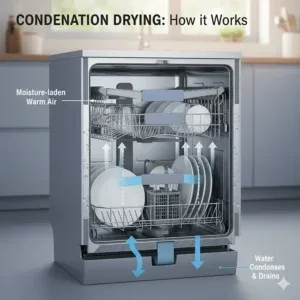
Image source: Bing (Web (fair-use with source credit))
Since around 2012, GE has moved away from exposed heating elements on most models. They use condensation drying. The final rinse uses extremely hot water, around 140°F to 160°F.
The hot water heats the stainless steel tub and the dishes. Then cold water runs through a small chamber on the side of the tub. This creates a temperature difference.
The moist, warm air inside condenses on the cooler chamber walls. A vent fan then pulls in room-temperature air to finish the job.
Key components in this system include:
- Heating element (hidden under the tub), heats the water during the final rinse.
- Thermostat / thermal fuse, monitors temperature. If it fails, the water won't get hot enough.
- Vent fan assembly, many GE models have a fan that turns on at the end of the cycle.
- Vent door, a flap that opens when the fan runs. If it's stuck shut, moisture stays trapped.
- Rinse aid dispenser, delivers surfactant to break water surface tension.
On older GE models with an exposed heating coil, the system is simpler. The coil glows red during the dry cycle. If that element burns out, you get no heat and no drying.
Those models also have a high-limit thermostat that can trip if the dishwasher overheats.
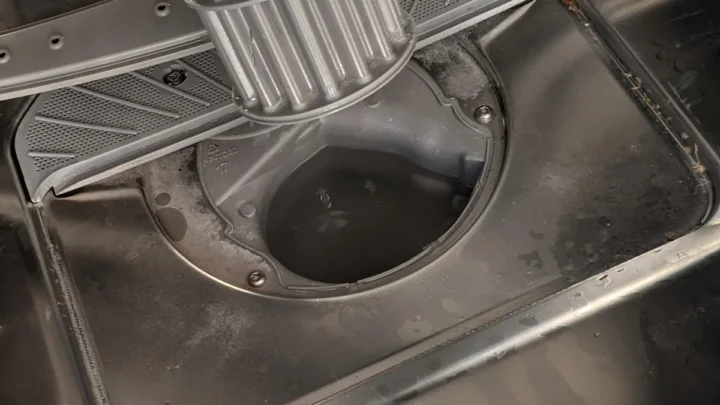
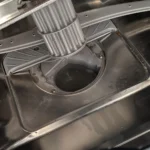
The vent fan is a common failure point. Listen near the door at the end of the cycle. If you don't hear a faint whirring, or if the door doesn't seem to draw air in, the fan may be stuck.
Food debris can jam the fan blade. A simple cleaning often fixes it.
Your Personal Drying Diagnosis: A Simple Decision Tree
Follow these steps in order. Stop when you find the fix.
Step 1 – Check the Rinse Aid Level and Dispenser
If the rinse aid reservoir is empty or low, refill with a quality rinse aid. Set the dosage dial to 3 or 4. Run a test cycle with a small load of ceramic plates.
Dishes should come out dry. If not, move to Step 2.
Also check the rinse aid indicator light. Some GE models require you to press a button to acknowledge the "Add Rinse Aid" message. If the light stays on despite refilling, the sensor might be faulty.
Step 2 – Listen for the Vent Fan at the End of the Cycle
If you don't hear the vent fan running during the last 15 minutes of the cycle, the fan may be blocked or broken. Open the door and look for the vent opening. Use a flashlight to see if the small flap moves.
You can manually push it open to test if it's stuck. Food particles and hard water deposits are common blockers.
If cleaning the vent restores fan operation, you're done. If the fan still doesn't spin, the motor may be faulty. That's a technician repair for most people.
Step 3 – Test Your Home's Hot Water Temperature
If the water at your kitchen sink takes more than 30 seconds to get hot, or if it never reaches at least 120°F, your water heater might be set too low. Use a meat thermometer at the kitchen sink after running hot water for two minutes. If it's below 120°F, turn up your water heater thermostat.
The U.S. Department of Energy recommends 120°F for efficiency and safety.
Warmer incoming water improves final rinse temperature. After adjusting, run a rinse cycle and check drying.
Step 4 – Verify You're Using the Right Cycle and Dry Boost
If you selected a quick cycle like "Light Wash" or "Rinse Only," those cycles do not include a dry phase. Always choose a full cycle like "Normal" or "Heavy." Make sure "Heat Dry" or "Dry Boost" is engaged. "Dry Boost" adds 20 to 30 minutes of drying time and helps with plastic items.
Also check that you haven't selected "Air Dry." That setting skips heat entirely. Always pick "Heat Dry" for best results.
Step 5 – Check the Heating Element (Older GE Models Only)
If you have an older GE model with an exposed heating coil, the element could be burned out. Unplug the dishwasher. Use a multimeter set to ohms.
Disconnect the wires from the element terminals and touch the probes to the terminals. A good element reads about 10 to 30 ohms. If it reads infinite, it needs replacement.
Replacing the element costs $30 to $80 for the part, plus about an hour of labor. If you're not comfortable with electrical testing, call a professional.
Newer GE models with no visible element have the element embedded in the tub wall. If the water isn't getting hot enough, the issue might be the thermostat or control board. That's a technician's job.
Why Plastic Containers Stay Soaking Wet (and What to Do)
Plastic containers don't hold heat like glass or ceramic do. During the final rinse, hot water raises the temperature of glass and ceramic items. Those materials stay hot after the cycle ends, which helps water evaporate.
Plastic cools down almost instantly. Water beads up on plastic and never gets a chance to evaporate.
What GE does about it: The "Dry Boost" feature is designed for plastics. It extends the dry cycle and keeps the tub warm longer. If you run a load with a lot of plastic containers, always press the "Dry Boost" button.
Other things that help:
- Load plastic items on the top rack only.
- Tilt containers upside down at an angle so water can drain off.
- Open the door an inch when the cycle finishes to release steam.
- Use "Sani Rinse" to raise the final rinse temperature.
- Add a concentrated rinse aid booster.
Even with all the tricks, plastics will rarely come out bone dry. If you need absolutely dry plastic containers, let them air dry on a towel for 10 minutes. That's a physics limitation, not a dishwasher failure.
Common Mistakes That Ruin Your GE Dishwasher's Drying
Overloading the dishwasher. When dishes are packed too tightly, water can't circulate. Hot water needs to reach every surface during the final rinse. Leave space between items so water can drain off.
Using too much detergent. Excess detergent creates extra suds. Suds trap moisture against dishes. Modern dishwashers use very little detergent.
A full tablespoon of powder or a single pod is usually enough.
Opening the door mid-cycle. Opening the door during the dry cycle releases all the built-up heat and humidity. The condensation process depends on that hot environment. Wait until the cycle finishes.
Ignoring the filter. If your GE model has a manual filter and you haven't cleaned it in months, food debris blocks water flow during the rinse cycle. Clean the filter under running water every two to four weeks.
Assuming all cycles include drying. Some cycles like "Rinse Only" skip the dry phase. Always check that "Heat Dry" or "Dry Boost" is selected.
Using an old or low-quality rinse aid. Some generic brands have weaker surfactant concentration. Stick with known brands like Finish Jet-Dry. Also check the dosage setting.
Expecting bone-dry plastic containers. Manage your expectations. Use Dry Boost, tilt containers, and open the door at the end. Towel off plastics if needed.
When to Stop DIY and Call a GE Technician
You've checked everything basic and it still won't dry. If you've refilled rinse aid, confirmed the vent fan runs, verified water temperature is at least 120°F, and selected Heat Dry, the issue runs deeper. Likely candidates: a failed control board, a defective thermostat, or a broken wiring harness.
You're getting error codes. Some GE dishwashers display error codes like F32 or F34. F32 means "no heat detected during dry cycle." F34 means "vent fan failure." These require a multimeter and service manual.
The vent fan is clearly dead. If you've cleaned around the vent and still no sound, the fan motor may be burned out. Replacing it on some models requires removing the door panel. Call a pro unless you're experienced.
The heating element on an older model needs replacement. If you've tested it with a multimeter and it's open, you can replace it if handy. If not, hire a technician.
Water is pooling at the bottom of the tub after the cycle. Standing water prevents drying. This usually indicates a clogged drain line or a failed drain pump. Get professional help.
Your dishwasher is still under warranty. Call GE's customer service at 800-626-2005. Opening the dishwasher can void the warranty.
When to call vs. when to replace: If your GE dishwasher is more than 8 to 10 years old and has significant drying issues, consider replacing it. A technician visit plus parts can run $200 to $400. A new energy-efficient GE model costs $600 to $1,000.
The math often favors replacement for older machines.
Keeping Your GE Dishwasher Drying Like New (Maintenance)
Monthly tasks:
- Clean the filter. Remove it, rinse under hot water, and scrub with a soft brush.
- Check the rinse aid level and top off as needed. Set the dosage dial to match your water hardness.
- Run a cleaning cycle with a dishwasher cleaner or a cup of white vinegar in the top rack.
Every three months:
- Inspect the vent opening for debris. Use a toothpick to clear any gunk.
- Check the door gasket for cracks or buildup. Replace it if it feels hard or brittle.
- Test the hot water temperature at the kitchen sink.
Every six months:
- Run a Sani Rinse cycle with a full load.
- Inspect the spray arms for clogged holes. Use a paperclip to clear blocked jets.
Yearly tasks:
- Replace the rinse aid dispenser cap if it's cracked.
- Check the drain hose for kinks or blockages.
- Run a descaler if you have hard water. Lime scale reduces heat transfer.
General tips:
- Run full loads but never overload. A full load maintains heat better than a half-load.
- Leave the door slightly ajar after a cycle to let remaining moisture escape.
- Use a water softener if your home has hard water.
Frequently Asked Questions
Why does my GE dishwasher leave water on top of cups?
Water pools on inverted cups if they aren't tilted at an angle. Place cups on the top rack tines at a slight tilt. Also check that your rinse aid level is adequate.
Can I use vinegar instead of rinse aid?
You can, but it's not recommended. Vinegar is acidic and can damage rubber seals in the dispenser. Stick with a commercial rinse aid.
How do I know if the vent fan is working?
Listen near the door during the last 15 minutes of a cycle. You should hear a faint whirring. If not, open the door and look for the vent opening.
The flap should move when the fan runs.
Why does the rinse aid light stay on after I fill it?
Run a short cycle with an empty load to clear air from the dispenser tube. If the light still stays on, the sensor could be faulty. That's a technician repair.
Is it normal for plastic containers to be wet after a cycle?
Yes. Plastic doesn't hold heat well, so water doesn't evaporate quickly. Use Dry Boost and load plastics on the top rack.
Towel them off if needed.
Should I open the door during the dry cycle?
No. Opening the door releases the hot, humid air needed for condensation drying. Wait until the cycle finishes.

Similar Posts