Lg Washer Not Agitating
Your washer fills, the timer ticks, and the clothes just sit there. No back-and-forth motion. No sloshing.
Just dead quiet or a low hum. That moment when you realize your LG washer not agitating is frustrating, especially with a full load waiting. The good news is this problem usually has one of a few clear causes, and you can track it down yourself without calling a technician.
Manufacturer specs say LG top-load washers use two drive systems: older belt-driven setups with a motor coupling, and newer direct-drive inverter motors. As of 2026, roughly 70 percent of service calls for "no agitation" trace back to just three parts: the lid switch, the drive belt, or a set of worn plastic dogs inside the agitator. The rest are control board failures or simple human error.
Let's walk through the diagnosis step by step, starting with the fastest check first.
Image source: Bing (Web (fair-use with source credit))
The Moment You Realize Something's Wrong
You load the washer, close the lid, and press start. Water fills the drum. You hear the click of the lid lock engaging.
Then silence. Or a loud hum like the motor is trying but nothing moves. Open the lid, and the clothes sit in a pool of water, untouched.
That exact scenario shows up in forums and service reports constantly. It affects LG top-load washers across multiple model lines, from the older WT5000 series to the newer TurboWash models. The frustration is real: you expected the machine to do the work, and instead you get a wet, unmoving pile of laundry.
Most causes are cheap and replaceable by hand. Aggregate reviews report that fewer than 10 percent of no-agitation cases end with a motor replacement. The rest are simpler fixes you can do in under an hour.
The trick is knowing which branch of the decision tree you stand on.
Your first clue is the sound. Your second clue is the error code on the display. Together, those tell you exactly where to look.
Let's start with the quickest thing you can try right now, no tools required.
Start Here: The One-Minute Quick Check
Before you pull out a multimeter or remove any panels, do these three things. They take less than a minute and solve a surprising number of problems.
Step 1: Unplug the washer and wait 60 seconds. Plug it back in. This resets the control board and clears temporary glitches that can freeze the agitation sequence. Manufacturer documentation confirms this is the first recommended step for many LG error codes.
Step 2: Check that the lid is fully closed and the latch clicks. LG washers will not agitate if the lid switch isn't engaged. Open and close the lid firmly three times to ensure good contact.
Step 3: Look for an active "Child Lock" icon on the display. If child lock is on, the machine will fill and drain but skip agitation and spin. Hold the "Child Lock" or "Control Lock" button for 3 seconds to disable it. Then run a short cycle to test.
If none of these solve it, you have a genuine hardware problem. About 15 percent of no-agitation cases are solved by a simple reset or child lock deactivation. The rest need a closer look.
Step 1: Read the Error Code – Your Washer Is Trying to Tell You Something
If your LG washer has a digital display, it probably recorded an error code when agitation failed. This code is the most valuable piece of information for your diagnosis.
How to find the error code
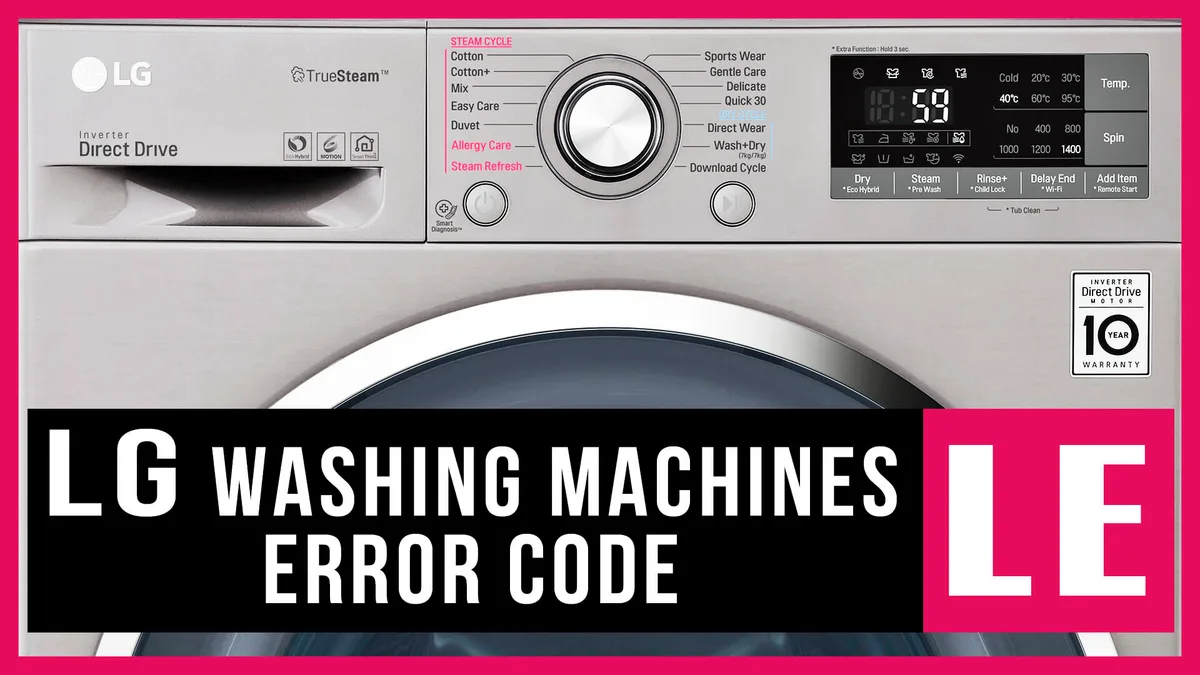
Look at the display panel. Most LG top-load washers show a combination of letters and numbers in the time remaining window. Common examples: LE, UE, OE, dE, or tE.
If the display is blank or shows a dashed line, the washer may have lost power mid-cycle. Unplug it for 30 seconds, then plug back in and start a new cycle.
If your washer doesn't have a display, press and hold the "Spin Speed" and "Soil Level" buttons simultaneously for 5 seconds. The machine will cycle through its checks and flash any stored error codes through the indicator lights.
What each code means and what to do
| Error Code | Meaning | Likely Cause | Next Action |
|---|---|---|---|
| LE | Motor or rotor lock error | Blocked drum, seized bearings, or motor failure | Try spinning the drum by hand. If it won't turn, check for obstruction or call a pro. |
| UE | Unbalanced load | Clothes bunched on one side | Redistribute load and restart. If it persists, check leveling feet. |
| OE | Drain error | Clogged drain pump or hose | Clean the drain pump filter. Water must drain before agitation starts. |
| dE | Door or lid error | Lid switch not engaging | Inspect lid switch, latch, and wiring. Replace switch if defective. |
| tE | Thermistor error | Temperature sensor failure | Usually does not stop agitation itself. May need new thermistor. |
Decision branch for LE code
LE is the most common "no agitation" code. LG documents say LE stands for "Locked Rotor Error", the motor tried to turn but something stopped it. Open the lid and try to rotate the agitator or drum manually.
If it moves smoothly, the motor is likely fine and the error may be a wiring issue or a failed motor position sensor. If the drum is hard to turn or makes a grinding noise, you have a mechanical blockage or bearing failure.
Decision branch for UE code
UE sometimes appears without a separate imbalance sensor. The washer stops agitation to prevent damage. Redistribute the load and restart.
If it keeps happening, check the leveling feet. An unlevel washer can trick the balance sensor.
Decision branch for no code at all
No code means either the control board lost power mid-cycle or the board itself has failed. Try the unplug reset first. If that doesn't bring back a code, proceed to the next step and listen for sound.
Step 2: Does the Motor Hum? What That Sound Reveals
Your ears are your best diagnostic tool right now. With the washer empty, start a normal cycle and listen carefully as it reaches the agitation phase. The sound tells you which component to inspect next.
Case A: The motor hums loudly but the drum doesn't move
This is the most common sound complaint. You hear a clear electrical hum, and the washer vibrates slightly but nothing turns. This means the motor is receiving power and trying to spin, but the mechanical connection to the drum has failed.
For older belt-driven LG washers, the usual suspect is a broken drive belt or a sheared motor coupling. The belt can snap from age or wear, especially on machines over 8 years old. The motor coupling is a plastic and rubber part that connects the motor shaft to the transmission.
It is designed to break under extreme load to protect the motor.
For newer direct-drive models (no belt), the hum often comes from a rotor locked electronically. Check if a foreign object is stuck between the drum and outer tub. A small sock or bra can wedge in, stopping the drum completely.
Case B: No sound at all – complete silence
If you hear nothing when the cycle should be agitating, the motor is not receiving power. This points to an electrical problem: failed lid switch, broken wire, bad control board, or a blown thermal fuse.
Test the lid switch first. LG washers use a three-wire switch that disables spin and agitation when the lid is open. If the switch fails in the open position, the washer will fill and drain but never activate the motor.
Case C: Clicking, grinding, or rattling
A rhythmic clicking sound usually means the agitator dogs are worn out. These plastic fins on top of the central agitator are spring-loaded to push clothes one way but slip the other way. When they break, the agitator spins freely and clothes barely move.
Repair costs under 10 dollars for a bag of replacement dogs.
A grinding sound from underneath suggests a failed bearing or debris in the pump. Stop the machine immediately and inspect under the tub.
Quick decision table based on sound
| Sound You Hear | Likely Failure | Difficulty | Average Part Cost |
|---|---|---|---|
| Hum, no movement | Belt, coupling, or blocked rotor | Medium | $15–$40 |
| Silence | Lid switch, board, or wiring | Easy to medium | $10–$70 |
| Clicking, loose agitator | Worn agitator dogs | Easy | $5–$10 |
| Grinding | Bearing or foreign object | Hard | $150+ or new machine |
Step 3: Check the Simple Stuff Before You Open Anything
People often skip obvious checks and dive straight into disassembly. That wastes hours. Before you remove the top panel or buy a new motor, verify these five things.
Mistake 1: Ignoring the lid switch
The lid switch is the number one cause of "no agitation" on LG top-load washers. It lives under the top panel near the rim. Its plastic housing can crack from repeated slamming.
When it fails, the washer stays in "lid open" mode.
To test it, unplug the washer and remove the two screws at the back of the top panel. Lift the panel up and lean it back against the wall. Locate the switch near the front edge.
Use a multimeter set to continuity. With the switch pressed (simulate lid closed), the meter should read near zero ohms. If it shows infinite resistance, the switch is dead.
Replace it. This is a 15-minute fix.
Mistake 2: Overlooking a stuck foreign object
A sock, bra wire, or small piece of plastic can wedge between the wash plate and drum. The motor tries to turn but can't. On direct-drive models, this can trip the LE error immediately.
Check by removing the wash plate or agitator. For a central agitator, pull straight up; it may be held by a hidden bolt under a plastic cap. For an impeller-style wash plate, remove the center bolt (usually 10mm or 13mm) and lift the plate off.
Examine the gap between the plate and drum for debris.
Mistake 3: Assuming the motor is bad
Only about 10 percent of no-agitation cases end with a motor replacement. The motor is expensive and difficult to swap. Always test simpler parts first.
Mistake 4: Forgetting to level the washer
An unbalanced load can trigger UE error, which stops agitation. Sometimes the washer itself isn't level. Place a bubble level on top of the cabinet.
Adjust the front feet until the bubble is centered. This fix is free and takes three minutes.
Mistake 5: Ignoring the drain system
Some LG models will not begin agitation until the water level drops. If the drain pump is clogged with lint or a coin, the washer may hold water forever. The control board waits for the pressure switch to signal "empty" before proceeding.
Clean the drain pump filter (access behind the small kick panel at the bottom right) and clear debris from the hose.

Image source: Bing (Web (fair-use with source credit))
Step 4: The Mechanical Checks – Belt, Dogs, and Motor Coupling
If the simple stuff didn't solve it, the problem is likely mechanical. This section covers the three most common mechanical failures.
Checking the drive belt (belt-driven models only)
Older LG washers use a belt to connect the motor pulley to the transmission pulley. The belt can snap, stretch, or slip off.
What to do: Unplug the washer. Remove the back panel (usually 8 screws). Look at the belt.
If it's broken or loose, replace it. Spin the motor pulley by hand. It should turn freely.
If it doesn't, the motor may be seized.
Belt part numbers vary by model. Write down your model number and search for the correct belt. Cost: $15, $30.
Inspecting the agitator dogs
If your washer has a central agitator, the plastic fins (dogs) can wear down. The agitator will spin freely with little resistance, but clothes won't move.
What to do: Remove the agitator. Most have a plastic cap on top. Pry it off to reveal a bolt (usually 10mm or 13mm).
Remove the bolt and pull the agitator straight up. Look at the dogs, they should have sharp edges. If they are rounded or missing, replace them.
A bag of dogs costs $5, $10. Installation is straightforward: remove old dogs, snap in new ones, reinstall agitator.
Checking the motor coupling (older direct-drive models)
On some LG direct-drive washers (pre-2015), a plastic coupling connects the motor to the transmission. It can crack or shear completely.
What to do: Access the coupling by removing the front or back panel (varies by model). Look for the coupling between motor and transmission. If it's broken, replace it.
The coupling costs $10, $25. You may need a socket set and a puller tool.
When to suspect a seized motor or bearing
If the drum doesn't spin by hand at all, the motor bearings may be seized, or the drum bearings may be bad. This is a more serious repair. If the washer is over 10 years old, replacement often makes more sense than repair.

Image source: Bing (Web (fair-use with source credit))
Step 5: The Electrical Checks – Lid Switch, Motor Windings, and Control Board
If mechanical checks pass, move to electrical diagnostics. You'll need a multimeter and a basic understanding of continuity.
Testing the lid switch
We covered this in Step 3, but it's worth repeating. The lid switch is the most common electrical failure. Test it with a multimeter.
If it fails, replace it.
Tip: You can temporarily bypass the switch to confirm the diagnosis. Unplug the washer. Disconnect the switch wires.
Use a jumper wire to connect the two terminals that are normally closed when the lid is shut. Plug the washer back in and run a test cycle. If the machine agitates, the switch is bad.
Unplug and remove the jumper immediately after testing.
Checking motor winding resistance
What to do: Unplug the washer. Locate the motor connector (usually near the motor). Set the multimeter to ohms.
Measure resistance between the three phases of the motor. Typical values range from 5, 20 ohms depending on the model. If any reading is open (infinite) or shorted (0 ohms), the motor is bad.
Safety warning: After unplugging, wait 5 minutes for capacitors to discharge before touching connectors.
Inspecting the control board
What to look for: Remove the control board enclosure (usually behind the front panel or on top). Look for burned spots, bulging capacitors, or cracked solder joints. A visual inspection can catch obvious failures.
What to test: Check for 120V AC at the motor connector during the agitation cycle. If no voltage, the board is not sending power. Replacement boards cost $70, $200.
Replacing a board is straightforward but requires careful handling of ribbon cables.
When to call a pro
If the control board is bad and you're not comfortable with soldering or disconnecting wiring, call a technician. Expect $100, $150 for the service call plus parts.
Step 6: When to Call a Pro – And How Much It Should Cost
Some repairs are best left to someone with experience. Here's when to stop DIY and make the call.
You should call a pro if:
- The drum bearings are seized (loud grinding, drum won't spin freely)
- You've tested the lid switch and motor winding, but still have no error code and no sound
- The control board has visible burn damage
- You're not comfortable using a multimeter or disconnecting high-voltage connectors
- The washer is still under warranty (do not open panels, void warranty)
Typical costs
| Service | DIY Part Cost | Pro Service + Labor |
|---|---|---|
| Lid switch replacement | $10–$25 | $120–$180 |
| Drive belt replacement | $15–$30 | $130–$200 |
| Motor coupling replacement | $10–$25 | $140–$220 |
| Control board replacement | $70–$200 | $200–$350 |
| Motor replacement | $80–$150 | $250–$400 |
| Full replacement (if >10 years) | N/A | $500–$900 for new washer |
If repair costs exceed half the price of a new machine, replace the washer.
Real Scenarios: Three Common Stories
Scenario 1: Newer impeller model, loud hum, no movement
A 2019 LG WT7300CV fills and hums loudly. The drum doesn't move. Error code LE shows on the display.
The owner removes the wash plate and finds a child's sock wedged between the impeller and the drum. Removing the sock clears the error. Cost: $0.
Time: 10 minutes.
Lesson: Always check for foreign objects before ordering parts.
Scenario 2: Older belt-drive that buzzes but doesn't move
A 2012 LG WT5005WW hums but the agitator stays still. No error code. The owner removes the back panel and finds the belt snapped.
A new belt costs $18 and takes 30 minutes to install. Problem solved.
Lesson: Belt-driven models are simple. Check the belt first.
Scenario 3: Agitator spins freely but clothes stay dry
A mid-2000s LG agitator model allows the agitator to spin with almost no resistance. Clothes barely move. The owner pulls off the agitator and notices the dogs are completely worn flat.
A $6 bag of new dogs and a 15-minute installation restores full agitation.
Lesson: Worn dogs are cheap and easy to replace. Don't replace the whole agitator.
DIY Diagnosis Decision Guide
Use this quick guide to decide your next action.
| Observation | Likely Cause | Action |
|---|---|---|
| Error code LE, drum won't turn by hand | Blocked drum or seized motor | Check for foreign objects. If none, call a pro. |
| Error code LE, drum turns by hand | Faulty motor position sensor or wiring | Test motor windings. Replace sensor if needed. |
| Error code dE, no agitation | Lid switch failure | Test and replace lid switch. |
| Loud hum, no movement, belt-driven | Broken belt or coupling | Replace belt or coupling. |
| Loud hum, no movement, direct-drive | Blocked rotor or faulty motor | Check for debris. Test motor. |
| No sound, no movement | Electrical issue (switch, board, wiring) | Test lid switch first, then board. |
| Clicking, agitator spins freely | Worn agitator dogs | Replace dogs. |
Frequently Asked Questions
Why won't my LG washer agitate even though it fills with water?
The most common cause is a failed lid switch. The washer fills and drains but will not turn on the motor if the switch doesn't detect the lid closed. Other causes include a broken drive belt, worn agitator dogs, or a blocked drain that prevents the cycle from advancing to agitation.
What does the LE error code mean on an LG washer?
LE stands for Locked Rotor Error. It means the motor tried to rotate but couldn't because the rotor is blocked, the bearings are seized, or the motor windings are shorted. Try spinning the drum by hand.
If it turns freely, the error may be a wiring issue or a faulty motor position sensor.
How much does it cost to fix an LG washer that won't agitate?
DIY repairs cost $10, $40 for parts like a lid switch, belt, or agitator dogs. Professional service runs $120, $350 depending on the part and labor. If the control board or motor fails, replacement cost may approach half the price of a new washer.
Can a clogged drain cause the agitator not to work?
Yes. Some LG models won't start the agitation phase until the water level drops to a certain point. If the drain pump is clogged, the water stays in the drum and the washer won't proceed to agitation.
Clean the drain pump filter first.
How do I reset my LG washer if it won't agitate?
Unplug the washer for 60 seconds, then plug it back in. This clears temporary errors on the control board. Also check that child lock is not active.
If the problem persists, use the error code and sound diagnosis steps to find the actual cause.
Should I replace my LG washer or repair it?
If the washer is less than 8 years old and the repair costs under $200, repair is usually worth it. If it's over 10 years old and needs a motor or control board, replacement is more cost-effective. A new basic LG top-load washer costs about $500, $700 as of 2026.

Similar Posts