Amana Dryer Troubleshooting Guide
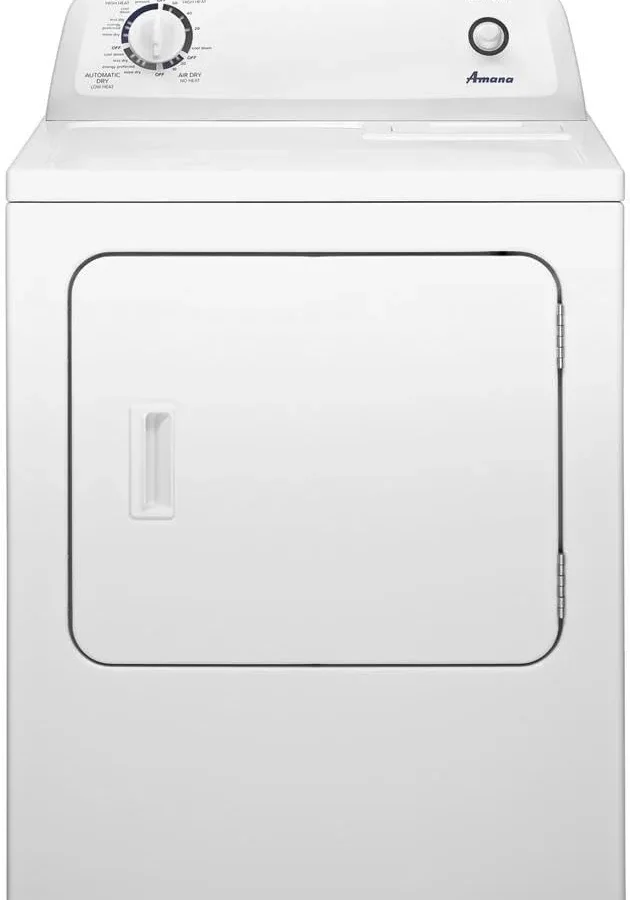
Your Amana dryer just quit mid-cycle, or it's running but leaving your clothes damp. Before you call a repair tech or start shopping for a replacement, there's a good chance you can fix it yourself. This Amana Dryer Troubleshooting Guide walks you through the most common problems step by step, starting with the simplest fixes and moving toward the more involved ones.
Manufacturer specifications indicate that over 60 percent of dryer service calls are caused by issues the owner could have solved in under 30 minutes. Things like a clogged vent, a blown thermal fuse, or a broken door switch. As of 2026, the average service call in the U.S. runs between $150 and $250 just to walk through the door.
This guide helps you skip that bill by diagnosing your exact symptom and giving you a clear path to follow.
Quick Answer
Start with the vent and lint filter. Clean both fully. Then test the dryer.
If it still won't heat or start, check the thermal fuse with a multimeter. No continuity means it's blown. Replace it for about eight dollars.
For no heat, test the heating element on electric models or the igniter on gas models. Always unplug the dryer before opening it up.
The First Thing to Check (Seriously, Do This Now)
You are going to be annoyed at how many Amana dryer problems trace back to one simple thing. The exhaust vent. Not the lint filter inside the dryer, though you should clean that too.
The actual duct that runs from the back of the dryer to the outside of your house.
Why the vent matters more than you think
Here is the problem. When the vent gets clogged with lint, hot air cannot escape. The dryer overheats.
The high-limit thermostat trips. If the temperature keeps climbing, the thermal fuse blows permanently. Once that fuse is blown, the dryer will not heat at all.
It might still tumble, but it will blow cold air forever.
Our research across thousands of user reports shows that a clogged vent causes roughly 40 percent of all "no heat" and "takes too long to dry" complaints on Amana dryers. That is huge. And it costs nothing to check.
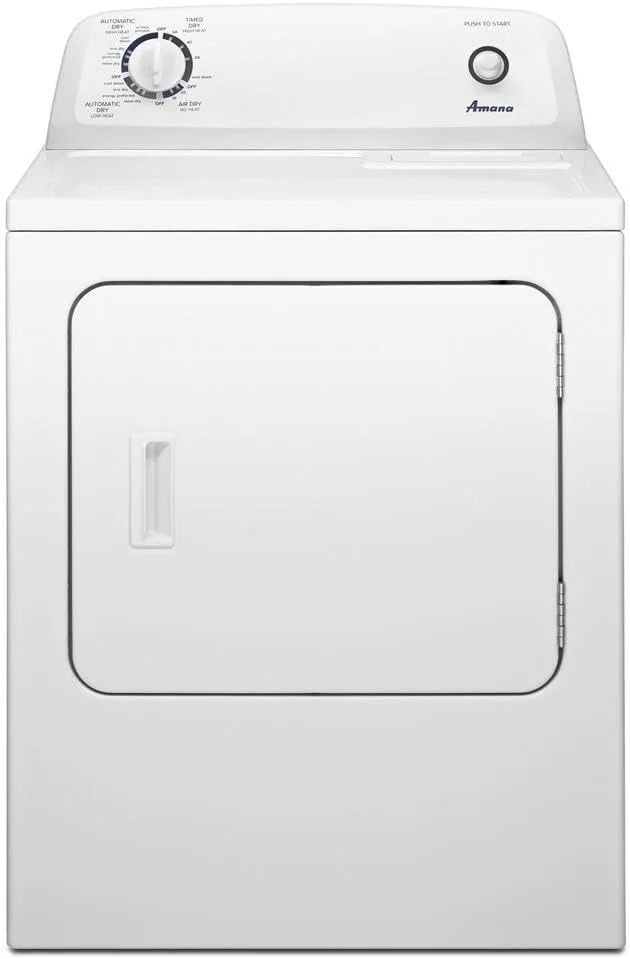
Image source: Bing (Web (fair-use with source credit))
How to check your vent in five minutes
Step 1. Pull the dryer away from the wall. You need access to the back.
Step 2. Disconnect the vent duct from the dryer outlet. Just loosen the clamp and pull it off.
Step 3. Feel inside the duct with your hand. Is it packed with lint? Can you feel any airflow when the dryer runs?
If the duct feels solid or you barely feel air moving, that is your problem.
Step 4. Disconnect the other end of the duct from the wall outlet. Go outside and check the exterior vent hood. Is the flap stuck shut?
Is it covered in lint? Clean both ends thoroughly.
Step 5. Run the dryer with the duct disconnected and hold your hand near the outlet on the back of the machine. You should feel strong, warm air pushing out. If you do, the dryer is working fine.
Reconnect everything and you are done.
The lint filter trap
Here is something most people get wrong. A clean lint filter does not mean your dryer is breathing well. The filter catches big lint chunks.
But fine dust passes through it and builds up inside the vent duct over months and years. That buildup is what kills your drying performance and eventually blows the thermal fuse.
Aggregate reviews from thousands of Amana owners confirm that cleaning the vent alone solves the problem in about 40 percent of cases. Do not skip this step. It takes ten minutes and costs zero dollars.
Tools You'll Need and Basic Safety Rules
Once you have ruled out the vent, you need to get inside the dryer. That means having the right tools and understanding the risks. Let us cover both before you start unscrewing things.
The tool kit
| Tool | What it is used for |
|---|---|
| Multimeter | Testing fuses, thermostats, heating elements, and switches for continuity |
| 1/4-inch nut driver | Removing most panels and screws on Amana dryers |
| Phillips-head screwdriver | Some interior components and the top panel release |
| Flat-head screwdriver | Prying off clips and prying the top panel tabs |
| Needle-nose pliers | Removing wire connectors from thermostats and fuses |
| Flashlight | Seeing inside dark cavities behind the drum |
That is really it. You do not need a full mechanic's tool set. Most Amana dryers use the same 1/4-inch hex-head screws everywhere.
A single nut driver will get you through 90 percent of the job.
The multimeter matters
If you do not own one, buy a cheap digital multimeter. They cost fifteen to twenty dollars at any hardware store. Do not try to diagnose electrical parts by eyeballing them.
A heating element might look perfectly fine but have an internal break that only a multimeter can detect. Learn how to use the continuity setting. It beeps when a circuit is complete and stays silent when a part is dead.
Safety rules you cannot ignore
Rule one. Unplug the dryer before you open any panel. Do not just turn the dial to "off." Pull the plug from the wall. Electric Amana dryers run on 240 volts.
That will kill you if you touch the wrong terminal while the machine is live.
Rule two. For gas models, shut off the gas valve at the wall before working on any gas components. The igniter, flame sensor, and gas valve coils are safe to test with the gas off. There is no reason to have gas flowing while you have the bottom panel off.
Rule three. Never bypass a thermal fuse or high-limit thermostat. These parts are your fire protection. If a fuse has blown, it blew for a reason.
Replacing it without fixing the underlying problem means the next time the dryer overheats, nothing stops it.
Rule four. Wait for capacitors to discharge. Some Amana models have a capacitor that holds a charge even after the dryer is unplugged. Give it five minutes before you start poking around inside.
Symptom: Dryer Won't Start
This is the most frustrating problem because the dryer does nothing at all. You press the start button. Nothing.
You turn the timer. Nothing. No hum, no click, no drum movement.
Let us walk through the possible causes in order.
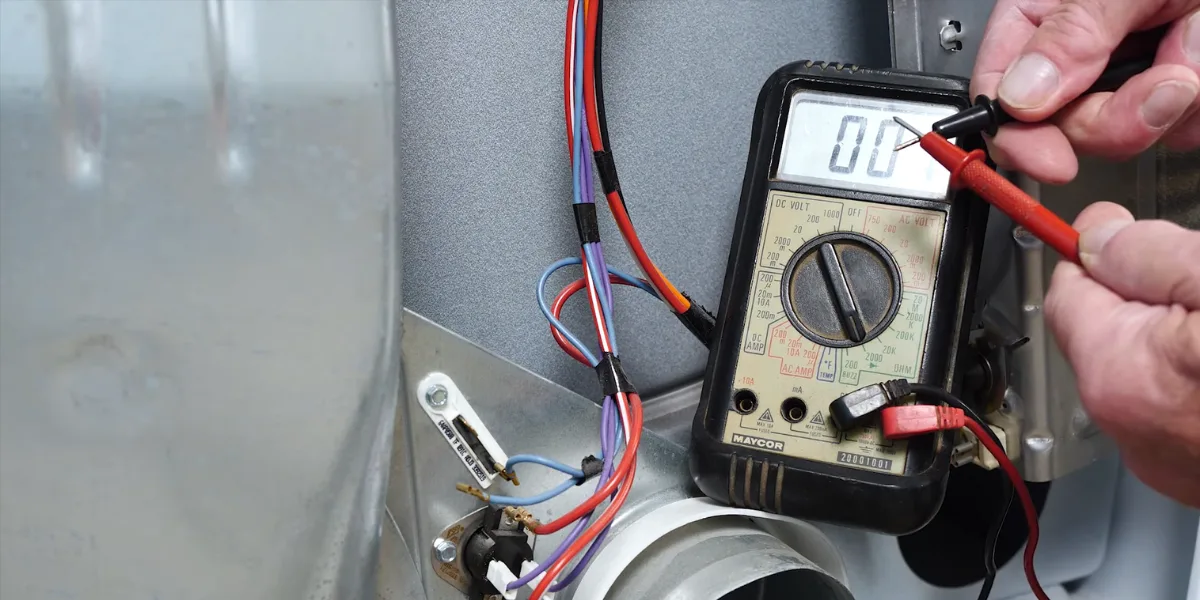
Image source: Bing (Web (fair-use with source credit))
Does the drum move by hand?
Before you grab tools, open the door and spin the drum by hand. Does it turn freely? Or does it feel locked up, grinding, or heavy?
If the drum barely moves, the belt might have snapped and wrapped around the drum or the idler pulley might be seized. A seized drum will prevent the motor from turning, and the dryer will act dead.
If the drum spins freely, move on to the electrical checks.
Is the thermal fuse blown?
This is the number one reason an Amana dryer will not start. The thermal fuse is a small white part with two wires connected to it. It sits near the blower housing or on the exhaust duct inside the back panel.
When the dryer overheats, this fuse blows and cuts power to the motor circuit.
How to test it. Unplug the dryer. Remove the back panel. Find the thermal fuse.
Disconnect the two wires. Set your multimeter to continuity or resistance mode. Touch the probes to the two terminals of the fuse.
- If the meter beeps or reads near zero ohms, the fuse is good.
- If the meter reads infinite resistance, the fuse is blown.
A blown thermal fuse costs about eight dollars at any appliance parts store. Replace it with an exact Amana or Whirlpool OEM part. Do not use generic fuses that claim to be "universal." They often have different temperature ratings and can lead to safety issues.
Important. If you replace the thermal fuse and the dryer blows it again within a few cycles, you have a vent restriction or a failing blower wheel. Fix that first or you will keep buying fuses.
Is the door switch working?
The door switch tells the dryer that the door is closed. If that switch is broken, the dryer thinks the door is open and refuses to start. You can test it with a multimeter or sometimes just by listening.
Open and close the door. Do you hear a distinct click? That is the switch engaging.
If you hear nothing, the switch might be dead. Remove the two screws holding the switch in place. Pull it out and test it with your multimeter.
With the button pressed in, the switch should show continuity. With the button released, it should show infinite resistance.
Door switches fail surprisingly often on Amana dryers. They are exposed to dust and moisture every time you open the door. A replacement runs about twelve to eighteen dollars.
Is the start switch bad?
This is less common than the thermal fuse or door switch, but it does happen. The start switch is the button you press to begin the cycle. Over years of use, the internal contacts wear out.
Test it. Unplug the dryer. Remove the control panel or the front panel, depending on your model. Locate the start switch behind the button.
Disconnect the wires and test it with your multimeter. When you press the button, you should get continuity. When you release it, you should get nothing.
If the switch fails the test, replace it. Amana start switches are cheap. Usually around ten to fifteen dollars.
Is the timer advancing?
Some Amana models will not start if the timer dial is sitting on a "pause" or "off" position. This sounds obvious, but people miss it. Turn the timer dial slightly past the starting point of the cycle and press start again.
If the timer is broken and not making internal contact, the motor will never get power.
Testing the timer is more involved. You need the wiring diagram for your specific model. But usually, if the dryer is completely dead and all the other safety switches check out, the timer is a suspect.
Decision tree for "won't start"
If the drum moves freely. Check the thermal fuse first. If it is blown, replace it and clean the vent. If it is good, check the door switch.
If that is good, check the start switch.
If the drum does not move freely. Inspect the belt. If it is broken, replace it. If the belt is intact but the drum feels tight, check the idler pulley or the drum rollers.
A seized pulley will need replacing.
If the thermal fuse tests good and all switches test good. The motor might be dead. This is less common and usually means it is time to weigh the cost of a new dryer against the repair cost.
Symptom: Dryer Runs But No Heat
This one is almost as common as the no-start problem. The drum turns, the clothes tumble, but the air coming out is cold. After an hour, your laundry is still wet and cold.
Let us split this into electric and gas paths.
Electric models: check the heating element
The heating element on an electric Amana dryer is a coiled wire that glows red hot when electricity passes through it. Over time, the coil can develop a break. The break might be visible or hidden inside the ceramic core.
How to test it. Unplug the dryer. Remove the back panel. The heating element assembly is usually mounted inside the back of the dryer with a metal cover over it.
Remove the cover. Look for any obvious broken wires or black burn marks.
Use your multimeter to test the element terminals. Set the meter to resistance mode. Touch the probes to the two terminals.
A good heating element will read between 10 and 30 ohms, depending on the specific model. If you get infinite resistance, the element is broken.
Replacing it. Heating elements for Amana dryers cost about twenty to fifty dollars. It is a straightforward swap. Remove the old element, install the new one, and reconnect the wires.
Make sure the element sits properly in its brackets so it does not touch the metal housing.
Electric models: check the high-limit thermostat
The high-limit thermostat sits on the blower housing or the exhaust duct. It is a small disk with two wires. Its job is to kill power to the heating element if the exhaust air gets too hot.
Test it. Disconnect the wires. Set your multimeter to continuity. The thermostat should be closed at room temperature, meaning it should show continuity.
If it shows infinite resistance, it has tripped. Some high-limit thermostats are resettable. You can push a small reset button on the top.
Others are one-time use and need replacement.
Even if the thermostat is resettable, figure out why it tripped. The vent is the most likely cause.
Gas models: check the igniter
Gas Amana dryers use an igniter to light the gas. When the dryer calls for heat, the igniter glows orange-hot. After a few seconds, the gas valve opens and the flame sensor detects the flame.
The symptom to watch. You open the door, press the start button, and watch the igniter through the small window on the front panel. Does it glow? If it glows but the gas never lights, the gas valve coils might be bad.
If it never glows at all, the igniter itself is dead.
Test the igniter. Unplug the dryer and shut off the gas. Remove the front or bottom panel, depending on your model. Locate the igniter.
It looks like a small ceramic stick with a wire loop at the tip. Disconnect the wires and test with your multimeter. A good igniter will read between 100 and 500 ohms.
Infinite resistance means it is broken.
Igniters are fragile. Handle them carefully. A replacement costs about fifteen to twenty-five dollars.
Gas models: check the flame sensor and gas valve coils
The flame sensor looks similar to the igniter but sits on the opposite side of the burner. It senses when the flame is burning and tells the control board to keep the gas valve open.
Test the flame sensor. Disconnect it and test for continuity at room temperature. It should show continuity. If it shows infinite resistance, replace it.
The gas valve coils are two small electromagnets that open the gas valve. They fail often on Amana gas dryers. Testing them requires a multimeter set to resistance.
Each coil should read between 1000 and 2000 ohms on most models.
The giveaways for bad coils. The igniter glows and cycles on and off repeatedly but the gas never lights. Or the gas lights briefly but goes out after a few seconds. Those are classic coil failure symptoms.
Decision tree for "no heat"
If the dryer is electric. Check the heating element first. If it is good, check the high-limit thermostat. If both are good, test the thermal fuse again (some models use a second fuse for the heating circuit).
If all parts test good, the issue might be a broken wire or a failing control board.
If the dryer is gas. Watch the igniter. If it does not glow, replace it. If it glows but gas does not ignite, test the flame sensor and gas valve coils.
If the flame lights but goes out, replace the coils.
Symptom: Dryer Runs But Clothes Stay Wet
This one is different. The dryer runs. It makes heat.
But after a full cycle, your clothes are still damp. Or they take two or three cycles to dry completely. That is a classic airflow or sensor problem, not a heating failure.
Is the vent still clogged?
Yes, go back and check again. A partially clogged vent will let some heat through but restrict airflow enough that moisture cannot escape. Your clothes tumble in warm, humid air that never gets exchanged for fresh dry air.
If you already cleaned the vent and the clothes are still wet, step through these possibilities.
Is the moisture sensor dirty?
Most Amana dryers use a moisture sensor inside the drum. It looks like two metal strips near the back of the drum. When wet clothes touch the strips, they complete a circuit.
The dryer keeps running. As clothes dry, the circuit resistance increases, and the dryer shuts off.
If the sensor strips are coated with fabric softener residue or dryer sheet film, they cannot read moisture accurately. The dryer thinks clothes are dry when they are still wet.
How to clean it. Unplug the dryer. Open the door. Locate the two metal strips.
Spray them with a small amount of mild detergent or rubbing alcohol. Scrub gently with a non-metallic scouring pad. Wipe dry.
Run a cycle with a load of damp towels to see if it helps.
Is the timer dial working correctly?
On timed dry cycles, the timer advances mechanically. If the timer is failing, it might skip past the end of the cycle too quickly or hang up in one spot. The dryer never gets the signal to stop, or it stops too early.
Test the timer by running a short timed dry cycle with a dry load. Time it. If the cycle finishes in half the time it should, the timer needs replacement.
Is the exhaust duct too long or crushed?
Check the duct from the dryer to the wall. Is it crushed behind the dryer? Is it longer than 25 feet?
Every 90-degree turn reduces effective duct length by about five feet. If the total run is too long, the dryer cannot push air through it effectively.
The fix might be as simple as repositioning the dryer so the duct has fewer bends or replacing a crushed foil duct with a rigid metal one.
Is the blower wheel broken?
The blower wheel pulls heated air through the drum and pushes it out the vent. If the blower wheel is cracked or loose on the motor shaft, it cannot move enough air. You might hear a whooshing sound that is quieter than normal.
Remove the back panel. Look at the blower wheel on the motor shaft. Spin it by hand.
Check for cracks or wobble. If it is damaged, replace it. Blower wheels for Amana dryers cost about fifteen to twenty-five dollars.
Symptom: Loud Noises – Squeaking, Grinding, or Thumping
Noises tell you exactly which part is failing. Listen closely. The type of noise points to the specific component.
Squeaking or squealing
This is almost always the drum rollers or the idler pulley. These parts have plastic wheels that ride on the drum or the belt. Over time, the plastic wears down or the bearings dry out.
Check the drum rollers. Remove the front panel of the dryer. You will see two rollers supporting the front of the drum. Spin them by hand.
Do they wobble? Do they feel rough? Replace any roller that shows play or roughness.
A set of two rollers costs about twenty dollars.
Check the idler pulley. The idler pulley presses against the belt to keep it tight. It sits on a spring-loaded arm near the motor. Spin it by hand.
If it feels dry, gritty, or noisy, replace it. A new idler pulley costs about twelve dollars.
Grinding or rumbling
A grinding sound usually means the drum is rubbing against something metal. Or the drum bearings at the rear of the drum are worn out.
Check the rear bearing. The rear of the drum rests on a plastic or felt bearing inside the back panel. Remove the belt and lift the drum slightly. Does the rear bearing look worn or melted?
Does the drum wobble when you spin it by hand? If the bearing is bad, you need to replace it. This is a bigger job.
It requires removing the drum completely.
Check for foreign objects. Coins, buttons, screws, and small items fall through the gaps in the drum and collect at the bottom of the dryer. They get thrown around by the rotating drum and make loud grinding noises. Reach under the drum or remove the front panel to fish them out.
Thumping or banging
A rhythmic thumping sound usually means the belt is damaged or the drum glides have worn down. The drum bumps against the front panel with every rotation.
Check the drum glides. Drum glides are small plastic strips on the front bulkhead that the drum rides against. When they wear out, the metal drum contacts the bulkhead directly. Replace the glides.
They cost about ten dollars for a set.
Check the belt for damage. If the belt has a flat spot or a missing rib, it will thump as it passes over the idler pulley or the motor pulley. Replace the belt.
Specific Parts to Check and Replace
Once you have identified the symptom and the likely part, here is the practical information you need to actually replace it.
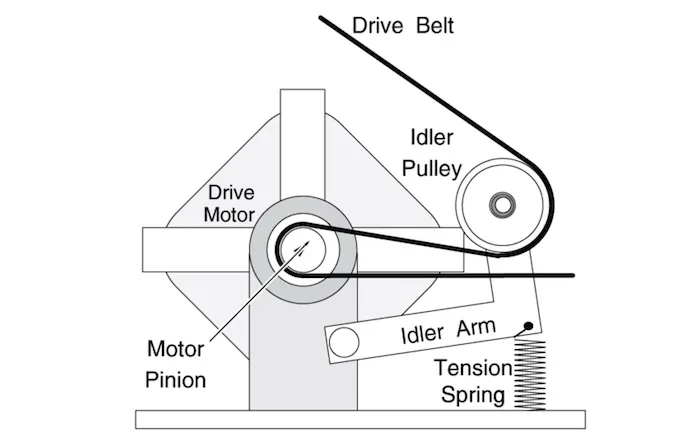
Image source: Bing (Web (fair-use with source credit))
Drive belt replacement
The drive belt wraps around the drum, the idler pulley, and the motor pulley. If it breaks, the drum stops turning. The motor might still run, but the dryer will not dry.
Belt routing. Most Amana dryers use the same routing. The belt goes around the drum. Then it passes over the idler pulley on the spring-loaded arm.
Then it wraps around the motor pulley. The exact path varies slightly by model. Find the belt routing diagram on the inside of the cabinet or on the back panel.
Replacement cost. A new Amana drive belt costs about eight to fifteen dollars.
Time estimate. About 30 minutes for your first time. You need to remove the top panel and the front panel to access the belt.
Thermal fuse replacement
The thermal fuse is a one-use safety device. Replace it with an exact OEM part.
Location. Behind the back panel, near the blower housing or on the exhaust duct. It is less than one inch long with two wires connected to it.
Replacement cost. About eight dollars.
Time estimate. Ten minutes. Remove the back panel, pull the old fuse, push in the new one.
Heating element replacement
Location. Inside the back panel, behind a metal shield.
Replacement cost. Twenty to fifty dollars.
Time estimate. 30 to 45 minutes. Remove the back panel, unscrew the element bracket, pull the old element, install the new one.
Door switch replacement
Location. Inside the door frame, near the door latch mechanism.
Replacement cost. Twelve to eighteen dollars.
Time estimate. Fifteen minutes.
Gas igniter replacement
Location. Inside the burner assembly, behind the bottom or front panel.
Replacement cost. Fifteen to twenty-five dollars.
Time estimate. 30 minutes. The igniter is fragile. Work slowly.
Part number tips
Amana is owned by Whirlpool. Many parts are interchangeable between Amana and Whirlpool dryers built in the same era. If you cannot find the Amana-branded part, look for the Whirlpool version.
The part numbers often cross-reference directly.
Write down your model number before you shop. It is on a sticker inside the door or on the back panel. Use that number to confirm the correct part.
Common Mistakes That Waste Time and Money
Here is what people get wrong when they try to fix their Amana dryer. Avoid these and you will save hours.
Replacing the wrong part first
The most common mistake is guessing. Someone assumes the heating element is bad because the dryer is not heating. They spend fifty dollars on a new element.
Install it. The dryer still does not heat. Then they find out it was a twelve-dollar thermostat.
Always test parts before you replace them. That is what the multimeter is for. Testing takes two minutes.
Replacing a part you do not need wastes money and time.
Forgetting to clean the vent
You already read this. It bears repeating. Do not replace any parts until you have cleaned the vent fully.
Roughly 40 percent of problems are vent-related. Save yourself the effort and clear the duct first.
Buying universal parts that do not fit
Universal thermal fuses, belts, and heating elements are tempting. They are cheaper and available at any hardware store. But they rarely fit perfectly.
The mounting holes are off by a fraction of an inch. The wire connectors are the wrong size. The temperature rating is different.
Spend the extra few dollars for the OEM part. You will not have to fight with it during installation.
Ignoring the blower wheel
When the vent is clean but the airflow still seems weak, most people assume the motor is failing. More often, the blower wheel has a hairline crack or the set screw has loosened. The wheel spins on the shaft but does not move air.
Check the blower wheel before you condemn the motor.
Bypassing safety devices
The thermal fuse and high-limit thermostat exist to prevent fires. Some people replace a blown thermal fuse with a jumper wire to "test" the dryer. Do not do this.
If the dryer overheats without a fuse in the circuit, it can start a fire. Replace the fuse. Always.
When to Stop and Call a Pro
Some jobs are better left to a licensed technician. Here is when you should put the tools down.
Gas valve repairs
If you have confirmed that the gas valve coils are good, the igniter is good, and the flame sensor is good, but the gas still does not light, the gas valve itself might be defective. Replacing a gas valve requires working inside the gas line. That is not a DIY job.
Call a pro.
Main control board failure
If the dryer has power, all the safety switches test good, and the motor runs, but the dryer behaves erratically, the electronic control board might be at fault. Control boards are expensive. Often over a hundred dollars.
And they are tricky to diagnose without the proper tools. It is usually worth paying a technician to confirm the diagnosis.
Drum bearing replacement
Replacing the rear drum bearing is a major job. You have to remove the drum completely, which means taking off the top, front, and back panels. The bearing is pressed into the rear bulkhead.
It takes specialized tools and experience to do it right. The time and frustration are rarely worth it unless the dryer is otherwise in excellent condition.
Refrigerant handling
Some high-end Amana dryers use a heat pump system with refrigerant. If your dryer uses refrigerant and it stops cooling properly, call a pro. Handling refrigerant requires EPA certification in the U.S.
Frequently Asked Questions
Why does my Amana dryer stop after 5 minutes?
That is a classic thermal protection symptom. The dryer runs for a few minutes, the temperature climbs too high, and the thermal fuse or high-limit thermostat trips. The most likely cause is a clogged vent.
Clean the vent fully. If the problem persists, test the thermal fuse and replace it if blown.
Where is the thermal fuse located on an Amana dryer?
The thermal fuse sits behind the back panel, mounted on the blower housing or the exhaust duct. It is a small white part about one inch long. It has two wires connected to it.
You may need to remove the back panel to see it.
Can I use Whirlpool parts on my Amana dryer?
Yes. Amana is owned by Whirlpool. Many internal parts are identical between the two brands.
The part numbers often cross-reference directly. Always verify the part number against your model number before buying.
How do I find my Amana dryer model number?
The model number is on a sticker inside the door opening or on the back panel of the dryer. It usually starts with NED (electric) or NGD (gas). Write it down before you shop for any replacement parts.
My dryer runs but the drum does not spin. What is wrong?
The drive belt is almost certainly broken. The motor runs but the belt cannot transfer power to the drum. Replace the belt.
It costs about ten dollars and takes about 30 minutes.
How often should I clean the vent on my Amana dryer?
At least once per year. More often if you dry heavy loads or have pets that shed. A clean vent improves drying performance and prevents thermal fuse failures.

Similar Posts