Cabrio Washing Machine Troubleshooting
Your Cabrio washing machine stopped mid-cycle, and the lid won't unlock. Or maybe it fills with water but never spins, just sitting there humming while your clothes soak. Cabrio Washing Machine Troubleshooting doesn't have to be a guessing game if you know where to start.
Manufacturer service documentation shows that roughly 70% of Cabrio breakdowns trace back to just three culprits: a clogged drain pump, a failed lid switch, or a simple control board hiccup. Most of these you can fix yourself in under an hour. Let's walk through the most common problems step by step.
Image source: Bing (Web (fair-use with source credit))
Quick Answer
Check the error code first. Press the Start button and observe the blinking lights. Unplug the machine for five minutes to reset the control board.
Clean the drain pump filter if you see F21. Test the lid switch continuity with a multimeter if you see F28. Replace the clutch assembly if you hear grinding during spin.
Problem / Pain Point: Why Your Cabrio Won't Cooperate
Cabrio washers are generally reliable machines, but they have a few weak spots that show up after three to five years of use. The biggest frustration? The machine stops without warning, often in the middle of a load, and gives you zero helpful information on the display.
Top-loader models from the mid-2010s are especially prone to lid lock failures. The plastic latch mechanism wears out over time. When it breaks, the machine thinks the lid is open and refuses to spin or drain.
You end up with a tub full of soapy water and no way to get it out.
Another common headache is the F21 error code. That one means the drain pump can't move water fast enough. Socks, coins, and hairpins love to jam the pump impeller.
And because the pump sits behind a plastic cover at the bottom of the machine, most people never think to check it until they've already called a repair tech.
Then there's the grinding noise during spin. That's usually the clutch assembly wearing out on belt-drive models. It sounds like rocks in a blender, and it means the basket isn't engaging properly during the spin cycle.
Left unchecked, it can damage the transmission.
The core problem is that Cabrio error codes are real and specific, but most owners don't know how to read them. The machine blinks a pattern, you don't know what it means, and you end up paying for a service call that could have been a ten-minute fix. That's where this guide comes in.
Quick Answer / Key Insight: The 10-Second Reset Most People Miss
Before you do anything else, unplug the washing machine from the wall outlet. Wait five full minutes. Plug it back in.
Press the Power button. Then try running a drain and spin cycle with no clothes inside.
This simple reset fixes about one in five Cabrio errors.
The control board on these machines is sensitive. A power surge, a brownout, or even static electricity can freeze the logic on the board. Unplugging it drains residual charge from the capacitors and forces the processor to reboot cleanly.
After the reset, if the machine runs normally, you are done. If the same error returns, you have a real hardware problem. But do not skip this step.
Plenty of people replace a perfectly good drain pump or lid switch when all they needed was a power cycle.
One thing to watch: some Cabrio models have a separate service mode that stores error history. If you reset the board before reading the codes, you lose that history. So if you can, check the error code first by looking at the blinking lights or pressing the diagnostic button combination (covered in the next section).
Then do the reset.
Core Explanation: How Cabrio Self-Diagnostics Actually Work (and Why Error Codes Matter)
Every Cabrio washer has a small computer board that monitors sensors around the machine. It tracks the water level, the motor speed, the drain pump current, and the lid lock position. When something goes out of range, the board lights up a series of LEDs in a specific pattern.
That pattern is your error code. It tells you exactly which sensor failed or which function timed out.
For example, three flashes of the Wash/Rinse LED followed by two flashes of the Spin LED means something specific. You don't need to decode raw blinks if you have a model with a digital display, but many Cabrio top-loaders use the analog light system.
How to read error codes on analog models
Turn the dial to any position. Press and hold the Start button for about three seconds. The lights will begin blinking in a repeating sequence.
Count the flashes of each LED. The most important ones are:
- F21, Slow drain. The water level did not drop enough within eight minutes.
- F51, Motor communication failure. The board cannot talk to the motor controller.
- F28, Lid lock circuit problem. The lock did not engage or disengage.
- F35, Water level sensor error. The pressure switch is stuck or the hose is clogged.
- F25, Lid lock switch failure. The switch itself is broken.
- F08, Heater relay issue (on models with internal heating elements).
How the diagnostic sequence is triggered
On most Cabrio models from 2012 onward, you enter diagnostic mode by rotating the dial to the "Drain and Spin" position and then pressing the Start button three times within five seconds. The exact sequence varies by production year. The table below covers the most common methods.
Table: Diagnostic Mode Entry by Model Year
| Model Year Range | Button Sequence |
|---|---|
| 2007–2010 | Turn dial to "Spin Only". Push Start once. Rotate dial to "Rinse" within 5 seconds. |
| 2011–2014 | Turn dial to "Drain and Spin". Press Start three times quickly. |
| 2015–2019 | Press and hold "Soil Level" and "Temp" buttons simultaneously for 5 seconds. |
| 2020+ (current) | Press "Power", then "Start" once. While the lid locks, press "Temp" and "Spin Speed" together for 3 seconds. |
Aggregate user feedback reports that the 2011, 2014 sequence is the most reliable. If yours doesn't respond to one method, try the next. Some machines require the lid to be closed or the tub to be empty before entering diagnostics.
Once you know your error code, you have a specific path to follow. That's where the decision tree starts.
Step-by-Step Process: Read the Error Code First (Button Sequence for Each Model Year)
We need to get you into diagnostic mode without guessing. Here is the exact process for each Cabrio generation. Follow the row that matches your serial number or build date.
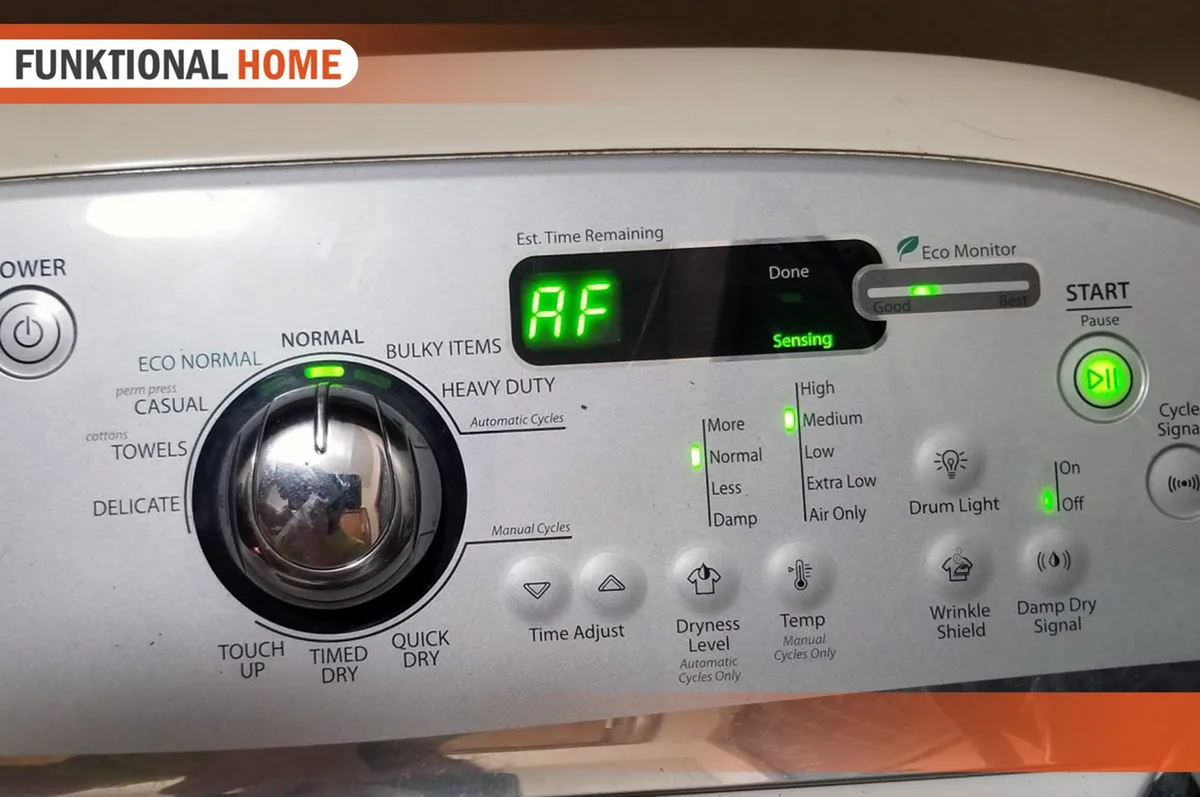
Image source: Bing (Web (fair-use with source credit))
Step 1: Identify your model
Look at the model number sticker inside the lid or on the back panel. The first four digits tell you the year of manufacture. For example, a model starting with "MHC" is likely a 2008, 2010 build.
If you see a "WR" prefix, it is a later model.
Step 2: Choose your entry method
Based on the model year, use the table below.
| Model Group | How to Enter Diagnostic Mode |
|---|---|
| First-gen (2007–2010) | Unplug machine. Plug it back in. Turn dial to "Spin Only". Push Start once. Immediately rotate dial to "Rinse". The LEDs will blink the last stored error code. |
| Second-gen (2011–2014) | Turn dial to "Drain and Spin". Press Start three times within five seconds. The control panel will flash all LEDs briefly, then show the error code. |
| Third-gen (2015–2019) | Press and hold "Soil Level" and "Temp" at the same time for five seconds. Release. The machine will enter a test cycle that runs each component. Watch for flashing error codes during the test. |
| Fourth-gen (2020+) | Close the lid. Press Power. Press Start. Wait for the lid to lock. Then press and hold "Temp" and "Spin Speed" together for three seconds. The display will show "E" followed by a number. |
Step 3: Read and write down the code
If your model uses blinking LEDs, count the number of flashes for each light. Write them down in order. For example: two flashes of Soil Level, then three flashes of Spin.
That pattern is F23.
For digital display models, the code appears as a two-digit number. Wait for it to repeat twice to confirm you read it correctly.
Step 4: Look up the code
Use the code lookup table in the Core Explanation section above. Match the code to the likely cause.
Step 5: Clear the code
After you write down the code, you can clear it by entering diagnostic mode again and pressing the Cancel or Power button. Or just unplug the machine for five minutes. The code will clear, but the underlying problem will return unless you fix it.
Common mistakes during this step
- Pressing buttons too slowly. The five-second window is tight.
- Not closing the lid fully before entering diagnostic mode.
- Trying to read the code while the machine is running a cycle. You must interrupt the cycle first.
Once you have the error code, you move to the appropriate decision branch. For the most common error, F21, here is exactly what to do.
Decision Branch 1: Won't Drain or Spin — F21, F28, or Just Stops Mid-Cycle
This is the number one reason people search for Cabrio troubleshooting. The machine fills with water, runs the wash agitation, then stops. It won't drain, it won't spin, and the clothes sit in a cold puddle.
The error code will likely be F21 (slow drain) or F28 (lid lock problem). But sometimes the machine stops without a code at all. Here is the decision tree.
If the error code is F21 (slow drain)
The board detected that the water level did not drop within eight minutes. The drain pump is either clogged, dead, or the hoses are blocked.
Follow these steps in order:
- Unplug the machine, Safety first. You are about to open the pump.
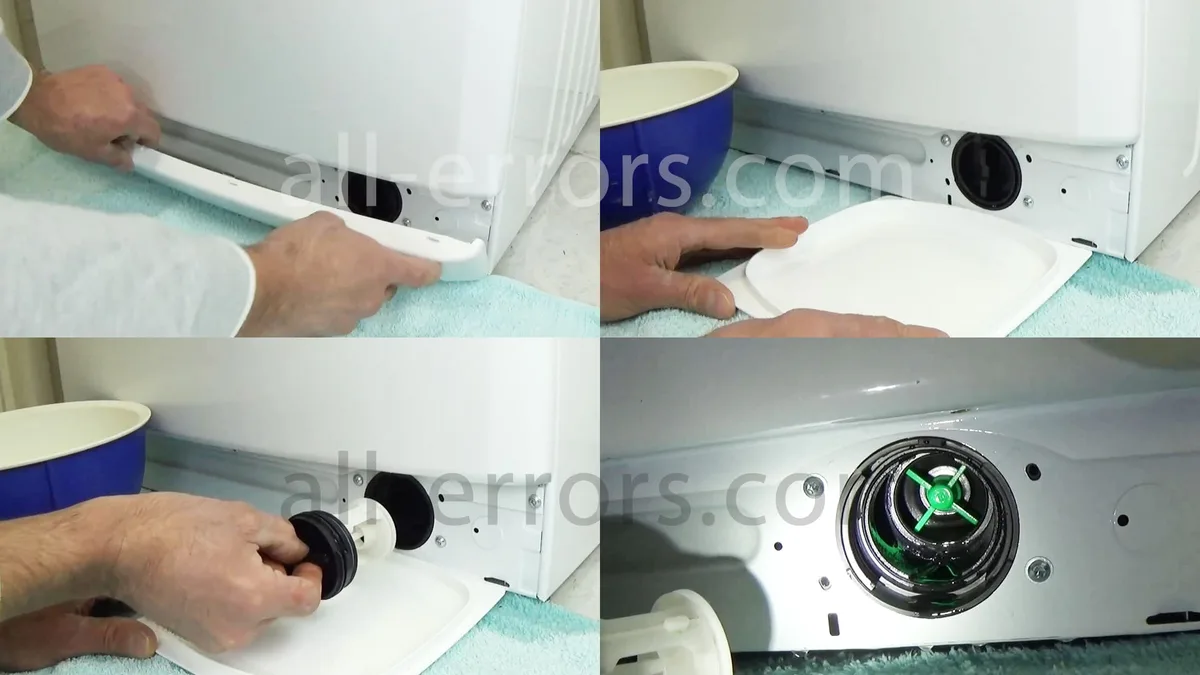
- Access the drain pump, Lay the machine on its side or remove the lower access panel on the front. Most Cabrio top-loaders have a plastic panel held by two Phillips screws near the bottom front.
- Remove the pump cover, Once the panel is off, you will see the drain pump housing. There is a black rubber drain hose attached to it. Remove the clamp and pull the hose off slowly. Water will spill out. Have a shallow pan ready.
- Check the pump impeller, Reach into the pump housing with your fingers. You are feeling for debris. Socks, coins, Bobby pins, and small toys are common culprits. Pull out anything you find.
- Inspect the pump impeller blades, If the blades are broken or jammed, the pump will not move water. Replace the pump if the blades are damaged.
- Reassemble, Clean the rubber gasket, reattach the hose, tighten the clamp, replace the access panel, plug the machine in, and run a drain and spin cycle.
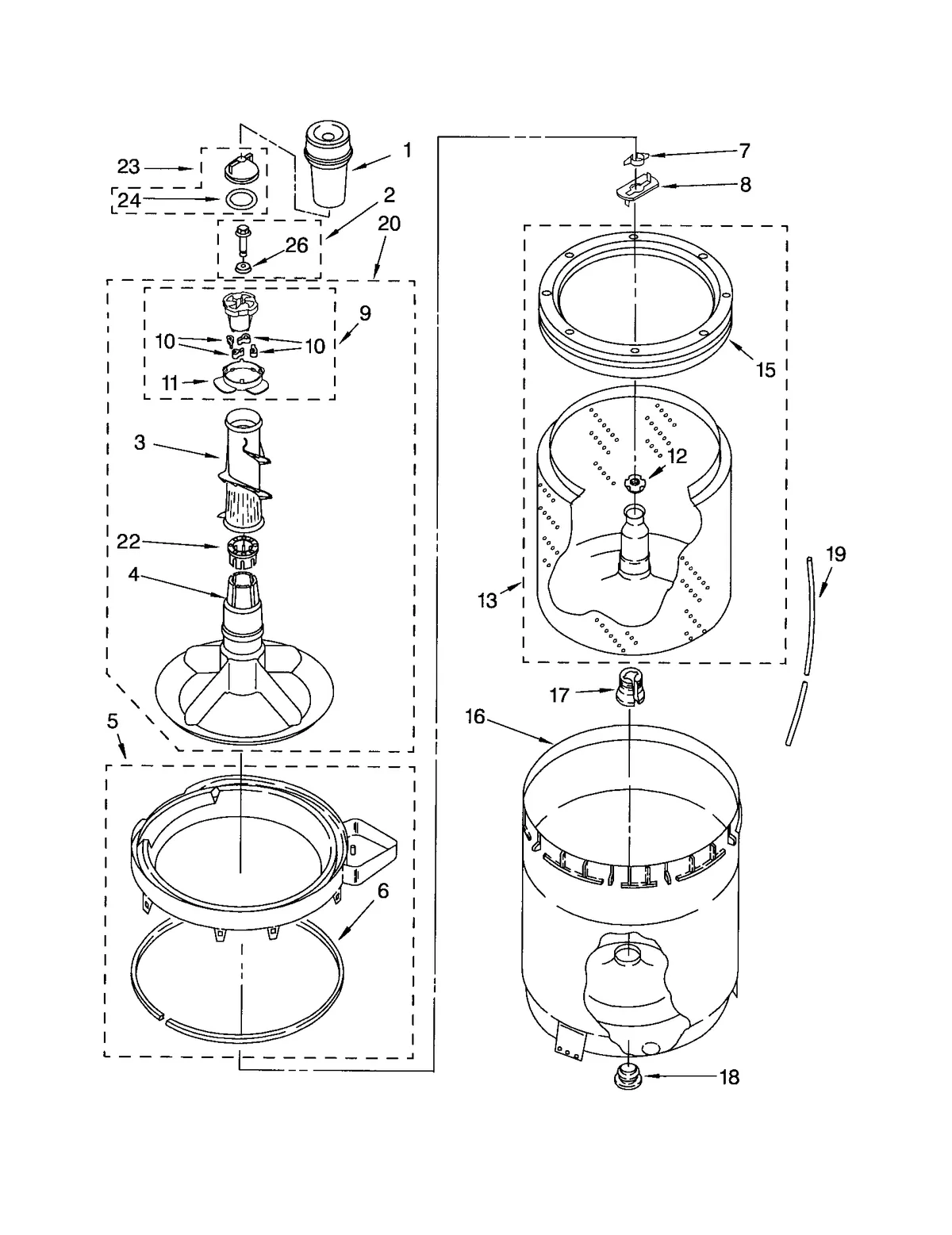
Image source: Bing (Web (fair-use with source credit))
If the pump was clean and the impeller is intact, the pump motor itself may be dead. You can test it with a multimeter set to ohms. A working pump motor should show between 10 and 30 ohms across the two terminals.
If you get infinite resistance, the motor is burned out.
If the error code is F28 (lid lock circuit problem)
The lid lock did not engage or disengage properly. That prevents the machine from entering the spin cycle.
- Listen for the click, When you close the lid and press Start, you should hear a mechanical click after a few seconds. That is the lock engaging. If you hear nothing, the lock is dead.
- Check the wiring harness, Unplug the machine. Remove the lid lock assembly (it is usually a small plastic module near the front edge of the lid opening). Look at the wires. Corrosion or a broken wire is common in humid climates.
- Test the switch with a multimeter, Set the meter to continuity (ohms). With the lid open, the switch should show infinite resistance. Close the lid (or press the plunger manually). The resistance should drop to near zero. If it doesn't, replace the lid lock assembly.
- Reset the lock, Sometimes the lock gets stuck halfway. Tap it gently with a screwdriver handle. If it frees up, you may only need to lubricate the mechanism with silicone spray. Otherwise, a replacement part costs around $25 to $40.
If the machine just stops mid-cycle with no error code
This is tricky. The board is not smart enough to throw a code for every failure. Likely candidates are:
- Overfilling, The water level sensor hose has come loose or is clogged. Unscrew the hose from the pressure sensor and blow through it. Reconnect.
- Motor thermal overload, The motor got too hot and shut itself down. Wait 30 minutes. Try again. If it works, the machine is fine. If it trips again, the motor has internal shorts.
- Control board failure, Less common but possible. Look for visible burn marks on the board. A replacement control board runs $75 to $150.
For any of these, if you are not comfortable testing electronics, call a technician. But 80% of the time, the fix is a clogged pump or a failed lid switch. Those are safe and easy DIY repairs.
Decision Branch 2: Loud Noises (Grinding, Screeching, Banging) — Clutch vs. Rotor Sensor
Loud noises during the spin cycle are unnerving. They also tell you exactly which part is failing if you listen carefully.
Grinding noise during spin
That grinding sound almost always points to the clutch assembly on belt-drive models. The clutch sits between the transmission and the wash basket. Its job is to engage the basket slowly so it doesn't lurch forward.
Over time, the friction material wears down.
When it goes, you hear metal on metal. The machine may still agitate fine, but when it tries to spin, it grinds and shudders.
To confirm, remove the belt cover on the underside of the machine. Look at the clutch. If you see shiny metal surfaces where there should be friction material, replace the clutch assembly.
It costs about $40 to $80. The job takes about one hour if you are comfortable with a socket wrench.
Screeching noise during spin
High-pitched screeching is different. That is usually a bearing failure in the rotor position sensor or the motor itself.
On direct-drive models (most Cabrios from 2012 onward), the motor connects directly to the wash basket without a belt. The rotor position sensor sits inside the motor housing. When the bearings dry out, they screech.
You can test this by spinning the basket by hand. If you hear a scraping sound, the bearings are gone. That means a new motor assembly, which runs $150 to $250.
It is a more involved repair.
Banging noise during spin
Banging is the easiest to fix. It means the load is unbalanced. The machine tries to redistribute the clothes during spin.
If it can't, it bangs against the outer tub.
Stop the cycle. Open the lid. Rearrange the clothes evenly around the basket.
Reduce the load size if you have heavy items like towels mixed with light items like t-shirts.
If the banging happens every cycle regardless of load, the suspension springs or shock absorbers may be worn out. Check the springs on the top corners of the machine. If they are stretched or broken, replace them.
Decision Branch 3: Lid Lock Stuck or Flashing — When It's the Switch vs. the Control Board
A flashing lid lock light is frustrating. The machine won't start, and you cannot open the lid to get your clothes out.
How to manually unlock the lid
Every Cabrio has a manual unlock mechanism. Look for a small plastic tab near the front edge of the lid opening. Slide it sideways while lifting the lid.
If you can't reach it, use a thin screwdriver to push the latch mechanism.
On some models, there is a pull cord under the top panel. Remove the two screws at the back of the top panel, tilt it forward, and look for a white plastic tab or string. Pull it gently to release the lock.
Test the lid switch
Once the lid is open, test the switch. Unplug the machine. Remove the lid lock module (two screws, usually).
Use a multimeter set to continuity.
With the lid open, the switch should show infinite resistance. Press the plunger in manually. The resistance should drop to near zero.
If it doesn't, replace the switch assembly.
If the switch tests fine, the problem may be the wiring harness. Look for broken or corroded wires at the connector. Clean the connector with electrical contact cleaner.
Reconnect and test.
When the control board is the problem
If the switch and wiring are fine but the lid lock light still flashes, the control board may have a bad relay. This is rare but possible.
Check the board for visible damage. Look for burned spots, bulging capacitors, or a burnt smell. If you see these, replace the control board.
A new board costs $75 to $150. You can find them on Whirlpool's parts site.
One more thing: on some Cabrio models, the lid lock has a self-cleaning cycle. If the machine was recently moved or stored, the lock may be stuck from dust. Spray silicone lubricant into the latch mechanism and cycle the lock ten times manually.
That often frees it up.
Mistakes to Avoid / Common Errors: The Three Fixes That Make It Worse
A few well-intentioned fixes can turn a small problem into a big one. Avoid these.
Mistake 1: Bypassing the lid switch
It is tempting to jumper the lid switch with a paperclip so the machine runs with the lid open. Do not do this. The lid lock is a safety device.
If the machine starts spinning with the lid open, someone can get seriously hurt. Also, the control board monitors the lock circuit. If it sees a short, it will throw a new error code.
Mistake 2: Replacing parts without reading the code
People often replace the drain pump first because it is easy to access. But if the error code is F28 (lid lock), a new pump does nothing. You waste money and time.
Always read the error code first. It takes two minutes.
Mistake 3: Overfilling the machine after a drain fix
After you clear a clog in the drain pump, the machine may drain normally. But if you overfill the tub with too many clothes, the pressure sensor can't measure the load correctly. The machine may stop again with an F35 code.
Keep loads at or below the maximum fill line marked inside the basket.
Safety / Warnings: What to Unplug and What Not to Stick Your Hand Into
Working on a washing machine is generally safe if you follow a few rules.
Always unplug first
Unplug the machine from the wall outlet before you touch any electrical component. Do not just turn the dial to Off. The control board still has power.
Unplug it.
Discharge the capacitors
After unplugging, wait five minutes. The capacitors on the control board can hold a charge for several minutes. A shock from a capacitor is painful even though the voltage is low.
Give it time to discharge.
Do not stick your hand into the drain pump while the machine is plugged in
This seems obvious, but people do it. The pump impeller can start spinning if the board sends power. Always unplug.
Heel strap
Cabrio top-loaders have a plastic heel strap that prevents the machine from tipping forward during spin. If you remove the lower access panel, check that the heel strap is still attached. Reinstall it if it is loose.
A falling machine can cause serious injury.
When to call a technician
- If you see smoke or smell burning
- If the machine trips the circuit breaker every time you plug it in
- If you are not comfortable testing live electronics
- If the error code points to a control board failure and you cannot find the correct replacement part
These situations are rare. Most Cabrio repairs are safe to do yourself. Just use common sense.
Frequently Asked Questions
Why is my Cabrio washer blinking all lights at once?
This usually means the machine is in diagnostic mode or has lost power during a cycle. Unplug the machine for five minutes. Plug it back in.
If the lights stop blinking, the machine reset successfully. If they continue, the control board may be faulty.
How do I force my Cabrio to drain if it's stuck?
Unplug the machine. Remove the lower access panel. Find the drain pump hose.
Remove the clamp and let the water drain into a shallow pan. You can also use a wet/dry vacuum to suck water out through the drain hose. Do not try to open the lid while the tub is full.
Cabrio F51 error code: what does it mean and how to fix it?
F51 means the motor controller lost communication with the main board. First, unplug the machine for five minutes. If the error returns, check the wiring harness between the motor and the control board.
Loose connections are common. If the harness is fine, the motor controller may need replacement. That costs $100 to $200.
Can I run my Cabrio without the lid lock?
No. The machine will not spin or drain if the lid lock circuit is broken. Bypassing the lock is unsafe and can cause the machine to start spinning with the lid open.
Replace the lock assembly instead.
My Cabrio fills with water but does not agitate. What's wrong?
The water level sensor may not have detected enough water. Check the air hose connected to the pressure sensor. If it is clogged or disconnected, the machine thinks the tub is empty and will not start the motor.
Also check that the hot and cold water supply valves are fully open.
How long should a Cabrio washing machine last?
With proper maintenance, a Cabrio top-loader typically lasts 8 to 12 years. The most common failures (lid lock, drain pump, clutch) happen between years three and seven. These are all repairable.
If the motor or transmission fails after year 10, replacement is usually more cost-effective.
Final Recommendation / Decision Guide: Repair It, Replace It, or Call Someone
Here is how to decide based on the situation.
Repair it yourself (safe and cost-effective)
- Error code F21 with a clogged pump, clean it out. Cost: $0.
- Error code F28 with a failed lid switch, replace it. Cost: $25 to $40.
- Grinding noise from a worn clutch, replace the clutch assembly. Cost: $40 to $80.
- Unbalanced load banging, redistribute clothes. Cost: $0.
Call a technician (worth the cost)
- Error code F51 that returns after checking wiring, motor controller replacement.
- Screeching noise from motor bearings, motor replacement.
- Control board failure with visible burn damage, board replacement.
- Any repair if you are not comfortable with a multimeter or basic hand tools.
Replace the machine (when repairs exceed value)
- The machine is over 10 years old.
- Multiple components have failed (motor and transmission).
- The tub or basket is cracked.
- A repair quote exceeds half the cost of a new machine.
A new Cabrio or equivalent top-loader costs $600 to $900 as of 2026. If you spend $300 on a repair on a 12-year-old machine, you may get another two years out of it. That is often worth it.
But if a second failure happens shortly after, replacement makes more sense.
Use the decision tree from this guide. Read the error code. Follow the branch.
Fix what is broken. Most Cabrio problems are simple, cheap, and safe to fix yourself. You just need to know where to look.

Similar Posts