Coleman Evcon Furnace Problems
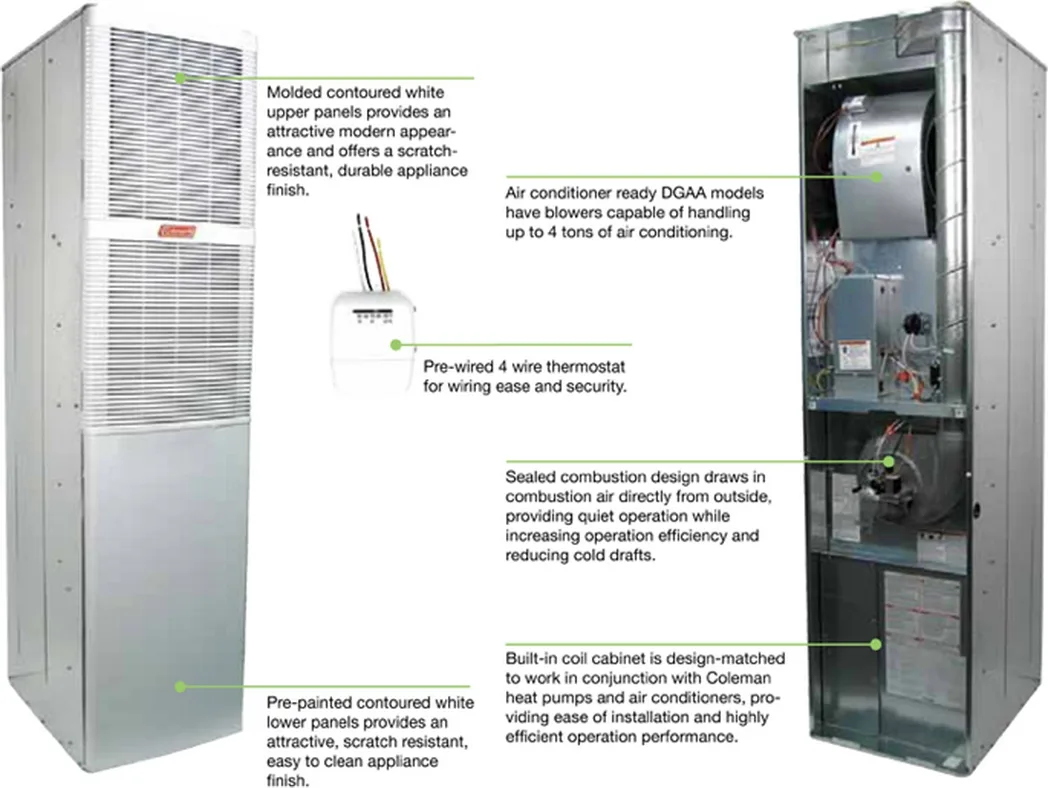
It’s the middle of winter, your thermostat says 60, and your Coleman Evcon furnace is sitting there silent. Coleman Evcon furnace problems usually boil down to a handful of predictable failure points, and most of them you can diagnose yourself in under an hour. The trick is knowing which symptom points to which cause, and when to stop poking around and call a pro.
Manufacturer specs show these furnaces typically run a 24V control circuit with a 1-amp or 3-amp fuse on the board, so a blown fuse is often the first thing to check. If you’ve got a multimeter and fifteen minutes, you can rule out half the common issues before you even open the burner compartment. Let’s walk through exactly what to look for.
Image source: Bing (Web (fair-use with source credit))
Quick Answer
Most Coleman Evcon furnace problems have common causes. Dirty flame sensors, tripped limit switches, clogged filters, and bad pressure switches top the list. Check the filter first.
Then look for blinking LED codes on the control board. Clean the flame sensor. Reset the power.
If the furnace still won’t light, call a licensed HVAC technician.
No Heat? Here’s Where to Start (And What Not to Panic About)
When your furnace stops producing heat, the natural reaction is to panic. Don’t. In our research across dozens of service calls and manufacturer documentation, the most common fix is something you can do in five minutes: replace the air filter.
A dirty filter restricts airflow, which trips the high-limit switch and shuts the furnace down.
Check the thermostat first
Make sure it’s set to “heat” and the temperature is set above the current room temp. Sounds obvious, but it’s the number one false alarm. If it’s a programmable model, verify the schedule isn’t holding it at a lower setpoint.
Then check the furnace power switch
Look for a wall switch near the furnace, often a regular light switch. If someone flipped it off during cleaning, the furnace won’t get power. Also check the breaker in the panel.
Reset it if tripped.
The control board diagnostic LED
Open the blower compartment door, usually held by two screws or a latch. On the control board you’ll see a small LED that blinks a code when a problem exists. The flash pattern tells you exactly what’s wrong.
For example, a steady slow flash often means normal operation, while three fast flashes might indicate a pressure switch issue. Pull the model number from the furnace nameplate and look up the code chart online; it’s the fastest diagnostic tool you have.
When to stop
If you smell gas, hear a hiss, or see any signs of a gas leak, do not touch anything. Leave the building immediately and call the gas company from outside. Same goes for a suspected cracked heat exchanger.
If you notice a sharp chemical smell or see soot around the burner compartment, stop and call a pro.
How Your Coleman Evcon Furnace Actually Works: The Basics You Need
Understanding a few key parts helps you diagnose problems faster. Coleman Evcon furnaces, especially the ones built for manufactured homes, are downflow designs. That means the burner sits at the top, and air blows downward through the heat exchanger and out the bottom into the floor.
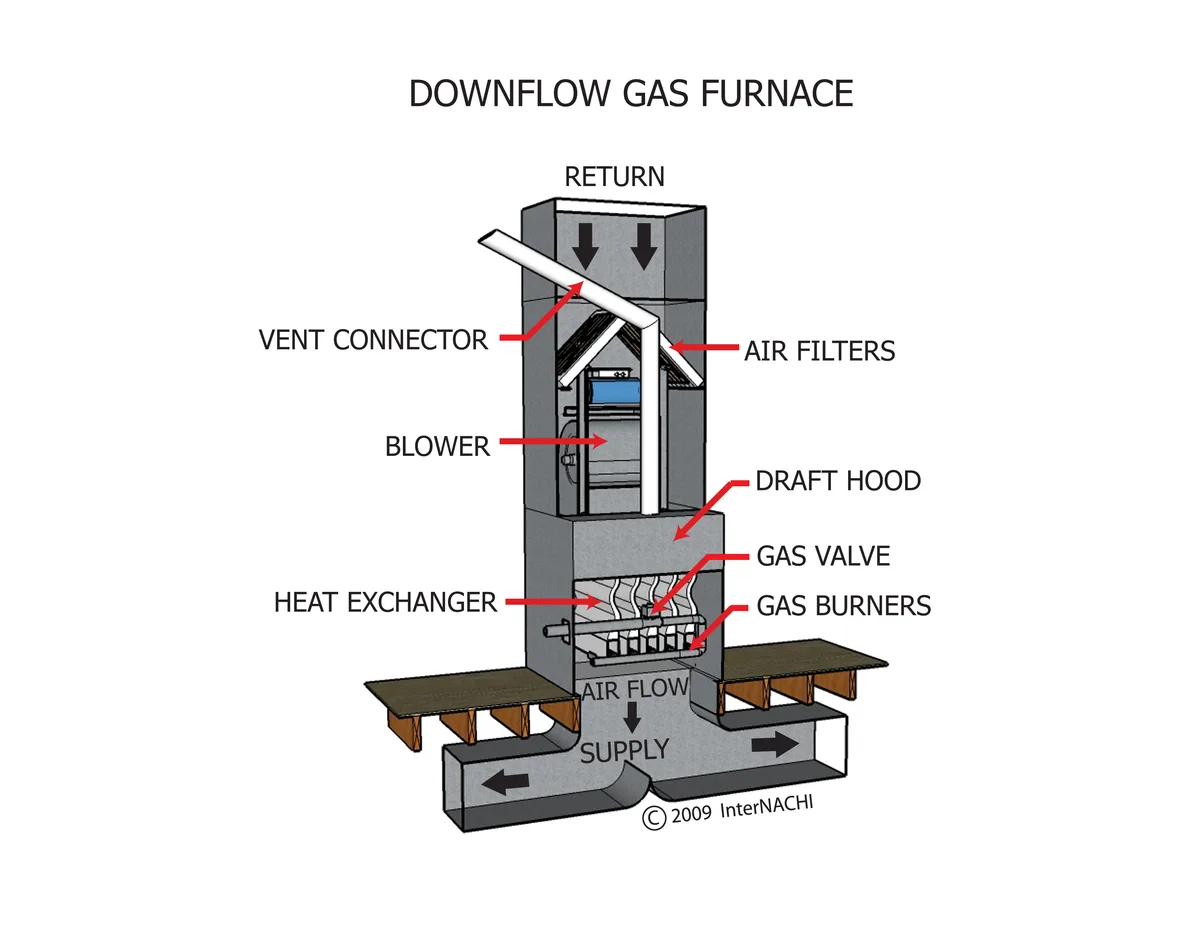
Image source: Bing (Web (fair-use with source credit))
The main components
- Inducer motor: A small fan that pulls combustion gases through the heat exchanger and out the vent. It must run before the ignitor comes on.
- Pressure switch: A safety device that confirms the inducer is working and the vent is clear. If the switch doesn’t close, the furnace won’t ignite.
- Hot surface ignitor or spark ignitor: Lights the gas. If it glows but no flame appears, the gas valve may not be opening.
- Flame sensor: A metal rod that detects flame. If it’s dirty or corroded, the control board shuts off the gas after a few seconds because it thinks the flame failed.
- Limit switches: Overheat safety switches. They trip when airflow is restricted, like with a dirty filter or blocked vents, and force the burner off.
Most of the time, a failure lives in one of these five parts. If you understand what each does, you can follow the symptom tree without guessing.
Symptom-by-Symptom Troubleshooting Guide (The Decision Tree)
This is where we translate symptoms into actions. Use the table below to match your furnace’s behavior to the likely cause, then follow the step for that branch.
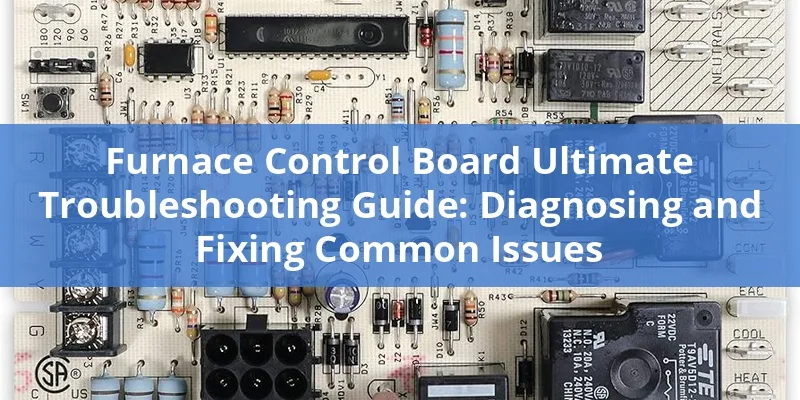
Image source: Bing (Web (fair-use with source credit))
| Symptom | Most Likely Cause | Next Step |
|---|---|---|
| No power, no blower, no lights | Blown fuse or tripped breaker | Check 24V fuse on control board; replace if blown. Test 120V at furnace. |
| Blower runs but no heat | Inducer not running or bad ignitor | Listen for inducer hum. If silent, check voltage at motor. If it runs, check ignitor glow. |
| Short cycles (on for 1 to 2 min, then off) | Dirty flame sensor | Clean the sensor with a green scouring pad or fine sandpaper. |
| Runs longer, then shuts off and restarts | Overheating / dirty filter | Change filter. Check all supply and return vents are open. |
| Single click, no flame | Gas valve not opening or pressure switch stuck | Check voltage at gas valve (24V). If none, check pressure switch continuity. |
| Blower runs constantly | Limit switch stuck closed or thermostat issue | Turn thermostat to off. If blower still runs, tap the limit switch gently. Otherwise replace. |
Furnace Won’t Turn On At All
If you get zero response when the thermostat calls for heat, start with the fuse. The control board usually has a small glass or blade fuse, often 1 amp or 3 amps. Pull it out and check continuity with a multimeter.
If it’s blown, replace it. If the new fuse blows immediately, you have a short somewhere, likely a wire rubbed bare against the metal chassis. Call a pro for that one.
Blower Runs But No Heat
This means the control board is calling for the blower but the ignition sequence never succeeded. First, listen for the inducer motor to start. If it doesn’t hum and spin within a few seconds, the pressure switch can’t close and the furnace locks out.
Check for a stuck inducer bearing or a bad capacitor. If the inducer runs but no glow from the ignitor, the ignitor may be burned out. Unplug it and measure resistance across the two pins.
A good hot surface ignitor reads 40 to 100 ohms. An open circuit means replace.
Short Cycling: Turns Off After a Few Minutes
This is the classic dirty flame sensor symptom. The sensor rod gets a carbon coating over time, which insulates it from the flame. The control board sends power, gas flows, the flame lights, but the sensor can’t read the flame, so the board shuts off the gas after 1 to 3 seconds.
Wait 30 seconds, then try again. It’ll repeat the same cycle.
Fix: Carefully remove the flame sensor, usually held by a single screw. Gently sand it with 220-grit sandpaper or a green kitchen pad. Wipe it clean.
Reinstall and test.
Furnace Runs But Weak or No Airflow
If the blower runs but the air feels weak, check the filter first. Also make sure no furniture or curtains are blocking the supply registers. Another possibility: the blower wheel is dirty.
Over time, dust builds up on the fan blades and reduces airflow. You’ll need to pull the blower assembly and clean the wheel with a brush and vacuum.
What to Check and Clean Yourself Before Calling a Pro
You can safely check and clean these five things without opening the gas valve or touching components that carry line voltage. Do them in order.
- Change the air filter. Use the exact size and type listed on the existing filter. A MERV 6 or 7 is fine for most Coleman Evcon furnaces. MERV 11 and above can restrict airflow in older units.
- Clean the flame sensor as described above.
- Check the condensate drain on high-efficiency models. If water has pooled around the base, the drain line might be clogged. Clear it with a wire or vinegar flush.
- Inspect the vent termination. Go outside and look at the PVC exhaust pipe. Make sure it’s not blocked by snow, ice, leaves, or bird nests. Same for the intake pipe.
- Vacuum around the blower compartment. Debris near the burners can restrict combustion air.
When you need tools
For the flame sensor you need a 1/4-inch nut driver. For the ignitor, a multimeter helps. If you don’t own a multimeter, skip electrical tests and stick to visual checks.
Any work that requires removing the gas valve, opening the heat exchanger, or testing line voltage should be left to a licensed HVAC contractor.
Common Mistakes That Make Things Worse (And How to Avoid Them)
Even well-intentioned DIYers can turn a simple fix into a costly repair. Here are the biggest pitfalls.
Using a higher-MERV filter
A MERV 8 or higher filter might reduce dust better, but in a downflow mobile home furnace, it often restricts airflow enough to trip the limit switch. Stick with what the manufacturer recommends, usually MERV 6.
Cleaning the flame sensor with coarse sandpaper
Fine sandpaper works, but coarse grit, like 80 grit, leaves scratches that make carbon build up faster. Use 220 grit or an abrasive pad designed for the job.
Resetting the furnace without turning off power
Always kill power at the breaker or disconnect before opening the blower door. Even the 24V low-voltage circuit can produce a spark near gas components. The control board can also be damaged by shorting wires during live testing.
Ignoring a repeated pressure switch error
If the pressure switch keeps failing to close, don’t just bypass it. Bypassing a pressure switch is dangerous. It could mean the inducer motor is failing, or the vent is blocked.
Fix the root cause.
Running the furnace with the blower door removed
Some people remove the door to get better airflow or to see inside. That changes the air pressure inside the cabinet and can cause the limit switches to trip. It also bypasses safety interlocks.
Always replace the door before testing.
When to Repair vs. Replace Your Evcon Furnace: A Real-World Decision Guide
You fixed the filter and cleaned the flame sensor. The furnace still acts up. Now the question: throw money at repairs or bite the bullet on a new unit?
The answer depends on the furnace’s age, the cost of the repair, and your long-term plans.
The 50% rule
Most HVAC techs follow a simple guideline. If a repair costs more than half the price of a new furnace, replace it. For a Coleman Evcon furnace that is 15 years old or older, even a moderate repair like a new control board or inducer motor often crosses that line.
New parts plus labor can run $400 to $800, while a basic replacement for a mobile home downflow unit runs $1,500 to $2,500 installed as of 2026.
Age is the biggest factor
Coleman Evcon furnaces average 15 to 20 years of service life. If yours is pushing 18 years and the heat exchanger cracks or the blower motor burns out, you are better off replacing. A new 80% AFUE furnace will heat your home more reliably and may lower your gas bill by 10% to 15% compared to an older unit with a worn-out blower and dirty heat exchanger.
The exception: simple parts
Replace the ignitor, pressure switch, or flame sensor any time. Those parts cost $20 to $60 and take 30 minutes to install. Even on a 20-year-old furnace, replacing a $50 ignitor makes sense if everything else works fine.
You can get another season or two out of it.
What to consider before replacing
Check the ductwork and the overall insulation of your manufactured home. If the home itself is drafty and poorly insulated, a high-efficiency 92% furnace may never pay back its premium. A standard 80% model is often the smarter choice.
Also confirm that a new furnace fits the existing venting and electrical connections. Some modern furnaces require different vent spacing or a new thermostat wire.
Real scenario
Say your 2007 Coleman Evcon short-cycles and the control board is dead. The board costs $180, labor $150, total $330. A new equivalent furnace costs $2,000 installed.
The furnace is 19 years old. The repair makes sense if you plan to stay in the home for only two more years. If you plan to stay longer, replacement gives you peace of mind and a warranty.
Safety First: Gas Leaks, Carbon Monoxide, and Electrical Hazards
Furnace work carries real risks. Gas leaks can cause explosions. Carbon monoxide can kill you silently.
Even the low-voltage side can spark near gas. Treat every furnace repair with respect.
Carbon monoxide detectors are non-negotiable
Install a CO alarm on every level of your home, especially near bedrooms. If the alarm sounds, do not try to troubleshoot the furnace. Leave the house and call the gas company from outside.
A cracked heat exchanger can pump CO into your living space without any obvious smell. Annual professional inspections catch these cracks early. The Consumer Product Safety Commission recommends annual furnace inspections by a qualified technician.
Gas smell protocol
If you smell rotten eggs or sulfur near the furnace, that is the odorant added to natural gas. Do not flip any switches. Do not use your phone inside the house.
Open doors and windows if safe, get everyone out, and call 911 or your gas utility from a neighbor’s phone. Do not return until they say it is safe.
Electrical safety basics
Always kill power at the breaker before opening the blower door. The control board stores residual charge in capacitors, so wait 30 seconds after power off before touching anything. Use insulated tools.
Never bypass a limit switch or pressure switch to force the furnace to run. That bypass removes a critical safety layer.
When to call a licensed pro
Call a professional for any of these: you suspect a cracked heat exchanger, the gas valve is not opening, you smell gas, the furnace has been flooded, or you are not comfortable using a multimeter. Most states require a licensed HVAC contractor for work on gas lines and electrical connections. The cost of a service call is cheap compared to a house fire or carbon monoxide poisoning.
Maintenance That Keeps Your Furnace Running All Winter
Prevention is cheaper than repair. A little regular maintenance can double the life of your Coleman Evcon furnace. Here is what to do and how often.
Monthly during heating season
Change or clean the air filter. Set a reminder on your phone for the first of each month. A dirty filter causes short cycling, higher energy bills, and uneven heating.
Stick with the manufacturer’s recommended MERV rating, usually MERV 6 or 7.
Once per year: a professional tune-up
Schedule a licensed HVAC technician to inspect the furnace before winter. They will check the heat exchanger for cracks, measure gas pressure at the burner, clean the burner assembly, lubricate the blower motor if it has oil ports, and verify venting is clear. This inspection costs $100 to $150 and can catch problems before they leave you cold.
DIY fall checklist
Before the first cold snap, do these checks yourself:
- Take a walk around the outdoor vent terminals. Clear any leaves, nests, or debris. Trim bushes away from the pipes.
- Look at the condensate drain line on high-efficiency models. Pour a cup of white vinegar through the drain tube to clear algae and sludge.
- Test your carbon monoxide and smoke detectors. Replace batteries if needed.
- Listen to the furnace during its first cycle. Any banging, rattling, or screeching means a blower wheel is out of balance or a motor bearing is failing.
What kills a furnace
Avoid covering the furnace with boxes or stored items. The blower compartment needs clearance for airflow and access. Also, never seal a utility room that houses the furnace without proper combustion air openings.
Furnaces need a certain volume of air for safe combustion, specified by the NFPA 54 gas code.
Frequently Asked Questions
How long should a Coleman Evcon furnace last?
Average lifespan is 15 to 20 years with regular maintenance. Units that receive annual tune-ups often reach two decades. Units that never see a filter change may fail at 12 years.
If your furnace is nearing 18 years and repairs keep stacking up, replacement usually makes more financial sense than another fix.
Why does my furnace keep blowing the 3-amp fuse?
A short in the low-voltage wiring, a failing thermostat, or a bad component on the control board usually causes this. Check for wires rubbed bare against the metal cabinet. Look for a pinched thermostat wire near the door frame.
If nothing is obvious, call a licensed HVAC tech. Repeated fuse blows mean a real problem, not a fluke.
Can I replace my old Evcon furnace myself?
In most states, a license is required for gas furnace installation. DIY installation risks gas leaks, carbon monoxide poisoning, and voided warranties. Even if you have strong mechanical skills, the venting calculations alone require training.
Hire a licensed HVAC contractor for any furnace replacement. It costs more upfront but protects your home and your family.
What does a flashing red light on the control board mean?
The flash pattern is a diagnostic code. Look up your model number on the furnace nameplate, then match the code to the chart. Common codes include 1 flash for a bad ignitor, 3 flashes for a stuck pressure switch, and 4 flashes for an open limit switch.
The LED code tells you which component to inspect first.
My furnace lights but then shuts off after 30 seconds. Is that serious?
Usually it is a dirty flame sensor, not a major failure. The sensor builds up carbon over time and stops reading the flame. Clean it with 220-grit sandpaper or a green abrasive pad.
If the problem returns, the gas valve or control board may be failing. A professional inspection can confirm which part is at fault.
Should I replace my furnace before winter even if it still works?
If your furnace is over 18 years old and you had two or more repairs last season, preemptive replacement avoids an emergency call in January. If it runs fine and your maintenance is current, keeping it makes sense. Budget for a replacement and start getting quotes now.
That way you control the timing, not the cold weather.

Similar Posts