Do Air Purifiers Help With Eczema Triggers
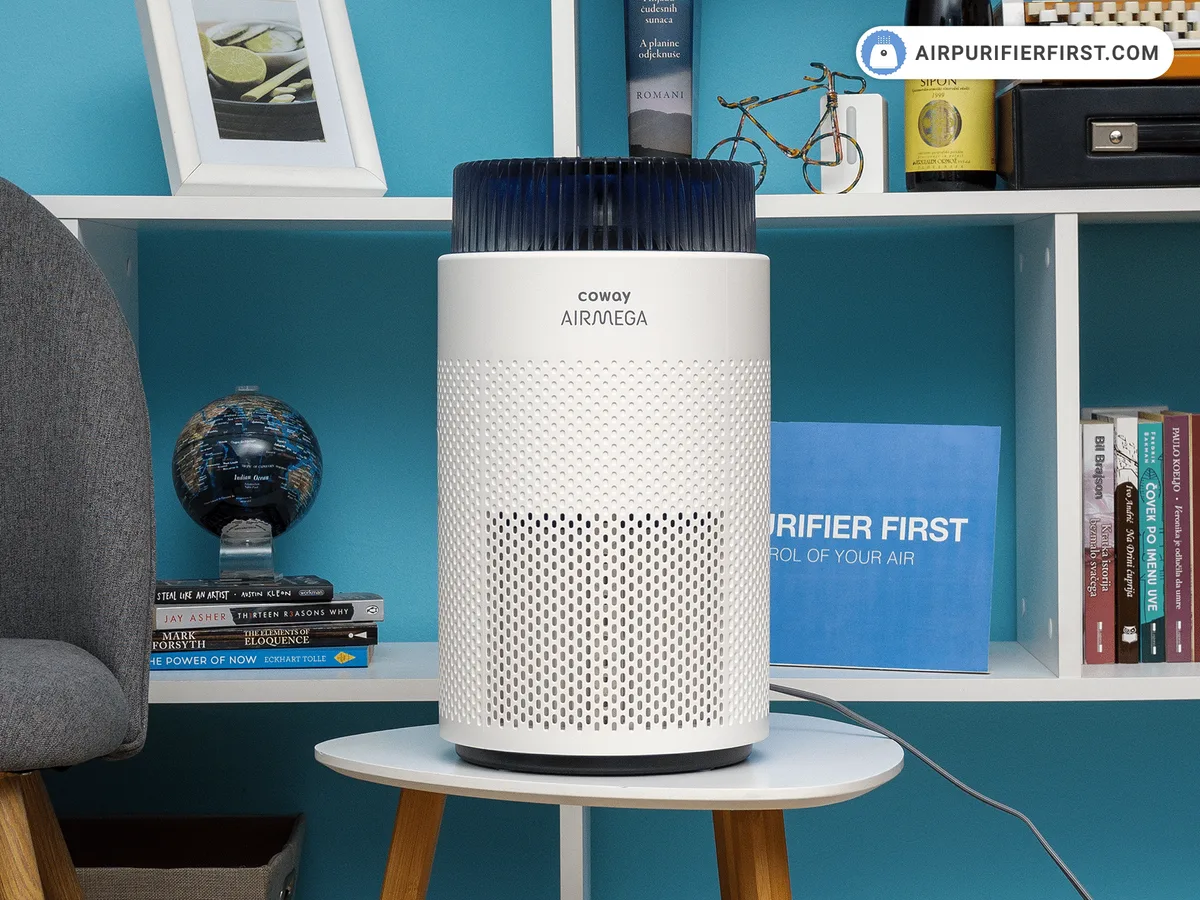
Dust mites, pet dander, pollen floating through your bedroom at 3 a.m. If you've ever searched "Do Air Purifiers Help With Eczema Triggers," you've probably seen confident yeses and flat-out nos. The honest answer sits in between: yes, but only for airborne triggers.
No for contact triggers, food allergies, or dry skin alone.
In our research, the data backs this up. The Environmental Protection Agency's indoor air quality guidance confirms that HEPA filters can meaningfully reduce airborne particulate matter. As of 2026, the Asthma and Allergy Foundation of America still includes HEPA filtration among its recommended allergen-control strategies.
The key is matching the right technology to your specific trigger profile.
Image source: Bing (Web (fair-use with source credit))
Quick Answer
Air purifiers help with airborne eczema triggers. Dust mites, pet dander, pollen, and mold spores are examples. They cannot help with contact triggers.
Choose a True HEPA purifier with zero ozone. Match the CADR to your room size.
The Short Answer: It Depends On Your Triggers
Eczema is a deeply personal condition. Your triggers are not your neighbor's. And most eczema triggers fall into two camps: airborne and non-airborne.
An air purifier can only address the first group.
Airborne triggers are things you breathe in that your immune system considers a threat. Dust mite particles, pet dander, pollen, and mold spores all belong here. They float in the indoor air, which a purifier can physically clean.
If your flare-ups show a pattern tied to seasons, pets, or dusty rooms, a purifier might genuinely help.
Non-airborne triggers are everything else. Laundry detergent residue on sheets. Nickel in jewelry or belt buckles.
Fragrances in shampoo. Eggs or peanuts in your diet. Stress, sweat, and hormonal shifts, too.
No filter removes those. You could run a high-end purifier and still flare up from scented lotion.
Here's the if/then logic that matters:
- If your skin improves when you sleep somewhere else, airborne triggers are likely contributing.
- If your flares appear after eating, wearing jewelry, or using a scented product, skip the purifier. It won't help.
- If you have eczema plus asthma or hay fever, the benefit is higher. The same airborne allergens drive all three.
Dust mites deserve special mention here. They're the most common environmental eczema trigger, yet they're not truly airborne. They live deep inside mattresses, pillows, and carpets.
They only lift into the air when you move or toss in bed. So a purifier helps capture what rises. The bigger win is allergen-proof mattress encasements and washing bedding above 130°F.
Per guidance from the American Academy of Dermatology, combining environmental controls beats any single measure.
Research on purifiers and eczema specifically is thinner than research on asthma. Most of the direct evidence comes from the allergy and asthma field, where HEPA filtration consistently reduces airborne allergen load. Dermatologists generally recommend it as a supportive measure, not a primary treatment.
That distinction matters when you're deciding how much to spend.
The bottom line: air purifiers are a yes for airborne triggers. They're a no for contact and food triggers. They're a tool, not a cure, and they work best as part of a layered approach.
Which Eczema Triggers An Air Purifier Can Actually Help With
Let's get specific about each trigger, because not all allergens behave the same in the air.
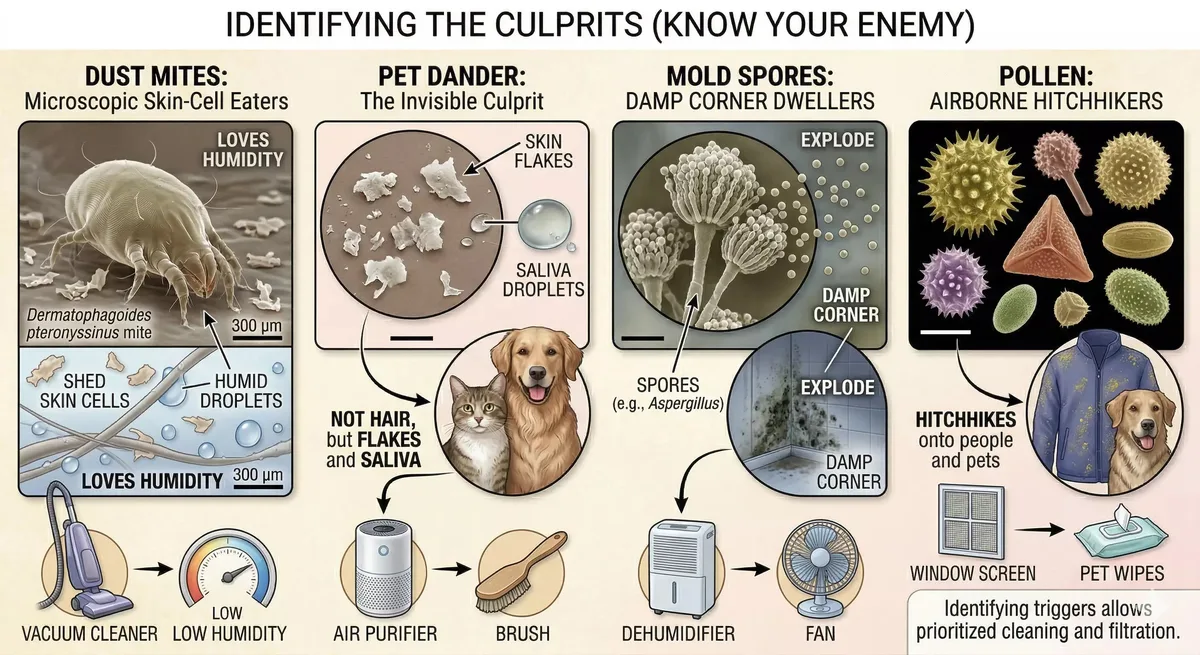
Image source: Bing (Web (fair-use with source credit))
Dust mite particles are the top environmental trigger for many eczema patients. They live in bedding, upholstery, and carpet, and they only become airborne when disturbed. A HEPA purifier will catch floating dust mite debris, but it won't reach the source.
Pair it with allergen-proof mattress and pillow encasements, and wash bedding in water at 130°F or hotter.
Pet dander is the strongest case for a purifier. Cat allergen (Fel d 1) is especially light and stays airborne for hours. Dog allergen (Can f 1) is heavier but still circulates.
A purifier in the bedroom gives you a dander-free zone even if the rest of the house is a fur factory. Bathing pets weekly and keeping them off the bed multiplies the effect.
Pollen sneaks in through open windows, door cracks, and on clothes. It's easy to remove from the air with HEPA filtration. If your eczema flares during spring or fall, a purifier running during pollen season can cut your exposure noticeably.
Mold spores grow in damp areas like bathrooms, basements, and window sills. Spores become airborne and can aggravate both eczema and asthma. A purifier catches them, but it doesn't fix the moisture problem.
You need to address the leak or humidity issue first, then run the purifier as support.
Smoke and VOCs are a different category entirely. A HEPA filter catches solid particles, like smoke particulate, but not gas-phase VOCs. Those need activated carbon.
If paint fumes, cleaning products, or cooking odors seem to trigger you, look for a unit with a substantial carbon layer.
Here's a quick reference table:
| Trigger | Airborne? | HEPA purifier help? | Real-world note |
|---|---|---|---|
| Dust mites | Yes, when disturbed | Yes | Use encasements plus hot-water washing |
| Pet dander | Yes | Yes | Best case for a purifier |
| Pollen | Yes | Yes | Most effective in seasons |
| Mold spores | Yes | Yes | Fix moisture problem first |
| Smoke / VOCs | Yes | Partially | Add activated carbon |
| Laundry residue | No | No | Contact trigger |
| Food allergens | No | No | Digestive or contact trigger |
One more thing worth knowing: the EPA's indoor air quality guidance highlights that indoor air can be two to five times more polluted than outdoor air. In homes with pets, carpets, or dampness, that number climbs higher. That's why the bedroom is the priority room for a purifier.
You spend a third of your life there, and you breathe that air for eight straight hours every night.
The Risks: When An Air Purifier Won't Help (And Could Make Things Worse)
Not every air purifier is safe for someone with eczema. In fact, some types could make your skin angrier.
The biggest risk is ozone. Ionizers and electrostatic precipitators generate ozone as a byproduct. Ozone is a known lung irritant, and it's also hard on skin.
There's no evidence it helps eczema. There's good reason to believe it can trigger irritation, especially in sensitive people. If the marketing says "ionizer," "plasma," "ionic breeze," or "ozone," walk away.
Look for CARB-certified, zero-ozone HEPA models instead. California's Air Resources Board sets strict ozone emission limits, and that certification is a solid safety marker.
Here are the other ways a purifier can let you down:
False security. This one is real and common. You buy a purifier, run it, and feel like you've solved the problem.
So you vacuum less. You wash sheets at lower temperatures. You skip the mattress encasement.
That's backwards. The purifier works best as a partner to source control, not a replacement for it.
Wasted money on the wrong size. A tiny tabletop purifier can't clean a large bedroom. You need a machine with a Clean Air Delivery Rate (CADR) that matches the room size.
Undersized units simply recirculate the air without cleaning it fast enough.
It won't fix dry air. Many eczema patients have drier skin in winter, and low humidity pulls moisture from your skin. An air purifier does nothing for humidity.
If dry air is a trigger for you, add a humidifier and keep indoor humidity between 30% and 50%.
It won't fix dust sources. Purifiers remove airborne dust but not dust sitting on shelves, floors, or inside bedding. You still need regular vacuuming with a HEPA-equipped vacuum, damp dusting, and weekly hot-water bedding washes.
It can't treat a contact trigger. If your eczema flares when your skin touches nickel, fragrance, or certain fabrics, no amount of air cleaning changes that. The purifier is irrelevant to those pathways.
| Risk | Why it matters | Safer alternative |
|---|---|---|
| Ozone from ionizers | Irritates skin and airways | True HEPA, CARB-certified |
| False sense of security | You relax on source control | Pair purifier with bed encasements |
| Wrong size unit | Room stays contaminated | Match CADR to room square footage |
| Dry air | Pulls moisture from skin | Add humidifier, monitor 30-50% |
| Contact triggers | Bypass the air entirely | Identify and remove the source |
What To Look For In An Eczema-Safe Air Purifier
Not all purifiers are created equal. For eczema, you want a few specific features and you want to skip a few others.
Start with True HEPA. That means the filter captures 99.97% of particles at 0.3 microns. Dust mite debris, pet dander, pollen, and mold spores all fall well within that range.
Choose "True HEPA" specifically, because "HEPA-like" or "HEPA-style" filters don't hold the same standard.
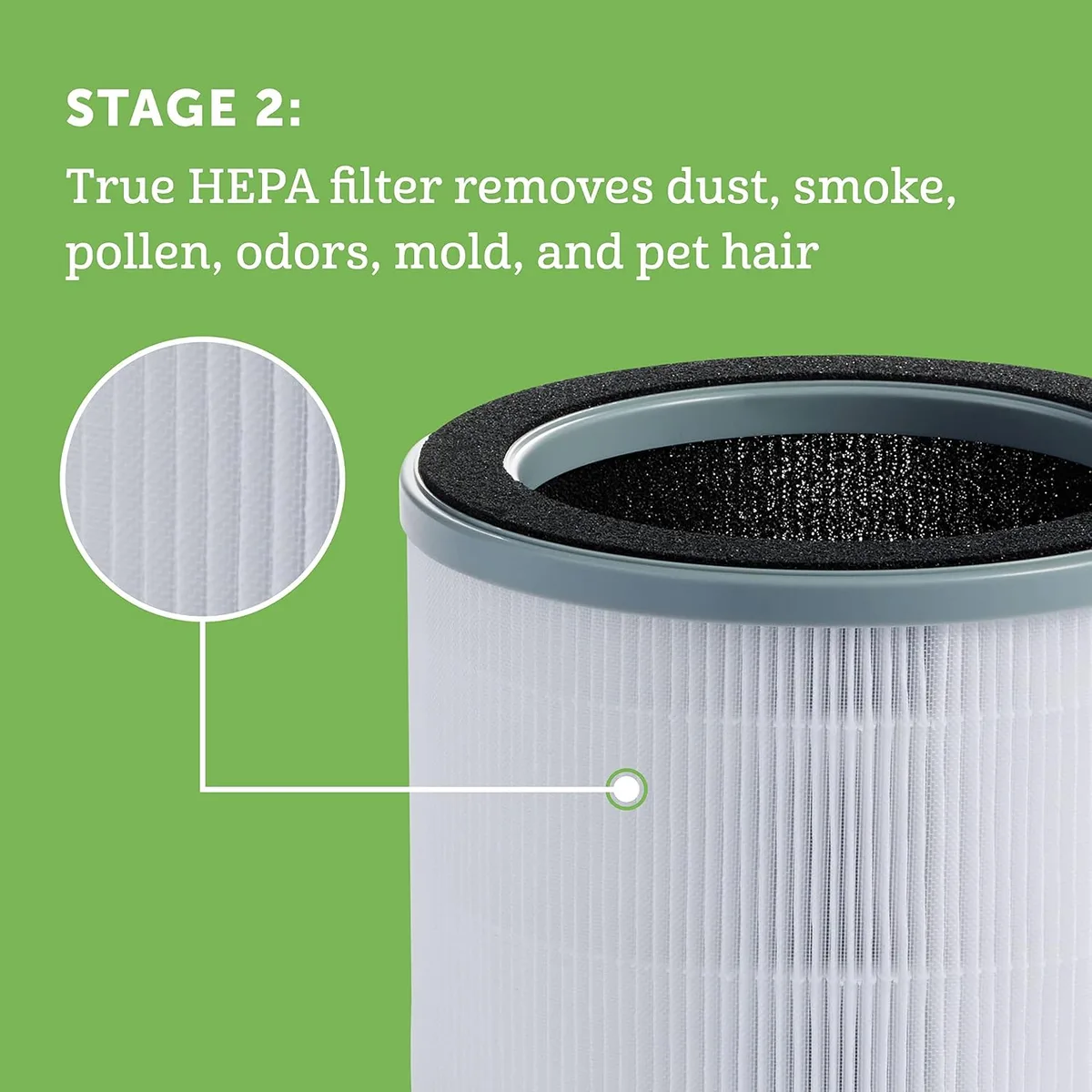
Image source: Bing (Web (fair-use with source credit))
Zero ozone output. Avoid ionizers and electrostatic units. Look for CARB certification, which legally limits ozone emissions in California.
Even if you don't live there, that certification is a strong safety marker for any market.
Match the CADR to your room. The Clean Air Delivery Rate tells you how fast the unit filters specified room sizes. A typical bedroom needs a CADR of at least 150 for dust and smoke.
For large rooms, you may need 250 or higher. Manufacturers list the room size on the box. If you're between sizes, take the next one up.
Target 4 air changes per hour (ACH). This is the rate recommended by guidance for allergy and asthma control. It means the entire room's air passes through the filter four times every hour.
Many reputable brands state their ACH or publish coverage for 15-minute cycles.
Add activated carbon if VOCs are a concern. HEPA handles particles. Carbon handles gases, including VOCs from paint, cleaning products, and cooking.
If that's your trigger, look for a filter with one pound or more of activated carbon. Cheap "carbon-coated" filters are minimal and won't do much.
Check noise and filter costs. A purifier only helps if you run it consistently. Look for a sleep mode under 50 decibels, or you'll stop using it.
Also check the replacement filter cost before buying. Expect to replace the HEPA filter every 6 to 12 months, and pre-filters more often. That hidden cost can add up to as much as the unit itself over two years.
| Specification | What to choose | Why it matters |
|---|---|---|
| Filter type | True HEPA, 99.97% at 0.3 microns | Captures allergen-sized particles |
| Ozone | Zero-ozone, CARB-certified | Protects sensitive skin and lungs |
| CADR | 150+ for bedrooms, higher for larger rooms | Ensures effective cleaning |
| ACH | 4 or more air changes per hour | Matches allergy guidance |
| Carbon layer | 1 pound or more of activated carbon | Adsorbs VOCs and smoke |
| Noise | Under 50 dB on sleep mode | You'll keep it running |
| Filter cost | $30-$80 per year typical for HEPA | No surprise expenses |
How To Use It Right: Placement, Run Time, And Maintenance
Buying the right purifier is only half the job. Most people run them wrong. Here's the correct playbook.
Measure the room first. Note the square footage and ceiling height. A 10% margin for high ceilings goes a long way.
Then match the CADR to that number.
Place it centrally and keep it clear. That means 3 to 4 feet from walls and furniture. Air needs to flow freely into the intake and out of the vent.
Tucking it into a corner or behind a sofa makes it nearly useless.
Run it 24/7. This is the biggest mistake we see. People switch the purifier off during the day to save electricity or noise.
Allergens build up constantly. Even on a low or auto setting, the purifier should never stop. Modern units on auto mode are energy-efficient enough for continuous running.
Close the windows. If outdoor pollen or pollution is a trigger, an open window fights the purifier. Run the unit with windows closed and doors mostly closed for the best results.
In humid climates, you'll also want the air conditioner or dehumidifier running.
Keep the door shut for that room. Concentrating filtration in one room beats spreading it thin across the house. The bedroom is the highest priority.
You spend six to eight hours there every night, and allergen exposure while sleeping has an outsized effect on eczema.
Clean the pre-filter regularly. Every 2 to 4 weeks, vacuum or rinse it. A dirty pre-filter blocks airflow before it ever reaches the HEPA layer.
That goes for any unit, regardless of brand.
Replace the HEPA filter on schedule. Most filters last 6 to 12 months. Many brands include an indicator light.
Don't wait until the air smells dusty. By then, the filter is clogged and the machine is struggling.
During the first month of use, track your itch and flare days. Compare that to the previous month. Tracking patterns helps you and your doctor adjust treatments, per American Academy of Dermatology guidance.
It's also the most honest way to judge whether your purifier is doing anything.
Here's the quick 8-step summary:
- Measure the room and choose a properly sized unit.
- Place it 3-4 feet away from walls and furniture.
- Run it 24/7 on low or auto.
- Keep windows and doors closed in the priority room.
- Keep the pet out of the bedroom.
- Vacuum and rinse the pre-filter every 2-4 weeks.
- Replace the HEPA filter every 6-12 months.
- Monitor flare frequency for a month before judging results.
Common Mistakes People Make (And How To Avoid Them)
Even with the right purifier, small errors can undo all the good. Here are the most common ones we've seen in editorial analysis of user reviews and expert guidance.
Buying based on hype instead of CADR. Brand names don't clean air. The CADR number does.
Always buy for the room size, not the marketing.
Assuming HEPA solves a mold problem. A HEPA purifier catches airborne spores. It does nothing for a damp wall, a leaky pipe, or a humid basement.
Fix the moisture source first. The purifier is a backup, not a solution.
Putting the purifier on a shelf or next to a curtain. This blocks airflow and muffles the intake. The machine will still hum, but it won't move enough air.
Keep it out in the open, with at least a foot of clearance on every side.
Turning it off at night to save money. Nighttime is when the machine works hardest. You're immobile, breathing steadily, and exposed to allergens in your bedding.
That's exactly when you need filtration most.
Skipping pre-filter care. A clogged pre-filter starves the HEPA layer. You end up paying for a HEPA filter that never actually filters anything.
Clean the pre-filter once or twice a month.
Using the purifier instead of washing bedding. Dust mites live in your pillow and mattress. A purifier catches only a fraction of what you churn up at night.
Hot-water washes and zipped encasements matter more than any machine.
Quitting after two weeks. Airborne allergen levels improve within days. Skin recovery takes longer.
Give the purifier a full month before you judge it. If your skin hasn't improved by then, your trigger probably isn't airborne.
Frequently Asked Questions
Do air purifiers help with dust mite eczema?
Yes, but only partially. Dust mites live in bedding and carpet, not in the air. A HEPA purifier catches the particles they release when you move.
For meaningful relief, also use allergen-proof mattress encasements and wash bedding above 130°F.
Are ionizers safe for eczema?
No. Ionizers and electrostatic precipitators produce ozone. Ozone irritates the lungs and can worsen skin sensitivity.
Choose a True HEPA purifier with CARB certification instead. CARB certified means the unit stays within strict ozone emission limits.
Where should I place an air purifier for eczema?
Put it in your bedroom, 3 to 4 feet from walls and furniture. Center it in the room so air flows freely. Keep the door closed while running it.
The bedroom matters most because you spend hours there breathing that air every night.
How long does it take for an air purifier to help eczema?
Airborne allergens drop within a few days. Your skin may need two to four weeks to show improvement. Track your flare days for a full month before deciding.
If nothing changes, your trigger is probably not airborne.
Should I run an air purifier all day?
Yes. Allergens build up around the clock. Running a purifier 24/7 on low or auto mode keeps levels consistently low.
Modern units are energy efficient enough for continuous use. Turning it off during the day creates gaps where allergen levels climb.
Can an air purifier replace my eczema medication?
No. Air purifiers support environmental control, but they are not a substitute for prescribed treatments. Moisturizers, topical steroids, and other medications still matter.
Keep your treatment routine and add the purifier as one layer. Talk to your dermatologist before changing anything.

Similar Posts