How To Fix Frizzy Hair
You've been fighting your hair for years, haven't you? You wash it, style it, and within an hour it's turned into a halo of puff and flyaways. I get it.
How to fix frizzy hair isn't one of those questions with a single answer, but once you understand what's actually causing yours to go rogue, the fix becomes pretty straightforward.
Here's what you don't usually hear: frizz is almost never about humidity alone. According to trichology research on hair cuticle structure, the real culprit is moisture imbalance inside the hair shaft itself. Your porosity, water pH, and drying technique each play a bigger role than the weather report.
That's good news. It means you have real control once you know your hair's specific profile. Let's walk through exactly how to diagnose yours and what to do about it.
Quick Answer
Start with your porosity. Frizzy hair is usually dry hair with an open cuticle. Low-porosity hair needs lightweight hydration and heat to let products in.
High-porosity hair needs protein to patch gaps and a thick sealer to lock it down. Medium-porosity maintenance is mostly about avoiding damage and using moderate moisture. Match your routine to your porosity.
That is your fix.
Why Your Hair Frizzes (The Real Reason, Not Generic Advice)
Humidity isn't the enemy you think it is
Let's clear something up. Humidity triggers frizz, but it doesn't cause it. Think of your hair cuticle like the shingles on a roof.
When those shingles lie flat, moisture in the air bounces right off. When they're raised, from damage, dryness, or chemical processing, that moisture pushes straight in and swells the hair shaft. The swelling creates roughness.
That roughness is frizz.
So really, you're looking at three separate root causes:
- Humidity frizz, your cuticle is mostly healthy, but moisture in the air temporarily swells it. This is reversible.
- Damage frizz, your cuticle is physically broken or lifted from heat, bleach, or mechanical stress. This needs repair, not just styling.
- Dryness frizz, your hair lacks internal moisture and is desperately trying to grab it from the air. This feels rough and dull.
Most people have a mix. The fix changes depending on which one dominates.
Your everyday habits matter more than you think
Here's the stuff nobody tells you. Your faucet might be your hair's worst enemy. Hard water, which is high in calcium and magnesium, builds up on the cuticle and prevents moisture from penetrating.
That mineral layer acts like a crust. Moisture can't get in, and your hair stays dry and frizzy no matter how much conditioner you use.
Then there's your drying routine. Rubbing your hair with a terry cloth towel is basically sandpaper for wet cuticles. I know it's convenient.
It's also one of the fastest ways to create permanent cuticle damage. And cotton pillowcases? Same friction problem, just over eight hours at a time.
Two quick ways to see where you stand
Before we get into the flowchart, try this. Run your fingers from the ends of your hair upward toward your scalp. If it feels rough and catches on little bumps, your cuticle is lifted.
If it glides smooth, your cuticle is sealed.
Then look at your hair when it's wet. Does it dry fast and feel rough? Or does it take forever and feel almost sticky to the touch?
That's a quick read on porosity. We'll make it official in the next section.
First, What Type of Frizzy Hair Do You Have?
The three frizz profiles
Every case of frizz falls into one of three categories. You might live in one or straddle two. Here's how to tell them apart.
Humidity frizz shows up on damp days. Your hair looks fine in dry weather. On humid afternoons, it expands.
The ends are healthy. The issue comes and goes with the forecast. That's cuticle swelling from moisture absorption, not damage.
Damage frizz is there every single day. It doesn't care about the weather. Your hair feels rough, looks dull, and has split ends running upward.
You've probably used heat without protectant, colored or bleached your hair, or both. The cuticle is physically broken.
Dryness frizz feels more like static than swelling. Your hair is brittle, tangles easily, and looks thirsty. It's not absorbing moisture from the air, it's not holding onto the moisture you give it.
Your products might be evaporating before they do anything useful.
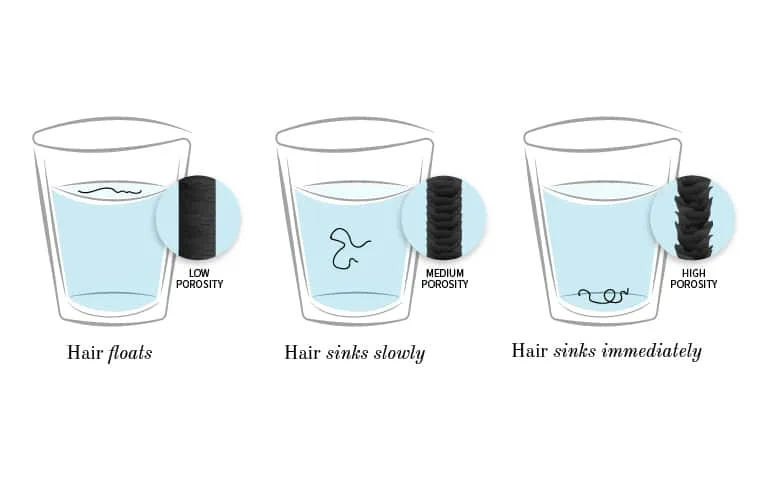
A self-test you can do in 30 seconds
Take a single clean strand of your hair. Wet it completely. Place it on a flat surface.
- If it lies flat and smooth right away, you're likely medium porosity.
- If it stays on top of the water for a while before sinking, you're low porosity.
- If it sinks immediately and the strand looks rough, you're high porosity.
This isn't perfect science, but it's reliable enough to tell you which branch of the decision flow to follow.
What this tells you about product fit
Once you know your profile, you stop guessing. Humidity frizz needs anti-humectants and sealers on high dew point days. Damage frizz needs protein treatments and bond repair.
Dryness frizz needs humectant-rich leave-ins followed by a heavy oil sealer.
Your texture, wavy, curly, coily, or straight, changes the product weight you need. Your porosity tells you what the product does to your hair. Trust porosity for the core fix.
Use texture to tune the details.
The Porosity Test: Your Single Most Important Diagnosis
Porosity isn't a buzzword. It describes how easily your hair absorbs and holds onto moisture. That one measurement determines more about your frizz outcome than any product label ever will.
Why porosity beats curl type for fixing frizz
I've seen people with tight coils who have low porosity hair. They can't use heavy butters because the stuff just sits on top. And I've seen people with loose waves who have high porosity hair.
They need protein every other week or their hair goes mushy.
Curl type tells you shape. Porosity tells you behavior. If you pick products by curl type alone, you're guessing.
If you pick by porosity, you're solving.
The float test vs. the slip test
The float test I described earlier is quick. The slip test is more useful. After you wash your hair, run a wide tooth comb through it while it's still wet and loaded with conditioner.
- If the comb glides easily, you're likely low or medium porosity.
- If it drags, catches, and feels resistant, you're high porosity.
High porosity hair has gaps in the cuticle. Conditioner doesn't create a slick surface because the product is disappearing into those gaps. Low porosity hair has a tightly packed cuticle, so conditioner sits on top and creates immediate slip.
Image source: Bing (Web (fair-use with source credit))
What each porosity needs and doesn't need
Here's the breakdown in plain terms.
| Porosity | What it needs | What to avoid |
|---|---|---|
| Low | Lightweight humectants (glycerin, aloe), heat to open cuticles, water-based products | Heavy oils, butters, protein overload, silicones that won't wash out |
| Medium | Balanced moisture and protein, regular trims, gentle shampoo | Over-manipulation, high heat, drying alcohols |
| High | Hydrolyzed protein (keratin, collagen), thick occlusives (shea butter, castor oil), acidic rinses | Over-washing, high pH products, glycerin in high humidity |
The key detail for low porosity: you need heat. A warm shower, a heated cap, or even steaming your hair helps open that tightly packed cuticle so moisture can get in. Without heat, the product just sits.
The key detail for high porosity: protein has to be part of your regular rotation. Without it, your hair absorbs too much water, swells, and frizzes from the inside out. The strand becomes weak and limp.
When to retest
Porosity can shift over time. Heat damage raises porosity. Protein treatments can lower it.
Seasonal changes can affect how your hair behaves. Retest every three to four months or after any major chemical service. Your routine should shift with it.
Your Decision Flowchart for Frizzy Hair
Now we get to the practical part. Based on what you just learned about your porosity and your frizz profile, you'll take a specific path. Here's how the branches work.

Image source: Bing (Web (fair-use with source credit))
Branch 1: You live in a humid climate
If you're in a place where the dew point regularly hits 60°F or higher, your primary enemy is moisture in the air. You need an anti-humectant strategy.
- Use products that list ingredients like PVP/DMAPA acrylates copolymer or polyquaternium-11. These form a flexible film that blocks moisture.
- Skip glycerin and hyaluronic acid on high humidity days. They pull water from the air into your hair, which is the opposite of what you want.
- Seal your length with a lightweight silicone serum after styling. Not the kind that builds up. A water-soluble one like dimethicone copolyol.
- Finish with a cool water rinse to close the cuticle. Then don't touch your hair until it's fully dry.
This branch works best if your porosity is medium or low. High porosity needs the protein route first.
Branch 2: Your hair is damaged or chemically treated
If you've bleached, relaxed, colored, or used high heat without protection, your cuticle is probably compromised. You need structural repair.
- Use a protein treatment with hydrolyzed keratin or wheat protein once a week for the first month, then every two weeks for maintenance.
- Follow protein with a deep moisture mask. Protein without moisture creates brittle hair that snaps.
- Avoid shampoo with sulfates for a while. Use a gentle cleanser or co-wash.
- pH matters here. A toner or rinse with apple cider vinegar (diluted, pH around 4.5) helps close the cuticle.
You'll know it's working when your hair feels less mushy when wet and looks shinier when dry. That's the protein filling in the gaps and the acid sealing them.
Branch 3: Your hair is dry but healthy
Your cuticle is intact, but it's thirsty. This is the simplest branch.
- Use a leave-in with glycerin or aloe vera as the first layer.
- Follow with a cream or lotion that contains oils or butters, but not too heavy for your texture.
- Apply to soaking wet hair, not damp hair. The product traps water inside the shaft.
- Air dry or diffuse on low heat. High heat will evaporate the moisture you just added.
This branch is a straight fix. The most common mistake here is using too heavy of a product. Dry hair that is also fine will flatten into greasy strands.
Stick with lightweight formulas.
Branch 4: You have fine, low-porosity hair
This is the trickiest combination. Your cuticle is tightly sealed, so products don't easily penetrate. And fine hair gets weighed down fast.
- Wash with a clarifying shampoo once a month to remove buildup. Low-porosity hair collects product on the surface.
- Use a lightweight, water-based leave-in. No butters, no heavy oils.
- Apply with the praying hands technique, not raking. Glide the product over the surface rather than pulling it through.
- Diffuse or sit under a warm hooded dryer to help the product absorb.
- Never layer more than two products. You don't need a full routine. You need the right one.
Your hair will feel lightweight and smooth. If it still feels frizzy after this, the issue is likely buildup, not dryness. Clarify and try again.
What to do if you're between two branches
That's common. For example, someone with damaged high-porosity hair who lives in a humid climate needs the protein routine from branch 2 first, then the anti-humectant sealing from branch 1. Solve the structural issue first.
Then protect against the environment. Always work from the inside of the hair outward.
Step-by-Step Routine (Matched to Your Frizz Profile)
Once you know which branch you're on, the routine becomes straightforward. Here's the sequence that works for all profiles, with tweaks for each.
Washing
Start with a sulfate-free shampoo if you have color-treated or dry hair. If you have buildup from hard water or silicones, use a chelating shampoo once a month. Focus the shampoo on your scalp only.
The ends get clean enough from the runoff.
Conditioning
Apply conditioner from mid-length to ends. Let it sit for three to five minutes. For low-porosity hair, add heat.
A warm shower cap works. For high-porosity hair, finish with a cool water rinse. That seals the cuticle immediately.
Applying products
Work on soaking wet hair. Water is your best moisturizer. Products just lock it in.
- For humidity frizz: apply a lightweight leave-in, then an anti-humectant styling cream.
- For damage frizz: apply a protein leave-in, then a thick cream to seal.
- For dryness frizz: apply a humectant-rich leave-in, then a lightweight oil.
- For fine, low-porosity: apply a single water-based product. That's it.
Drying
- Air drying works for low-porosity hair that isn't very dense.
- Diffusing on low heat works for high-porosity and dense hair. It speeds up drying and prevents the cuticle from staying wet too long.
- Never go to bed with wet hair. The friction and moisture trapped against your pillow create frizz by morning.
The Biggest Mistakes That Keep Your Hair Frizzy
Over-moisturizing high-porosity hair
High-porosity hair already absorbs too much moisture. Adding more without protein makes it swell further. The result is mushy, limp, frizzy strands.
If your hair feels gummy when wet, stop the moisture masks and switch to protein treatments.
Under-moisturizing low-porosity hair
Low-porosity hair rejects moisture if the cuticle isn't opened. Products just sit on top. If your hair feels dry but products don't seem to help, you need heat during conditioning and a lightweight leave-in, not heavier products.
Towel rubbing and cotton pillowcases
Terry cloth tears wet cuticles. Switch to a microfiber towel or an old cotton t-shirt. Pat and squeeze.
Don't rub. And swap your cotton pillowcase for silk or satin. The friction difference is measurable.
You'll see less breakage within a few weeks.
Using the wrong oil for your porosity
Coconut oil penetrates the hair shaft because of its low molecular weight. That's great for high-porosity hair. But for low-porosity hair, it sits on top and never absorbs.
Use jojoba or grapeseed oil instead. They're lighter and won't cause buildup.
Frequently Asked Questions
Can you truly fix frizzy hair or is it genetic?
Both. Your hair's natural texture and porosity are genetic. But frizz is usually caused by damage, dryness, or environmental factors.
You can't change your curl pattern. You can change how you treat your cuticle. Adjusting your routine eliminates most frizz.
How often should you use protein treatments?
High-porosity hair needs protein every two to three weeks. Low-porosity hair should use protein once a month or less. Too much protein makes hair brittle and causes breakage.
Watch for stiffness or snapping as a sign to stop.
Does hair oil actually reduce frizz or just mask it?
It depends on the oil and your porosity. Lightweight oils like jojoba penetrate low-porosity hair and hydrate it from within. Heavy oils like castor sit on top of high-porosity hair and seal moisture in.
If you use the wrong oil for your porosity, it only masks the frizz temporarily.
What's the best haircut for frizz-prone hair?
Blunt cuts reduce frizz by preventing split ends from traveling up the shaft. Long layers on curly hair can create more surface area for friction. If you have damaged ends, get a trim every six to eight weeks.
Healthy ends don't frizz as easily.
Can humidity-proof products really work?
Yes, if they contain film-forming ingredients like PVP/DMAPA acrylates copolymer or polyquaternium-11. These create a barrier that blocks moisture from entering the cuticle. They work best on medium to low-porosity hair.
High-porosity hair needs protein first to close the gaps, then the film former on top.

Similar Posts