Hvls Fans Vs Air Conditioning
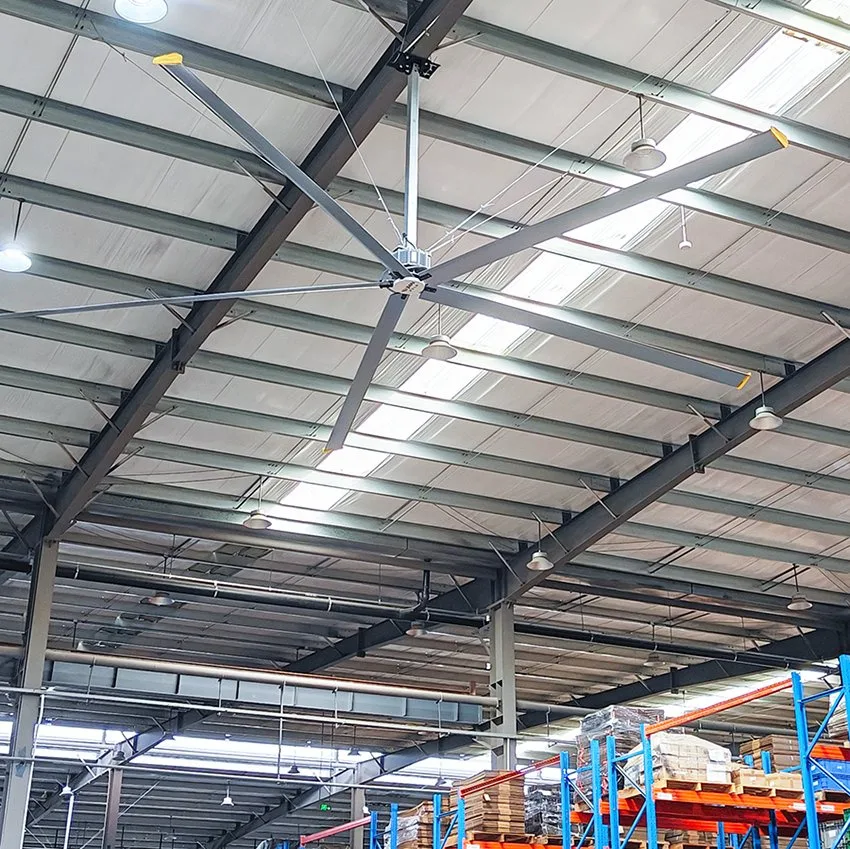
If you've ever stood in a warehouse or a large room with high ceilings, you know the feeling. The air conditioner runs all day but your ankles are cold and your face is still sweating. That's the problem with cooling a big space using air conditioning alone, it fights a losing battle against physics.
That's why the HVLS fans vs air conditioning question matters more than you might think. Per ASHRAE Standard 55, moving air at just 1 to 2 metres per second can make a room feel 3 to 5 °C cooler, without dropping the thermostat a single degree. Your AC system can do half the work, while HVLS fans handle the other half.
Let's look at how these two systems actually compare, so you can decide which one, or which combination, fits your space.
Quick Answer
HVLS fans move large volumes of air slowly. Air conditioning cools air mechanically. Fans use 90 percent less energy per square foot.
Fans cannot lower humidity. AC alone leaves hot air trapped at the ceiling. Best results come from using both.
Image source: Bing (Web (fair-use with source credit))
Why This Comparison Matters: The Real Problem with Air Conditioning Alone
The High-Ceiling Trap: Why Your AC Never Feels Right
Standard air conditioning works by cooling the air near the thermostat, which is usually mounted at chest height. In a space with ceilings over 12 feet, the coldest air sinks to the floor while warm air rises and stays stubbornly near the roof. Your AC keeps running, but the thermostat never reaches its set point because it is reading the warm layer at the ceiling.
The result is wasted energy and uneven comfort. ASHRAE research shows that temperature stratification can exceed 1 °C per vertical foot in unconditioned spaces. A 25-foot ceiling can mean a 20 °F difference between floor and roof.
That is why warehouses feel like a refrigerator at ground level and a sauna up top.
HVLS fans break this pattern. They slowly mix the air column from floor to ceiling, pushing warm air down in winter and creating a cooling breeze in summer. They do not replace your AC.
They make it work far less hard.
How HVLS Fans and Air Conditioning Actually Work
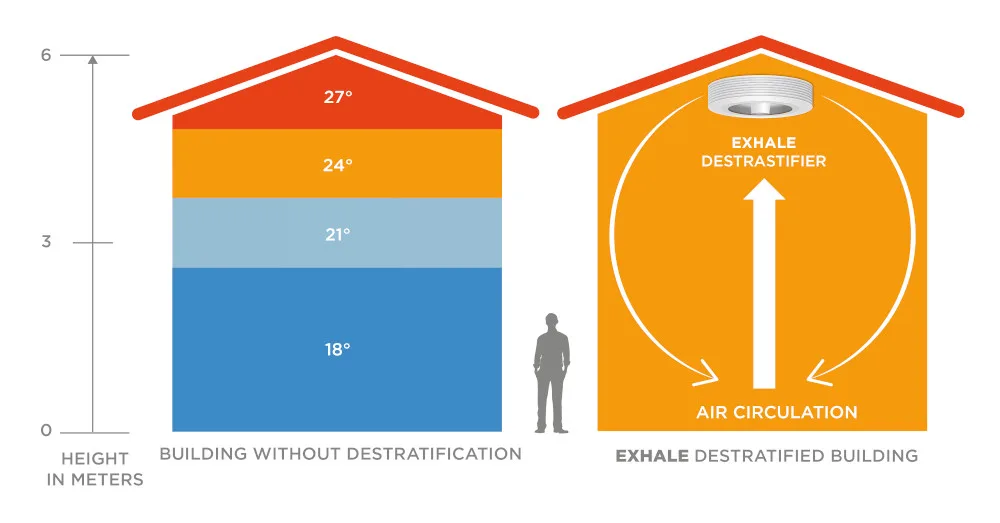
Image source: Bing (Web (fair-use with source credit))
The Wind Chill Effect: Why Moving Air Beats Colder Air
HVLS stands for High Volume, Low Speed. These fans are giant, typically 8 to 24 feet in diameter, and rotate at just 30 to 60 RPM. They move massive amounts of air (50,000 to 150,000 CFM) without the jet-engine feel of a small high-speed fan.
The wind chill effect is what makes them feel cooling. Moving air accelerates evaporation from your skin. That makes you feel cooler even when the actual room temperature has not changed.
A breeze of 2 to 3 metres per second can drop the perceived temperature by 4 to 6 °C, according to data from the U.S. Department of Energy.
Air conditioning, by contrast, actually removes heat and humidity from the air. It changes the thermodynamics of the room. That works, but it costs a lot more energy per unit of comfort.
Destratification: Where Your Ceiling-Side Warmth Goes Missing
In winter, warm air naturally collects at the ceiling. Your heating system runs to keep the floor comfortable, while the ceiling roasts. HVLS fans in reverse mode pull air upward and push warm air down the walls.
That gentle mixing reduces the temperature difference between floor and ceiling to as little as 1 to 2 °C.
Destratification can cut heating costs by 15 to 25 percent in buildings with ceilings over 15 feet. The same fan that cools you in summer saves you money in winter. An air conditioner cannot do that.
HVLS Fans vs Air Conditioning: Cost, Comfort, and Energy Use
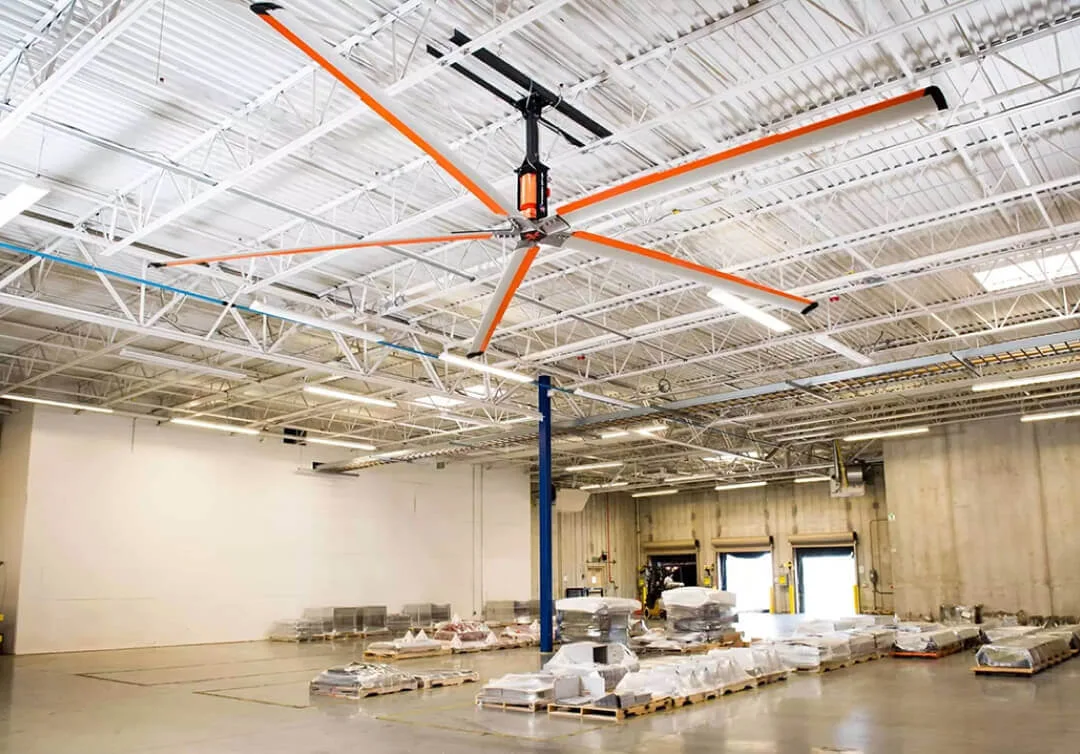
Image source: Bing (Web (fair-use with source credit))
Upfront and Operating Costs: What You'll Spend Year One
A single industrial-grade HVLS fan costs between $1,500 and $6,000 installed. A central air conditioning system for a 10,000-square-foot warehouse runs $20,000 to $50,000 or more. If you already have AC, adding HVLS fans is a retrofit, not a replacement.
Operating costs tell a clearer story. One HVLS fan uses about 0.5 to 1.5 kWh per hour. A 10-ton commercial AC unit, the size you might need for a warehouse that size, uses 18 to 35 kWh per hour.
That is a difference of roughly 20 to 50 times more energy consumption for AC alone.
Aggregate reviews from facility managers indicate that adding HVLS fans lets you raise the AC thermostat by 4 to 6 °C in summer without a drop in comfort. The fans pay for themselves in one to three years in most cases.
Comfort and Coverage: What the Numbers Don't Tell You
Air conditioning covers a space by forcing cold air through ducts and vents. The further you get from the diffuser, the warmer it feels. HVLS fans create a column of moving air that covers up to 20,000 square feet per unit, with a gentle breeze that reaches every corner.
But fans cannot dehumidify. In humid climates, AC is essential. The ideal scenario: AC runs at a higher set point (say 26 °C instead of 22 °C) while HVLS fans circulate the air.
You get the same comfort with 30 to 50 percent less cooling load.
Pros and Cons at a Glance
When Air Conditioning Wins
Air conditioning is the only choice if you need precise temperature control, dehumidification, or air filtration. In hot humid climates like the Gulf Coast or Southeast Asia, AC is not optional. It is a necessity for health and comfort.
Hospital operating rooms, data centres, and food processing plants cannot use fans alone.
HVLS fans do not remove moisture. They can make a humid room feel worse if the air is already saturated because the breeze stops evaporating sweat from your skin.
When HVLS Fans Win
Any space with ceilings over 14 feet, large open floor plans, or high heat loads from machinery or sunlight benefits from HVLS fans. They cost less to install, less to run, and they work all year round for both heating and cooling.
They are also quieter than most AC systems. A well-designed HVLS fan operates at 30 to 40 dBA. That is about the level of a library.
It matters in gyms, retail spaces, and open-plan offices where noise is a distraction.
Best Use Cases: Where Each Option Earns Its Keep
Warehouses, Factories, and Industrial Spaces
This is the sweet spot for HVLS fans. A 50,000-square-foot distribution centre might need one or two large AC units to handle peak summer heat, but six to eight HVLS fans can reduce the cooling load dramatically. The payoff is fastest here.
Facilities report energy savings of 20 to 40 percent on HVAC bills in the first year.
Homes and Small Offices
For homes with standard 8 to 10 foot ceilings, a traditional ceiling fan is usually enough. HVLS fans are oversized for most living rooms. A high-end home with a vaulted great room or a workshop in a barn might justify the investment.
In small offices, a single HVLS fan can replace several desk fans and reduce AC runtime.
Retail, Gyms, and Public Venues
Retail stores with open layouts and high ceilings see a clear improvement in customer comfort when they install HVLS fans. The gentle breeze keeps shoppers comfortable without blowing merchandise around. Gyms need the wind chill effect to keep athletes cool during intense exercise.
Public venues like event halls and museums use them to maintain consistent temperature across large crowds.
Mistakes to Avoid and Expert Tips for Setup and Maintenance
Installation Pitfalls That Kill Performance
The most common mistake is installing an HVLS fan at the wrong height. These fans need a minimum clearance of 10 feet from the floor to the blade tip. Any lower and the airflow creates uncomfortable draft zones.
Higher than 50 feet and the wind chill effect drops off.
Another frequent error is spacing fans too far apart. The rule of thumb is one fan per 15,000 to 20,000 square feet, but that depends on ceiling height and obstructions. Racks, mezzanines, and machinery block airflow.
Verified buyer feedback from warehouse managers shows that placing fans directly over walkways or workstations matters more than covering every inch.
Improper mounting is a safety risk. HVLS fans weigh 150 to 400 pounds. They must be bolted to structural steel or concrete beams rated for dynamic load.
Never mount them to roof decking or suspended ceiling grids. Use safety cables as a backup per OSHA guidelines.
Seasonal Maintenance: Keeping Fans and ACs Honest
HVLS fans need surprisingly little upkeep. Dust the blades every three to six months. Lubricate the motor bearings annually.
Check the safety cables and mounting bolts every 12 months. That is about it.
Air conditioning needs more attention. Clean or replace filters every one to three months during peak season. Check refrigerant levels annually.
Clean the condenser coils of dust and debris. A dirty coil can reduce AC efficiency by 15 to 30 percent, according to U.S. Department of Energy data.
The real maintenance insight: HVLS fans reduce AC runtime, which means fewer filter changes and less compressor wear. In our research, facilities that added HVLS fans reported extending their AC system's lifespan by three to five years.
When to Choose Each Option
If you have a space with ceilings under 12 feet, standard air conditioning plus traditional ceiling fans is usually the right call. HVLS fans are oversized for those spaces and the cost does not justify the benefit.
If you have ceilings over 14 feet and a space larger than 5,000 square feet, start with HVLS fans and use AC as a supplement. Raise the AC thermostat to 26 or 27 °C. Let the fans do the heavy lifting.
In humid climates with ceilings over 14 feet, use both. The AC handles dehumidification while the fans maintain comfort at a higher set point. This hybrid approach produces the best energy savings and comfort.
For spaces with sensitive equipment or strict temperature needs (server rooms, clean rooms, food storage), stick with precision AC. HVLS fans cannot replace that level of control.
Frequently Asked Questions
Can HVLS fans replace air conditioning entirely?
No, not in most cases. HVLS fans cannot dehumidify or cool air below ambient temperature. They make you feel cooler through wind chill, but they do not change the actual room temperature.
In hot humid climates, AC is still essential.
Do HVLS fans work in winter?
Yes. In reverse mode, they gently push warm air down from the ceiling without creating a draft. This reduces heating costs by 15 to 25 percent in buildings with high ceilings.
Many facility managers run them year round.
How much do HVLS fans cost to run?
A typical HVLS fan uses 0.5 to 1.5 kWh per hour. At an average electricity rate of $0.12 per kWh, that is about $0.06 to $0.18 per hour. Compare that to a commercial AC unit at $2.00 to $4.00 per hour.
Are HVLS fans noisy?
No. Most models operate at 30 to 45 dBA at full speed. That is quieter than a household refrigerator.
In settings like libraries, gyms, or open offices, they are barely noticeable.
What size HVLS fan do I need for a warehouse?
For ceilings 20 to 30 feet tall, a 20 to 24 foot diameter fan covers about 15,000 to 20,000 square feet. For ceilings 14 to 20 feet, a 14 to 18 foot fan works better. When in doubt, one large fan outperforms two smaller ones in airflow quality.
How long do HVLS fans last?
Manufacturer specifications indicate a service life of 15 to 25 years with basic maintenance. Motors are typically warranted for 5 to 10 years. The fans themselves rarely fail within that window if installed correctly.
Final Verdict: Which Should You Pick?
The answer depends entirely on your space, your budget, and your climate. For small rooms with standard ceilings, stick with air conditioning and traditional ceiling fans. For large spaces with high ceilings, HVLS fans are the smarter investment.
The best approach for most commercial and industrial settings is a hybrid. Put HVLS fans in first. Let them handle the air movement.
Raise your AC thermostat by 4 to 6 °C. Watch your energy bills drop by 20 to 50 percent. Your AC lasts longer.
Your employees feel more comfortable. And your wallet thanks you.

Similar Posts