Pergola Vs Arbor Vs Trellis
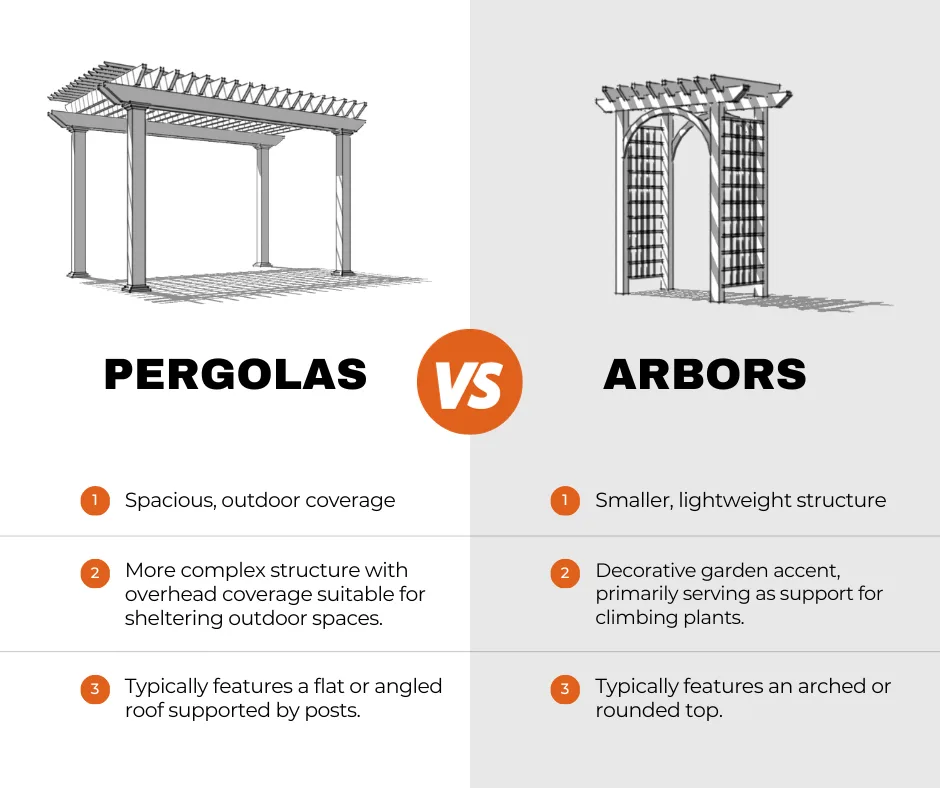
When you're staring at a gap in your backyard, it's easy to wonder what to put there. The problem is that "Pergola Vs Arbor Vs Trellis" sounds like three names for the same thing, and nobody wants to drop hundreds of dollars on the wrong structure.
Here's the reality: each one serves a completely different purpose. Picking the wrong one means wasted money and a structure that doesn't do what you need. Manufacturer specifications show that a pergola supports around 400 pounds of snow load, while a lightweight trellis maxes out at 50 pounds of vine weight.
That difference tells you everything about what they're built for. Let's walk through each one so you can match the right structure to your actual problem.
Quick Answer
Choose a pergola for seating areas with partial shade. Pick an arbor to mark a garden entrance or walkway. Use a trellis to cover a wall or fence with climbing plants.
Pergolas handle heavy vines and weather loads. Arbors frame a passage. Trellis panels stay flat against a surface.
Match your need, not your budget.
Image source: Bing (Web (fair-use with source credit))
Why This Comparison Actually Matters
Most people walk into a garden center, see three similar-looking wooden structures, and grab whichever is on sale. That's how you end up with a $60 trellis holding up a wisteria that needs a 6×6 post pergola. These three options look alike but function completely differently.
The real cost isn't just the purchase price. It's the time spent installing something that collapses under a mature vine. It's the disappointment of sitting under a trellis that provides zero shade.
Aggregate buyer feedback shows that the number one regret is buying based on price instead of purpose.
There's also a structural safety angle. A pergola attached to your house needs proper ledger board mounting and concrete footings. Skip those, and you're looking at a wind hazard.
The International Code Council sets minimum standards for outdoor structures because people underestimate how much force wind and snow put on a raised framework.
This comparison matters because the decision determines how your outdoor space functions for the next decade. Get it right, and you have a beautiful, functional addition. Get it wrong, and you have an expensive eyesore that needs replacing in three years.
Arbor: The Walkway Marker
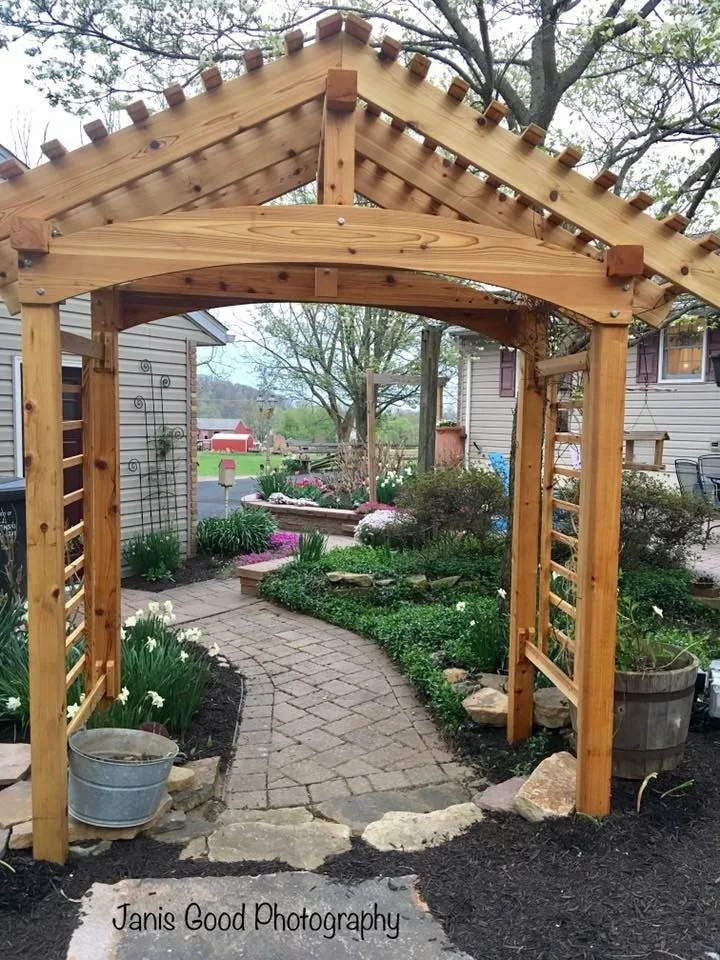
Image source: Bing (Web (fair-use with source credit))
An arbor is a doorway for your garden. It's a standalone arch that you walk through, not a structure you sit under. Think of it as a decorative punctuation mark that says "you're entering a special space."
What defines an arbor
An arbor has three distinguishing features. First, it's narrow, typically 3 to 5 feet wide. Second, it's tall enough to walk under, usually 6 to 8 feet of clearance.
Third, it's lightweight compared to a pergola, with smaller posts and a curved or peaked top.
Most arbors are open on both ends. You walk straight through them. They're designed to frame a view or mark a transition point in your landscape.
What an arbor does well
- Defines an entrance. An arbor at your garden gate makes it feel intentional. It draws the eye and creates a sense of arrival.
- Supports light to moderate vines. Climbing roses, clematis, and jasmine do well on arbors. The structure gives them a natural arch to climb.
- Quick installation. Most arbors come as pre-assembled kits. You can install one in an afternoon with basic tools.
- Low cost. A decent cedar arbor runs $150 to $400. Custom-built wooden arbors rarely exceed $800.
Where an arbor falls short
An arbor provides almost no shade. The arch is narrow and open. It's purely a passage marker.
It also can't handle heavy vines. A mature wisteria or grapevine will crush a standard arbor within three years. If you want to grow heavy fruit or dense foliage, you need a pergola's post system.
Who should buy an arbor
You're the right candidate for an arbor if you have a garden path or backyard entrance that feels flat. You want something decorative that frames the view and gives climbing plants a place to show off. You're not planning to sit under it, and you're not growing anything heavier than a climbing rose.
Trellis: The Workhorse Wall Support
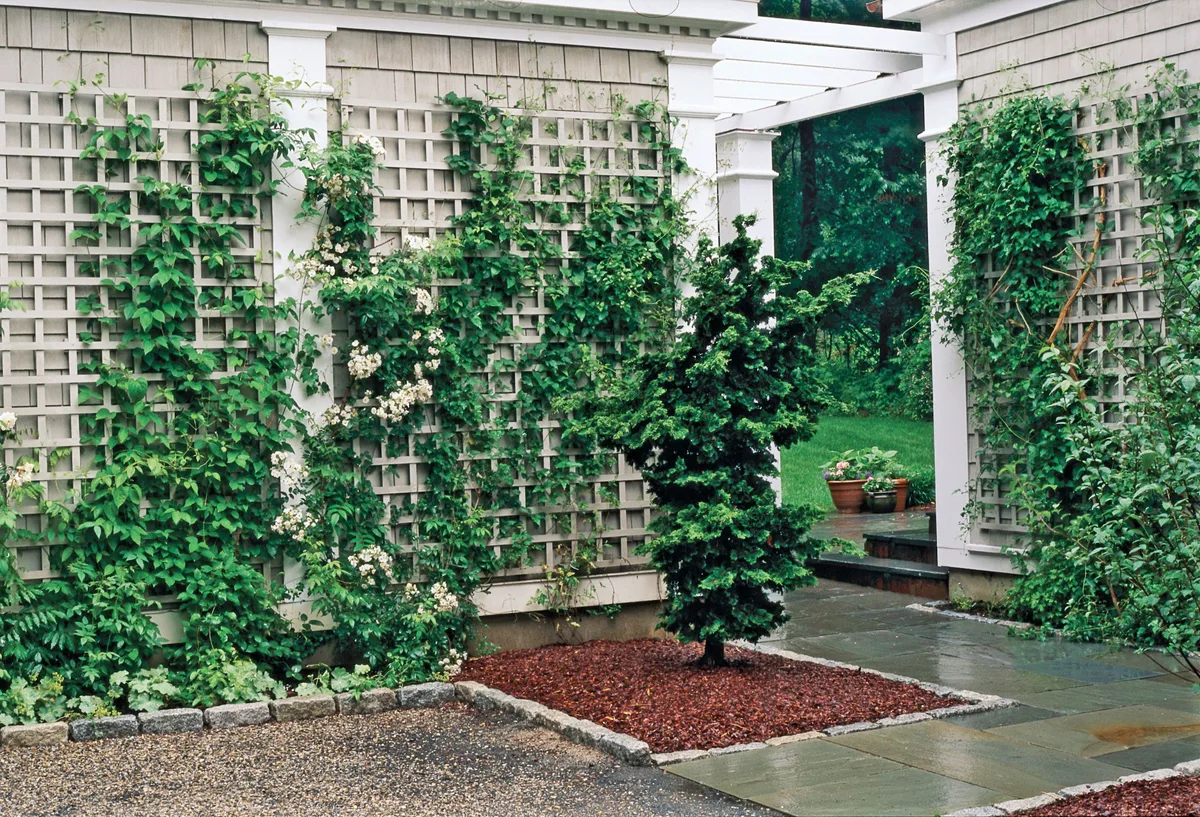
Image source: Bing (Web (fair-use with source credit))
A trellis is the simplest of the three. It's a flat panel designed to sit against a wall, fence, or standalone post. Its only job is to give climbing plants something to hold onto.
What defines a trellis
Trellises come in diamond lattice, square grid, or fan shapes. They're thin, typically 1 to 2 inches deep, and made from wood, metal, or vinyl. Most are 2 to 4 feet wide and 4 to 8 feet tall.
The key distinction is that a trellis is a plant support system, not a human-scale structure. You don't sit on it or walk under it. It's a vertical surface for greenery.
What a trellis does well
- Covers ugly walls and fences. If you have a bare fence or a blank side of your house, a trellis with climbing vines transforms it into a living wall.
- Maximizes small spaces. Balconies, patios, and tiny backyards benefit from vertical gardening. A trellis takes up no floor space.
- Cheapest option. A basic wooden trellis panel costs $20 to $60. Custom wrought iron designs stay under $400.
- Simple installation. Most trellises attach with a few screws into a wall or fence. Some freestanding models have ground stakes.
Where a trellis falls short
A trellis provides zero shade. It's flat against a wall, so it offers no overhead coverage. It also has weight limits.
Heavy vines like wisteria can pull a flimsy trellis off the wall or snap the lattice. Match the trellis material and mounting to the vine's mature weight.
Trellises also need airflow behind them. Mount one flush against a wall, and moisture gets trapped. Leave a 2 to 3 inch air gap to prevent rot.
Who should buy a trellis
You're the right candidate for a trellis if you're working with limited space, renting and can't install permanent structures, or want to hide an ugly fence with greenery. You're growing lightweight climbers like clematis, morning glories, or jasmine. You don't need shade, just vertical plant coverage.
Pergola: The Outdoor Room Builder
A pergola is the heavyweight of the three. It's a freestanding or attached structure with vertical posts supporting an open roof of cross beams and slats. Unlike an arbor that you walk through or a trellis that plants climb, a pergola defines an actual outdoor living space.
What defines a pergola
Pergolas are large. Standard sizes start at 8×10 feet and go up to 16×20 feet or more. Posts are typically 6×6 lumber set in concrete footings 24 to 36 inches deep.
The roof consists of beams with cross slats spaced 4 to 8 inches apart.
The open roof creates dappled shade. It's not solid coverage like a patio roof, but it provides enough protection to sit comfortably on a sunny day.
What a pergola does well
- Creates an outdoor room. A pergola defines a seating area, dining space, or outdoor kitchen. It gives structure to your patio or deck.
- Provides partial shade. Lath spacing of 4 to 6 inches blocks about 50 to 60 percent of direct sun. Add a retractable canopy for more coverage.
- Supports heavy vines. A properly built pergola handles wisteria, grapevines, climbing hydrangea, and trumpet vine. Posts are sized for significant weight.
- Adds property value. A well-designed pergola adds to curb appeal and perceived square footage of usable outdoor space.
Where a pergola falls short
Pergolas cost more and require more work. A DIY kit runs $500 to $1,500. A custom built structure runs $2,000 to $6,000 with professional installation.
You also need permits in most jurisdictions, and you must pour concrete footings below the frost line.
Snow load is a real concern. In northern climates, angled slats or a slightly pitched roof helps snow slide off. Flat roofs with close-spaced slats can accumulate dangerous weight.
Who should buy a pergola
You're the right candidate for a pergola if you have a patio or deck that feels exposed. You want a defined outdoor living area with seating, a dining table, or an outdoor kitchen. You're okay with a larger investment and some installation labor.
You want something that lasts 15 to 20 years with proper maintenance.
Side-by-Side: Which One Solves Your Actual Problem?
| Factor | Arbor | Trellis | Pergola |
|---|---|---|---|
| Primary purpose | Passage or entryway | Plant support against wall | Seating area with partial shade |
| Typical size | 3–5 ft wide, 6–8 ft tall | 2–4 ft wide, 4–8 ft tall | 8–12 ft wide, 8–10 ft tall |
| Cost range | $100–$800 | $20–$400 | $500–$6,000 |
| DIY difficulty | Easy | Very easy | Moderate to hard |
| Anchoring needed | Light (stakes or small footings) | Minimal (screws to wall or stakes) | Heavy (concrete footings 24–36 in deep) |
| Best for | Garden entrances, pathways | Fence cover, wall greenery, small spaces | Patios, decks, full seating areas |
| Plant load capacity | Light to moderate | Light to moderate | Heavy (climbing roses, wisteria) |
| Shade provided | Minimal (just the arch) | None | Partial (depends on lath spacing) |
| Resale value boost | Low to moderate | Low | Moderate to high |
This table cuts through the confusion fast. If you want a place to sit, that's a pergola. If you want to mark a path, that's an arbor.
If you want to cover a wall with plants, that's a trellis.
The materials also differ by structure. Pergolas lean toward cedar and pressure-treated pine for rot resistance. Arbors lean toward vinyl for low maintenance or cedar for natural appearance.
Trellises use the widest range of materials, including powder-coated steel for longevity.
Best For Each Situation
Choose an arbor if: You're marking a garden entrance, creating a walkway arch, or want something decorative that's quick to install. You're growing lightweight climbers like clematis or climbing roses. You don't need shade, just a visual anchor.
Choose a trellis if: You're covering an ugly fence, training climbers against a wall, or working with a tiny balcony. You have limited square footage and need vertical growing space. You're renting and can't pour concrete footings.
Choose a pergola if: You want an actual outdoor living space. You need real shade over a seating area. You're planning to furnish the space with chairs and a table.
You're okay with a weekend of work and a permit application.
Three Mistakes People Make
Mistake #1: Buying a flimsy arbor for heavy vines. A thin metal arbor from the big box store won't hold mature wisteria. Check the post thickness before buying. Anything under 4×4 lumber or thin-gauge metal is decorative only.
Mistake #2: Using a trellis where you need a pergola. A trellis against a wall gives zero shade. People mount a trellis over their patio and wonder why they're still baking in the sun. A trellis is for plants, not people.
Mistake #3: Skipping footings on a pergola. Setting posts directly in dirt guarantees wobble, rot, and collapse. Concrete is non-negotiable. Dig below the frost line and use post anchors.
Quick Rules of Thumb
For the arbor: Minimum 6 feet of clearance underneath. Choose cedar, redwood, or powder-coated metal. Pine rots in 3 to 5 years.
Position it so you walk through it, not past it.
For the trellis: Leave 2 to 3 inches of air gap between trellis and wall. Use treated wood or metal if it touches soil. Go bigger than you think.
Vines fill available space within two seasons.
For the pergola: Post spacing should never exceed 10 feet. Eight feet is safer for snow loads. Lath spacing of 4 to 6 inches gives about 50 to 60 percent shade.
Attach to house with a ledger board, not brackets.
Maintenance Reality Check
Wood structures need sealing or staining every 2 to 3 years. Skip one cycle and you'll see gray weathering. Skip two cycles and you'll see rot at ground level.
Vinyl structures need a garden hose rinse once a year. The downside is that vinyl becomes brittle in sustained cold below 20 degrees Fahrenheit. It also fades over 5 to 7 years.
Metal structures need rust prevention. Powder-coated aluminum holds up well. Wrought iron needs annual rust inspection.
Galvanized steel is the most durable but has an industrial look.
Check the base of every post annually for rot, rust, or insect damage. That's where failure starts. A 10 minute inspection each spring adds years of life.
The Bottom Line
A pergola creates an outdoor room with shade. An arbor marks a garden entrance. A trellis covers a wall on a budget.
Match the structure to your primary goal. If you want to sit outside, buy a pergola. If you want to frame a path, buy an arbor.
If you want to hide a fence with vines, buy a trellis.
Don't let the sale price trick you into buying the wrong tool for the job. The cheapest option becomes the most expensive when you replace it in three years. Spend the money once on the right structure and enjoy it for the next decade.
Frequently Asked Questions
Can I use an arbor as a pergola?
No. An arbor is too small and too light to create a seating area. Its posts are typically 4×4 at most, and its arch is only 3 to 5 feet wide.
You cannot fit a table and chairs under it.
How long does a wooden trellis last?
Pressure-treated pine trellises last 5 to 7 years with sealing. Cedar trellises last 10 to 15 years. Vinyl or powder-coated metal trellises can last 20 years with almost no upkeep.
Do I need a building permit for a pergola?
Most municipalities require permits for permanent pergolas over 100 square feet or any structure attached to a house. Check with your local building department before buying materials.
What's the best vine for a trellis?
Clematis is the top choice because it's lightweight and climbs without damaging the structure. Morning glories and jasmine also work well. Avoid heavy vines like wisteria unless your trellis is heavy-duty metal.
Can I attach a trellis directly to my house?
Yes, but leave a 2 to 3 inch air gap using standoff brackets. Direct contact traps moisture and leads to rot on both the trellis and your house wall.

Similar Posts