Coleman Evcon Furnace Troubleshooting
Your furnace stops blowing heat on the coldest night of the year. You stare at a metal box that should be running but isn't. If you're here for Coleman Evcon Furnace Troubleshooting, you know the stakes: no heat, possible lockout, and a choice between fixing it yourself or calling a pro.
That's exactly what we're walking through today.
Most Coleman Evcon problems share a handful of common causes. Manufacturer service documentation shows roughly 70% of no-heat calls trace back to a dirty flame sensor, a tripped limit switch, or a failed draft inducer motor. Per the NFPA National Fuel Gas Code (NFPA 54), any furnace that repeatedly locks out or shows a rollout switch trip needs immediate professional evaluation.
Let's start with the safety reality, because skipping this part turns a simple fix into a dangerous mistake.
Quick Answer
Turn off power and gas before touching anything. Read the LED error code on the control board. Clean the flame sensor with fine sandpaper.
Reset the furnace by cycling the thermostat. If it still won't run, call a licensed HVAC technician.
Image source: Bing (Web (fair-use with source credit))
Why This Matters First – The Safety Stakes with Coleman Evcon Furnaces
Troubleshooting a gas furnace is not like fixing a leaky faucet. You're dealing with combustion, carbon monoxide (CO), high-voltage electricity, and flammable fuel. One wrong move can send you to the hospital.
The Three Biggest Risks
Carbon monoxide poisoning tops the list. A cracked heat exchanger or blocked flue pushes CO into your living space. The U.S.
Consumer Product Safety Commission reports over 400 people die each year from accidental CO poisoning in the U.S. Many of those deaths happen during cold snaps when people try to restart a furnace without checking for safe operation. Install a CO detector near your bedrooms and furnace room.
Fire or explosion is the second risk. A failed gas valve, damaged wiring, or blocked burner compartment can cause gas buildup. When the ignitor sparks, that trapped gas ignites with force.
The NFPA 54 code requires that any furnace with a tripped rollout switch must be inspected before restarting. Do not just push the reset button and walk away.
Electrical shock rounds out the list. Your furnace contains 120-volt circuits in the blower, inducer motor, and transformer. Even when the furnace is off, capacitors can hold a charge.
Always disconnect power at the breaker panel before opening access panels. No exceptions.
When You Must Stop and Call a Pro
If you smell gas even slightly, turn off the gas at the meter and leave the house. Call your gas company from outside. If you see melted wires, scorch marks, or water pooling inside the furnace, stop.
If the furnace has been flooded, do not attempt to restart it. And if you don't own a multimeter or don't know how to safely check voltage, this is not the time to learn.
Homeowners who try to diagnose complicated issues without the right tools often waste hours and cause more damage. Knowing when to hand it off is smart.
How Your Coleman Evcon Furnace Works – The Ignition Sequence You Need to Know
Before you troubleshoot, you need to understand the sequence of events every time your thermostat calls for heat. Each step depends on the previous one. If any step fails, the furnace stops or locks out.
The Full Ignition Sequence (Standard Electronic Ignition)
- Thermostat calls for heat, The thermostat closes the circuit between R (power) and W (heat call). This sends 24 volts to the furnace control board.
- Control board starts the draft inducer motor, The inducer fan spins up to create a draft through the heat exchanger. This clears out residual gas and pulls in combustion air.
- Draft inducer pressure switch closes, As the inducer creates negative pressure, a tube connected to the pressure switch senses that pressure. When it reaches the switch setpoint (typically -0.40 to -1.20 inches of water column), the switch closes. That tells the control board it's safe to proceed.
- Hot surface ignitor glows, The control board sends power to the ignitor. It heats up for about 20 to 60 seconds, reaching a bright orange glow.
- Gas valve opens, Once the ignitor is hot enough, the board opens the gas valve. Gas flows into the burner and ignites.
- Flame sensor verifies ignition, A small rod mounted near the burner detects the flame's electrical signature. If it senses flame, the board keeps the gas valve open. If not, the board closes the gas valve and tries again.
- Main blower starts, After the heat exchanger warms up (usually 30 to 90 seconds), the board turns on the indoor fan to push warm air through your ducts.
- Burner shuts down, When the thermostat is satisfied, the board closes the gas valve. The flame goes out. The inducer runs for another 30 to 60 seconds to purge remaining gas. Then everything shuts off.
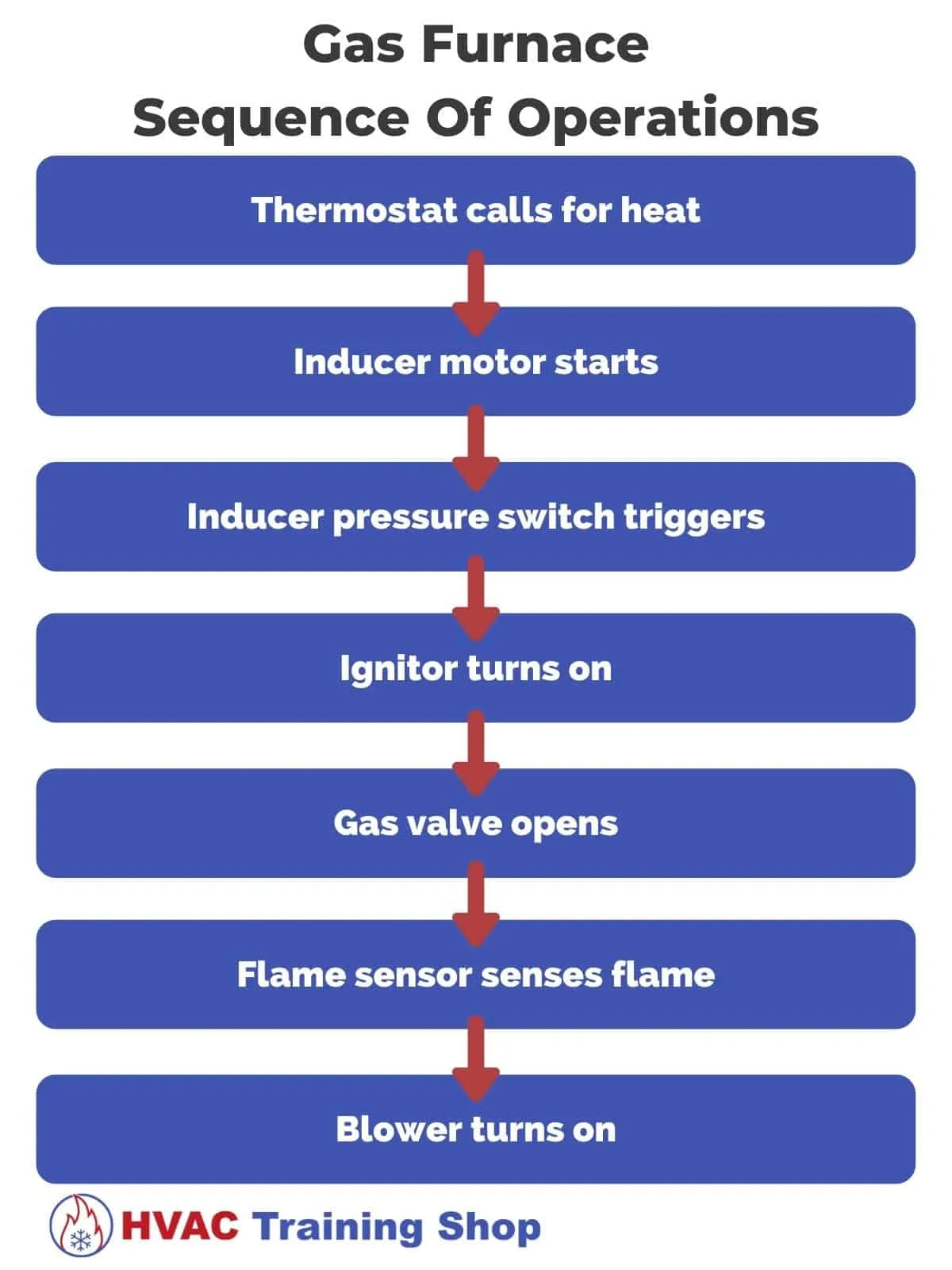
Image source: Bing (Web (fair-use with source credit))
Why This Sequence Matters for Troubleshooting
Every symptom matches a specific stage. If you hear the inducer running but the furnace never tries to light, the problem is before the ignition step. That could be a failed pressure switch, blocked vent tube, or control board issue.
If the furnace lights but goes out after a few seconds, it's almost certainly a dirty flame sensor.
If the burner runs but no blower comes on, the issue is in the fan circuit. If the blower runs continuously, the problem is the fan limit switch or thermostat wiring.
Knowing the sequence lets you skip random guesses. You zero in on the step where the furnace stops. That is the only step you need to debug.
The Most Common Failure Points on Coleman Evcon Models
Over years of service calls and aggregate reviews from homeowners, five components fail more than anything else on Coleman Evcon gas furnaces. Here's each one, the symptoms, and how to test it safely.
1. Dirty Flame Sensor
Symptoms: Furnace tries to light, flame appears for a few seconds, then goes out. This repeats several times until the furnace locks out. You see a flashing error code for ignition failure (typically 1 flash on many models).
Why it happens: The flame sensor is a metal rod in the burner flame. Over time, a thin layer of carbon builds up on its surface. That layer insulates the rod and prevents it from sensing the flame.
The control board thinks there is no flame and shuts the gas valve off.
What to do: Turn off power and gas. Remove the flame sensor (usually one screw). Gently clean it with fine sandpaper, emery cloth, or a dollar bill.
Do not use steel wool or a file. Reinstall and test.
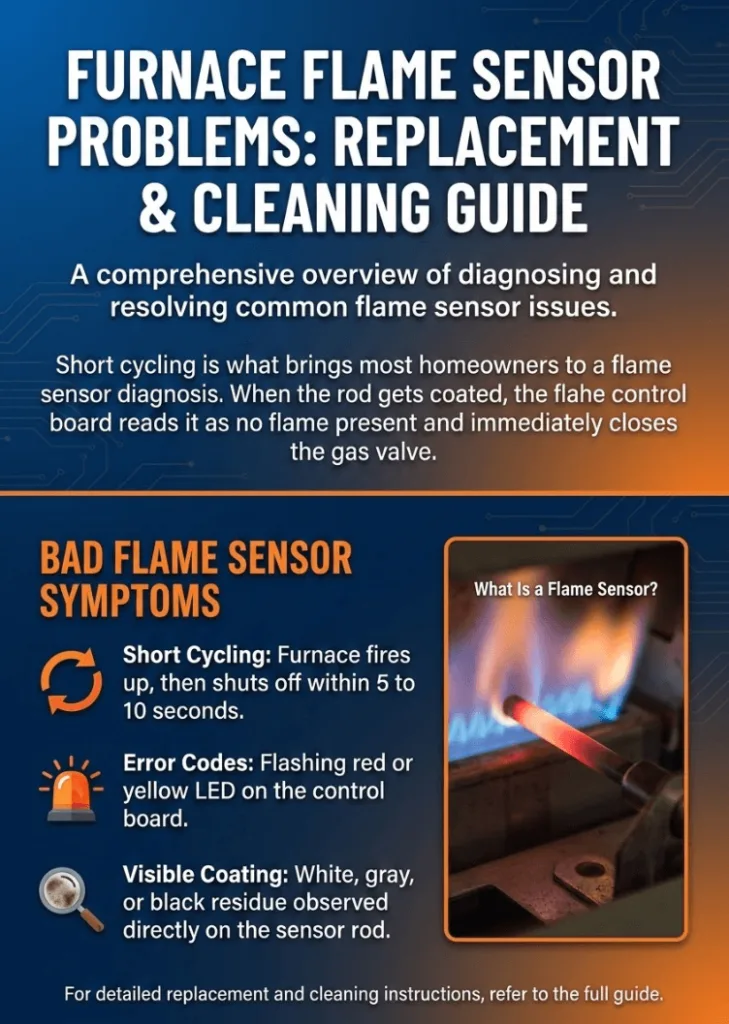
Image source: Bing (Web (fair-use with source credit))
2. Failed Draft Inducer Motor
Symptoms: Furnace hums or squeals but the inducer fan doesn't spin. Or you hear nothing at all when the thermostat calls for heat. The error code may show pressure switch open or inducer fault.
Why it happens: The motor's bearings wear out over time. The motor seizes. Or the capacitor that starts it fails.
On Coleman Evcon models, this is common after 10 to 15 years.
What to do: Listen for the inducer. If it's silent, check for 120 volts at the motor while the furnace is calling for heat. If voltage is present and the motor doesn't spin, replace the motor or capacitor.
If no voltage, the control board or wiring may be bad.
3. Pressure Switch Stuck Open
Symptoms: Inducer runs normally, but furnace never tries to light. The error code flashes 2 times or indicates pressure switch open. You may hear a clicking sound from the switch.
Why it happens: The switch itself can fail. More commonly, the rubber tube connecting it to the inducer housing gets cracked, clogged, or disconnected. Even a pinhole prevents the switch from sensing negative pressure.
What to do: Check the tube for cracks or kinks. Disconnect the tube from the switch and gently blow through it. It should be clear.
If the tube is fine, use a multimeter to check continuity across the switch terminals while the inducer is running. If no continuity, replace the switch.
4. Limit Switch Tripped (High Limit or Rollout)
Symptoms: Furnace runs for a few minutes then shuts off. Or it cycles on and off rapidly. The error code may show 4 flashes for high limit open.
Why it happens: A dirty air filter, blocked supply registers, or a closed return grille causes the heat exchanger to overheat. The high limit switch opens to prevent fire. A rollout switch trips if the burner flames roll out of the combustion chamber.
That indicates a flue blockage or cracked heat exchanger.
What to do: Check your air filter first. Replace a dirty one and reset the furnace. If the limit trips again, check for closed vents or a blocked return.
If the rollout switch has tripped, do not reset it. Call a pro. That is a red flag for serious safety issues.
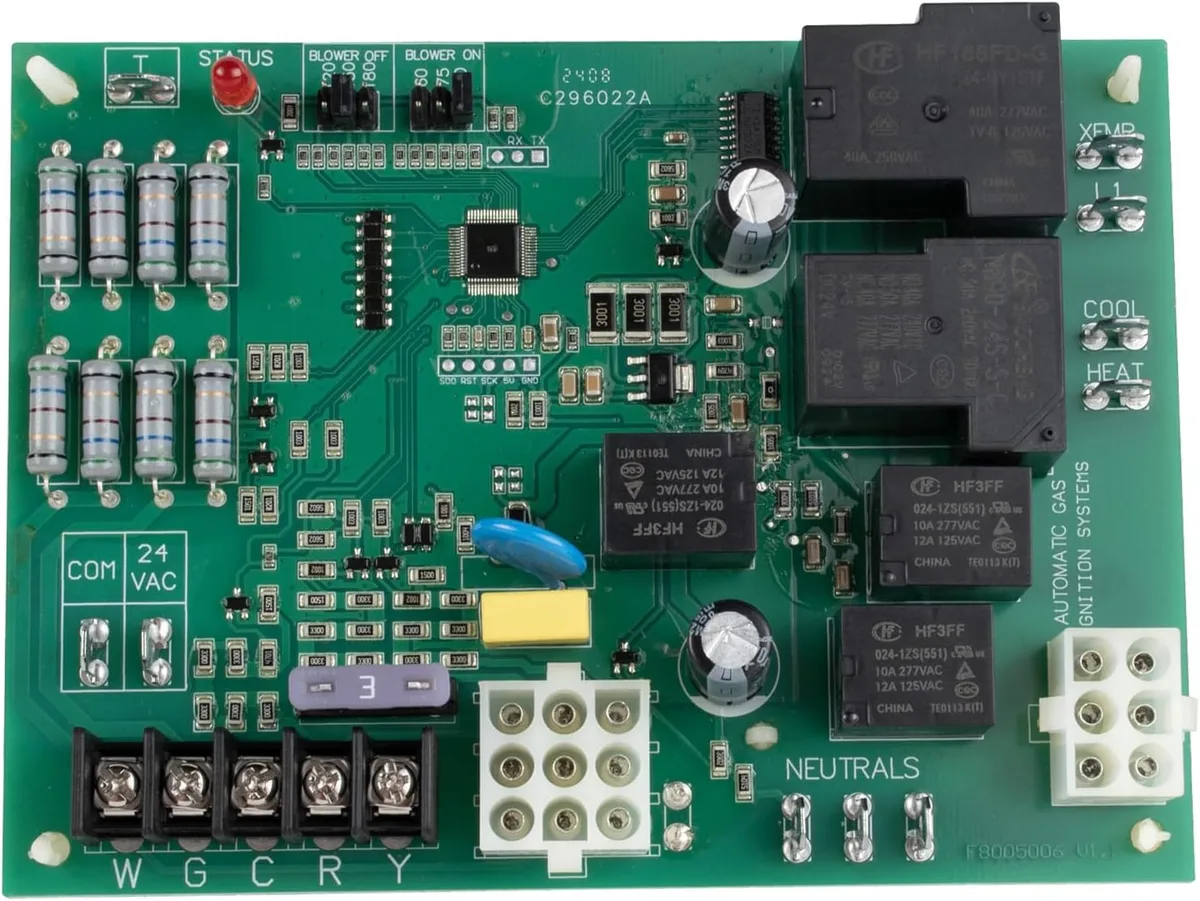
5. Control Board Failure
Symptoms: No LED lights. Furnace completely dead. Continuous flashing that doesn't match any known code.
The furnace may run with no thermostat input.
Why it happens: Power surges, moisture, or age can damage the board. Relays can stick, causing blowers to run constantly.
What to do: Confirm 24 volts is reaching the board at the R and C terminals. If power is present but the board does not respond, the board likely needs replacement. Use an OEM part specific to your model number (e.g., 031-01047-000 or 031-02090-000).
How to Read Your Furnace's Error Codes – The Fastest Diagnostic Shortcut
Coleman Evcon furnaces have a diagnostic LED on the control board. This little light flashes a specific pattern that tells you exactly what's wrong. Learning these codes saves hours of guesswork.
Locating the LED
Open the lower access panel. The control board is usually mounted on the blower compartment wall or standing upright on the side. The LED may be visible through a small window.
It will blink, either a steady series of flashes or a two-digit code.
Common Error Code Patterns for Coleman Evcon
| Flash Pattern | Meaning | Recommended Action |
|---|---|---|
| 1 flash | Ignition failure – gas valve not opening or flame not sensed | Clean flame sensor, check gas supply |
| 2 flashes | Pressure switch open – inducer not running or tube blocked | Check inducer motor, inspect tubes |
| 3 flashes | Rollout switch tripped – dangerous condition | Call a pro immediately |
| 4 flashes | Limit switch open – high temperature condition | Inspect limit, change filter, verify airflow |
| 5 flashes | Flame sensed outside normal timing – gas valve leak | Call a pro |
| Slow continuous flash (once per 2 seconds) | Normal operation | Nothing – furnace is fine |
| Rapid flash (multiple times per second) | Control board error | Cycle power, if persists replace board |
| No flash at all | No power to board | Check transformer, breaker, door switch |
Your specific model may vary. Check the manual inside the access panel for your exact code chart.
How to Count Flashes Correctly
Watch the LED for a full cycle. Some boards flash a two-digit code: a longer flash followed by a series of short flashes. The long flash represents the tens digit.
The short flashes represent the ones digit. For example, one long flash followed by two short flashes equals code 12.
If the LED is flashing rapidly without stopping, the board might be bad. If it's blinking a steady repeated pattern, count the flashes in a row. Then wait for a pause and see if it repeats.
What to Do After Reading the Code
Write down the code before you reset anything. If the code indicates a rollout switch (code 3) or flame sensed incorrectly (code 5), call a professional. Those are not DIY repairs.
For ignition failure or limit switches, you can safely proceed with the step-by-step process below.
Step-by-Step Troubleshooting Flow – From Dead Furnace to Heat
Follow these steps in order. If at any point you encounter a condition that says call a pro, stop and do that. Do not skip ahead.
Step 1: Confirm Power and Gas
If the furnace is completely dead: Check the breaker at your main panel. Make sure it's on and not tripped. Also check the furnace disconnect switch near the unit.
Confirm the gas shutoff valve is open. The handle should be parallel to the pipe, not perpendicular.
If you have a front door switch: Many Coleman Evcon furnaces have a safety switch that disables the furnace when the blower door is removed. Make sure the door is securely in place.
Step 2: Read the Error Code
Follow the instructions from the previous section. Write down the code. If you see code 3 or 5, stop here and call a pro.
Step 3: Reset the Furnace
Turn the thermostat to off or lower the setpoint so it stops calling for heat. Wait 30 seconds. Then turn it back to heat and set the temperature above room temperature.
Sometimes the furnace just needed a reset after a temporary glitch.
If the furnace starts and runs normally: You're done. Monitor it for a few cycles. If the same error returns, proceed to Step 4.
Step 4: Clean the Flame Sensor (For Ignition Failure)
If you got code 1 or the furnace lights and goes out, start here. Turn off power to the furnace. Remove the flame sensor.
Clean it with fine sandpaper. Reinstall and test.
If it now works: Problem solved. The sensor was dirty.
If it still fails: Move to Step 5.
Step 5: Check Pressure Switch and Tubes
If code 2 appears or the inducer runs but no ignition happens, inspect the rubber tubing from the pressure switch to the inducer housing. Look for cracks, holes, or blockages. Also check the small port on the inducer housing where the tube attaches.
Sometimes dirt or spiderwebs block it.
Clear the tubing if needed. Reset and test.
If the tube is clear and the problem persists: The pressure switch itself may be bad. Test it with a multimeter while the inducer is running. If the switch doesn't close when the inducer creates negative pressure, replace the switch.
Step 6: Inspect and Replace Air Filter (For High Limit Trips)
If code 4 appears or the furnace short cycles, your filter is the most likely culprit. Remove the filter and check it. If it's dirty, replace it with a clean one of the same size.
Do not use a high-MERV filter unless the furnace is designed for it. A restrictive filter starves the furnace of airflow.
Reset and test. If the furnace now runs normally, you're done. If the limit trips again within 10 minutes, there may be a clogged return or a bad limit switch.
Step 7: Test the Draft Inducer Motor
If the inducer doesn't run at all, use a multimeter to check for 120 volts at the motor terminals while the thermostat is calling for heat. If voltage is present, the motor or capacitor is bad. If no voltage, the control board or wiring is at fault.
Replacing the inducer motor is a moderate DIY job if you are comfortable with electrical work. Match the motor specs exactly.
Step 8: Check the Control Board
If you've gone through all steps and the furnace still does not start, the control board may be the issue. Visually inspect it for burnt components or bulging capacitors. If the LED is erratic or dead, the board likely needs replacement.
Replace the board only with an OEM or approved universal board that matches your furnace's model number. Do not use generic boards unless you have the correct wiring diagram.
When to Give Up and Call the Pro
If you've completed steps 1 through 8 and still have no heat, you are beyond the DIY scope. A professional technician has tools like a manometer to check gas pressure, a combustion analyzer to test CO levels, and experience to spot hidden issues. The cost of a service call is less than the cost of an ER visit.
When to Call a Pro – Lines You Don't Cross as a DIY Homeowner
Some repairs are not worth the risk. Here are the situations where you stop what you're doing and call a licensed HVAC technician.
Heat Exchanger Inspection
You cannot properly inspect a heat exchanger yourself. It requires removing the burner assembly, using a borescope, and running a combustion analysis test. A cracked heat exchanger leaks CO into your ductwork.
If you suspect this, do not run the furnace. Call a pro.
Gas Pressure Adjustment
The gas valve has two pressures: inlet pressure and manifold pressure. Both need to be set within a tight range for safe combustion. Adjusting them requires a manometer and knowledge of the correct specifications for your model.
Do not turn screws on the gas valve without proper training.
Rollout Switch That Has Tripped
If the rollout switch has tripped, something serious is wrong. It could be a blocked flue, a cracked heat exchanger, or improper venting. Do not just reset it and hope for the best.
The furnace needs a thorough inspection first.
Replacing the Gas Valve
The gas valve is a safety-critical component. It controls the flow of fuel into your home. Incorrect installation can cause a gas leak or explosion.
Leave this to a licensed professional.
Electrical Work Beyond Basic Checks
If you need to replace the control board and don't know how to safely discharge capacitors or verify polarity, call a pro. A wrong connection can fry the new board instantly or cause a fire.
Mistakes That Cost Homeowners Time, Money, and Safety
Homeowners make the same mistakes every year. Avoid these.
Mistake 1: Skipping the Error Code
Many people start replacing parts before reading the error code. They swap the control board only to find out the real issue was a dirty filter. Read the code first.
It takes 30 seconds and saves hundreds of dollars.
Mistake 2: Using Steel Wool on the Flame Sensor
Steel wool leaves microscopic metal fragments on the sensor rod. These fragments can cause false flame readings. Always use fine sandpaper, emery cloth, or a dollar bill.
Mistake 3: Replacing Parts Without Testing
Parts are not cheap. A pressure switch costs around $30. A control board costs $150 to $300.
Test each component before buying a replacement. Use a multimeter to confirm the part is actually bad.
Mistake 4: Blocking Airflow With Furniture or Curtains
Supply registers and return grilles need to be open and clear. Covered registers cause the high limit switch to trip. Check every room when the furnace short cycles.
Mistake 5: Forgetting the Condensate Drain
High-efficiency Coleman Evcon models produce water as a byproduct of combustion. If the drain line freezes or clogs, a safety switch stops the furnace. Check the drain line in attics and crawlspaces during cold weather.
Mistake 6: Ignoring the Thermostat
Sometimes the furnace is fine and the thermostat is the problem. Check for loose wiring, dead batteries, or incorrect settings. Replace batteries annually.
Maintenance That Prevents Most Breakdowns
Preventive maintenance keeps your furnace running longer and catching problems early.
Monthly Tasks
- Check and replace the air filter. A dirty filter is the #1 cause of limit switch trips.
- Ensure all supply registers and return grilles are open and unobstructed.
- Listen for unusual noises from the inducer motor or blower.
Annual Tasks (Before Heating Season)
- Clean the flame sensor. Do this even if the furnace is running fine. It takes 10 minutes.
- Inspect the pressure switch tubing for cracks or blockages.
- Check the condensate drain line for clogs or freezing.
- Vacuum the blower compartment to remove dust and debris.
- Test the CO detector and replace batteries.
Every Three to Five Years
- Have a professional inspect the heat exchanger.
- Have a technician check gas pressure and combustion efficiency.
- Consider replacing the draft inducer motor if it's approaching 15 years old.
Frequently Asked Questions
Why does my Coleman Evcon furnace light then go out after a few seconds?
This is almost always a dirty flame sensor. Turn off power, remove the sensor, clean it with fine sandpaper or a dollar bill, and reinstall. If the problem persists, the sensor or control board may be failing.
What does one flash on my Coleman Evcon furnace mean?
One flash indicates ignition failure. The furnace tried to light but didn't detect a flame. Clean the flame sensor first.
If that doesn't work, check the gas supply and confirm the gas valve is open.
How do I reset my Coleman Evcon furnace?
Turn the thermostat to off. Wait 30 seconds. Turn it back to heat and set the temperature above the room temperature.
If the furnace is in lockout mode, turning off power at the breaker for 60 seconds may also reset the control board.
Why does my furnace click but not start?
The clicking sound is likely the pressure switch or gas valve. If the inducer motor is running and you hear clicking, the pressure switch may be failing to close. Check the tubing for cracks or blockages.
If the tubing is fine, test the switch with a multimeter.
Can I replace the control board myself?
Yes, if you are comfortable with electrical work. Label every wire before disconnecting. Use an OEM board that matches your model number exactly.
Power down the furnace completely before touching any components.
How often should I replace the air filter?
Check it monthly during the heating season. Replace it when it looks dirty. Standard fiberglass filters should be replaced every 1 to 3 months.
High-MERV filters may need more frequent changes.
Final Decision Guide – Repair This One or Replace the Whole Unit?
At some point you face the question: fix it again or buy a new furnace? Here's how to decide.
Repair if:
- The furnace is less than 10 years old
- The cost of the repair is under $500
- The part is readily available
- The furnace has been well maintained
- The heat exchanger is in good condition
Replace if:
- The furnace is over 15 years old
- The heat exchanger is cracked
- The repair cost exceeds 50% of a new unit
- Parts are discontinued or hard to find
- You've had three or more major repairs in the last five years
- The AFUE rating is below 80% and you want better efficiency
A new standard-efficiency Coleman Evcon furnace costs roughly $2,000 to $3,500 installed. A high-efficiency model runs $3,500 to $5,500. Compare that to the cost of chasing repairs on a 20-year-old unit.
Sometimes the smarter move is to start fresh.
The bottom line: Coleman Evcon furnaces are reliable machines when maintained. Most problems come down to a handful of known failure points. Read the error codes.
Clean the flame sensor. Check the filter. Clear the tubes.
If those steps don't work, call a professional who knows the brand. You'll be back to warm air faster than you think.

Similar Posts