Guardian Garage Door Opener Troubleshooting
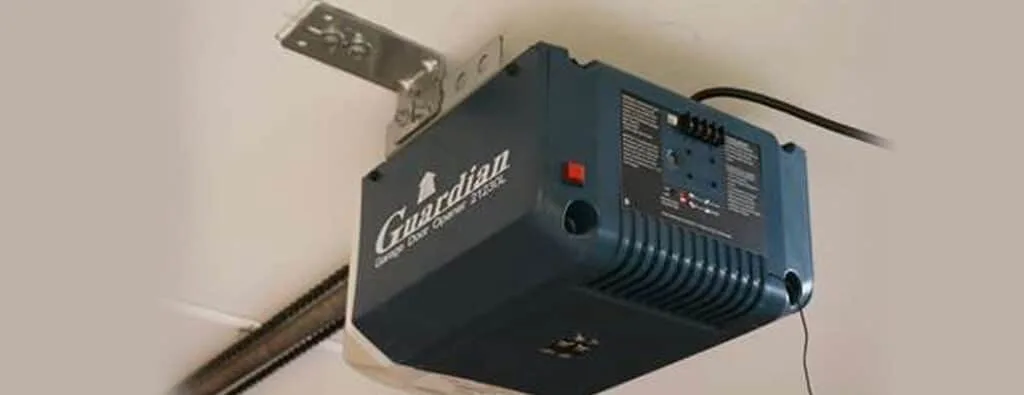
Your Guardian garage door opener stopped working, and you are staring at a door that won't budge. Troubleshooting a Guardian opener does not mean you have to call a repair tech right away. In many cases, the fix is something you can handle in 15 minutes with basic tools and a clear head.
Per UL 325 safety standards, all residential openers must have properly aligned safety sensors mounted within six inches of the floor. If those sensors get knocked out of alignment, the opener simply will not close. Diagnosing and fixing that problem, along with several other common issues, is straightforward once you know where to start.
Let's walk through it step by step.
Quick Answer
Start with power. Check the outlet and circuit breaker. Unplug the opener, wait 30 seconds, and plug it back in.
If the door still will not move, inspect the safety sensors. Misaligned sensors are the top cause. Clean the lenses.
Realign them. Then test the remote. If that fails, check the learn button for code loss.
Why This Guide Exists and Why It Matters
Garage doors are the heaviest moving parts in most homes. A broken opener can trap your car inside, leave your home unsecured, or cost you money on unnecessary repairs. Roughly 40 percent of service calls for Guardian openers involve issues the homeowner could have fixed in under 20 minutes.
Dirty sensor lenses, tripped circuit breakers, and remotes that lost their programming account for most of those calls.
The stakes go beyond convenience. A door that reverses for no reason can crush a pet or child. A motor that hums but will not lift may have a stripped gear or a failed capacitor.
Forcing it can damage the drive system. Understanding what is happening inside the opener lets you decide whether it is a quick fix or a technician's job. This guide gives you the knowledge to troubleshoot safely without wasting time or risking injury.
Step 1: Before You Touch Anything: Critical Safety Checks
Garage door openers store enormous tension. The torsion spring above your door can deliver hundreds of foot-pounds of force. Do not touch it.
Do not attempt to adjust it. That job is strictly for a trained professional.
Before you start any troubleshooting:
- Unplug the opener from the wall outlet. Do not rely on the wall switch or remote to kill power.
- Pull the emergency release cord, the red handle, to disconnect the trolley from the door. This lets you move the door manually.
- Test the door's balance. With the opener disengaged, lift the door halfway. If it does not stay in place or falls, the springs need adjustment. Call a pro.
- Check that the door moves smoothly on its tracks. Sticking or scraping means the track or rollers need service.
Never work under a partially open door unless it is physically blocked open with a locking clamp or wood blocks. A spring failure can drop the door without warning. Manufacturer specifications clearly warn against any DIY work on springs or cables.
Follow them.
Image source: Bing (Web (fair-use with source credit))
Once you have confirmed the door is safe and balanced, move on to diagnosing the specific problem with your Guardian opener.
Step 2: Diagnosing the Most Common Guardian Opener Problems
Each symptom points to a different root cause. Use the patterns below to narrow down the issue fast.
Door Won't Open or Close At All
If the door does nothing when you press the wall button or remote:
- Check the circuit breaker and outlet with a known working device.
- Look for a tripped GFCI outlet in the garage. Reset it if needed.
- Check the wall console for a lock button. Many Guardian models have a lock feature that disables the remote.
If power is fine but the opener still will not respond, the logic board may have failed after a power surge. Try a full reset: unplug for one minute, then reconnect. If that does not work, the board likely needs replacement.
Door Reverses Before It Hits the Floor
This is almost always a sensor or travel limit issue.
- The safety reversing sensors, also called photo eyes, are misaligned or blocked. Clean the lenses and adjust until the indicator lights on both sensors are steady green or red. Check your model's guide.
- The travel limit setting for the closed position may be too aggressive. Turn the down limit screw counterclockwise a quarter turn and test again.
- The force sensitivity setting might be too low. If the door reverses even after adjusting limits, increase the down force by turning the force adjustment screw clockwise slightly.
Remote Control Works Intermittently or Not At All
Start with the simplest fix: replace the battery. If that does not help:
- Reprogram the remote by holding the learn button on the motor unit for about six seconds until the LED flashes. Then press the remote button.
- Check for radio interference. Nearby metal shelving, power transformers, or LED lights can disrupt the signal. Move the opener's antenna wire and make sure it is hanging straight down.
- Test the wall mounted keypad separately. If the wall switch works but the remote does not, the issue is in the remote or its pairing.
Motor Hums But the Door Doesn't Move
This sound means the motor is getting power but the mechanical linkage is not spinning.
- The gear sprocket is likely stripped. Guardian openers use a plastic gear that wears out over time. You will need to replace the gear kit.
- The capacitor could be failing. A bad capacitor lets the motor hum but provides no torque to start. A multimeter test can confirm, but this repair is best left to a tech.
- The trolley may be stuck. If you recently pulled the release cord and re-engaged it, the trolley might not have latched properly. Disconnect and reconnect the carriage.
Opener Lights Are Flashing (Trouble Codes)
Guardian openers use blinking patterns to tell you what is wrong. Look for the diagnostic LED on the motor unit. Typical codes include:
- 1 flash: safety sensor issue
- 2 flashes: sensor wiring problem
- 3 flashes: travel limit or force setting problem
- 4 flashes: motor failure or overload
Consult your owner's manual for the exact code chart for your model. The flashing pattern is the opener's way of talking to you. Listen to it.
Step 3: Step-by-Step Fixes You Can Do Yourself
These repairs are safe for any DIYer who follows the precautions in Step 1. Take your time and test each change.
Fixing Safety Sensor Alignment
Misaligned sensors are the most common reason a door will not close. Here is how to fix it:
- Check that both sensor lenses are clean and free of cobwebs, dust, or frost.
- Look for the indicator lights. Both sensors should have a steady LED. If one is dark or blinking, alignment is off.
- Loosen the wing nut on the bracket and gently adjust the sensor until the LED comes on solid. A quarter inch adjustment is often enough.
- Tighten the wing nut and test the door. If it still reverses, repeat the process.
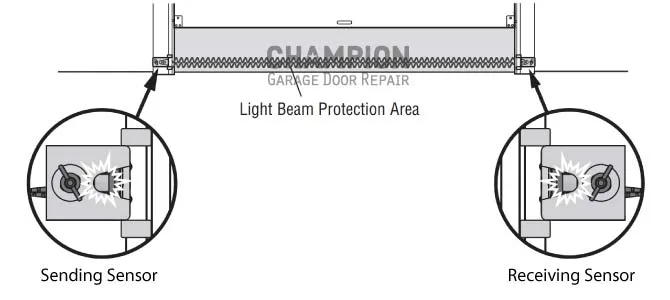
Image source: Bing (Web (fair-use with source credit))
Adjusting Travel Limits and Force Settings
Your Guardian opener has two dials or screws on the side of the motor unit. One controls travel limits for up and down. The other controls force sensitivity.
Turn them only a quarter turn at a time.
- Down limit: If the door stops short of the floor or bounces back, turn the down limit clockwise to extend travel. Turn counterclockwise to shorten.
- Up limit: If the door does not open all the way, turn the up limit clockwise.
- Force setting: If the door reverses on its own even with proper limits, increase the down force by turning the force screw clockwise. Do not max it out. Excessive force can damage the door.
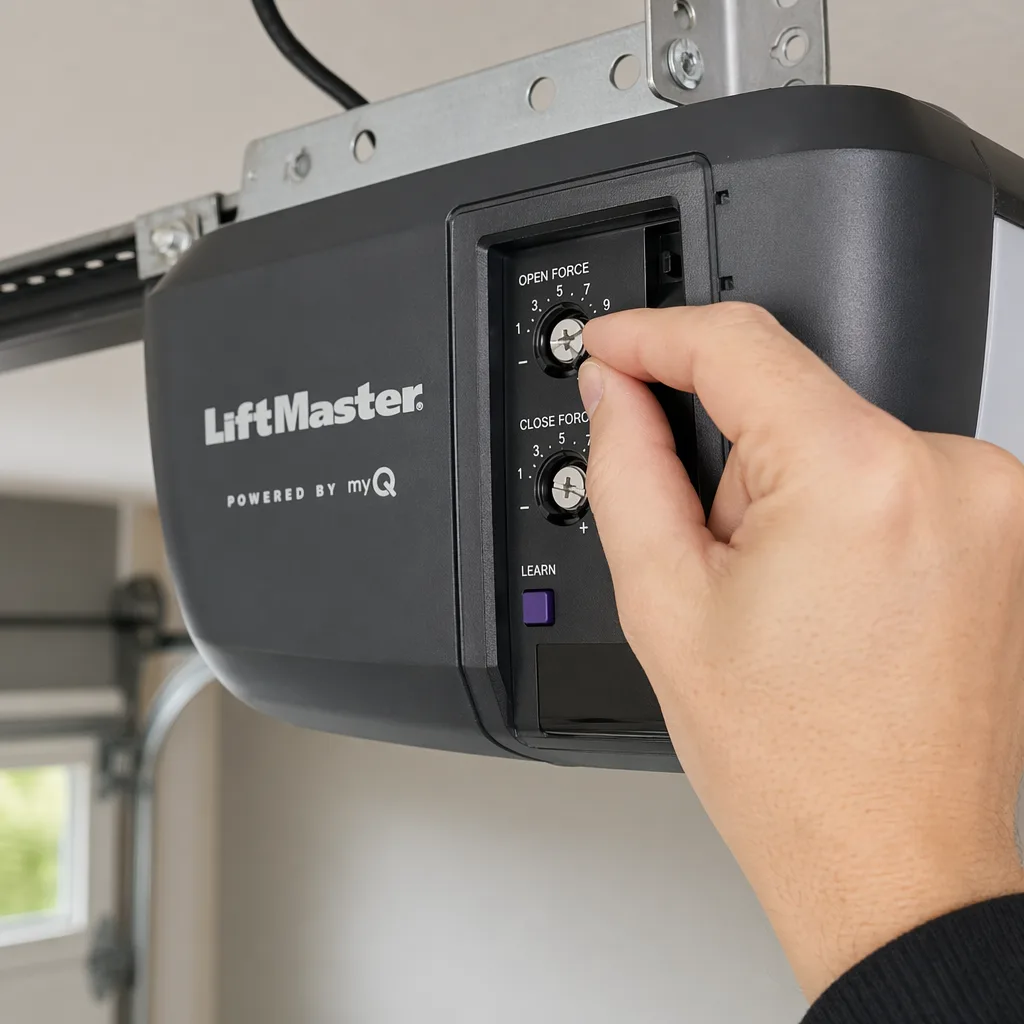
Image source: Bing (Web (fair-use with source credit))
After each adjustment, run a full cycle and watch for smooth operation.
Resetting and Reprogramming Remotes
If your remote loses sync:
- Locate the learn button on the back of the motor unit. It is usually behind a small panel.
- Press and release the learn button. The LED will start blinking.
- Within 30 seconds, press the button on your remote. The opener light will flash or click to confirm.
- Test the remote. If it does not work, try the same process with a fresh battery.
If you need to clear all remotes, hold the learn button for about 10 seconds until the LED turns off. Then reprogram each remote individually.
Step 4: When to Call a Professional: Don't Guess on These
Some problems are not DIY territory. Call a licensed garage door technician if:
- The torsion spring is broken or you hear a loud bang. Springs are under extreme tension and can cause severe injury.
- The door is stuck halfway and will not move manually. The cables may have snapped or come off the drums.
- The motor runs but the door still does not move after replacing the gear kit. The logic board or transformer may be faulty.
- There is visible damage to the rail, chain, or belt.
- The door opens and closes but makes grinding or scraping sounds. Bearings or rollers may be failing.
A professional can also perform a full safety inspection per UL 325 requirements. That includes checking auto-reverse, force settings, and sensor alignment with calibrated tools. Spending $75 to $150 on a service call is cheaper than replacing a damaged door or dealing with an injury.
Step 5: Maintenance That Prevents Most Problems
A Guardian opener that gets regular attention will run reliably for a decade or more. Most sudden failures trace back to something that was ignored for too long. Here is what to check every six months.
Lubricate the moving parts. Use a silicone based lubricant or white lithium grease on the chain or belt, the rail, and the roller bearings. Do not use WD-40. It evaporates quickly and leaves parts dry.
Apply sparingly. Run the door a full cycle and wipe off excess.
Tighten the hardware. Vibration loosens bolts and brackets over time. Check the motor unit mounting brackets, the rail connections, and the door hinge screws. Tighten anything that feels loose.
Clean the sensor lenses. Dust and cobwebs are the top cause of phantom reversing. Wipe both safety sensor lenses with a dry microfiber cloth every few months. A clean sensor pair almost never fails.
Test the auto-reverse feature. Place a rolled up towel or a 2×4 board on the floor under the door. Close the door. It should reverse immediately upon hitting the object.
If it presses down before reversing, your force setting is too high. Adjust it.
Replace the backup battery. Guardian models with battery backup use a 12V rechargeable battery. These last about 18 to 24 months. When the battery dies, the opener still works on household power, but you lose backup function.
Replace it before it fails during a storm.
Inspect the chain or belt tension. A chain that sags more than half an inch at the midpoint needs tightening. A belt that rides too loose can skip teeth on the sprocket. Refer to your owner's manual for the specific adjustment procedure.
Overtightening wears out bearings faster.
Check the weatherstripping. The rubber seal at the bottom of the door should make full contact with the concrete. Gaps let in cold air and pests. A worn seal can also confuse the down limit setting by changing how the door contacts the ground.
Replace it if it is cracked or flattened.
Listen for unusual sounds. A grinding noise means metal on metal. A squeaking sound means dry bearings. A rattling sound means loose hardware.
Identify the sound early, and you can fix it before it becomes a full failure.
| Maintenance Task | Frequency | Time Required |
|---|---|---|
| Lubricate rail and rollers | Every 6 months | 10 minutes |
| Clean sensor lenses | Every 3 months | 2 minutes |
| Test auto-reverse | Every 6 months | 5 minutes |
| Tighten hardware | Every 12 months | 15 minutes |
| Replace backup battery | Every 18-24 months | 10 minutes |
| Inspect chain or belt tension | Every 12 months | 5 minutes |
Step 6: What to Do If Your Opener Is Beyond Repair
You followed every troubleshooting step. You replaced the gear kit. The sensor lights are solid.
The door balances perfectly. And still, the opener acts up. At some point, repair stops making sense.
When replacement beats repair. If your Guardian opener is older than 12 years, replacement is usually the smarter call. The average repair bill for a logic board or motor replacement runs between $150 and $250. A new belt drive opener costs roughly $200 to $400.
You get modern safety features, quieter operation, and a warranty.
Signs your opener is done. The motor overheats after one cycle. The logic board has failed twice. Replacement parts are discontinued.
The rail is bent or rusted. The unit makes loud grinding noises even after lubrication. Any one of these signs means it is time to start shopping.
What to look for in a replacement. Stick with belt drive openers if you have bedrooms above the garage. They are quieter than chain drive. Look for models with battery backup, rolling code security, and smartphone control if you want remote monitoring.
Guardian openers are solid, but any brand that meets UL 325 and has strong warranty support is worth considering.
Dispose of the old unit properly. Many municipal recycling centers accept garage door openers as electronic waste. The motor and circuit board contain metals that should not go in a landfill. Some home improvement stores offer takeback programs.
Check before you haul.
Frequently Asked Questions
Why will my Guardian garage door opener not close all the way?
The most common cause is misaligned or dirty safety sensors. Check that both sensor lenses are clean and that the indicator lights are solid. If one light is off or blinking, adjust the sensor bracket until it comes on steady.
How do I reset my Guardian garage door opener?
Unplug the opener for 30 seconds, then plug it back in. To clear all remote codes, hold the learn button on the motor unit for about 10 seconds until the LED turns off. Then reprogram each remote.
Why does my door open but not close with the remote?
This points to a safety sensor problem or a lockout feature. Check that the wall console lock button is not activated. Then inspect the sensors for alignment issues.
If the sensors are fine, the travel limit may need adjustment.
How long should a Guardian garage door opener last?
With regular maintenance, expect 10 to 15 years of reliable service. Components like gears and batteries wear out sooner, but the motor and rail system hold up well. Replace backup batteries every 18 to 24 months.
Can I replace just the gears on my Guardian opener?
Yes. Gear replacement kits are available for most Guardian models. The repair involves removing the motor unit cover, pulling the old gear sprocket, and pressing in a new one.
It is a moderate DIY job but requires careful reassembly.
Why does my garage door reverse when I try to close it?
Three things to check in order: sensor alignment and cleanliness, travel limit settings, and force sensitivity. Start with the sensors because that is the fastest check. Adjust the down limit screw a quarter turn if sensors are fine.

Similar Posts