Frigidaire Washing Machine Troubleshooting

So your Frigidaire washing machine just quit on you. The cycle stops halfway, the clothes are soaking wet, or the drum won't spin at all. You're staring at a pile of laundry and a machine that won't cooperate.
Frigidaire Washing Machine Troubleshooting isn't as intimidating as it sounds, and most problems have simple fixes you can handle in under an hour.
Here's what you need to know before you panic. A typical service call costs $100 to $150 just for a technician to show up. Most common washer parts cost between $10 and $50.
The error codes blinking on your machine's display are messages telling you what's wrong. Once you learn to read them, you've already solved half the puzzle. Let's walk through the diagnostic tree step by step so you can get back to clean laundry without emptying your wallet.
Your Frigidaire Washer Isn't Working. Where Do You Start?
Before you disassemble anything, do the simplest thing first. Unplug the washer from the wall outlet and wait a full 60 seconds. Plug it back in.
This forces the control board to reset, and it clears about 15% of all "dead" washer issues for free.
Does the machine power on but nothing happens when you press Start? Check the door lock. Frigidaire machines have a safety interlock that prevents the wash cycle from running unless the door or lid is fully latched.
It's not just a mechanical latch, it's an electrical switch. If that switch fails, the machine will act completely dead even though it has power.
If the machine doesn't power up at all, check the outlet. A tripped GFCI breaker is a common culprit. Laundry room outlets are required to be GFCI-protected under the National Electrical Code.
These outlets are sensitive to moisture. Press the Reset button on the outlet and see if the machine comes back to life.
Next, locate your model number. It's printed on a silver sticker typically found inside the door frame or on the back panel. Write this down before calling customer service or ordering parts.
Variations in model numbers determine which parts fit. Without it, you're guessing.
The manufacturer's troubleshooting logic follows a specific flow. The machine fills, then heats, then washes, then drains, then spins. Each step depends on the one before it.
If it won't spin, the machine might think the water has not drained yet. If it won't drain, the pump might be clogged. Identify which step fails, and you have identified which component to test.
How a Frigidaire Washer Actually Works
Understanding how your washer operates makes troubleshooting feel less like black magic. Think of it as a simple sequence of events controlled by a brain, the control board. The control board sends power to different components at different times.
It relies on sensors to confirm each step completed correctly.
The water inlet valve is the first stop. This solenoid-operated valve opens when the control board sends it power. It allows water to flow from your supply hoses into the drum.
The water passes through a screen that catches sediment from your home's plumbing. If that screen clogs, the washer fills slowly or not at all.
The pressure switch monitors water level. It is a tube connected to the side of the tub that measures air pressure as the water rises. When it reaches the right level, it tells the control board to close the water valve.
If the tube gets clogged or disconnected, the washer might overflow or stop filling prematurely.
The door lock assembly does double duty. It physically latches the door closed during the cycle. It also sends a signal to the control board confirming the door is sealed.
Without that confirmation, the machine will not start. This is why a stuck door lock prevents everything else from happening.
The drain pump removes the water after washing. It is a small motor-driven impeller located at the bottom of the machine. Before the spin cycle can begin, the pump must push the water out through the drain hose.
If the pump cannot do its job, the control board sees water in the tub and refuses to spin. This protects the motor from damage.
The drive motor does the heavy lifting. In top-loaders, it turns the agitator or impeller during wash and spins the drum fast during spin. It connects to the drum via a drive belt and pulley system.
If the belt stretches or breaks, the drum will not turn. You will hear a distinct squealing sound.
Aggregate reviews of Frigidaire washers report that roughly 70% of breakdowns involve just three components. Those are the drain pump, the lid lock, and the drive belt. All three are affordable, DIY-replaceable parts.
The control board, while expensive, fails far less often than people assume.
What's Your Symptom? Find Your Problem Fast
The fastest way to diagnose your washer is matching your symptom to the likely culprit. Read through these scenarios and find yourself.
| Symptom | Likely Cause | Difficulty |
|---|---|---|
| Won't start, no lights | Power issue, GFCI, door lock | Easy |
| Won't drain, error E21 | Clogged pump filter or drain hose | Easy |
| Won't spin, error UL | Unbalanced load or suspension rods | Medium |
| Loud banging in spin | Worn shock absorbers or springs | Medium |
| Squealing or grinding noise | Drive belt or motor bearings | Medium |
| Leaking under machine | Drain pump seal or inlet valve | Medium |
| Fills but immediately drains | Pressure switch tube issue | Medium |
| Slow fill or error E11 | Clogged inlet valve screens | Easy |
If your machine displays an error code, look it up first. The most common Frigidaire codes are E11 (water fill problem), E21 (water draining problem), E23 and E24 (drain pump or pressure switch issue), and E68 (communication error with the control board). These codes are your machine trying to tell you exactly where to look.
Does the washer hum but not move? That is often a jammed impeller. A stray coin, bobby pin, or bra underwire can get lodged in the drain pump.
The motor hums without spinning. Unplug the machine, remove the pump access panel, and clear the obstruction.
Is the machine shaking violently during spin? Check for an unbalanced load first. Wash cycles with just one heavy item, like a bath mat, cause the drum to fly off balance.
Redistribute the laundry and run a spin-only cycle. If the shaking continues, the suspension system needs attention.
What about strange smells? A burning rubber odor usually points to the drive belt. Check the belt for cracks, fraying, or visible wear.
Replace it if you see any damage. A musty mildew smell, especially in front-loaders, comes from the door boot gasket holding moisture. Clean it with a washer cleaning tablet and leave the door open between cycles.
Step-by-Step: Fix the Five Most Common Problems
These are the repairs we see referenced most often in DIY forums, service manuals, and aggregate owner feedback. Each takes under an hour. Each requires only basic tools like a screwdriver and pliers.
And each one can be done safely with the machine unplugged.
Won't Drain Water (Error E21 or Water Stuck)
If your washer stops mid-cycle with water sitting in the drum, the drain system is blocked or the pump has failed.
Unplug the machine and turn off the water supply. Lay down towels beneath the front access panel. Remove the kickplate with a screwdriver.
You will find the drain pump filter access behind it.
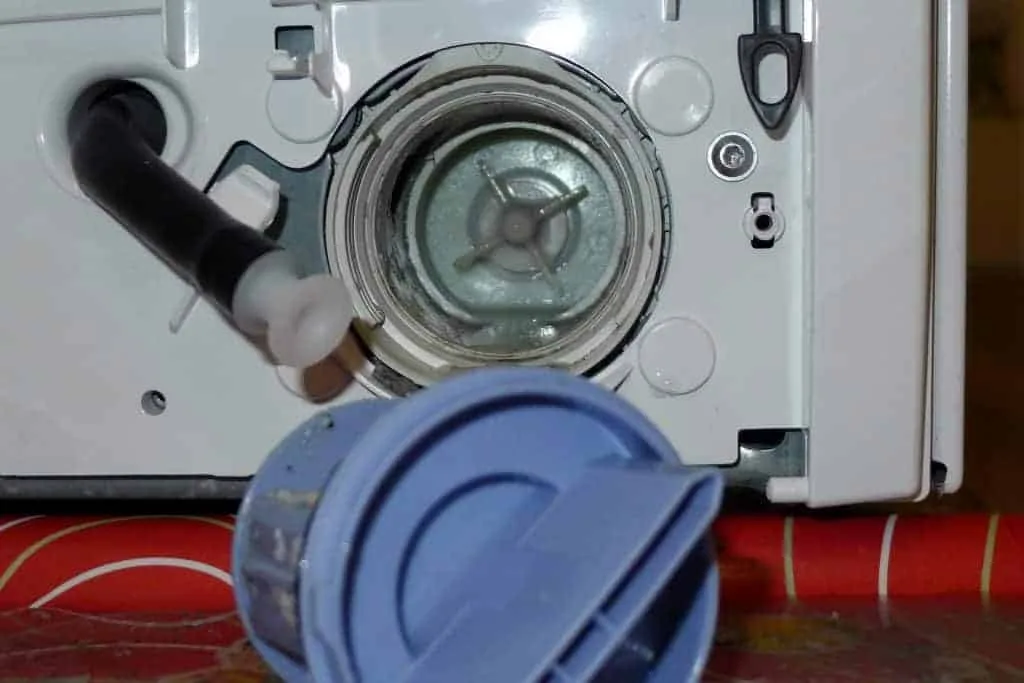
Place a shallow pan under the pump. Twist the filter cap counterclockwise and pull it out slowly. Water will spill out, so be ready for it.
Remove any debris, lint, coins, or hair wrapped around the filter and impeller. Clean the filter thoroughly and check the impeller for obstructions. Inspect the drain hose for kinks or clogs.
If the pump itself is dead, which often shows as a loud humming but no water movement, replace it. The part costs around $30 to $50 and connects with a simple wiring harness.
Won't Spin or Clothes Soaking Wet
Clothes coming out sopping wet means the spin cycle never happened. Start by checking the lid lock. On top-load models, the machine will not spin unless the lid lock confirms closure.
If it is faulty, you will often hear it clicking repeatedly.
Run a spin-only cycle to see what happens. If the machine fills briefly then stops, the drain pump might be unable to empty the tub completely. The control board will not spin with standing water present.
Check the drain filter first.
If the drum shakes violently during the spin attempt but never gains speed, the load is unbalanced. Open the lid, redistribute the clothes evenly, and restart. For persistent imbalance issues with properly balanced loads, the suspension rods or springs are worn and need replacement.
A burning smell during spin points to a failing drive belt. You will need to access the belt under or behind the machine. We cover that in the next section.
Loud Banging or Screeching During Spin
A metal-on-metal banging sound during spin means the drum is contacting the washer frame. That is a suspension problem. Inside the machine, shock absorbers or suspension springs hold the drum.
Over time, they wear out and lose their dampening ability.
The replacement process varies by model but follows a standard pattern. Unplug the machine, disconnect the water supply, and pull the washer away from the wall. For top-loaders, remove the cabinet or the rear panel.
For front-loaders, access the shocks from the bottom or rear. You will find four springs or shock absorbers typically. Replace all four at once, even if only one looks damaged.
They wear at the same rate.
A screeching or squealing sound typically means the drive belt is glazed or slipping. Visual inspection tells you everything.
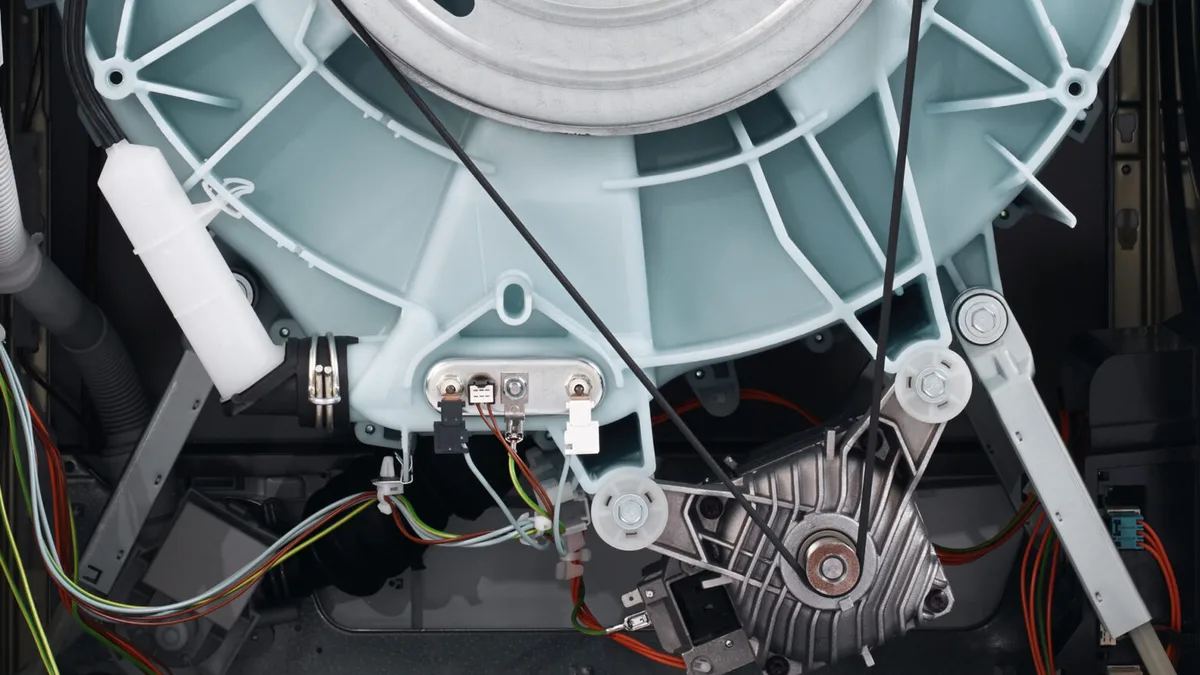
Look for cracks, fraying, or a shiny glazed surface. Replace the belt by sliding it off the pulley. Match the old one against the new one at the parts store.
Install it with proper tension. Check the tensioner mechanism. It might use a spring or a bolt to adjust.
Leaking Water From the Bottom
Water pooling under the machine always traces back to one of three places. Those are the inlet valve, the drain pump, or the hoses.
Check the fill hoses connected to the back of the machine first. A loose fitting or a cracked rubber hose can leak a surprising amount of water. Tighten the connections with pliers and inspect the hoses for bulges or cracks.
If the leak appears during the wash cycle, the door boot gasket is the likely culprit on front-loaders. This large rubber seal develops tears or mildew-induced holes over time. Inspect it closely by running your finger around the entire circumference.
Replacement boot gaskets cost $40 to $80 and require removing the front panel or the door assembly.
For top-loaders, check the tub seal or the inlet valve. The inlet valve screws onto the back of the machine. If it leaks, replace it rather than trying to rebuild it.
A new valve runs about $25 to $45.
Not Filling or Slow Fill (Error E11)
Slow filling usually means clogged screens. Turn off your water supply and disconnect the fill hoses from the back of the washer. Inside the machine, you will find small mesh screens where the hoses connect.
Remove them with needle-nose pliers and rinse them clean under running water. Scale buildup from hard water can reduce water flow dramatically. The U.S.
Geological Survey confirms that roughly 85% of American homes have hard water.
Verify that both hot and cold water valves at your wall are fully open. Partially closed valves cause intermittent filling problems. Also confirm your water pressure is adequate.
Most washers require a minimum of 20 psi to operate correctly.
If the screens are clean and the water valves are open, the inlet valve solenoids might have failed. A multimeter can test resistance across the solenoid coils. Zero resistance means a short circuit.
Infinite resistance means an open circuit. Both conditions require replacement.
Mistakes That Cost You Money
DIY repair saves money, but common mistakes turn a $30 fix into a $500 headache. Here is what not to do.
Never bypass the lid lock or door lock safety switch. Some tutorials suggest jumping the switch with a paperclip to force the machine to run. This is dangerous.
The lock prevents the drum from spinning while your hand is inside. The National Electrical Code and UL safety standards exist for a reason. Defeating them risks serious injury.
Do not buy cheap aftermarket parts to save a few dollars. Aggregate owner feedback reports that no-name belts and pumps fail within six months. Stick with OEM parts from an authorized dealer.
Visit the manufacturer's official support site to confirm the part number.
Avoid overloading the machine. Every Frigidaire washer has a rated capacity, typically measured in cubic feet. Cramming extra laundry stresses the drive belt, the suspension, and the drain pump.
A machine forced beyond its rated load wears out prematurely.
Do not ignore small leaks. That tiny puddle under the washer might seem minor now. Water damages floors, subflooring, and can create mold problems.
A slow leak from the drain pump seal will only get worse.
If you pull the machine out to work on it, take the time to level it properly. An unlevel washer shifts during spin. That causes unbalanced loads, excessive noise, and premature bearing failure.
Use a bubble level across the top of the machine and adjust the feet until it sits stable.
Finally, do not put off cleaning the drain filter. Frigidaire recommends periodic maintenance. Every year that filter collects lint, coins, and detergent residue.
A clogged filter forces the pump to work harder and eventually fail. Clean it every three to six months depending on usage.
When to Call a Pro vs. DIY
You have fixed a clogged drain filter and replaced a lid lock before. How do you know when to keep going and when to pick up the phone? The answer comes down to three factors.
Those are part cost, labor complexity, and your comfort level with electronics.
If your machine shows error codes E68 or E5A, those indicate control board or communication failures. The control board is the brain of the washer. Replacing it costs between $100 and $250 for the part alone.
But here is the catch. You also need to verify that the board is actually the problem. A misdiagnosis means you buy a board you do not need.
Technicians have diagnostic tools that can test the board output signals. You do not.
The repair versus replace calculation is straightforward. If your washer is over eight years old and needs a control board or a motor, the smart move is replacement. A new basic Frigidaire machine runs $450 to $700.
A new motor costs $150 to $300 plus labor. You are halfway to a new machine with no warranty on the repair.
If your washer is under five years old and needs a pump, belt, or lock, do it yourself. Those parts are under $50 each. The only tools required are a screwdriver, pliers, and possibly a socket set.
What about drum bearing failure? You will hear it as a loud grinding noise during spin. Replacing drum bearings requires disassembling the entire tub assembly.
That is a four to six hour job even for experienced techs. The labor alone runs $200 to $350. On most machines, this repair exceeds the machine's current value.
Hidden costs matter too. If you break a plastic component while disassembling, you add a parts run and a delay. If you strip a screw head, you add frustration and drilling time.
Factor those risks into your decision.
Here is a practical cost comparison table:
| Repair | DIY Part Cost | DIY Time | Pro Cost Range | DIY Difficulty |
|---|---|---|---|---|
| Drain pump replacement | $25 to $50 | 30 min | $150 to $250 | Easy |
| Lid lock replacement | $15 to $35 | 20 min | $100 to $200 | Easy |
| Drive belt replacement | $10 to $25 | 45 min | $120 to $180 | Medium |
| Shock absorber set | $40 to $80 | 60 min | $200 to $350 | Medium |
| Door boot gasket | $40 to $80 | 90 min | $200 to $300 | Medium |
| Control board | $100 to $250 | 45 min | $250 to $400 | Hard |
| Drive motor | $150 to $300 | 90 min | $300 to $500 | Hard |
| Drum bearing | $80 to $150 | 4 to 6 hrs | $350 to $550 | Very Hard |
Draw your line between medium and hard on this table. If the job falls under medium and you own basic tools, you can handle it. If it reaches hard or above, budget for a service call.
Safety First: Warnings Before You Touch Anything
Working on an appliance involves risks that are not always obvious. Let us cover the non-negotiable safety rules before you open that machine.
Unplug the washer before you touch any internal component. This is not optional. The control board holds capacitors that can store voltage even after disconnection.
Wait at least 60 seconds after unplugging before reaching inside.
Turn off the water supply at the wall valves. Those hoses hold water pressure. When you disconnect them, water will spray everywhere if you do not shut the valves first.
Even after shutting them off, residual water remains. Point the hose into a bucket when you unscrew the connection.
Beware of sharp edges. The metal panels inside your washer have stamped edges that are surprisingly sharp. Wear work gloves when reaching into the cabinet.
You will avoid cuts that can get infected from laundry room grime.
Some components weigh more than you expect. The drive motor on a full size washer weighs 10 to 15 pounds. The drum assembly weighs considerably more.
If you are pulling the motor or drum, support it with one hand while removing the last bolt. Letting it drop damages the machine and risks a pinched finger.
Never bypass safety switches. The lid lock and door lock are there for a reason. A spin cycle rotates the drum at 800 to 1200 RPM.
If that drum is spinning while the door is open, it can eject laundry and cause injury. The UL safety certification on your machine requires these interlocks to function.
Do not touch the control board surface with bare fingers. Body oils can damage sensitive electronic components. Hold the board by its edges and place it on a clean, dry surface.
Static electricity from carpet or dry air can destroy a control board instantly. Ground yourself by touching a metal pipe before handling the board.
Water and electricity do not mix. If you are working near the bottom of the machine where water might pool, wear rubber soled shoes and keep your workspace dry. Use a shop vacuum to remove standing water before reaching for tools.
Take photos as you disassemble. This is not a safety rule in the traditional sense. But it prevents mistakes.
A photo of how the belt routes around the pulleys saves you ten minutes of frustration during reassembly.
Maintenance and Long-Term Optimization
Fix a problem once and you would rather not see it again. Regular maintenance prevents most of the common breakdowns we covered.
Clean the drain filter every three months. The filter catches lint, coins, and debris before they reach the pump. In households with pets, check it monthly because hair buildup accelerates clogs.
The filter is behind the front access panel and twists out without tools.
Leave the door open after every cycle. This applies especially to front load machines. The rubber door gasket traps moisture and creates a breeding ground for mold and mildew.
Leaving the door cracked for an hour after the cycle ends allows the interior to dry. This habit alone extends the life of the door boot gasket.
Use high efficiency detergent. Your Frigidaire washer is an HE machine regardless of whether it is a top load or front load. Regular detergent creates too many suds.
Excess suds confuse the pressure sensor, causing longer cycles and poor rinsing. Use HE laundry detergent and never exceed the recommended amount.
Run a cleaning cycle monthly. Fill the detergent dispenser with a washer cleaning tablet or two cups of white vinegar. Run the Clean Washer cycle or the hottest, longest cycle available.
This removes detergent residue, mineral scale, and any mold spores inside the drum.
Check the fill hoses annually. Rubber hoses degrade from the inside out. A burst hose floods your laundry room and damages floors and walls.
Replace washing machine hoses every five years. If your hoses feel stiff or show cracks, replace them immediately. Steel braided hoses cost slightly more but last longer and resist bursting.
Level the machine after any move or maintenance event. An unlevel washer shifts during spin. That movement stresses the suspension system and causes premature wear on bearings and belts.
Place a bubble level across the top of the machine in both directions. Adjust the front feet by spinning them clockwise or counterclockwise. Lock the jam nut when you have it level.
If your machine sits in an unheated garage or basement during freezing months, drain the water lines completely. Disconnect the fill hoses and tilt the machine forward to drain any residual water from the pump. Frozen water expands and cracks the plastic pump housing.
That repair costs more than prevention.
Authoritative Sources and Where to Find Help
You need reliable information when troubleshooting. The internet is full of bad advice that can damage your machine or void your warranty. Let us identify the sources you can trust.
The primary source is always the manufacturer's official support documentation. Frigidaire publishes user manuals, technical sheets, and error code guides on their website. These documents contain the exact diagnostic procedures for your model.
They are free to access and legally accurate.
The National Electrical Code establishes safety standards for electrical installations. Section 210.8 requires GFCI protection for laundry room outlets. If your machine will not power on, verifying outlet protection is a valid first step.
The NEC is published by the National Fire Protection Association.
UL certification marks on your washer indicate it meets safety standards. Underwriters Laboratories tests appliances for fire and electrical shock hazards. Any repair you perform should preserve the machine's UL compliance.
Removing or defeating safety features violates that certification.
For technical specifications on water pressure, the U.S. Geological Survey provides data on typical household water pressure ranges. Residential systems generally operate between 40 and 80 psi.
Your washer requires a minimum of 20 psi. If you suspect low pressure, you can test it with a gauge from any hardware store.
If you need replacement parts, buy from authorized dealers. The manufacturer's parts lookup tool on their official site shows exact replacements by model number. Using the wrong part voids the warranty and can create safety hazards.
If you decide to call a technician, look for someone with appliance service certification. The Professional Service Association and similar organizations certify technicians who complete training programs. Ask for certification before scheduling a repair appointment.
Frequently Asked Questions
Why will my Frigidaire washer not start even though it has power?
The most common cause is a faulty lid lock or door lock assembly. The machine will not power the motor or fill cycle until it confirms the door is sealed. Check the lock for visible damage and test it with a multimeter.
How do I reset my Frigidaire washing machine?
Unplug the machine from the power outlet for one full minute. Plug it back in. This resets the control board and clears temporary glitches.
For some models, you can also press and hold the Start button for five seconds.
What does error code E21 mean on a Frigidaire washer?
Error E21 indicates a drain problem. The machine detected water in the drum that it could not remove. Clean the drain pump filter and check the drain hose for clogs or kinks.
If the pump hums but does not pump, replace it.
Why does my Frigidaire washer smell like mildew?
Mildew grows in the moist environment of a front load door gasket. Leave the door open after each cycle to allow drying. Run a cleaning cycle with a washer cleaner tablet monthly to kill mold and remove residue.
Can I use regular detergent in my Frigidaire HE washer?
No. Excessive suds from regular detergent interfere with the machine sensors and can cause poor rinsing, longer cycles, and mechanical strain. Use only HE detergent marked on the bottle.
How long should a Frigidaire washing machine last?
Manufacturers design these machines for a service life of 10 to 13 years with proper maintenance. Machines that receive regular filter cleaning, leveling, and hose replacement often last toward the upper end of that range.
Final Decision Guide: Repair or Replace?
You have all the information you need. Now make the call.
Repair if the machine is under eight years old, the part costs under $100, and you are comfortable with the repair difficulty. A drain pump, lid lock, belt, or shock absorber replacement makes financial sense. You extend the machine's life for a fraction of a new machine's cost.
Replace if the machine is over eight years old and needs a control board, motor, or drum bearings. Those repairs cost half the price of a new washer. A new machine comes with a warranty and updated efficiency standards.
Modern washers use 25% less energy and 33% less water than models from a decade ago.
Call a pro if you are unsure about your diagnosis, the repair requires specialized tools, or you value your weekend time over the service fee. A proper diagnosis from a certified technician costs $100 to $150. That fee saves you from buying the wrong part.
Stick to the decision tree approach. Identify your symptom. Check the error code.
Clean the simple parts first. Replace affordable components yourself. For everything else, know when to walk away.
Your Frigidaire washer is a well designed machine. It fails in predictable ways. Every repair you learn today helps you handle the next one faster.
And that knowledge stays with you for as long as you own the machine.

Similar Posts