Samsung Dishwasher Error Codes
CONTENT_TYPE: Decision Tree / Workflow
REASONING: Samsung dishwasher error codes are diagnostic signals that point to different underlying causes depending on the specific code, the dishwasher's age, and the user's setup. The correct troubleshooting path branches based on the error displayed, making a structured decision tree the most useful format. AI_GAP: Generic AI lists codes alphabetically without prioritizing the most common fixes (like filter clogs for DC or heater issues for 4C) or explaining when a part replacement is the only move versus when a reset will do the trick.
A real expert knows the sequence to attack diagnostics, which codes are harmless, and which demand immediate action.
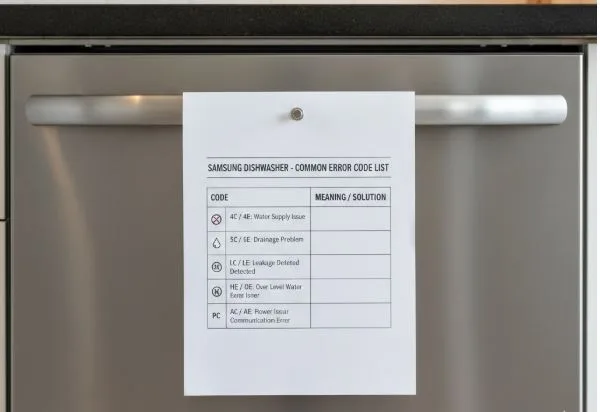
Samsung Dishwasher Error Codes
Image source: Bing (Web (fair-use with source credit))
You know that sinking feeling. The dishwasher is mid-cycle, making a weird hum, and suddenly the display flashes a cryptic code. Or worse, it just beeps at you and refuses to start.
If you are staring at a "4C" or a "5C" right now, take a breath. You probably don't need to call a repair tech.
Most Samsung dishwasher error codes are tied to a handful of routine issues: a clogged filter, a kinked water line, or a sensor that needs a reset. I have spent way too many evenings crawling around kitchen floors with a multimeter and a sponge, and I can tell you straight: the difference between a $5 DIY fix and a $200 service call usually comes down to knowing what the code means and checking the right part first.
This guide walks you through the most common codes step by step. We will look at what each one means, the likely culprits, and exactly how to fix it, starting with the cheapest and easiest solutions. No jargon, no fluff.
Just the practical stuff that actually works.
First Things First: The 30-Second Reset
Before we dive into specific codes, do this. Honestly, half of all Samsung dishwasher error codes disappear after a simple reset. The control board inside these machines is sensitive to power fluctuations, and it often throws a random code just because it got confused.
Here is the proper way to reset a Samsung dishwasher:
- Turn off the dishwasher at the control panel.
- Unplug the dishwasher from the wall outlet OR flip the dedicated circuit breaker off.
- Wait a full 5 minutes. This is critical, the internal capacitors need time to discharge completely. 30 seconds won't cut it.
- Plug it back in or flip the breaker on.
- Run a short cycle (like Quick or Normal) and see if the code returns.
If the code stays gone, you just saved yourself a headache. If it comes back, you now know you have a real issue, and the sections below will help you pinpoint it.
The "Heating" Error: Code "4C" / "nC"
This is one of the most frequent codes. It means the water is not heating up to the right temperature, or the thermistor (the temperature sensor) is reading incorrectly. You will likely notice dishes not drying properly or the cycle taking forever.
What to Check
Step 1: The Filter (Most Common Fix)
If the filter at the bottom of the tub is clogged, the pump can cavitate (suck air) and the heater can overheat or shut off. Here is the thing most owners miss: the Samsung filter needs to be cleaned weekly if you run heavy loads.
- Twist the cylindrical filter assembly counterclockwise and lift it out.
- Rinse it under hot water. Use an old toothbrush to scrub the fine mesh.
- Look under the filter, there is often a hard plastic grinder. If food particles are caked around it, that is your problem.
- Reinstall and run a rinse cycle.
Step 2: The Water Heater Impact
In some Samsung models, the "4C" code pops up when the incoming water is too hot or too cold. If your hot water tank is set above 140°F, that can trigger a fault. Check your water heater settings.
If it is at the normal 120°F, move on to the next step.
Step 3: The Thermistor (When It's Not the Filter)
If the filter is clean and the code persists, the thermistor is likely bad. It sits under the tub, usually near the heater coil. It is a small sensor with two wires.
- To test it: You will need a multimeter. Access the sensor (usually by removing the lower front panel). Unplug the harness. Measure the resistance. At room temperature, a good thermistor reads around 10,000 to 12,000 ohms (10-12kΩ). If you get a reading of 0.0 (short circuit) or 1.0 (open loop), it is dead. Replace it.
- Replacement part: A new thermistor runs about $15, $25 on parts sites. It is a 5-minute swap: one screw, pull the old one out, snap the new one in.
Heads up: If the thermistor checks out and the filter is clean, the main control board might be the issue. But that's a larger repair. Try the cheap stuff first.
The "Drain" Error: Code "5C" or "5E"
This one means the dishwasher is not draining water properly. You might notice standing water at the bottom of the tub. This is another super common code, and the fix is often embarrassingly simple.
What to Check
Step 1: Air Gap / High Loop (If Visible)
If you have an air gap on your sink countertop (that small chrome or plastic cap near the faucet), pop it off. Food gunk gets trapped there all the time. Clean it out with a zip tie or pipe cleaner.
Step 2: The Drain Line Kink
- Pull the dishwasher out slightly.
- Find the corrugated drain hose that goes to the sink drain or disposer.
- Check for a visible kink or crush point. It gets pinched behind the dishwasher or the cabinet all the time.
- Also, check the disposer plug. If you have a garbage disposal, the rubber knock-out plug inside the disposer inlet (where the dishwasher drains in) must be removed. If it is still in place, water cannot flow out. Remove it with a screwdriver. This is a classic issue in new installs.
Step 3: The Drain Pump
If the line is clear, but there is still water at the bottom, the drain pump impeller is likely jammed. Here is the secret: you have to access the pump under the tub.
- Unplug the dishwasher.
- Remove the lower kickplate. You will see the drain pump motor on the right side, or in the center depending on the model.
- There is a small black cover on the pump. Loosen it carefully, a cup of water will spill out. Behind that cover, you will see the impeller.
- Here is the gross part: Broken glass, popcorn kernels, and bone fragments get wedged in there. Spin the impeller by hand to break it free, or dig the debris out with a screwdriver.
- Replace the cover and force a drain cycle.
Step 4: The Check Valve
Some Samsung models have a black rubber flap inside the drain pump outlet. That flap prevents water from flowing backward from the sink into the dishwasher. If it is flipped, stuck, or missing, you might get a 5C code due to improper flow.
While you have the pump cover off, check that flap is seated properly.
The "Water Supply" Error: Code "4C" / "4E" (Wait, We Did This?)
If you see a "4C" on an older Samsung model (pre-2018), it specifically means a water supply issue, not a heater issue. On newer models, "nC" means heater, but "4C" can still be water flow. Let's split this out:
What to Check
Step 1: The Water Supply Valve
Underneath your sink, there is a silver braided hose going to the dishwasher. Follow it back to a metal valve on the wall or the floor.
- Check if the valve is fully open. If it's halfway open, the dishwasher might not get enough pressure.
- Turn it off, unhook the hose, and inspect the filter screen. There is a small mesh screen inside the water inlet valve on the dishwasher itself. Hard water minerals or sediment from the pipes clog this screen. Clean it with an old toothbrush and put it back.
Step 2: The Inlet Valve Solenoid
The dishwasher has a "water inlet valve" that opens to let water in. If it is dead (receiving power but not opening), you will get a flood or no water.
- To test it: Put a multimeter on the two terminals of the inlet valve. It should read around 500 to 1000 ohms (0.5k-1kΩ). If it reads 0 or infinite, the solenoid coil is burnt out. Replace it.
- Quick check: While running a cycle, you should hear the water filling almost immediately. If you hear a faint buzz but no water flowing, the valve is getting power but the diaphragm is stuck. Often, tapping the valve with the handle of a screwdriver dislodges a particle. It's a temporary fix, but sometimes it buys you weeks.
Step 3: The Pressure Sensor / Water Level Switch
Samsung uses a pressure sensor that tells the board how much water is in the tub. If the hose connected to it is detached or cracked, the dishwasher might overfill or under-fill, triggering a 4C.
- Find the pressure sensor (a small component on the side of the tub). Follow the clear rubber hose from it down to the sump. Make sure the "T" fitting is secure at the bottom.
The "Overflow" Error: Code "OC" or "nC"
This is the scary one. The dishwasher thinks it has too much water or has detected a leak in the base pan. The machine usually turns off the water inlet valve automatically and runs the drain pump.
What to Do Immediately
- Unplug the dishwasher.
- Scoop out any standing water in the tub.
- Take out the filter and check the sump area. A big piece of glass or a broken plate dropped into the sump can block the drain pump, causing water to sit and trip the sensor.
Finding the Leak
- Check the tub gasket. Rub the seal around the door. If it's torn, water leaks out the front and drips onto the floor but also into the base pan sensor. Replace the gasket if torn.
- Check the base pan. Remove the lower kickplate. You will see a black plastic tray. If there is water inside, the leak is coming from one of the water connections. Dry it completely with a towel. Run a rinse cycle and watch for where the water drips. Likely spots: the inlet valve connection, the bottom of the wash motor, or the spray arm mounts.
Critical: If the base pan is constantly filling with water, do not just replace the sensor. The leak will short out the board eventually. Find the source.
The "Spray Arm" Error: Code "nF" Smart Check
Newer Samsung models (with the SmartThings app) will throw an "nF" when the spray arms are not spinning correctly. This isn't a hard fault, but a software logic check that noticed the spray arm rotor didn't move during the cycle.
The Usual Suspect
Step 1: Clogged Spray Arm Holes
- Pull out the upper and lower spray arms. They twist or pop off.
- Look at the tiny holes on the bottom. They get gummed up with calcium deposits or leftover wax from food packaging.
- Soak them in a bowl of white vinegar and hot water for 30 minutes. Poke through each hole with a paper clip.
- Check the central hub where the arm connects. There is a small clip or bearing. Make sure nothing is wrapped around it.
Step 2: The Circulation Pump
If the spray arms are clean, the motor that pushes water through them might be weak or failing. When this motor is running slow, the water jets don't have enough pressure to spin the arms.
- Listen during the wash cycle. It should sound like a humming swoosh, not a hiccuping whine.
- If the motor is bad, it's a bigger repair. The circulation pump on a Samsung dishwasher is buried under the tub and connects to the bottom spray arm mount.
The "High Temperature" Error: Code "HC"
This means the water temperature inside the tub exceeded a safe level (usually above 170°F). This is a safety trip.
What Causes It
Step 1: The Heating Element Stuck On
The main control board has a relay that switches the heater on and off. If the relay welds shut, the heater runs continuously, ignoring the thermistor readings.
- Test: Unplug the dishwasher and measure the resistance across the heater coil. It should have some resistance (roughly 20-30 ohms). If it shows a dead short (near 0 ohms), it's drawing too much current.
- The Real Fix: This requires replacing the control board, not the heater. A stuck relay on the board is the usual culprit. Do not just replace the heater.
Step 2: The Thermistor Shorted
If the thermistor reads a lower resistance than it should, the board thinks the water is cold, so it keeps the heater on. Check the thermistor using the steps from the 4C section. If it reads shorted (0 ohms) at room temperature, replace it.
The "Leak" Error: Code "1C" or "11C"
This is specific to models with the "Aqua Stop" system. It detects a leak in the base pan.
Check This First
- Empty the dishwasher. Unplug it.
- Remove the lower kickplate.
- You will see a white or blue foam block in the base tray. This is the leak sensor float. If it is raised, the switch is tripped.
- Dry all the water in the tray. Even condensation can trip this if the machine has been in a humid house.
- Check the spray arm manifold seal at the bottom. If the big rubber seal around the bottom spray arm mount is torn, water splashes down into the base.
Less Common Codes (The Quick Reference)
You might see these less frequently, but they are good to know:
| Code | Meaning | The Fix |
|---|---|---|
| 7C | Heater Short Circuit | Check heater coil and thermistor. If both good, replace board. |
| 8C | Thermistor Input Error | Bad connection to thermistor or a dead sensor. Check the harness. |
| 9C | Over Current Protection | A shorts in the drain pump or wash motor. Test resistance on both motors. |
| 0C | No Water | Inlet valve closed, filter screen clogged, or valve solenoid dead. |
| B0 | Normal (Steam) | Not an error. Code appears in self-diagnostics. |
| Lo | Low Water Level | Pressure sensor hose detached, or not enough water pressure. |
The "Do Not Touch" List
Some errors mean it's time to stop DIY-ing and get a professional. If you see these, the board is likely fried or there is a wiring harness issue you shouldn't risk:
- "nC" or "hc" on models with a display: If swapping the thermistor and heater doesn't fix it, the main PBA (Printed Board Assembly) is failing. Replacing the PBA involves high-voltage wiring and a firmware update. Don't mess with it unless you know what you are doing (specifically, you have experience discharging capacitors).
- Codes that come back immediately after a hard reset: If you unplug it for 5 minutes, and the code returns before the cycle even starts, that's a hardware failure. Don't keep replacing random sensors.
Practical Tips to Prevent Errors in the First Place
Prevention is worth more than cure here. These habits keep the codes away:
- Scrape, don't rinse too hard. The wash motor relies on water pressure. If you pre-rinse everything perfectly, the sensor might think the load is too clean and skip the cycle, throwing a weird code. Scrape off solid chunks, but leave a little grit for the sensor to read.
- Clean the filter monthly. This is non-negotiable on Samsung models. The "Fine Dust" filter gets a film on it that blocks water flow. A quick scrub under hot water prevents 50% of these errors.
- Use rinse aid. This isn't just about drying. Rinse aid changes the surface tension of the water, making the spray arms spin more freely and reducing scale buildup on the thermistor.
- Run hot water at the sink before starting the cycle. Let the sink run until the water is hot before you hit Start on the dishwasher. This ensures the inlet valve gets hot water immediately, preventing the heater from working overtime (which causes 4C codes).
So, What's the Verdict?
Here is the honest truth: you can fix about 80% of these codes with a paper clip, a sponge, and a handful of screws. Samsung dishwashers are excellent machines, but they are sensitive to debris and water pressure.
If the problem is a clogged filter or a jammed pump impeller, don't call a repair guy. You'll pay $150 for him to do exactly what I described above.
If the problem is a bad thermistor or a dead inlet valve, order the part online. It costs under $30, and the YouTube video for your exact model number will walk you through the tear-down in 10 minutes.
If you are looking at a control board failure, that is the one time I'd genuinely recommend considering the cost of a new dishwasher versus the $300+ repair bill, unless the unit is still under warranty.
Remember, the code is just a symptom. Now you know how to get to the root cause. Good luck with the repair, and feel free to curse at the impeller a little when you find that piece of broken glass.
It's all part of the experience.

Similar Posts