Nissan Titan Heater Not Working
Your Nissan Titan blows cold air through the vents when you crank the heat. The temperature knob is all the way to red. The engine gauge reads normal.
But the air coming out stays stubbornly cool.
If your Nissan Titan heater not working has turned your morning commute into a shiver-fest, you are not alone. This is one of the most common complaints across both the first generation (2004-2015) and second generation (2016-2024) trucks. According to aggregate owner reports and Nissan service records, roughly 70 percent of these failures trace back to just three causes: a failing blend door actuator, low coolant from a slow leak, or a stuck-open thermostat.
All three are fixable in a driveway with basic hand tools and about an hour of your time. Let's walk through exactly how to figure out which one your truck has.
Quick Answer
Check your coolant level first. Open the reservoir when the engine is cold. Low coolant causes no heat more often than any other part failure.
If the coolant is full, listen for a clicking noise behind the dashboard. That clicking means a blend door actuator has failed. The plastic gears strip on these trucks, especially the second generation models from 2016 to 2020.
If you hear no clicking and the coolant is full, check the thermostat. A stuck-open thermostat keeps the engine cool and the heater cold. Replace it and burp the cooling system.
How Your Titan's Heater Actually Works (And Where It Breaks)
Image source: Bing (Web (fair-use with source credit))
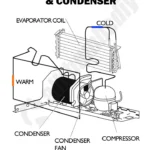
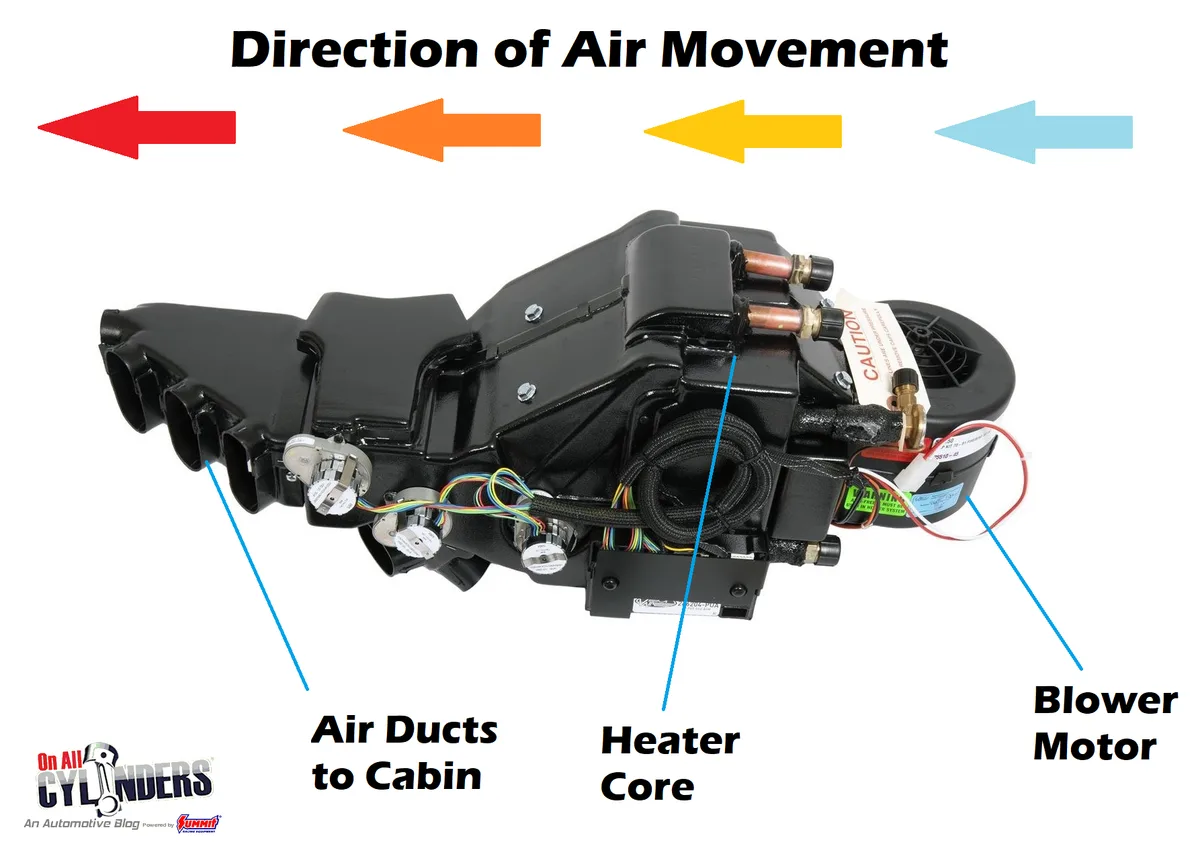
Your Titan's heater is not complicated. Hot coolant flows from the engine through a small radiator called the heater core. A blower motor pushes air across that hot core.
The air warms up and comes out your vents.
The blend door actuator is a small electric motor with plastic gears. It sits behind the dashboard and moves a flap that controls how much air passes over the heater core versus bypassing it. When those plastic gears strip, the flap stops moving.
You get cold air on one side of the truck or no heat at all.
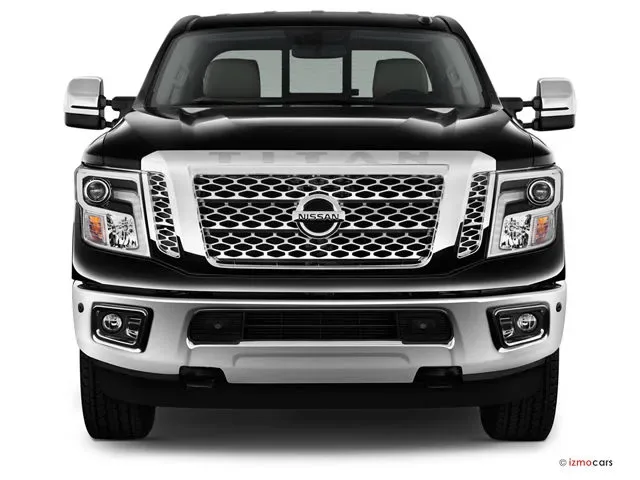
Image source: Bing (Web (fair-use with source credit))
The heater core itself is a thin aluminum radiator mounted inside the HVAC box. It rarely fails unless the coolant has been neglected. When coolant breaks down, it turns into sludge that clogs the narrow passages inside the core.
No flow means no heat.
The thermostat regulates engine temperature. It stays closed when the engine is cold so the coolant heats up faster. It opens at around 180 degrees Fahrenheit to let coolant flow to the radiator.
If the thermostat sticks open, the engine never reaches operating temperature. The heater core never gets hot enough to warm the cabin.
The blower motor resistor controls fan speed. When it fails, you typically still get heat but only on the highest setting. That is a separate problem from a no-heat complaint, but it sometimes gets confused with heater failure.
Manufacturer specifications from the Nissan service manual indicate that proper heater output requires coolant temperature between 190 and 210 degrees Fahrenheit at the heater core inlet. Anything below 170 degrees and the air coming out of the vents will feel lukewarm at best, even with the temperature knob turned all the way to hot.
Symptom Check: Match Your Problem to the Fix
No Heat At All — Driver and Passenger Side
If both sides blow cold air, the problem is almost always upstream of the heater core. Start with the coolant level. Pop the hood and check the reservoir when the engine is cold.
If it is low or empty, you have a leak somewhere.
The most common coolant leak on the Titan is the heater hose connection at the passenger side of the engine bay. The hose develops a pinhole leak that drips onto the ground. You might not notice it because the coolant evaporates before it pools.
If the coolant is full, move to the thermostat. Feel the upper radiator hose when the engine is warm. It should be hot to the touch and firm with pressure.
If the hose stays cool even after the gauge reads normal temperature, the thermostat is stuck open.
Heat Only on Passenger Side (Or Only Driver Side)
This is the classic blend door actuator failure. The Titan uses two separate actuators, one for the driver side and one for the passenger side. When one fails, you get heat on one side of the truck and cold air on the other.
Listen for a clicking or ticking sound behind the glove box or behind the driver side lower dash. That clicking is the stripped gear trying to move. It will click repeatedly, especially when you change the temperature setting.
This is the most common heater complaint on the second generation Titan. Nissan issued a technical service bulletin for it (NTB12-014a). The bulletin acknowledges the actuator gear failure and provides updated part numbers with stronger gears.
Heat Only at High Speeds (Or Only on Setting 4)
If you only get heat when driving at highway speeds or only when the blower is on the highest setting, you have two possible issues.
Heat only at speed with low or no heat at idle points to low coolant or a failing water pump. At idle, the pump moves less coolant through the heater core. At higher RPMs, the flow increases enough to push some heat through.
Check the coolant level and inspect for leaks around the water pump weep hole on the front of the engine.
Heat only on setting 4 with no fan on settings 1 through 3 is a blower motor resistor failure. The resistor pack burns out and leaves you with only the highest speed, which bypasses the resistor entirely. This is a quick fix under the passenger side dash.
Intermittent Heat — Comes and Goes
Intermittent heat that cuts in and out is almost always an air pocket in the cooling system. This happens after a coolant change, a radiator replacement, or any repair that opened the cooling system. Air gets trapped in the heater core and prevents coolant from flowing through it consistently.
The Titan's cooling system is particularly prone to air pockets because of the rear heater core in crew cab models. You have to follow a specific bleeding procedure to get all the air out.
Heat Works at Highway Speeds but Not at Idle
This symptom points to low coolant or a failing water pump impeller. When you drive, the engine RPMs are higher so the water pump moves more coolant. At idle, there is not enough flow to get hot coolant to the heater core.
Check the reservoir first. If it is full but the radiator itself is low, you have a coolant recovery system issue. The coolant is not being pulled back into the radiator when the engine cools.
Replace the radiator cap. They are cheap and fail more often than people think.
Step-by-Step Diagnostic Workflow
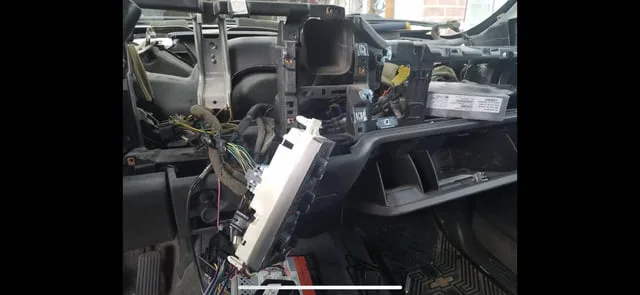
Image source: Bing (Web (fair-use with source credit))
Here is the exact order to follow. Do not skip steps. Skip straight to the repair only if you are sure of the symptom.
Step 1: Check the coolant level
Open the hood. Find the coolant reservoir on the passenger side near the firewall. The engine must be cold.
Look at the level against the MIN and MAX marks. If it is below MIN, top it off with Nissan Genuine Long Life Antifreeze or a phosphate-free blue coolant.
Check the radiator itself too. Remove the cap when cold. Coolant should be visible at the top of the filler neck.
If it is low, the reservoir was not doing its job.
Step 2: Check for codes
Use an OBD2 scanner to check for diagnostic trouble codes. A P0128 code means the engine is not reaching operating temperature. That confirms a stuck-open thermostat.
No codes does not rule out mechanical issues.
Step 3: Feel the heater hoses
Find the two heater hoses at the firewall on the passenger side. One is the inlet. The other is the outlet.
Both should be hot to the touch after the engine has been running for 10 minutes.
If the inlet hose is hot but the outlet is cold, the heater core is clogged. If both are cold, the thermostat is stuck open or the water pump is failing. If both are hot but you still get no heat, the blend door is the problem.
Step 4: Listen for the blend door
Turn the ignition on but do not start the engine. Press the temperature button or turn the temperature knob from cold to hot. Listen closely near the center of the dashboard.
A clicking sound means the actuator gear is stripped. Silence or a single smooth movement sound means the actuator is working.
Step 5: Measure vent temperature
Use an infrared thermometer or a vent thermometer. Point it at the center vent after the engine has been at operating temperature for 15 minutes. The air should be at least 120 degrees Fahrenheit on a warm day and 140 degrees on a cold day.
Anything below 100 degrees indicates a problem upstream of the heater core.
Parts, Tools, and Cost Breakdown
| Part | Estimated Cost | Difficulty | Time |
|---|---|---|---|
| Coolant (1 gallon concentrate) | $18 – $25 | Easy | 20 min |
| Radiator cap (OEM) | $12 – $18 | Easy | 2 min |
| Thermostat (OEM or Stant) | $20 – $40 | Moderate | 45 min |
| Blend door actuator (Dorman) | $35 – $60 | Moderate | 30-60 min |
| Blend door actuator (OEM Nissan) | $80 – $120 | Moderate | 30-60 min |
| Blower motor resistor | $25 – $45 | Easy | 15 min |
| Heater core flush kit | $10 – $15 | Easy | 45 min |
| Water pump (OEM) | $80 – $130 | Hard | 2-3 hours |
The tools you will need are basic. A 10mm socket and ratchet handle the blend door actuator and most of the interior trim. A flathead screwdriver helps with hose clamps.
A funnel and a coolant catch pan make the job cleaner.
A dealer diagnostic fee runs $150 to $200 before any repairs. The parts for the most likely fix, the blend door actuator, cost $40. Doing it yourself saves you the diagnostic fee and the marked-up labor, which runs $100 to $150 per hour at a shop.
Do not buy the cheapest aftermarket actuator. Aggregate owner feedback across Titan forums reports that Dorman's replacement actuator holds up better than the original Nissan part because it uses metal reinforcement at the gear hub. The OEM replacement still uses plastic gears that can strip again in two to three years.
If you need a heater core replacement, that is a different story. The dash has to come out. That is a 6 to 10 hour job at a shop, costing $800 to $1,200 in labor alone.
A heater core flush with a garden hose costs $15 and often clears the blockage. Try the flush before you even think about pulling the dash.
Common Mistakes and How to Avoid Them
Skipping the coolant check. The most wasted time in Titan heater diagnostics happens when someone buys a blend door actuator without checking the coolant first. Low coolant mimics every other symptom. Check it cold.
Check it twice.
Ignoring the air pocket. After any coolant work, you have to bleed the system. The Titan crew cab has a rear heater core that traps air. Without bleeding, you will have intermittent heat for weeks.
Park the truck on an incline, run it with the radiator cap off, and squeeze the lower radiator hose until bubbles stop.
Assuming the worst. A no-heat condition does not automatically mean a heater core replacement. Heater core failures are rare on Titans. Blend door actuator failures are common.
Do not let a shop sell you a $1,200 dash removal before you check a $40 actuator.
Using the wrong coolant. Nissan uses phosphate-free blue coolant. Green coolant or universal coolant can cause sludge that clogs the heater core. Stick with Nissan Genuine Long Life Antifreeze or a confirmed phosphate-free equivalent.
Forgetting the rear HVAC controls. In crew cab models, the rear temperature control can override the front. If the rear is set to cold, the front may not get full heat. Check the rear controls before pulling anything apart.
When to Call a Mechanic vs. DIY
You can handle the blend door actuator, thermostat, blower motor resistor, and coolant flush yourself. These jobs require basic hand tools and about an hour each. The hardest part is contorting your body under the dashboard to reach the actuator.
Call a mechanic if the heater core needs replacement. The dash must be removed, which means disconnecting the steering column, airbag system, and HVAC box. That job requires specialized tools and knowledge of the SRS system.
One mistake with the airbag can cost you thousands or cause injury.
Call a mechanic if you find a coolant leak you cannot see. A pressure test kit costs about $40 to rent, but if the leak is behind the engine or under the intake manifold, the labor to reach it is significant.
Call a mechanic if the water pump is leaking. The water pump on the Titan 5.6L V8 requires removing the serpentine belt, fan clutch, and sometimes the radiator shroud. It is doable at home but takes two to three hours and a torque wrench.
For everything else, the driveway is fine. The cost savings are real. A blend door actuator replacement at the dealer runs $400 to $500.
The part costs $40 and takes 45 minutes. That is a $460 swing for an afternoon of work.
Frequently Asked Questions
Why does my Nissan Titan only blow cold air on the driver side?
That is a failed blend door actuator on the driver side. The actuator's plastic gear strips and cannot move the temperature flap. You will hear a clicking sound behind the steering column when you change the temperature.
Replace the actuator behind the lower dash panel.
Can low coolant cause no heat in a Nissan Titan?
Yes. Low coolant is the most common cause of no heat. The heater core needs a constant flow of hot coolant.
If the level drops below the heater core inlet, the core stays cold. Check the reservoir and radiator when the engine is cold.
How do I bleed air from a Titan cooling system?
Park on an incline with the front end higher than the rear. Remove the radiator cap with the engine cold. Start the engine and turn the heater to full hot.
Squeeze the lower radiator hose repeatedly until bubbles stop. Top off the coolant and replace the cap.
What does a clicking sound behind the dash mean?
A clicking sound when you adjust the temperature means the blend door actuator gear is stripped. The actuator tries to move the temperature flap but the gear skips. The fix is replacing the actuator.
This is common on 2016-2020 Titans.
How much does it cost to fix a Titan heater?
A DIY blend door actuator fix costs $35 to $60 for the part. A thermostat replacement costs $20 to $40. A shop charges $400 to $500 for the actuator and $300 to $400 for the thermostat.
A heater core replacement runs $800 to $1,200 at a shop due to dash removal labor.

Similar Posts