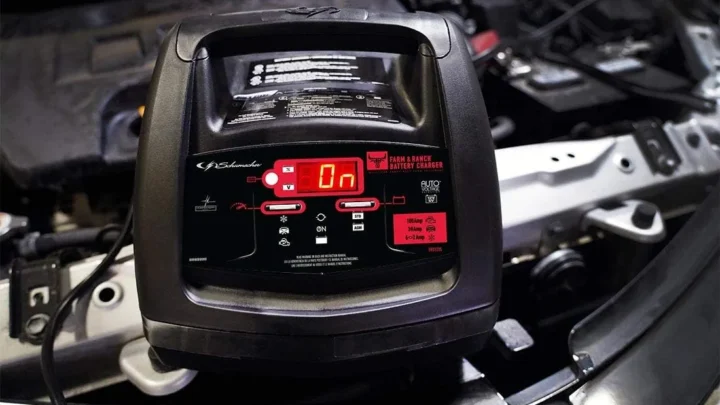
12 Voltage Battery Charger
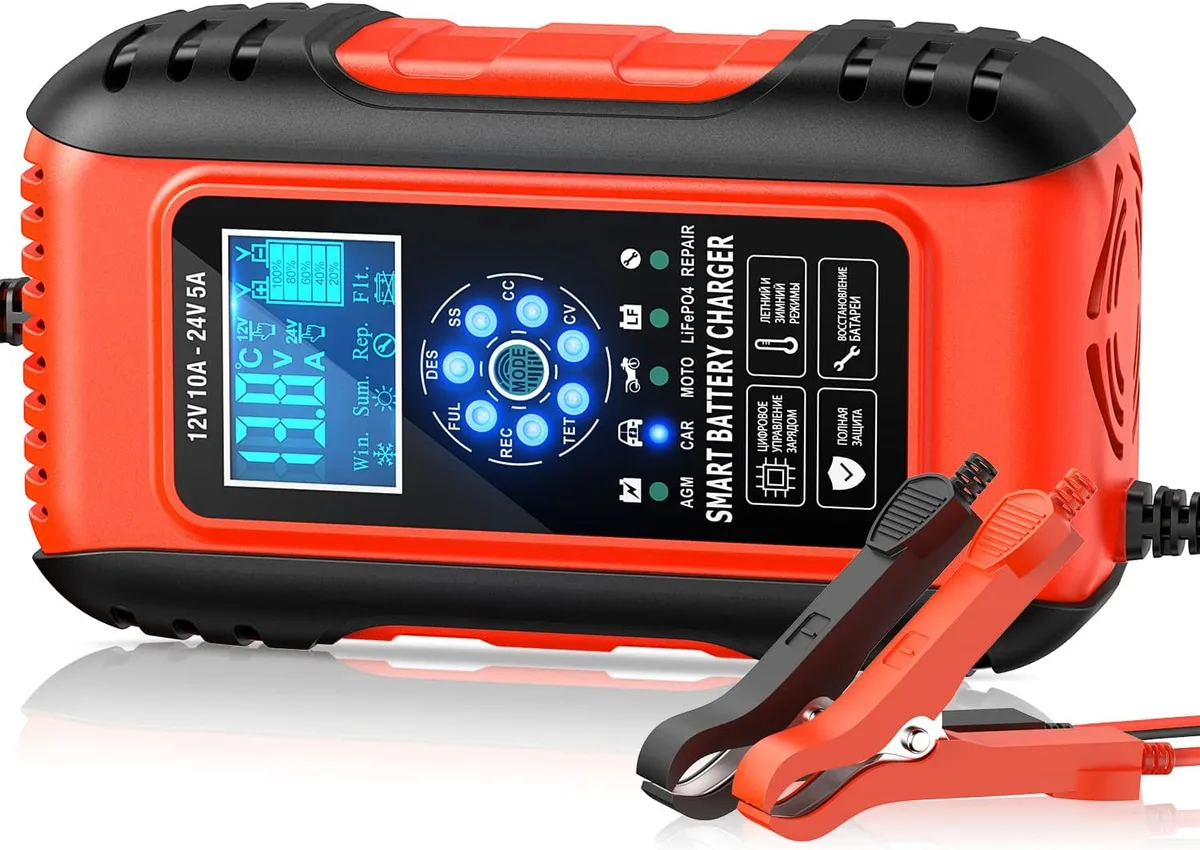
You've probably got a dead battery, or one that's not holding a charge like it used to. And now you're staring at a shelf full of chargers, wondering which one won't fry your battery or start a fire. A 12 Voltage Battery Charger isn't a one-size-fits-all tool, and picking the wrong one can cost you time, money, and even your safety.
Manufacturer specifications tell us that a standard 12V lead-acid battery needs a charging voltage between 14.2 and 14.8 volts during the absorption stage, but a lithium battery of the same nominal voltage can be permanently damaged by that same voltage. That's the kind of detail that separates a smart buy from a costly mistake. Let's walk through exactly what you need to know before you plug anything in.
Quick Answer
A 12V battery charger converts AC power to DC voltage. It replenishes energy stored in a 12-volt battery. You must match the charger to your battery type.
Lead-acid, AGM, gel, and lithium each need different voltage profiles. A smart charger handles this automatically. A manual charger requires you to know the difference.
Image source: Bing (Web (fair-use with source credit))
Why Getting This Right Actually Matters
Batteries aren't cheap. A quality deep-cycle battery for an RV or marine setup can run you $200 to $400, and a lithium battery bank can push well past a thousand dollars. The charger you choose directly determines how many charge cycles that battery will deliver before it's done.
Get it wrong and you're sidelining a battery that should have lasted years.
The chemistry is surprisingly simple once you know the rules. Lead-acid batteries want to be pushed to roughly 14.4 volts during the bulk stage, then held at a lower float voltage around 13.2 to 13.6 volts once they're full. Lithium iron phosphate batteries, on the other hand, should never be held at float voltage for extended periods.
They don't need it, and doing so stresses the cells.
Our research indicates that the single most common cause of premature battery failure is improper charging, not the battery itself. Sulfation alone accounts for roughly 80 percent of lead-acid battery failures according to industry estimates. That's what happens when a battery sits undercharged for weeks or months.
The lead sulfate crystals harden on the plates and won't convert back during charging. A good charger that completes a full multi-stage cycle prevents that.
Then there's the safety angle. Overcharging a flooded lead-acid battery produces hydrogen gas. That's explosive.
Undercharging a lithium battery can cause internal plating that leads to a short circuit and thermal runaway. Neither scenario is something you want happening in your garage, your boat, or your RV compartment while you're asleep.
As of 2026, the vast majority of consumer-grade chargers on the market are "smart" chargers with microprocessors that handle the voltage decisions automatically. But here's the catch: smart doesn't mean universal. Many smart chargers still default to a lead-acid profile unless you manually switch them to lithium or AGM mode.
If you don't set it correctly, the "smart" charger will happily follow the wrong program.
The First Question: What Kind of Battery Are You Charging?
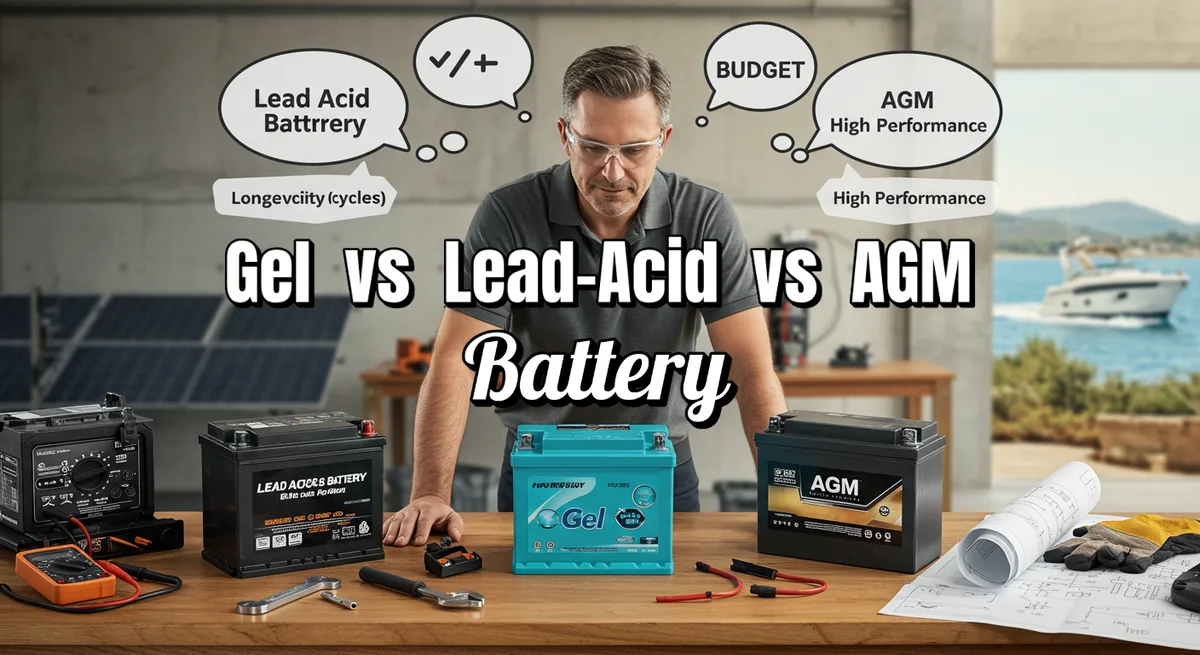
Image source: Bing (Web (fair-use with source credit))
This is the fork in the road. Everything downstream depends on your battery chemistry. If you don't know what kind of battery you have, stop right now and go look at the label on the side.
It'll say flooded, AGM, gel, or lithium. If it just says "sealed lead-acid" without specifying, it's almost certainly AGM or gel.
Let's break each one down so you know exactly what you're working with.
Flooded Lead-Acid (Wet Cell)
This is the old-school battery that's been under the hood of cars for over a century. It has liquid electrolyte inside that you can actually see if you pop the caps. You can top them off with distilled water when the level gets low.
They're cheap, tough, and forgiving of overcharging within reason, but they do vent hydrogen gas during charging.
Flooded batteries need a charging voltage in the 14.4 to 14.8 volt range during absorption, and they benefit from an occasional "equalization" charge that runs a bit higher to knock sulfation off the plates. Not all chargers have an equalization mode, so if you run flooded batteries in a solar or off-grid setup, that's a feature worth looking for.
The big downside is maintenance and gassing. You have to check water levels. You need ventilation.
And if you overcharge them regularly, they'll boil dry and fail quickly.
AGM (Absorbed Glass Mat)
AGM batteries are sealed. The electrolyte is absorbed in fiberglass mats between the plates. They don't spill, they don't need water, and they handle vibration better than flooded batteries.
That makes them popular for motorcycles, boats, RVs, and high-end vehicles with start-stop technology.
AGM batteries are more sensitive to voltage than flooded batteries. They prefer an absorption voltage around 14.2 to 14.6 volts, and they absolutely hate being held above that. Overcharging an AGM dries out the electrolyte because the gas that vents can't be replaced.
Once that happens, the battery is done.
They also don't tolerate long periods at full float voltage the way flooded batteries do. Most AGM chargers will drop to a lower maintenance voltage, typically around 13.2 volts, after the battery is full. That's fine for a few weeks, but for long-term storage, you're better off disconnecting the battery entirely.
Gel Cell
Gel batteries use a silica additive that turns the electrolyte into a gel. They're even more sealed than AGM and practically spill-proof in any orientation. They were popular in medical equipment, UPS systems, and some high-end marine applications, but they've largely been displaced by AGM and lithium in most consumer roles.
Here's the critical thing about gel batteries: they charge at a lower voltage than any other lead-acid type. Most gel batteries want an absorption voltage between 14.0 and 14.2 volts, and they can be permanently damaged if you push them above 14.4 volts. If you plug a generic "lead-acid" charger that outputs 14.7 or 14.8 volts into a gel battery, you'll wreck it in a few cycles.
If you have a gel battery, you absolutely need a charger with a specific gel setting. There is no shortcut here.
Lithium (LiFePO4)
Lithium iron phosphate batteries are a completely different animal. They're lighter, they hold voltage flatter during discharge, and they can handle far more charge cycles than any lead-acid chemistry. A quality LiFePO4 battery can deliver 3,000 to 5,000 cycles at 80 percent depth of discharge, compared to maybe 500 cycles for a lead-acid deep-cycle battery.
But they require a dedicated lithium charging profile. The absorption voltage is typically 14.2 to 14.6 volts, similar to AGM, but the big difference is float. Lithium batteries do not need a float voltage at all.
Most lithium battery management systems will disconnect the battery from the charger once it's full, so a float voltage just sits there doing nothing useful and potentially stressing the BMS over long periods.
Many modern "lithium-ready" chargers detect the BMS disconnect and automatically go into a standby mode. If your charger doesn't do that, you should not leave a lithium battery connected to it indefinitely.
What All Those Charger Specs Really Mean
Charger packaging is loaded with numbers and marketing terms that sound complicated. They're not. There are really only three specs that matter for most people: the amp rating, the number of charge stages, and whether the charger is smart or manual.
Amp Rating: How Fast vs How Safe
The amp rating tells you how much current the charger can deliver. A 1.5-amp charger puts out 1.5 amps per hour, so it takes roughly 10 hours to recharge a 15 amp-hour battery. A 10-amp charger does the same job in about 90 minutes.
Faster sounds better, but it's not always the right choice. Battery manufacturers generally recommend charging at a rate between C/10 and C/5, where C is the battery's amp-hour capacity. For a 100 amp-hour deep-cycle battery, that means a charge rate of 10 to 20 amps.
A 40-amp charger would push that battery harder than recommended, generating excess heat and shortening its life.
For small batteries like motorcycle batteries (10 to 20 amp-hours), a 1.5 or 2-amp charger is perfect. For car batteries in the 50 to 70 amp-hour range, a 4 to 10-amp charger is the sweet spot. For large deep-cycle banks, you might want 20 amps or more, but only if the battery can handle it.
| Battery Type | Typical Capacity (Ah) | Recommended Charger Amps |
|---|---|---|
| Motorcycle | 10–20 Ah | 1.5–2 A |
| Car | 50–70 Ah | 4–10 A |
| Marine/RV Deep-Cycle | 80–200 Ah | 10–20 A |
| Large Battery Bank | 200+ Ah | 20–40 A (per bank) |
The key takeaway: use the lowest amp rating that still gives you an acceptable charge time. Faster is not better for battery health.
Charge Stages: Bulk, Absorption, Float (and Why They Matter)
A modern smart charger doesn't just push a fixed voltage. It goes through stages.
Bulk mode delivers full current at a rising voltage until the battery hits roughly 80 percent state of charge. That's the fast part. The battery pulls as much current as it wants, and the charger delivers it up to its rated limit.
Absorption mode holds the voltage steady at the target level (typically 14.4 to 14.8 volts for lead-acid) while the current gradually drops. This is what pushes the battery from 80 percent to full. The charger isn't forcing current in.
It's holding the voltage steady while the battery finishes accepting charge at its own pace.
Float mode drops the voltage to a maintenance level (13.2 to 13.6 volts) that keeps the battery topped off without overcharging. This is safe for long-term connection with lead-acid batteries.
Some chargers add a fourth stage called desulfation, which pulses voltage to break down sulfate crystals on lead-acid plates. It works best as prevention and on mildly sulfated batteries. It won't resurrect a battery that's been dead for two years.
Smart vs Manual: The One Feature That Saves Your Battery
A manual charger is just a transformer and a rectifier. It pushes a fixed voltage and current until you unplug it. If you leave it connected too long, it will overcharge the battery.
There's a reason these are mostly obsolete for consumer use. They're cheap, but they're dangerous.
A smart charger uses a microcontroller to monitor battery voltage and temperature, then adjusts the output automatically through the stages described above. It knows when to switch from bulk to absorption. It knows when to drop to float.
It shuts off or enters a maintenance mode when the battery is full.
As of 2026, there is almost no reason to buy a manual charger unless you're doing specialized industrial work. Smart chargers cost a bit more, but they extend battery life by years and eliminate the fire risk of overcharging.
The Real-World Dangers of Mixing Chargers and Batteries
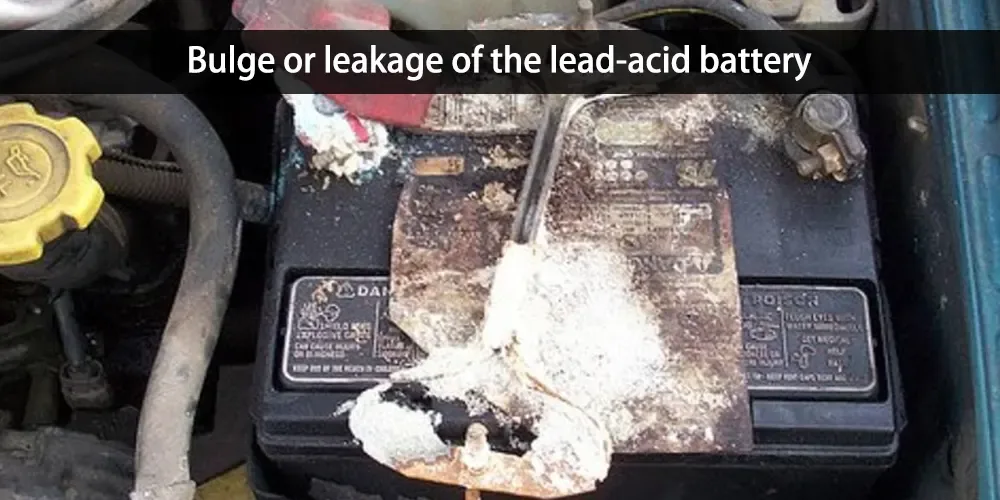
Image source: Bing (Web (fair-use with source credit))
This is where the rubber meets the road. Mixing the wrong charger with your battery isn't just inefficient. It's genuinely hazardous.
Let's be specific about what goes wrong and why.
What Happens When You Use a Lead-Acid Charger on Lithium
The most common mismatch people make is plugging a standard lead-acid charger into a lithium battery. It seems reasonable. They're both 12 volts, right?
The problem is that many lead-acid chargers enter a "desulfation" or "equalization" mode that pushes voltage above 15 volts for short periods. Lithium batteries have a built-in BMS that protects against overvoltage, but the BMS has limits. If the charger keeps trying to push high voltage after the BMS disconnects, the unloaded charger output can spike even higher.
Worse, some older lead-acid chargers can spike to 16 or 17 volts unloaded. That can damage the BMS, cause it to fail in a shorted state, and then the unprotected cells are at the mercy of the charger. That's how lithium fires start.
Per UL testing standards, lithium batteries should only be charged with chargers specifically listed for lithium chemistry. If the charger doesn't say "LiFePO4" or "lithium" on the box, don't use it on a lithium battery.
The Overcharging Trap (and How to Spot It)
Overcharging a lead-acid battery causes gassing. The water in the electrolyte splits into hydrogen and oxygen. If the battery is sealed (AGM or gel), that gas has nowhere to go.
Pressure builds up. The safety vent opens and releases the gas, but the electrolyte level drops permanently.
Signs of overcharging include excessive heat, swelling or bulging of the battery case, a sulfur smell (rotten eggs), and visible corrosion around the terminals. If you see any of these, disconnect the charger immediately. The battery may still be usable, but its capacity is already degraded.
For lithium batteries, overheating is the main warning sign. A lithium battery that's hot to the touch during charging is being pushed too hard or charged with the wrong profile. Stop charging and let it cool.
If it's swollen at all, replace it. Do not continue using a swollen lithium battery.
Fire, Fumes, and Explosion Risks You Need to Know
This isn't scare tactics. The National Electrical Code has specific requirements for battery charging areas for good reason. Flooded lead-acid batteries produce hydrogen gas during charging.
Hydrogen is explosive at concentrations as low as 4 percent in air. A single spark from a loose connection or static discharge can ignite it.
That's why you always connect the positive clamp first, then the negative. Connecting the negative first and then touching the positive can spark if the metal tool touches the battery terminal and a ground at the same time. Connect positive first to minimize the chance of a short circuit.
Also, charge flooded batteries in a well-ventilated area. Not a closet. Not an unvented garage with the door closed.
Outside or with the garage door open is ideal. If you're charging in a boat or RV compartment, make sure that compartment has ventilation to the outside.
Lithium batteries have different risks. They don't vent hydrogen, but they can go into thermal runaway if a cell is damaged, overcharged, or exposed to extreme heat. That's a chain reaction where one cell heats up and ignites the next one.
The resulting fire is extremely hot and difficult to extinguish. A Class D fire extinguisher (for metal fires) or a lithium-specific extinguisher is needed. Water can make it worse.
The practical takeaway: always charge lithium batteries on a non-combustible surface like concrete. Don't leave lithium batteries charging unattended in a vehicle or living space. And use only the charger that matches the battery's chemistry and voltage requirements.
Step-by-Step: How to Charge a 12V Battery Safely
Charging a battery isn't complicated, but skipping steps can cost you. Here's the exact process, start to finish.
Pre-Charge Inspection
Check the battery voltage with a multimeter first. A healthy 12V battery reads 12.6 volts or higher at rest. At 12.4 volts, it's about 75 percent charged.
Below 12.0 volts, it's significantly discharged and may need a slow charge to recover.
Look at the battery case for cracks, bulges, or leaks. If the case is damaged, don't charge it. Replace the battery.
Check the terminals for corrosion. White or blueish powder around the posts means you need to clean them with a wire brush and a baking soda and water solution before connecting the charger.
For flooded batteries, check the electrolyte level. The plates should be fully submerged. Add distilled water if needed.
Don't add battery acid unless you know what you're doing.
Connection Order That Prevents Sparks
Connect the positive (red) clamp to the positive battery terminal first. Then connect the negative (black) clamp to the negative terminal or a clean, unpainted metal ground point on the vehicle chassis. Grounding to the chassis instead of the battery post reduces the risk of spark near the battery.
When you're done charging, disconnect in reverse order. Remove the negative clamp first, then the positive. This way, if you accidentally touch the positive clamp to ground, it won't spark because it's already disconnected.
Choosing the Right Amp Setting
Refer to the table earlier in this article. For a standard car battery, 4 to 10 amps is the sweet spot. For a small motorcycle battery, use 1.5 to 2 amps.
For a large deep-cycle battery, 10 to 20 amps is appropriate.
If your charger has a battery type selector (flooded, AGM, gel, lithium), set it now. This adjusts the absorption voltage and float profile to match your battery chemistry. Don't guess.
Read the battery label.
Knowing When to Disconnect
A smart charger will tell you. Most have a green light or display that says "charged" or "float mode." That means the battery is full and the charger has dropped to maintenance voltage.
If you're using a manual charger, check the voltage with your multimeter. Disconnect when the battery reads 12.6 to 12.8 volts at rest. Don't leave a manual charger connected overnight.
It will overcharge.
For lithium batteries, disconnect as soon as the BMS indicates full charge. Some lithium chargers automatically stop, but not all do. When in doubt, unplug it.
Common Charging Mistakes That Shorten Battery Life
Most battery failures are avoidable. Here are the mistakes we see most often.
Leaving a battery discharged for weeks at a time. Lead-acid batteries self-discharge at roughly 5 percent per month. If you store a battery at 50 percent charge through winter, sulfation will set in.
Use a battery maintainer (a low-amp smart charger) for seasonal vehicles.
Using too high an amp rating. A 40-amp charger on a 20 amp-hour motorcycle battery will cook it in an hour. Match the charger to the battery size.
Ignoring temperature. Battery charging voltage needs temperature compensation. Cold batteries need higher voltage to accept a charge.
Hot batteries need lower voltage to avoid overcharging. Smart chargers with temperature probes handle this automatically. If your charger doesn't have one, don't charge in extreme temperatures.
Charging a frozen battery. Never charge a flooded battery that's frozen. The ice can crack the case, and charging produces gas that can cause an explosion.
Let it thaw completely first.
Mixing battery chemistries in a bank. If you have multiple batteries wired together, they should all be the same type and age. Mixing an old flooded battery with a new AGM in a parallel bank will cause one battery to overcharge while the other undercharges.
How to Pick the Right Charger for Your Situation
Your choice depends on what you're charging and how often. Here's a practical breakdown.
For a Car You Drive Daily
You don't need a charger at all unless the battery is dead. A standard 4 to 10 amp smart charger is fine for occasional use. Look for one with reverse polarity protection and automatic shutoff.
A basic model covers your needs.
For a Seasonal Vehicle (Boat, RV, Motorcycle)
You need a battery maintainer or tender. These are low-amp smart chargers (1.5 to 2 amps) that can stay connected for months. They cycle between charging and float mode to keep the battery topped off without overcharging.
Make sure it's rated for your battery chemistry.
For a Deep-Cycle Battery in a Solar Setup
You need a charger with an equalization mode for flooded batteries and a lithium-compatible profile if you switch to lithium. Look for a multi-stage charger with at least 20 amps output. Temperature compensation is valuable if the battery lives in an unheated garage or outdoors.
For Emergency Backup or Jump-Starting
A combined jump starter and battery charger is a practical choice. These units include a high-amp boost mode for jump-starting and a lower-amp smart charger for maintenance. They're portable and work as a power bank for devices.
Just make sure the charger side supports your battery chemistry.
Maintenance: Keeping Your Battery and Charger in Good Shape
A little maintenance goes a long way.
For flooded batteries, check the electrolyte level every three months during regular use. Top off with distilled water only. For AGM and gel batteries, keep the terminals clean and tight.
For lithium batteries, store them at roughly 50 percent charge if you're not using them for months. Full storage stressed them. Empty storage can damage them.
For your charger, keep the cables coiled loosely when not in use. Don't wrap them tight around the charger body. That strains the internal connections.
Store the charger in a dry place. Moisture corrodes the internal electronics over time.
Test your charger once a year. Plug it into a known good battery and confirm it cycles through the stages. If it stays in bulk mode for hours on a charged battery, the charger may be faulty.
Replace it.
Frequently Asked Questions
Can I use any 12V charger on any 12V battery?
No. You must match the charger to the battery chemistry. A charger set for lead-acid can damage AGM, gel, or lithium batteries.
Always check the battery label and confirm your charger has the correct profile.
How long does it take to charge a 12V car battery?
It depends on the charger amperage and battery size. A 50 amp-hour car battery with a 10 amp charger takes roughly 5 hours. A 1.5 amp maintainer takes 30 hours or more.
Faster charging is possible but harder on the battery.
What's the difference between a battery charger and a battery maintainer?
A charger delivers higher amperage to recharge a discharged battery quickly. A maintainer delivers low amperage to keep a fully charged battery topped off over weeks or months. Many smart devices do both, automatically switching between modes.
Can a battery charger damage my car's electronics?
Yes, if you use a high-amp charger without disconnecting the battery from the vehicle. Modern cars have sensitive electronics that can be damaged by voltage spikes. Disconnect the battery's terminals from the vehicle before charging, or use a charger designed for modern electronics.
How do I know when my battery is fully charged?
A smart charger shows a green light or "charged" indicator. With a multimeter, a fully charged 12V battery reads 12.6 to 12.8 volts at rest. If it reads below 12.4 volts after charging, the battery may be sulfated or failing.
Should I charge a lithium battery to 100 percent every time?
No. Lithium batteries last longest when charged to 80 to 90 percent for daily use. Charge to 100 percent only when you need the full range.
Most BMS units handle this, but you can manually stop charging earlier if you want to maximize cycle life.

Similar Posts